 |
 Let’s Not Go There
 18 October 2010 | by
 For those in amateur radio blogademia outside of K/W/N land, the tea party in the United States is a political movement that has sprung up since the current president took office. The tea party started out as a supposedly independent grassroots movement, but has clearly emerged as a right wing conservative Republican organization funded by commercial interests. You can see footage of them here and here protesting taxes and healthcare reform. Google "tea party signs" and make your own judgement.
While it appears this QSO party is the creation of a handful of amateurs and is somewhat an informal thrown-together event, and albeit on that armpit of an amateur radio forum known as QRZ, this is the first time I'm aware of an operating event with a political theme. As if it wasn't enough to have non-stop right wing politics in 80 meter roundtables and on amateur radio forums, now we're luring people into working stations in a somewhat rare state under the semblance of a political movement and agenda. It's distasteful and not in the spirit of amateur radio.
Having politically-oriented operating events could open the door to a whole new realm of contests and special event stations, both conservative and liberal oriented that would offend just about everyone. Can you imagine having operating events such as the Obama Re-election Party or the Sarah Palin QRO Sprint? How about the National Rifle Association Worked All Free States Award or the QRP Pro-Choice Contest? And while we're bringing politics into amateur radio, why not religion? How about a Mosques On The Air weekend, or a Westboro Baptist Church Koran Burning special events station? I could go on and on, but I think you get the idea. We don't want to start an arms race of political and religious on-the-air events in amateur radio.
This may come as a surprise, but I did participate in the South Dakota tea party event. I made no contacts, but since there are no rules I awarded myself 10 billion points and I made a clean sweep of all counties in South Dakota. Such is life without rules. Perhaps next year I'll actually get on the air, but make up my own callsign in the spirit of limited government and regulation, and political inanity....

Anthony Good, K3NG, is a regular contributor to AmateurRadio.com and writes from Pennsylvania, USA. Contact him at [email protected].
LHS Episode #049: CQRlog Revisited
 Hello, everyone! Due to Cheryl having some hand surgery and my being a telecommuter for the last month or so, I haven’t been able to keep up with the podcast release cycle. We’ve been recording episodes like we’re supposed to. It’s just been impossible to get them released on time. That means that #047 and #048 are going to be released in rapid succession so you’ll get twice the LHS yummy goodness.
This time around, Richard has been looking a little deeper into CQRlog, a great logging program for Linux created by OK2CQR. We talked about this program in a past episode and we’ve mentioned it a few more times in passing. This time we’re getting down deep into the features and all of the integrations CQRlog has with other ham radio applications. We also address our usual announcements, feedback, other technical topics and throw in a bunch of witty banter just to keep things interesting. Thanks, all, for staying with us while we try and get back to a regular podcasting cycle. Keep listening and keep spreading the word.
73 de The LHS Guys
Russ Woodman, K5TUX, co-hosts the Linux in the Ham Shack podcast which is available for download in both MP3 and OGG audio format. Contact him at [email protected].
Arctic DXpedition
Over the weekend sunspot 1112 erupted and produced a strong solar flare. Now according to Space weather sites there’s a 25-35% chance of high latitude auroras on 19-20 October.
And right now a group of four Norwegian friends are enjoying their annual DXpedition to Kongsfjord – well and truly in the high latitudes – at 70°43′N 29°21′E at the top of Norway.

Kongsfjord, Norway - a nice place to set up your 500 metre Beverage antenna
Four of the main participants are Arnstein Bue, from Trondheim, Bjarne Mjelde (host), from Berlevåg, Odd-Jørgen Sagdahl, from Trondheim and Tore Johnny Bråtveit, from Trondheim. As you’ll see if you visit their pages these men are serious medium wave and short wave DXers, with impressive equipment racks and listening achievements to match.
Arnstein Bue’s blog DX Paradise gives a sense of some of the QSL trophies. DXpedition host, Bjarne Mjelde’s blog Arctic DX has an entry logging their first day last Friday anticipating the weather awaiting them:
“+2 Celsius, 15-20 m/s (35-45 mph) northerly winds, rain and sleet showers…”
As I write this it’s early afternoon there and according to their website it’s warmed up to +4 Celsius!
They also appear to operate remotely from this spot. Their antennas include a new 500 metre long Beverage aimed at the North Island of New Zealand which is clearly working very well. Two shorter Beverages (225m & 330m) and a Quad Delta Flag Array complete this dream DXing antenna farm.
And if you visit the site you’ll see ample evidence that they clearly know how to enjoy themselves at the dining table as well. Local King crabs are accompanied by the finest New Zealand wines. Their dining notes are as tempting as their DX!
Main course was pork sirloin marinated in garlic and chili, served with tagliatelle, basil, leeks and cherry tomatoes. With the pork we tried Kim Crawford’s Pinot Noir. Maybe a bit light for the quite tasty meat, but absolutely a super wine!
For dessert we had local blueberries with grappa – another Kongsfjord signature dish! And now we are off to listen to more recordings and prepare for another – hopefully eventful night. The solar indexes are going down and the K-index for Tromsø is now 0, and we hope that it will remain like this!
The main website is also the repository of a number of documents on DXing issues by Dallas Lankford. There are also data sheets for a large number of receivers (including AOR, Racal, Rohde & Schwarz, R L Drake Company, Siemens, Harris, TenTec, Icom etc) and information about antennas. Bjarne Mjelde has distilled his experience into a definitive article about the best antenna wire. The conclusion? A thumbs up for galvanised steel and aluminium. A number of his reviews are also aggregated on the site, including reviews of the IC-703 and the Perseus SDR.
Their sites demonstrate how much a part SDR plays in modern DXing and monitoring. There are some huge SDR recordings and mp3 files available as well. Retrospective analysis of these files enables them to find rare stations as well as – presumably – traditional live listening.
It’s been a delight checking in on their site each day to catch up with the activities of such a convivial group of friends. Truly inspiring to this reader on the other side of the globe.
Stephen Rapley, VK2RH, is a regular contributor to AmateurRadio.com and writes from New South Wales, Australia. Contact him at [email protected].
All roads leading to Software Defined Radio (SDR)
Before I tell you about the weekend and SDR – I want to do a shameless plug. My lovely wife, Julie is very talented in many dimensions. She’s just set up an online shop on ETSY where you can see some of the beautiful craft items that she makes and perhaps buy them too! Do have a look there – with Christmas coming up, you might find a nice gift for someone special.
Anyway. Back to Software Defined Radio. It’s funny how sometimes you can’t escape a particular topic! On Saturday, the latest Practical Wireless dropped through the door. Naturally I checked the VHF column had come out ok (it had, thanks Rob and the team!) and then started to look through the other examples. I was particularly interested in the review of the FlexRadio 1500 QRP SDR transceiver by Phil, G3XBZ.
What a fascinating looking little box that you plug an aerial and a morse key into, connect the USB to your computer and control the rig and all the filtering from within the computer. Phil had obviously had a good time with the rig and had made some nice CW and SSB QSOs with it. Ideal too, I should think for data modes. Very tempting. I don’t need another rig or anything like that. But if I did….
The next ‘nudge’ towards SDR came from an interesting posting via the Southgate club’s blog about the AMSAT-UK FuncubeDongle. This is a dongle, which takes antenna input via an SMA adapter and plugs into your USB port. It forms a VHF/UHF/SHF receiver, obviously aimed at the satellite market which operates between around 64 to 1700MHz. You can use it with any of the current raft of SDR control programs and thus decode all sorts of modes.
Interestingly, there will be two versions of the dongle – a basic one aimed at the educational/schools market – to allow them to listen / decode transmissions from the Funcube satellite and a ‘Pro’ one with a little more flexibility. The feature set of the basic and Pro models isn’t entirely clear at the moment. This looks a brilliant project. Pricing for the ‘Pro’ model looks to be around £100. A 64-1700MHz receiver for £100. That sounds worth keeping an eye on, doesn’t it!
See the FuncubeDongle site here. But before you do, go and see Julie’s ETSY shop and tell her I sent you 🙂

Tim Kirby, G4VXE, is a regular contributor to AmateurRadio.com and writes from Oxfordshire, England. Contact him at [email protected].
Keyboard Trays, QRP Rig, and SoftRocks
Time, as they say, has been of the essence of late. So, when I do have time to play radio, I rarely have a chance to write about it. Here are some photos of my latest tinkerings.
Keyboard Trays
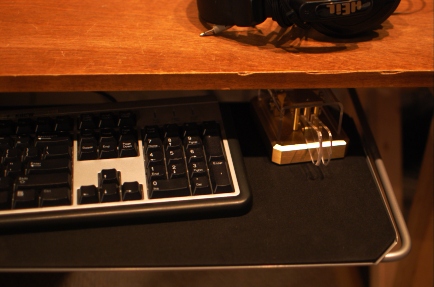
Sarah has always talked about using a keyboard tray at work as a part of an ergonomic workstation. Until recently, my work invovled enough variety of computer and non-computer time that I did not think about it. But, after coming home from work with stiff shoulders and wrists, I decided something should be done. While I was at it, I upgraded the HF and VHF/SDR operating positions at K8GU with pull-out trays, as well. These were $10 each at IKEA and pretty easy to install, although I told Sarah that I was grateful that she didn’t witness my contortions to hold them up with my knees while driving the first screws.
Liberating my inner QRPer
Back in high school, I built a Small Wonder Labs SW-40 that I had seen in a QST article. It lived in a variety of enclosures, but spent the last decade in the ugly PC board half-enclosure that looked like a redneck pickup truck at right. I decided to put it into a proper enclosure, being the diecast box at left.
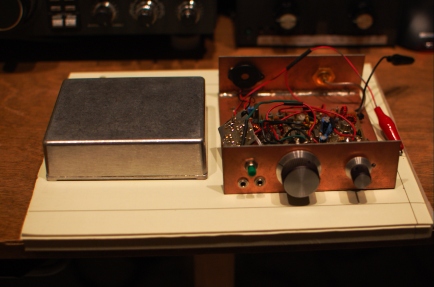
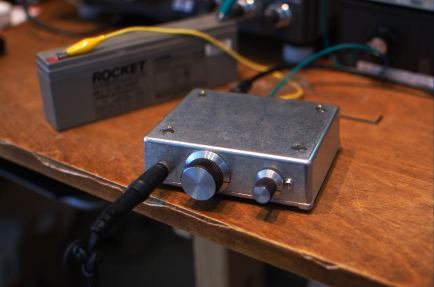
Despite the fact that I made the radio impossible (no room for front panel controls) to assemble the first time I drilled the board mounting holes, I’m pleased with the result. Four dabs of gray epoxy cover the errant holes. I probably could sand and polish those now. The power connector is a pair of Anderson Power Poles.
VHF Softrock and Enclosures
Readers of the blog have seen the screen capture from my new Softrock Ensemble II VHF. Tony does not advertise these on his site because they are not 100% supported with documentation yet. Robby, WB5RVZ has done a great service to the community by preparing step-by-step instructions for most of the SoftRock series. I’m not a step-by-step kind of guy, so I just used his photos showing the locations of the 0.1 uF and 0.01 uF chip capacitors and built the rest my way: mount all chip caps, all SMT ICs, all through-hole ICs and sockets, all through-hole resistors and diodes, all through-hole capacitors, all inductors, and all connectors. It worked right away.
I also have two v6.0 SoftRocks that I built a few years ago while I was in grad school. One of these (for 160) has been a bare board all these years and the other (for 40 and 80) has been living in an ugly little RadioShack black plastic project box. I decided to upgrade them to diecast boxes with external power connectors (also PowerPoles—I’m slowly switching the station over) and a switch for 40 and 80 meters. Here’s the happy family of little radios…
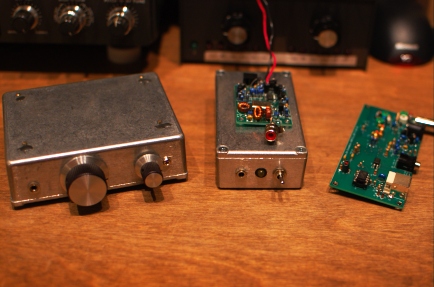
The 160-meter SR v6.0 is on top of the diecast box holding the SR v6.0 40/80. The Ensemble II VHF is on the right. It’s unfortunately too long for either size diecast box. I don’t like the commercially-available box for it. So, we’ll have to see…
Ethan Miller, K8GU, is a regular contributor to AmateurRadio.com and writes from Maryland, USA. Contact him at [email protected].
Bureau Cards
If you have come to the site checking to see if I am still alive because you have not received a QSL card via the bureau system, you have come to the right place. I finally mailed about four years worth of CE/K8GU, KP4/K8GU, PJ2/K8GU, and K8GU bureau cards out this week. (Yes, it was a nice-sized pile, but not as big as it could have been.) There are a few recent requests that have not been filled because I ran out of CE/ and KP4/ cards. I will get some more soon.
Ethan Miller, K8GU, is a regular contributor to AmateurRadio.com and writes from Maryland, USA. Contact him at [email protected].
On the air!
My QRSS beacon is now on the air, running 50mW into my MFJ magnetic loop in the attic. It is showing up very well right now on the grabber of PA0TAB.

I also saw it less strongly on the grabber of I2NDT, but I forgot to grab the image before it faded into QSB.

Reception reports will be most welcome to:

Julian Moss, G4ILO, is a regular contributor to AmateurRadio.com and writes from Cumbria, England. Contact him at [email protected].
 Ham Radio Deluxe |
 W5SWL Electronics |
 Ham Radio Prep |
 KB3IFH QSL Cards  Hip Ham Shirts  HamRadioAuctions HamRadioAuctions Reliance Antennas Reliance Antennas Enigma Shop Enigma Shop |  morseDX  Ni4L Antennas  R&L Electronics R&L Electronics antennas.us antennas.us QRV QRV |
- Matt W1MST, Managing Editor
