 |
 Memory fix
 20 October 2010 | by
 Six months ago I bought an old Kenwood TH-205 on eBay for spares or repair. I got it working, managed to find a new replacement NiCad battery pack for it and built a drop-in charger for it for a total cost of well under £20. The backup battery had died so the memories didn’t work and the radio wouldn’t even remember the frequency it was last used on, but I was pleased just to have got it working and I was afraid the replacement would be an expensive part the cost of which couldn’t be justified.

Today I decided to have a look and see if the backup battery could be replaced. I wasn’t sure where the backup battery was, but I guessed it might be hidden under a foam pad in the centre of the circuit board. I had a peek and was pleased to find that it was a CR2032 3V lithium button cell. However it wasn’t your regular CR2032 cell that you can buy in stores, but one with solder tags spot welded to each side.
I looked on eBay, but although this turned up zillions of sellers of the regular cells at prices from five for a pound, no-one had the version with solder tags. I looked to see if I could fit a cell holder into the radio but the PCB mount one I had was quite a bit thicker than the cell itself and there was insufficient space for it.
I tried a Google search and Digikey had a CR2032 with solder tags for £1.17 a time, but there was a £12 shipping charge which made it uneconomic. The cost of the repair needed to be proportionate to what I paid for the radio.
So I decided to try taping wires to a regular CR2032 cell. I doubt that I could solder to it, and that probably isn’t a good idea anyway. I had a CR2032 which came in a kit I purchased recently but haven’t started to build yet. It was new and sealed in its packing so I thought I would use that. It was a good job I decided to check the voltage after taping the wires to it, in order to verify they were making good contact, because it was as dead as a dodo! Even the one I took out of the radio showed more signs of life, as it acts as a capacitor and charges up a little bit when the battery power is turned on.
So it’s back to eBay to order a couple of replacement cells, one for the Kenwood and one for the kit I haven’t yet built.

Julian Moss, G4ILO, is a regular contributor to AmateurRadio.com and writes from Cumbria, England. Contact him at [email protected].
Rigol DS1052 scope hack – NEAT!
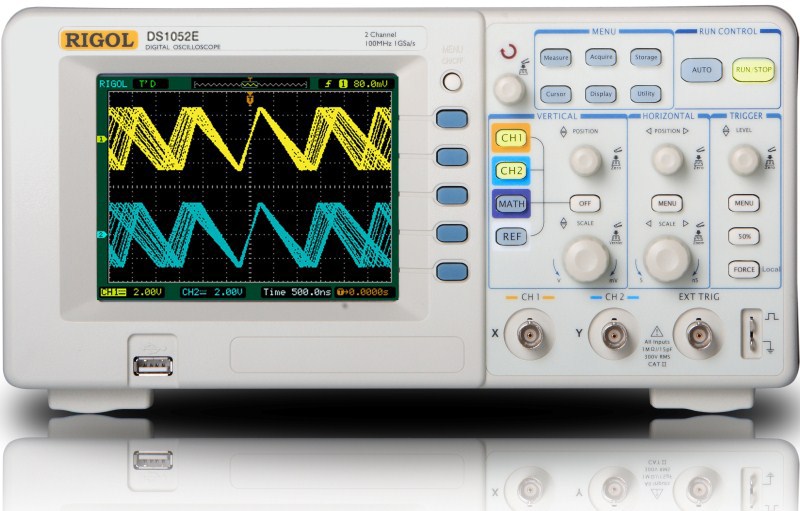 OK, regardless of what many “old hat” hams think, there is a lot of kit building and homebrew activity going on in our little “geek” subculture. I don’t bother with the discussions with many of my friends, as they don’t go anywhere to see the truly neat projects people are developing.
To that end, many hams have asked me over the past few months about scopes (even a recent topic on “the zed”). Basically, you can go one of four routes.
1: Buy a super expensive scope
2: Buy a decent used scope for a couple hundred
3: Buy a USB/computer based scope
4: Buy a brand you may not be familiar with, hack it, and get double what you paid for (in the $400. range).
I’m a fan of 2 and 4. Both have their merits. A used O’scope (not really Irish either) is a bargain, you can get a name brand and will cover most of what you need in our hobby. Used scopes are also great to learn on as well until you figure out what you really may need.
That leads us to a “no name” brand. The Rigol is truly a neat scope. I used one on my last job for about 9 or so months and it really had some neat features. It is portable, can store images to a USB drive, can connect via USB to a computer, the list goes on, but here’s a few:
| Model | DS1052E | |||
| Bandwidth | 50 MHz | |||
| Analog Channels | 2 | |||
| Vertical Sensitivity | 2 mV/div – 10V/div | |||
| Real-time Sample Rate | 1 GSa/s?each channel??500 MSa/s?dual channels? | |||
| Equivalent Sample Rate | 10 GSa/s | |||
| Memory Depth | Mode | capture rate | common | long memory |
| one channel | 1 GSa/s | 16 kpts | N/A | |
| 500 MSa/s | 16 kpts | 1 Mpts | ||
| dual channels | 500 MSa/s 250 MSa/s | 8 kpts 8 kpts | N.A. 512 kpts | |
| Standard Interface | USB Host & Device, RS-232, P/F Out | |||
| Vertical Resolution | 8 bits | |||
| Math | ?, ?, ×, FFT | |||
| Max Input Voltage | All inputs 1M??15pF 300 V RMS CAT? | |||
| Cursor Measurements | Manual, Track and Auto Measure modes | |||
Not a bad scope for the $400. range on ebay.
But…… (think Vince from “Slap Chop”)…… if you act now, because we can’t do this all day………
Dave Jones over at the EEVBlog has a neat video on Youtube on how you can double some of the specs…. for nothing. Be wary of some google searches on the topic, some want you to hack into the scope and do all sorts of nonsense. This is a simple first start and many people have had great results with it.
If you would like to go to the actual Rigol page and look up the specs and download the manual, go here:
http://www.rigolna.com/products/digital-oscilloscopes/ds1000e/ds1052e/
Finally, if you’re still not sure what you are looking for, you may be able to try a scope at a few places. Some trade schools, community colleges and such will let you come down and just take a look (or attend a workshop). There is also a growing number of “hackerspaces” around the globe. A “hackerspace” is a place to explore and learn technology in all it’s facets. Some vendors (Tektronix for example) have some really good resources on their websites as well.
Jonathan Hardy, KB1KIX, is a regular contributor to AmateurRadio.com and writes from Connecticut, USA. Contact him at [email protected].
C’mon people, listen!
A lot has been written recently (including by me) about the general conduct of hams on the airwaves. Over the last few days, I’ve seen something that has just been so absurd that I had to vent here.
I’ve discussed operating in pileups before, and how it’s important to listen to the operator’s instructions to understand where they are listening. It’s frustrating when an operator doesn’t listen and calls right on top of the DX station instead of on his split frequency. While there’s really no excuse, the occasional call or two can be understood by operators who just send 5NN TU (on CW) or just “Thanks” on phone without giving the split often. The same can be said for those operators who don’t ID often.
What I cannot understand, and to me what’s totally inexcusable was the behavior that I’ve seen on RTTY in the pileups for the folks operating from the new PJ entities recently. The vast majority of operators at the DX end seem to be really top-notch operators and are doing their best to control the pileup. They leave nothing to chance when, at the end of a contact, they send something like “K2DBK TU DE PJ7E UP 2-4”. You know who the station is, and you know that they are listening for your transmission 2-4 up. In spite of this, operators repeatedly (and I don’t mean once or twice, but dozens of times) continue to call on the operators transmit frequency, not where he’s listening.
I believe in Heinlein’s Razor: Never attribute to malice that which is adequately explained by stupidity. I don’t believe that most of these operators are calling just to QRM (create noise) on the DX station. For one thing, they are all using their callsigns, so we know who they are. (There is a chance that they are using someone else’s callsign to intentionally make them look bad, but I don’t think that’s the case.) I think that either they don’t have a good enough copy on on the DX station to be able to understand that he’s listening on a different frequency, or they don’t understand what “UP” means. In the former case, they shouldn’t be calling at all. If you don’t have a good enough copy on a station to receive what they are sending, how on earth are you going to know if you’ve worked them? If it’s the latter, and you don’t know that “UP” means that the operator is working stations using split operation, then ask someone what it means, don’t just ignore it.
Incidentally, I want to mention that I’ve looked up a number of callsigns that are guilty of this behavior. There is a mix of stations, but a significant number of stations seem to be US Amateur Extra class, and, as best I can tell, they have been Extras for quite some time. This isn’t a case of “no-coders” not knowing how to operate. It may well be that RTTY, which has increased in popularity recently, is new to these operators, but like any mode you need to learn how to use it.
When in doubt, refer to the DX Code of Conduct.

David Kozinn, K2DBK, is a regular contributor to AmateurRadio.com and writes from New Jersey, USA. Contact him at [email protected].
C’mon people, listen!
A lot has been written recently (including by me) about the general conduct of hams on the airwaves. Over the last few days, I’ve seen something that has just been so absurd that I had to vent here.
I’ve discussed operating in pileups before, and how it’s important to listen to the operator’s instructions to understand where they are listening. It’s frustrating when an operator doesn’t listen and calls right on top of the DX station instead of on his split frequency. While there’s really no excuse, the occasional call or two can be understood by operators who just send 5NN TU (on CW) or just “Thanks” on phone without giving the split often. The same can be said for those operators who don’t ID often.
What I cannot understand, and to me what’s totally inexcusable was the behavior that I’ve seen on RTTY in the pileups for the folks operating from the new PJ entities recently. The vast majority of operators at the DX end seem to be really top-notch operators and are doing their best to control the pileup. They leave nothing to chance when, at the end of a contact, they send something like “K2DBK TU DE PJ7E UP 2-4”. You know who the station is, and you know that they are listening for your transmission 2-4 up. In spite of this, operators repeatedly (and I don’t mean once or twice, but dozens of times) continue to call on the operators transmit frequency, not where he’s listening.
I believe in Heinlein’s Razor: Never attribute to malice that which is adequately explained by stupidity. I don’t believe that most of these operators are calling just to QRM (create noise) on the DX station. For one thing, they are all using their callsigns, so we know who they are. (There is a chance that they are using someone else’s callsign to intentionally make them look bad, but I don’t think that’s the case.) I think that either they don’t have a good enough copy on on the DX station to be able to understand that he’s listening on a different frequency, or they don’t understand what “UP” means. In the former case, they shouldn’t be calling at all. If you don’t have a good enough copy on a station to receive what they are sending, how on earth are you going to know if you’ve worked them? If it’s the latter, and you don’t know that “UP” means that the operator is working stations using split operation, then ask someone what it means, don’t just ignore it.
Incidentally, I want to mention that I’ve looked up a number of callsigns that are guilty of this behavior. There is a mix of stations, but a significant number of stations seem to be US Amateur Extra class, and, as best I can tell, they have been Extras for quite some time. This isn’t a case of “no-coders” not knowing how to operate. It may well be that RTTY, which has increased in popularity recently, is new to these operators, but like any mode you need to learn how to use it.
When in doubt, refer to the DX Code of Conduct.
David Kozinn, K2DBK, is a regular contributor to AmateurRadio.com and writes from New Jersey, USA. Contact him at [email protected].
Isn’t QRP amazing?
The Royal Society for the Protection of Birds, a British wildlife conservation charity, has a slogan “aren’t birds brilliant!” I think QRPers should start promoting low power operation using the slogan “Isn’t QRP amazing!” Because whenever I try using low power the results simply amaze me.
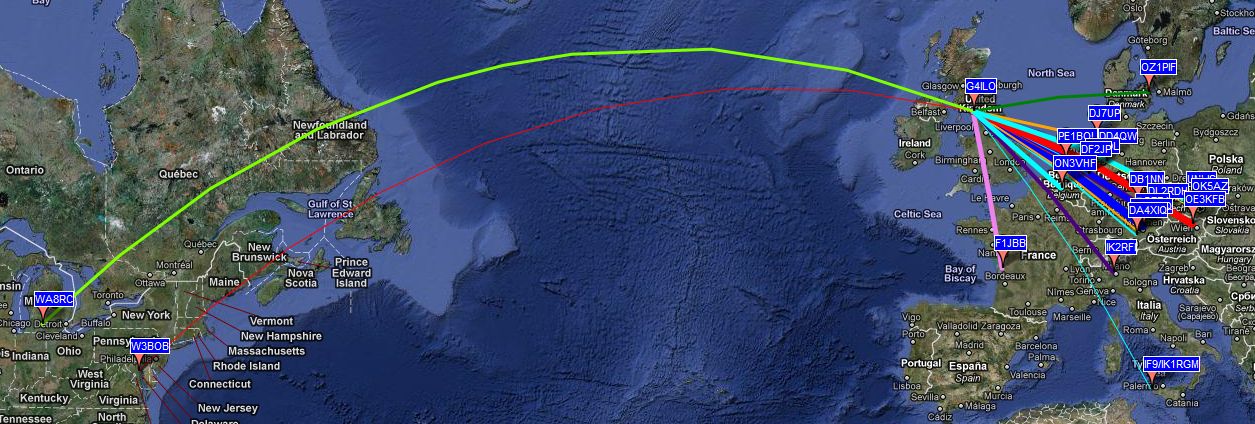
Until starting on my QRSS adventure I had never tried very low power, sometimes called QRPP. I was inspired by Paul PC4T who yesterday wrote about using WSPR on 20m using 50 milliwatts. At the moment I am QRSSing with 50mW on 30m using my magnetic loop, but that still leaves my multiband dipole antenna for some QRPP WSPR experiments.
I connected my QRP power meter to my K3, turned the power control to the lowest setting (0.1W) and sent a Tune signal from the WSPR software. The meter read about 65mW. I thought that I would be lucky to get any reception reports at all at that power level so I was amazed to be spotted by around 20 different stations in the space of a couple of hours, including two from the USA. One, WA8RC, was at a distance of more than 5,800km! To be heard, consistently, over that kind of distance across the Atlantic Ocean using less than 100mW to a dipole zig-zagged into a tiny attic is simply incredible.
I think we all use too much power, myself included. We do it because it makes copy easier or because it increases the chance of someone hearing us calling CQ. Even WSPR users mostly use 5W or more, despite the fact that the “WS” in the name of the mode means “weak signal.” Because of our macho desire to have a bigger signal than the other guy we never discover just how far a little power will really go. And that’s a discovery that’s far more enthralling than receiving yet another 599 report, surely.
Isn’t QRP amazing?

Julian Moss, G4ILO, is a regular contributor to AmateurRadio.com and writes from Cumbria, England. Contact him at [email protected].
QRSS success
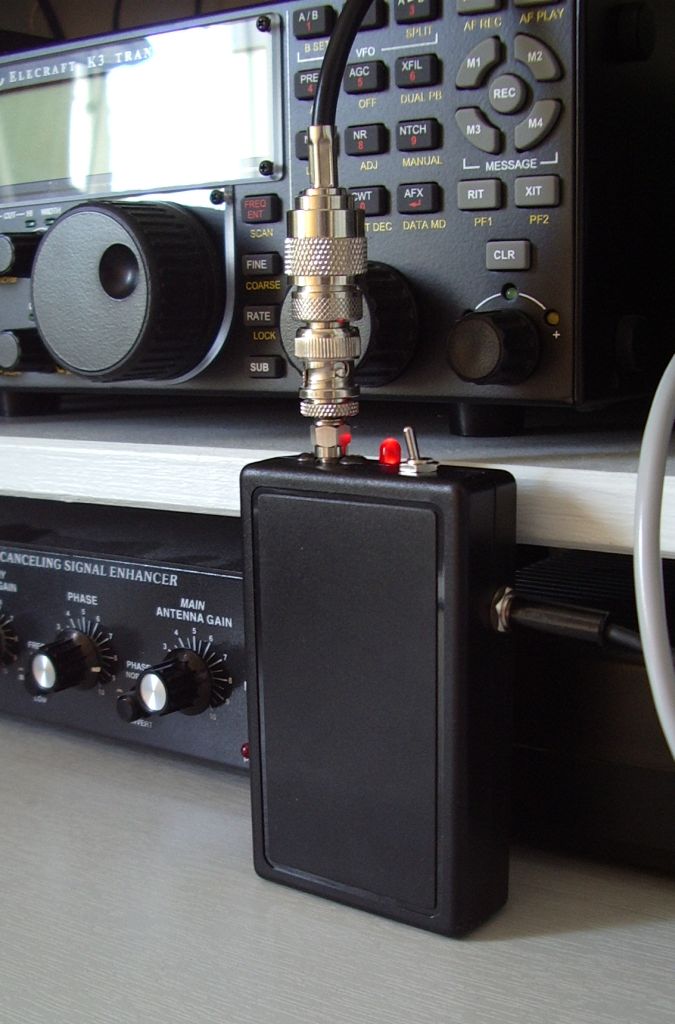
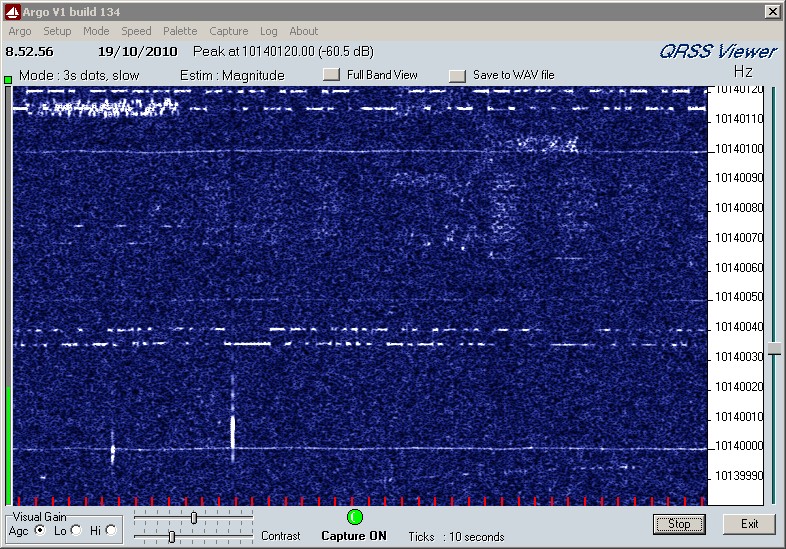
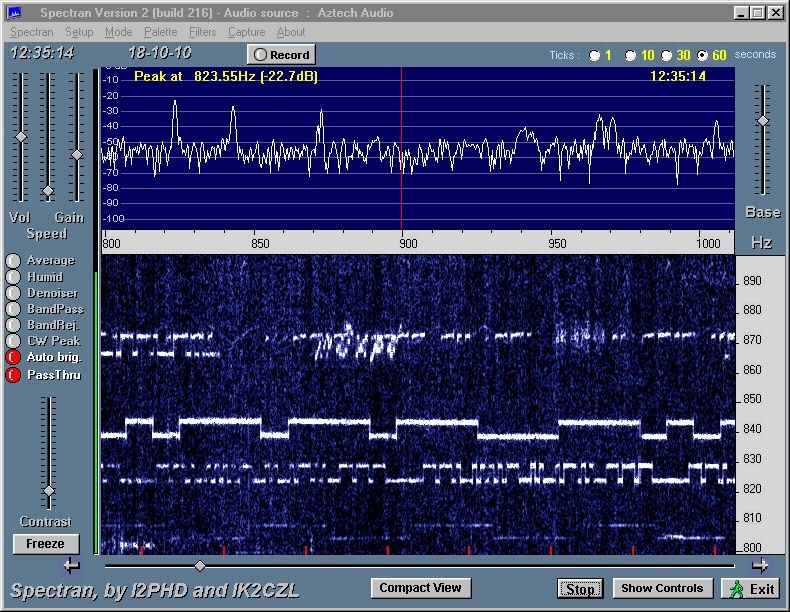
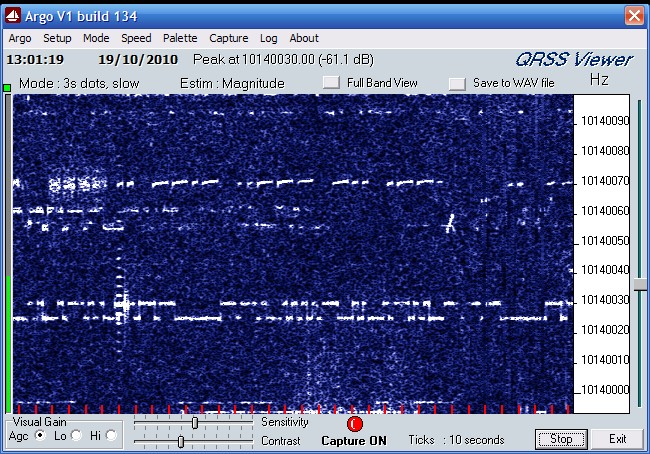
My 30m QRSS beacon transmitter is working very well. It has been on the air for more than a day now and has been received in Italy, Belgium, Holland and the UK. This is a 50 milliwatt signal being radiated by a magnetic loop antenna in the attic! Isn’t QRP amazing?
On Sunday I assembled the QRSS beacon into a nice case. This is not my favourite constructional task – give me toroids to wind any day! – but I do like the projects I build to look reasonable. The case I used was one I bought for the abortive 2m FM Fredbox project. I even used the SMA chassis socket I bought for that project as the case wasn’t really suitable for a BNC socket and I didn’t have any of the RCA phono chassis sockets I often use for QRP projects in my junk box.
This case has a compartment for a PP3 9V battery. I had toyed with the idea of using a PP3 battery and building in a regulator to reduce the voltage to the required 5V but space was tight and I was concerned that the heat given off by the regulator would affect frequency stability. Also with a current consumption of 70mA at 50mW output a rechargeable PP3 battery with a capacity of 280mAH would last for less than 4 hours between charges.
I observed that it is possible to squeeze 4 x AAA cells into the same space. Rechargeable NiMH AAA cells have a capacity of 1100mAH. Four of them will provide a voltage of 4.8 – 5.2V which will give 15 hours of operation and require no regulation at all. So that is what I will use.
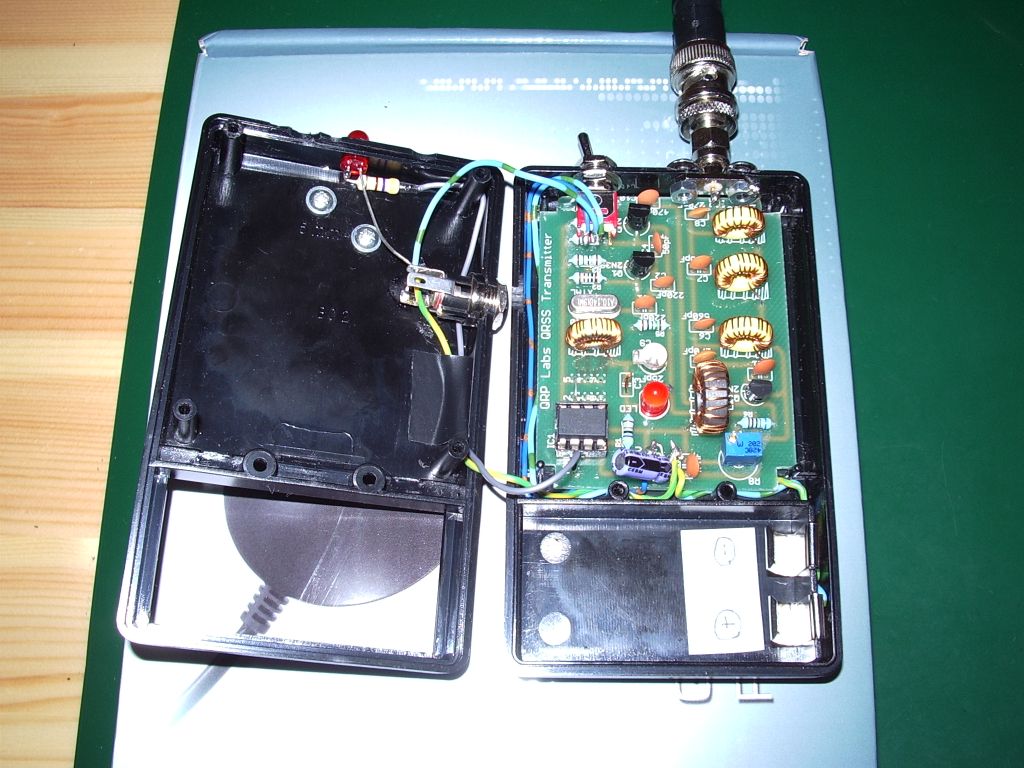
Fitting the project into the box took a bit of time because it was a tight fit in the case. I had to be very careful positioning the antenna socket, switch and external power / charger socket to ensure they didn’t foul any of the components. One of the frustrating things about boxing-up projects is that you can never find a case of exactly the size you want.
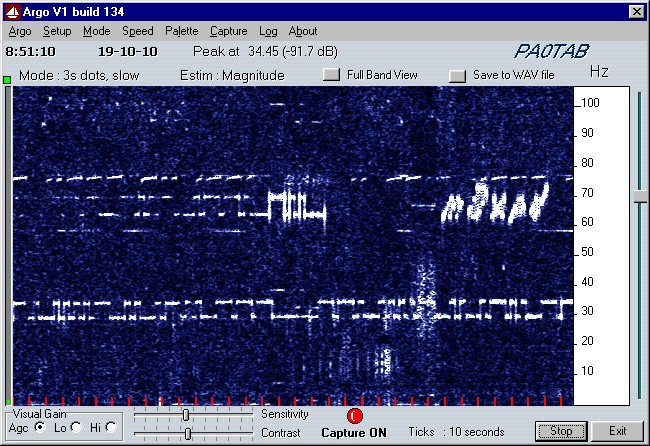
As I didn’t have a suitable battery pack I started off powering the transmitter from the computer. I took a redundant USB cable, cut the end off, determined the +5V and GND leads and soldered a DC power connector to them. That got the rig on the air, where it was almost immediately spotted by PA0TAB. The stability of the transmitter is excellent. There is a slight drift down in frequency by 10Hz or so during the first few minutes of operation. After that it appears to be pretty steady. There does not seem to be any need to encase the crystal oscillator in insulating material or use an oven as some QRSS builders have done.
Later on I dug out a charger for a mobile phone which has a USB socket on it and I switched the power over to that so I could keep the QRSS transmitter on overnight after I had shut down the computer. Nobody spotted me overnight, but I will leave it on for a few days to see whether I can be received further afield than Italy. To be received on the other side of the Atlantic would be a great thrill!
Here is a selection of grabs from stations that received my signal in the last 24 hours:

Julian Moss, G4ILO, is a regular contributor to AmateurRadio.com and writes from Cumbria, England. Contact him at [email protected].
Let’s Not Go There
The weekend before last while operating the Pennsylvania QSO Party, I noticed spots on the DX cluster for the “South Dakota Tea Party“. At first I thought it was a joke, but Googling I found this contest announcement on the ‘zed. The contest organizer claims that this contest has “an emphasis limited government and there are no rules.” Extra points are offered for things like having a valid concealed weapons permit, a hunting license, or fishing license. I’m not sure how this relates to limited government as all of these are issued by government agencies, as are amateur radio licenses. (Several of the posts in this announcement thread have disappeared; I’m not sure why.)
For those in amateur radio blogademia outside of K/W/N land, the tea party in the United States is a political movement that has sprung up since the current president took office. The tea party started out as a supposedly independent grassroots movement, but has clearly emerged as a right wing conservative Republican organization funded by commercial interests. You can see footage of them here and here protesting taxes and healthcare reform. Google “tea party signs” and make your own judgement.
While it appears this QSO party is the creation of a handful of amateurs and is somewhat an informal thrown-together event, and albeit on that armpit of an amateur radio forum known as QRZ, this is the first time I’m aware of an operating event with a political theme. As if it wasn’t enough to have non-stop right wing politics in 80 meter roundtables and on amateur radio forums, now we’re luring people into working stations in a somewhat rare state under the semblance of a political movement and agenda. It’s distasteful and not in the spirit of amateur radio.
Having politically-oriented operating events could open the door to a whole new realm of contests and special event stations, both conservative and liberal oriented that would offend just about everyone. Can you imagine having operating events such as the Obama Re-election Party or the Sarah Palin QRO Sprint? How about the National Rifle Association Worked All Free States Award or the QRP Pro-Choice Contest? And while we’re bringing politics into amateur radio, why not religion? How about a Mosques On The Air weekend, or a Westboro Baptist Church Koran Burning special events station? I could go on and on, but I think you get the idea. We don’t want to start an arms race of political and religious on-the-air events in amateur radio.
This may come as a surprise, but I did participate in the South Dakota tea party event. I made no contacts, but since there are no rules I awarded myself 10 billion points and I made a clean sweep of all counties in South Dakota. Such is life without rules. Perhaps next year I’ll actually get on the air, but make up my own callsign in the spirit of limited government and regulation, and political inanity….


 Ham Radio Deluxe |
 W5SWL Electronics |
 Ham Radio Prep |
 KB3IFH QSL Cards  Hip Ham Shirts  HamRadioAuctions HamRadioAuctions Reliance Antennas Reliance Antennas Enigma Shop Enigma Shop |  morseDX  Ni4L Antennas  R&L Electronics R&L Electronics antennas.us antennas.us QRV QRV |
- Matt W1MST, Managing Editor
