 |
 Cross Country Wireless SDR update
 22 October 2010 | by
 Cross Country Wireless has just announced an updated version 2 of its low cost SDR Receiver. The new version has an RF preamplifier using a power MOSFET after the RF bandpass filter which is claimed to improve sensitivity – which was a criticism of the earlier version – and reduce local oscillator output at the antenna port.
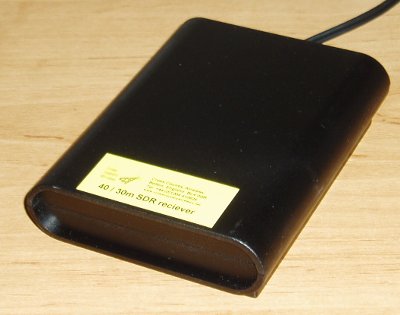 The designer Chris, G4HYG, claims that the receiver will now display a CW carrier at a level of -135 dBm on the waterfall of SDR-Radio using a 48 kHz sound card. The level of the local oscillator at the antenna port is now specified as -65 dBm, though a more typical measurement is -70 dBm. This should make it an ideal choice as a panadapter for radios such as the Elecraft K3. In fact, Chris recently stated that most orders for the receiver have been for use as panadapters, in conjunction with a sound card and suitable software such as PowerSDR-IF.
The cost of the standard SDR is £49.95. For panadapter use you will need a custom crystal for your radio’s IF which increases the price to £59.95. The SDR has two (switched) local oscillators so the other one could be specified to cover 40m or 30m for use as a conventional receiver. It’s also available as a built and tested board for assembly into your own case (at a significant saving.) If you built a USB sound device into the same box then it would be rather neat.

Julian Moss, G4ILO, is a regular contributor to AmateurRadio.com and writes from Cumbria, England. Contact him at [email protected].
LHS Episode #050: Ham Radio is Dead
 As I was roaming around the Intertubes, I came across an article at AmateurRadio.com written by Jeff, KE9V. I had been an avid listener of Jeff’s “Cornbread Road” podcast while he was publishing it as a podcast. The format was different enough to keep me interested. When it went away, I was highly disappointed.
As it turns out, his recent article disappointed me quite a bit as well. I don’t want to give much away, but suffice it to say the outlook Jeff paints is fairly bleak. At the same time, some of the points are valid and overall the essay was fairly thought provoking. Because of that, Richard, Bill (KA9WKA) and myself decided to discuss Jeff’s recent article. We also have our usual assortment of announcements, banter, gripes and response to feedback. So settle in for an interesting episode. We all had a good time. We hope you do, too.
73 de The LHS Guys (and Bill)
Russ Woodman, K5TUX, co-hosts the Linux in the Ham Shack podcast which is available for download in both MP3 and OGG audio format. Contact him at [email protected].
A meta-post
This is a short meta-post. That is, it’s a post about my posts. Actually, it’s a post about some responses that I’ve been getting to my posts. In my recent post about how the pileups for some of the PJ stations were huge, Bill, W9VA, who was the operator at PJ2T at the time that I posted the image of my bandscope, comments about what it was like on the other end of the pileup.
On my soapbox post about how people don’t seem to listen, I got a bunch of comments. Most of them were agreements with my thoughts (including a rather astonishing anecdote from Ed, N4EMG). There was also a comment from Jeremy, KB7QOA, who mentions that he hasn’t jumped into the piles because he hasn’t learned how to operate split on his radio. David, K2DSL, responded with detailed instructions, which really demonstrates the ham spirit.
As an aside, the reason why I’m mentioning these comments is because Blogger, the platform that I use for blogging, doesn’t support an easy way for folks to see comments that have been posted after they’ve read an entry, and I wanted to make sure that my readers had the opportunity to see them. If you’ve commented recently, or even not so recently, and I didn’t mention it, please don’t take it personally. I do read and usually reply to most comments here and they are greatly appreciated.
Thanks for everyone for contributing.

David Kozinn, K2DBK, is a regular contributor to AmateurRadio.com and writes from New Jersey, USA. Contact him at [email protected].
A meta-post
This is a short meta-post. That is, it’s a post about my posts. Actually, it’s a post about some responses that I’ve been getting to my posts. In my recent post about how the pileups for some of the PJ stations were huge, Bill, W9VA, who was the operator at PJ2T at the time that I posted the image of my bandscope, comments about what it was like on the other end of the pileup.
On my soapbox post about how people don’t seem to listen, I got a bunch of comments. Most of them were agreements with my thoughts (including a rather astonishing anecdote from Ed, N4EMG). There was also a comment from Jeremy, KB7QOA, who mentions that he hasn’t jumped into the piles because he hasn’t learned how to operate split on his radio. David, K2DSL, responded with detailed instructions, which really demonstrates the ham spirit.
As an aside, the reason why I’m mentioning these comments is because Blogger, the platform that I use for blogging, doesn’t support an easy way for folks to see comments that have been posted after they’ve read an entry, and I wanted to make sure that my readers had the opportunity to see them. If you’ve commented recently, or even not so recently, and I didn’t mention it, please don’t take it personally. I do read and usually reply to most comments here and they are greatly appreciated.
Thanks for everyone for contributing.
David Kozinn, K2DBK, is a regular contributor to AmateurRadio.com and writes from New Jersey, USA. Contact him at [email protected].
Bête noire
In the digitalradio Yahoo group a few people have been experimenting with APRS on HF using the robust ALE400 mode. I am interested in trying more robust modes for APRS and wish that someone would work out how to interface the new Winmor TNC to an APRS client. But as nobody has, I thought I would try to give this a go. Unfortunately this meant getting to grips with MultiPSK, a program that is something of a personal bête noire as whenever I have been tempted to try I have never been able to figure out how to use it. Today turned out to be no different.
I downloaded the latest version of the program, started it, and was presented with an unexpected screen for a digital modes program. After a few seconds of puzzlement I realized that this was the configuration screen. Normally with software you get the main screen and select configuration from a menu but MultiPSK is not as other software. Oh no. The author threw away the book when he wrote this program, the book in question being “Microsoft User Interface Guidelines.”
I managed among the bewildering array of buttons and options to find one to set the sound card, another to set the KISS TNC port that I would need and one that I presumed would set the serial port for PTT. As I couldn’t find an OK button I tried closing the window and MultiPSK itself closed. Completely. I tried again and realized that you have to click a large button marked RX/TX Window to get to the main operational screen. Bizarre!
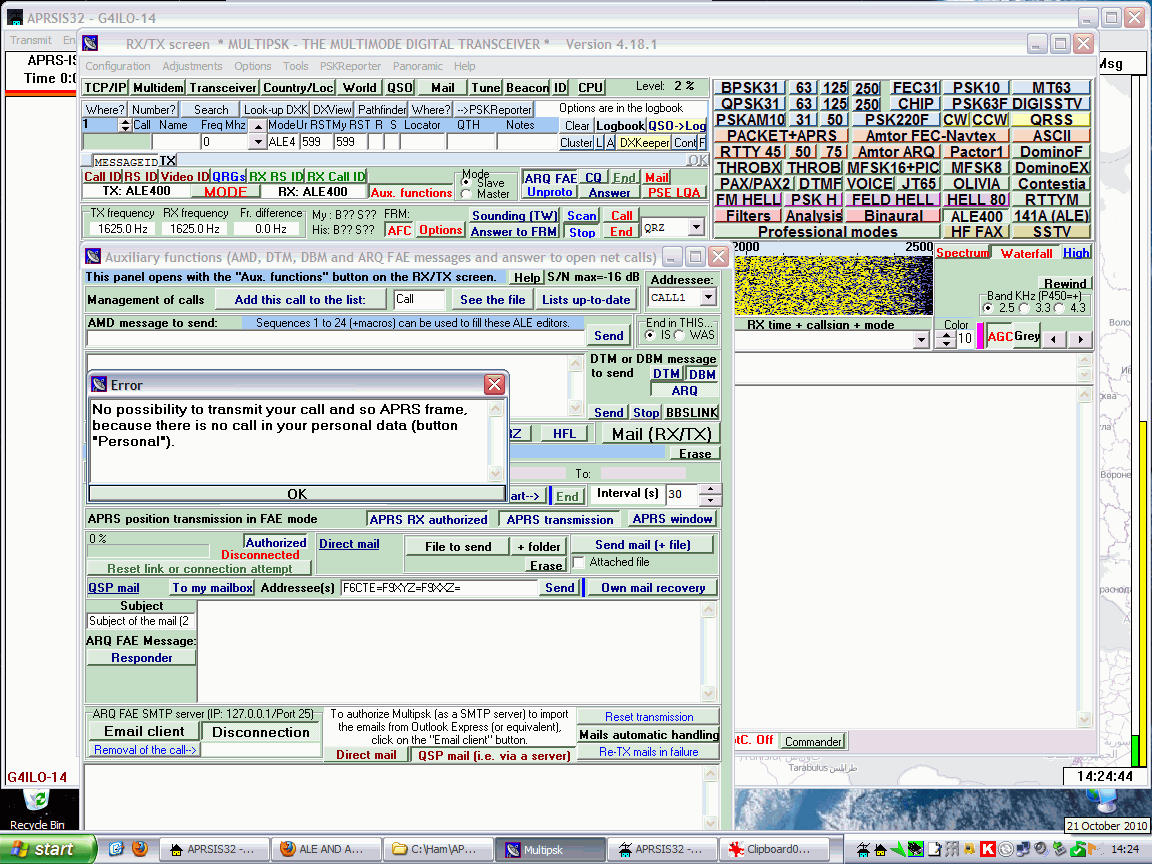
The main screen contains another mind-boggling array of buttons and controls, but I did see a waterfall with noise scrolling down the screen, which looked encouraging. At least I’d managed to select the sound card correctly. After staring open-mouthed at the screen for fully two minutes I managed to spot a button marked ALE400, so I clicked it. I was now in ALE400 mode. At least, I think I was, though I don’t know how I was supposed to tell for sure.
One of the Yahoo group postings had mentioned that you needed to click a button marked “Aux. functions”. After some more searching I found this button it and clicked it and up popped another bewildering dialog box crammed with buttons. Hilariously, at the top is the caption “This panel opens with the Aux. functions button in the TX/RX screen.” Yes, I really laughed out loud when I saw that. If I didn’t know that how would I ever find it?
I spotted that some buttons on this new dialog were to do with APRS. I clicked one and a dialog popped up saying something about there being no map folder. So apart from being a digital modes program MultiPSK is trying to be an APRS client as well? The phrase “jack of all trades, master of none” sprang briefly to mind before I dismissed it as being uncharitable.
I clicked another button marked “APRS Transmit” and a strange notepad-style window appeared with the caption Error which said “No possibility to transmit your call and so APRS frame because there is no call in your personal data (button ‘Personal’).” The English wasn’t great but I could understand what it was trying to tell me. I closed the error dialog but although I could see several places that looked as if they were meant to have a call entered in them I couldn’t see anywhere marked “Personal.”
I did discover a documentation file to do with setting up APRS using ALE400. Unfortunately it is a .doc file and I don’t have Microsoft Word. I did try opening it in Wordpad which is what I normally use but it displayed several errors about graphics filters and opened the file without the all-important images. Google’s HTML view of the document couldn’t display the images either. Hello, anyone heard of PDF files?
Now I do feel a little bit guilty criticizing the work of a fellow amateur programmer. I’m sure the author of MultiPSK, Patrick F6CTE, is far more talented than I ever was in being able to implement all of these sound card digital modes. But when it comes to user interface design I’m sorry but MultiPSK sucks.
This has to be the worst user interface of any program I have ever encountered, by a long way – and at one time in my life I used to review software for a living. Its worst sin is that it uses buttons instead of menus and apparently has no context-sensitivity (or more specifically mode-sensitivity) so that you are presented with all of the available options all at once, which is not only confusing but wastes a lot of screen space. It is testimony to the delight that so many practitioners of our hobby take in doing things the hard way that so many people are willing to use this program to operate digital modes when there are so many better-designed alternatives.
Once again MultiPSK has been deleted from my hard drive without transmitting so much as a digit. If APRS over ALE400 is only achievable by those able to master MultiPSK then I’m afraid it will go nowhere.

Julian Moss, G4ILO, is a regular contributor to AmateurRadio.com and writes from Cumbria, England. Contact him at [email protected].
Spotted in Spain
My 30m 50mW QRSS signal has now been received in Spain by the grabber of EA1FAQ. (It’s the one at 10140.030 kHz.)
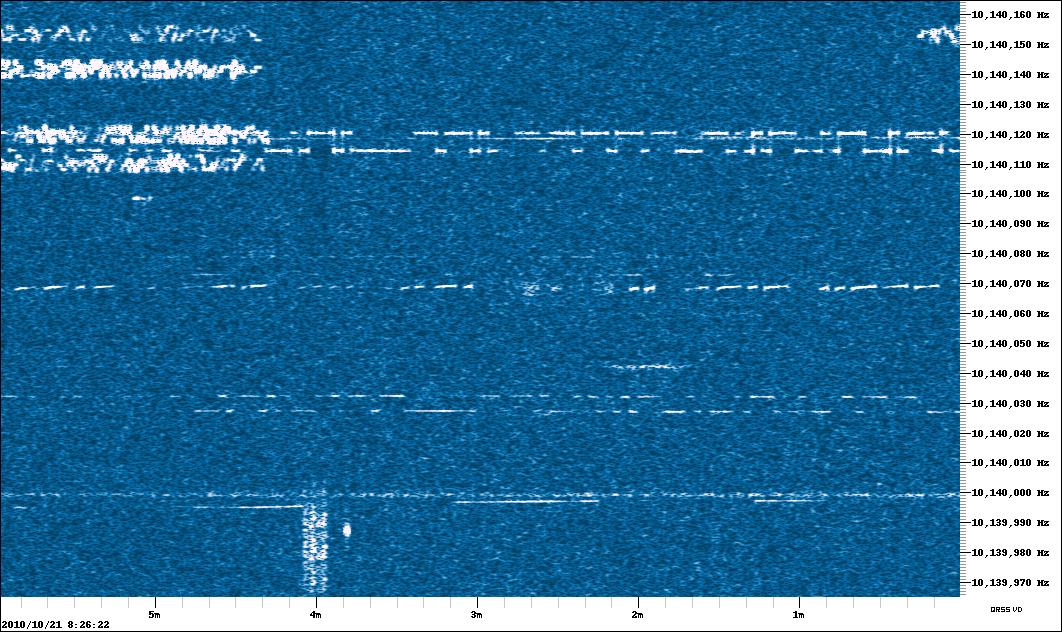
That’s a distance of 1458km or 906 miles.
[Off-topic note: When will Blogger fix its frigging “Add Images” uploader so it works in Firefox? I had to use the ghastly IE to insert the picture.]

Julian Moss, G4ILO, is a regular contributor to AmateurRadio.com and writes from Cumbria, England. Contact him at [email protected].
Handiham World for 20 October 2010
Welcome to Handiham World!
It’s time for a new HF net – Part 2

Last week we said : We need at least consider moving our HF net to 160, 75, or 40 meters, and those bands are likely to be most useful in the evening. Because 160 requires a very long antenna, it is impractical for many users. 40 can get crowded, but requires the shortest antenna of the three. Of course we can consider reviving our 17 meter “non-net roundtable”, which was originally started by Alan, K2WS, but the sun will have to spit out a few more spots for that band to get where it needs to be. So what do you think? 160? 75? 40? Or something else? And what about the time and day?
Interestingly enough, the 75 meter band seems to be favored so far. More than one respondent has suggested that we would have the best chance of success in the Extra Class segment of the band. The reason cited was that the General segment is crowded in the evening when the band is open to longer distance communications and thus most useful for our purposes.
I think we can agree that the 160 meter band is “out” because of the antenna requirements. 40 is a good alternative because of its propagation characteristics, but the phone portion of the band is less than half that available on 75 meters and there is no doubt that it will be difficult to find some open real estate for an evening net. Besides, we already have the CW net on 7.112 MHz.
So what do you think? A 75 meter net in the evening to be in the Extra portion of the band? Remember, only participants with Extra Class licenses would be able to transmit, but anyone could listen. We could initiate a “check in by email”, or some similar system, which I have heard on other nets, to accommodate those without transmit privileges. Another idea would be to have the Handiham Radio Club as the net sponsor. We do need regular HRC activities, aside from a single meeting at Radio Camp during the year.
Weigh in! I hope to hear from you about these suggestions soon. Please drop me an email, and I’ll share your thoughts with our readers and listeners.
QST Reviews Wouxun KG-UVD2 & KG-UVD1P Talking Handheld Radios

The Wouxun KG-UVD1 talking HT created quite a stir at Hamvention in May, both for its low price and for its built-in speech access for the blind. As I stated in a previous story, “Handiham volunteers Larry Huggins, KA0LSG, and Ken Silberman, KB3LLA, both found the new Wouxun 2m/70cm KG-UVD1P HT at Dayton, and Larry actually had his radio along to demonstrate to us at Handiham Radio Camp.”
We have had many questions about this radio, but details on its overall quality and functionality were mostly anecdotal. That has changed with a QST review of the latest versions of the KG-UVD2 & KG-UVD1P talking handheld radios by Bob Allison, WB1GCM, ARRL Test Engineer. Bob’s article appears in the November 2010 QST, which will be available to blind Handiham members in the upcoming Friday audio updates in the Members Only section of the Handiham website. QST is also produced in audio through the Library of Congress National Library Service and will be available for the new NLS digital players, available to those who qualify for services. The NLS version of QST is the complete magazine without advertising, but it takes some time to produce and is typically around a month later than the print mailing or Handiham digest version.

Pat Tice, WA0TDA, is the manager of HANDI-HAM and a regular contributor to AmateurRadio.com. Contact him at [email protected].
 Ham Radio Deluxe |
 W5SWL Electronics |
 Ham Radio Prep |
 KB3IFH QSL Cards  Hip Ham Shirts  HamRadioAuctions HamRadioAuctions Reliance Antennas Reliance Antennas Enigma Shop Enigma Shop |  morseDX  Ni4L Antennas  R&L Electronics R&L Electronics antennas.us antennas.us QRV QRV |
- Matt W1MST, Managing Editor
