 |
 CW Sweepstakes 2010
 8 November 2010 | by
(Image credit: via contesting.com)
After missing the two contests that I hoped would kick off my contest season, ARRL Sweepstakes was next on the list. I managed a decent showing that would have won the MDC certificate for A-power last year, provided the log-checkers don’t take too much.
Highlights (“Wins,” as we like to say on #wwyc):
- 80 meters was awesome. Good conditions and the K9AY helped me keep the noise under control.
- Everything worked for the most part and everything still works after the contest is over.
- SO2R CW with TRLog.
- Working lots of old friends from my time in MRRC, MWA, and SMC.
- Working lots of new friends from PVRC.
- Getting my receiver crushed on all bands when I tuned across W4EE who lives less than a mile away.
Lowlights (Fails):
- RFI to the CO detector waking Sarah up in the middle of the night. KA9FOX and AA9DY have had this problem.
- Not spending enough time on 15 meters and missing VY0JA and VY1EI there. Missed the sweep by 1.
- Not being able to answer people responding to my main radio CQ while working someone on the second radio. This only happened about five times. But, one of these was my Bureau sorter! Sorry!
- Getting confused for K1GU a few times.
Here are the numbers…thanks to all for the QSOs. See you again in two weeks on phone with a different callsign.
ARRL Sweepstakes Contest, CW

Call: K8GU
Operator(s): K8GU
Station: K8GU

Class: Single Op LP
QTH: MDC
Operating Time (hrs): 17
Radios: SO2R

Summary:
 Band  QSOs
------------
  160:
   80:  367
   40:  243
   20:  100
   15:    0
   10:
------------
Total:  710  Sections = 79  Total Score = 111,548

Club: Potomac Valley Radio Club
Ethan Miller, K8GU, is a regular contributor to AmateurRadio.com and writes from Maryland, USA. Contact him at [email protected].
ICQ Podcast Series Three Episode Twenty-Three – PMR Conversion (07 November 2010)
Series Three Episode Twenty-Three of the ICQ Amateur / Ham Radio Podcast. News Stories include:
Your feedback and Martin (M1MRB) reports on the PMR Conversions.
Colin Butler, M6BOY, is the host of the ICQ Podcast, a weekly radio show about Amateur Radio. Contact him at [email protected].
ICQ Podcast Series Three Episode Twenty-Three – PMR Conversion (07 November 2010)
Series Three Episode Twenty-Three of the ICQ Amateur / Ham Radio Podcast. News Stories include:
Your feedback and Martin (M1MRB) reports on the PMR Conversions.
Colin Butler, M6BOY, is the host of the ICQ Podcast, a weekly radio show about Amateur Radio. Contact him at [email protected].
What Kinda Radio Set You Workin’ On In That Basement?
By his description of who he talks to it must be an 80 meter phone rig. :-) If only neighbors took this much interest in radio today…

Good Customer Service is NOT Dead!
Recently I began a project for a wire vertical antenna and it called for a 20 ft fiberglass or non-conducting pole/mast of some sort. Not to worry as I have a trusty 20 ft Jackite pole in a nice green color. I put the antenna together but the vertical wire was too long and so there was considerable slack wire swinging in the breeze. After some head scratching, I measured my 20 ft Jackite and found it was only 18 ft long!!! YIKES! Did it shrink?

Did it shrink? Nope, it is all good to go!
Thanks to the internet, I was able to send an email to Jackite products and ask if that was normal. In a short time, I received a very nice response from the Jackite vp and an offer that was over the top and way more than I was expecting. It was more than I could accept as I’ve been quite happy with the product otherwise. Turns out that it was a small quality control issue that I can tweak and correct personally.
I get no monetary or other gain out of this, but did want to give credit where credit is due. This level of customer support is often lacking in today’s busy world. I am glad to give a shout out to this company and its products! They do the job and the company stands behind them with good service. Outstanding job Jackite!
72,
Kelly K4UPG PB #173
Kelly McClelland, K4UPG, is a regular contributor to AmateurRadio.com and writes from Florida, USA. Contact him at [email protected].
Ottawa Mini Maker Faire 2010

For readers local to my home area you may be interested in this exciting and free event in Ottawa this weekend. Full details can be found on the Artengine website. The essential details are:
Dates and times: Nov. 6th and Nov 7th, 12pm to 6pm.
Location: Arts Court 2 Daly Ave. Ottawa, ON K1N 6E2
If you are not sure what makers do or what goes on at a Maker Faire take a look at this video of the 2010 Kansas City Mini Maker Faire



Alan Steele, VA3STL, is a regular contributor to AmateurRadio.com and writes from Ottawa, Ontario. Contact him at [email protected].
Spot on
Having an interest in weak signal narrow band modes, not to mention APRS which requires you to park your receiver on a specific frequency, I have always wished that the frequency readout on my radios could be relied upon. The QRSS band, for example, is only 100Hz wide. If your dial reading is out by that much, you’ll miss it completely.
Many people try to calibrate their transceivers using WWV but that is not often a very good signal over here, and what with all the other carriers around 10MHz – many of them locally generated – you can never be sure that you have tuned to the right signal. I have wanted an accurate frequency reference for some time so a couple of weeks ago, following a comment by QRSS enthusiast Steve G0XAR, I ordered an Efratom LPRO-101 rubidium frequency standard on eBay. It arrived in about a week.
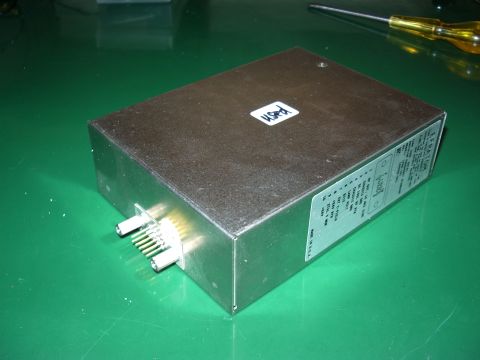
The unit I bought cost about £50 and came with a plug for the 10-pin connector and a 24V switched-mode power supply. These second hand units are widely available. New, they cost over $1,000 even in quantity. They are used in cellular base stations and are manufactured to have a maintenance-free life of ten years. To ensure reliable service the cellphone network providers take the equipment out of service before the ten years is up after which it is presumably shipped to China for reclamation. The used units should have several years of life in them, especially in occasional amateur use.
Rubidium frequency standards work by locking a crystal oscillator to the very precise frequency at which the amount of light from a rubidium lamp dips due to a phenomenon known as the hyperfine transition. A synthesizer locked to a reference oscillator is swept through this frequency until the dip is detected. The LPRO-101 includes an oven for the reference crystal, circuits to detect the dip and lock the oscillator, an output that tells you when the unit is locked, and the frequency reference output at 10MHz. The connector also provides signals that can tell you the state of health of the rubidium lamp. Once that fails you may as well scrap the unit because it can only be replaced by the manufacturer at a cost far in excess of what you paid for it.
To use the LPRO-101 you could simply attach a 24V supply and connect a cable to the 10MHz output. However, it’s useful to have a circuit that shows you when the unit is locked on frequency. I used one shown in an article by KA7OEI built up on a piece of Veroboard, which uses a dual-colour LED to light red when the reference oscillator is unlocked and green when it is locked. You can see the circuit board inside the partially assembled case.
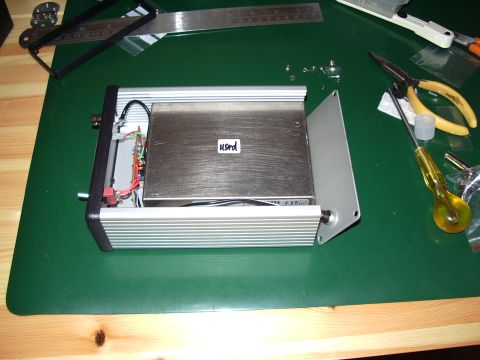
The voltage regulator and crystal oven inside the LPRO-101 generate a lot of heat so the unit is intended to be mounted on a heat sink. I purchased a Hammond extruded aluminium case to use for the project, which should provide reasonable heat sinking for the module.
One thing I learned from researching on the internet is that the LPRO-101 will run cooler when operated from its minimum recommended supply of 19V. This just so happens to be the output voltage of the power supply for an old Toshiba laptop whose screen failed so I decided to use that instead of the 24V supply that was sent by the seller.
The other thing I learned is that the rubidium lamps wear out with time. When they are made, the manufacturer ensures that they contain sufficient rubidium to achieve the stated maintenance free life of ten years, so the expected life in continuous use would be ten years less the use it has already had.
If I ran the unit all the time my rig is on – for example as an external frequency reference for a transceiver – then it is going to fail sooner or later. If I only use it for frequency calibration purposes, switching it on only when needed, then it will probably outlast me. The TCXO in my K3 is pretty stable so I should be able to obtain adequate accuracy for my purposes by manually calibrating the master oscillator using the rubidium standard and repeating this as often as necessary. How often that turns out to be, we’ll see.
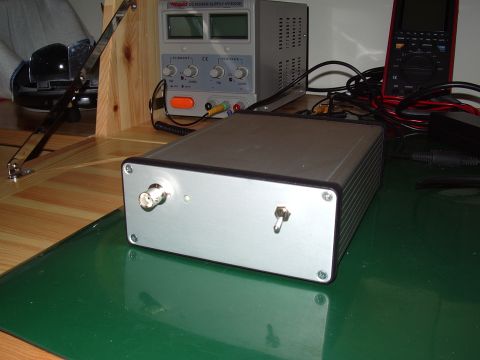
Here is the finished unit. Annoyingly, I messed up the front panel of the rather expensive Hammond case. Originally I had intended to use an SMA socket for the output but I didn’t get the holes for its two mounting screws in the right place and after filing to fit it looked unsightly. So I fitted a BNC socket instead which is what I should have done in the first place. Unfortunately you can see the two holes for the SMA mounting screws either side of the BNC socket. So my frequency standard doesn’t look quite as professional as this one built by DL2MDQ. Oh well, it’s only a piece of test equipment!

Julian Moss, G4ILO, is a regular contributor to AmateurRadio.com and writes from Cumbria, England. Contact him at [email protected].
 Ham Radio Deluxe |
 W5SWL Electronics |
 Ham Radio Prep |
 KB3IFH QSL Cards  Hip Ham Shirts  HamRadioAuctions HamRadioAuctions Reliance Antennas Reliance Antennas Enigma Shop Enigma Shop |  morseDX  Ni4L Antennas  R&L Electronics R&L Electronics antennas.us antennas.us QRV QRV |
- Matt W1MST, Managing Editor
