 |
 Tracker trouble
 10 November 2010 | by
 Today was one of those perfect days you sometimes get in winter. It was too good to stay indoors, especially as rain is forecast for tomorrow, so after lunch I packed my APRS tracker and Motorola GP300 in my rucksack and went for a short hike up Binsey, one of the Wainwright hills in the northern Lake District.

There had been a frost overnight and even now in the early afternoon the temperature was only a degree or two above freezing. Looking towards the central Lake District across Bassenthwaite Lake you could see the distant hills were covered with a light dusting of snow.
On the way up to the summit of Binsey I observed that my tracker was not transmitting. The tiny red LED on the GPS was flashing to say the receiver was working but the GPS OK light on the tracker itself was out. If I switched the unit off and then on it would send its position as soon as GPS lock was obtained, but that was usually all I got. When the beacon was sent I also heard a few noises from the Motorola receiver. None of this had happened during testing in the shack, but a cold fell-top is not the ideal place for troubleshooting. The lack of position reports received during my walk on Sunday was probably not due to conditions
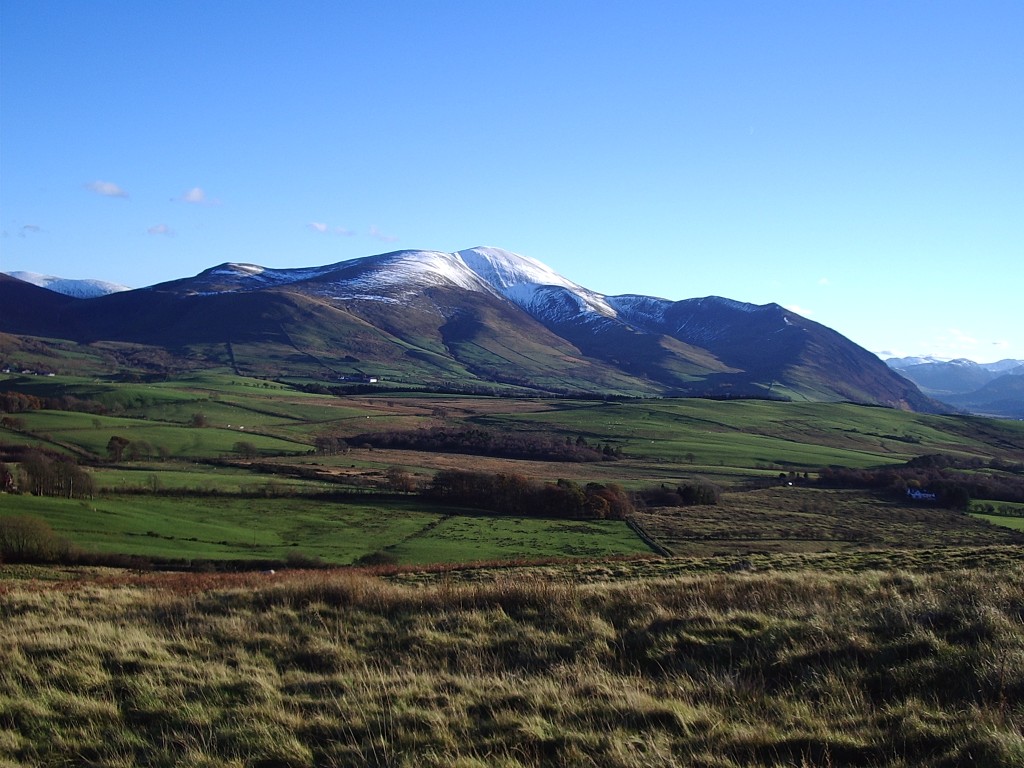
On my descent I enjoyed the view of the snow-dusted Skiddaw range against an almost cloudless blue sky. To think, some people are stuck in an office on a day like this! (OK, I know, I don’t have to rub it in!)
Back home I connected up my tracker on the bench and it worked perfectly again. I then put it in my rucksack as it had been while I was out and it started to behave as it had while I was out. Some braaps were accompanied by a sort of farting sound that was probably RF feedback. I’m pretty sure RF is getting in somewhere and causing the tracker board to misbehave, but the question is: where?
I’ve tried moving cables about and clipping ferrites on the leads but so far I’m not sure what is the cause. I hate this kind of problem which can have you going round in circles thinking you’ve fixed it and then it recurs. I’m not sure yet if the RF is being picked up on one of the cables – both the PS/2 GPS cable and the curly Motorola cable are quite long for this application – or whether it is getting to the module directly since it is only in a plastic case. Perhaps I should try it in a die cast box. Any ideas?

Julian Moss, G4ILO, is a regular contributor to AmateurRadio.com and writes from Cumbria, England. Contact him at [email protected].
QSO with G8DDY, Marconi Memorial CW and AO-51
Not had a chance to write things up since the weekend. But I had quite a varied and interesting time on the air at the weekend. Didn’t spend too much time, as is often the case, but it was proof that a few quick visits to the radio can be interesting.
First interesting contact was from the mobile, as I was driving to get some catfood on Saturday morning. I had the FT8900 scanning and as it went through GB3RD, it stopped and I heard ‘Golf Eight Delta Delta’ in a very distinctive voice and then the rig resumed scanning. I recognised the voice and went back to GB3RD. As I’d thought it was Peter, G8DDY from the Isle of Wight, who was mobile on one of the highspots of the island. I remembered Peter as being my first QSO from the Isle of Wight on both 144 and 432MHz way back in the early 1980s.
By the time I’d got the rig back on GB3RD, Peter was already in QSO, but I listened and waited for the QSO to end. It did and I called in. It was fun to speak to Peter and compare notes of operating from the island. He knew the apartments where we have stayed and how good a radio spot it is! A lovely QSO and nice to catch up again after all this time.
The first weekend of November is always the Marconi Memorial CW contest on 144MHz. Though I don’t treat it as a contest, I always tune around as it’s interesting to see what can be heard. This year was no exception and there were some nice contacts to be made. Conditions weren’t brilliant, but I was pleased to make some reasonable contacts – mostly from Continental Europe. The best DX was F8DGY in JN18. The two gotaways, at greater distance were DK0BN (JN39) heard for a reasonable period on Saturday afternoon, just above the noise and TM0W (JN36) again, heard for a good period on Saturday evening, but not QUITE strong enough to work! I did hear TM0W again briefly on Sunday, but conditions were poorer and tropo was very weak by this time (there were some good MS bursts though!).
The other experiment was to listen for the AO-51 satellite (repeater in the sky). I was inspired to do this, after seeing a tweet from Paul, 2E0BHA. I’d hoped to try and work him. However, the experiment was only partially successful in that I heard signals on the IC-E92 handheld. But despite the overhead pass, signals were weak. After the event, I discovered that the satellite had not been operating at full strength, so I shall have to try again on a more auspicious occasion.

Tim Kirby, G4VXE, is a regular contributor to AmateurRadio.com and writes from Oxfordshire, England. Contact him at [email protected].
Handiham World for 10 November 2010
Welcome once again to my humble QTH:
Retirement!

To many of my friends, retirement means being more active than ever and being involved in more things than while they were in the work force. Some of my other friends just sit around all day with nothing to do except watch TV, listen to the radio, or read. For me it has been a little of both. I am hunting for another job just for something to do to keep active with people on a more daily basis. Also, I have been meeting with several of the people I went to high school and grade school with so very long ago. We are planning a 70 year, weeklong, Birthday Bash because we will all turn 70 at the same time, plus or minus a couple months. Many will be flying in from all over the world. Once a month we have a lunch for those who happen to be in town at that time.
Because of my interest in Amateur Radio Since 1956, when I first became licensed, I have never been lacking any friends and have always had something to keep my interest. There is always new technology to keep up with. In fact, I have attended several local ham radio events and do a considerable amount of listening both on and off the ham bands. I also check out many of the ham radio web sites to see what is new and what various clubs are doing. Of course I have been checking out the Handiham web pages too. I have been out to the new offices and visited with Pat and Nancy a few times too. Pat & I have worked on a couple Handiham projects as well.
Which brings me to this: Although my rigs consist of a Yaesu FT-100 & VX7R , a Kenwood TS-50 with the automatic antenna tuner, an Icom IC-T7H HT, I also have and use a couple of HT scanners , a Bearcat R4020 and a Radio Shack Pro-96, which I use to listen to many things both on and off the ham bands. They scan pretty fast so I do not miss very much and I catch most of the VHF/UHF nets and things going on. Many times I am listening to the Handiham net on the scanner and go to jump in only to notice that there is no push to talk switch on the scanner.
One subject of interest to me is the question of a 75/80 meter Handiham net and where on the band to have it.
My suggestion was, half kidding, to have a slow speed Handiham CW net on 75 meters.
How about it? What do you think?
I would volunteer to be ONE of the net controls if we have some others that would help.
I know, I know… The requirement for CW has been dropped. But here is the funny thing about that. More and more people are learning the code just for the fun of it. And, some people cheat using computers to translate the code so they don’t even need to know it. If you think about it, there is plenty of room in the CW part of the band for a net and the range would be greater using CW than on SSB so people from outer areas would have a better chance of checking in.
And, Yes! I know Handihams has a Slow Speed CW net on 7112 Friday Mornings. However Paul, the net control, is on the East Coast and as many times as I have tried to check in from Minnesota no one has heard me. Another slow speed Handiham CW net for those of us on “THIS” side of the Appalachian Mountains might be what is needed.
What do you think? Please send your ideas , suggestions, wishes to be a volunteer CW net control, etc. to Pat at [email protected] and he will pass on the information to me.
So, until next time…
73 es DX de K0HLA Avery

Pat Tice, WA0TDA, is the manager of HANDI-HAM and a regular contributor to AmateurRadio.com. Contact him at [email protected].
Two new continents on 40m
I popped up to the shack after watching some evening TV and decided to have a listen to what was happening on JT65A on 40m. I tuned my K3 to 7.076MHz and had only been listening for a couple of minutes when I saw a CQ call from VK6BN appear on the screen. I only just managed to set up a reply before the start of the transmit period and you could have knocked me down with a feather when he came back with a report! We completed the QSO in the minimum 6 minutes.
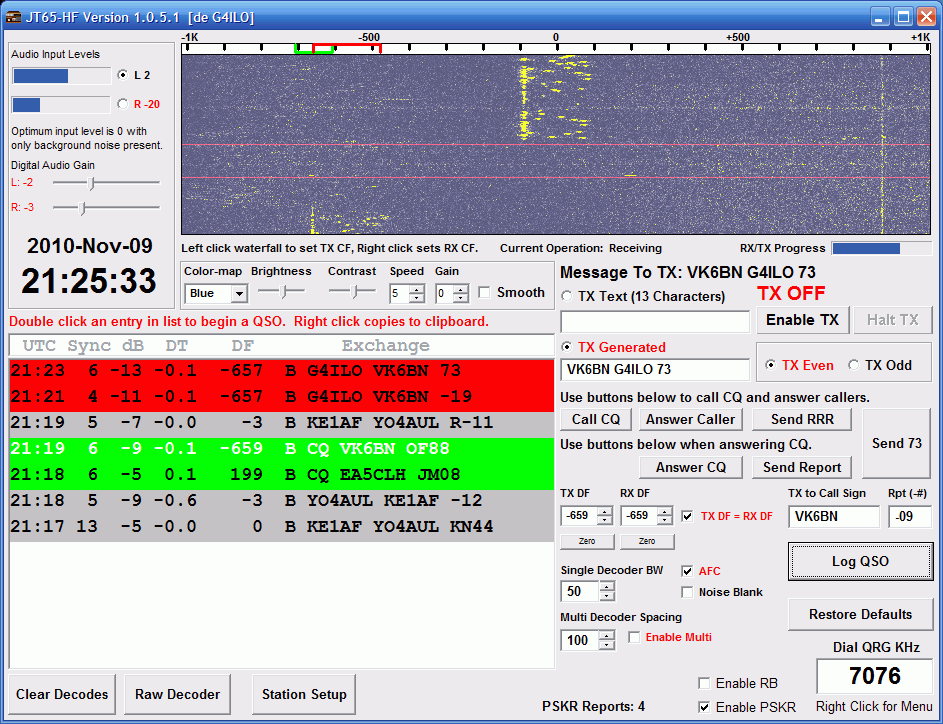
I’ve been reported in VK before using WSPR, that’s nothing unusual, but this is my first ever two-way contact with Australia on any band or mode and I’m pretty amazed to have achieved it on 40m of all bands using just 30 watts to my attic dipole. JT65A really is amazing!
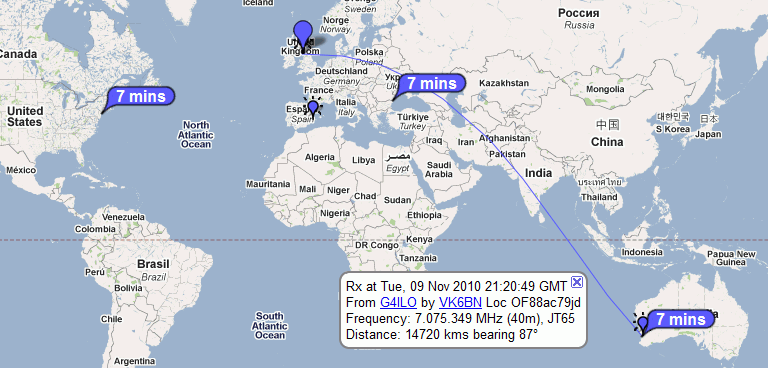
As if that wasn’t enough, I then worked KE1AF for my first contact with North America on 40m. So I shall be going to bed this evening feeling pretty pleased!

Julian Moss, G4ILO, is a regular contributor to AmateurRadio.com and writes from Cumbria, England. Contact him at [email protected].
Autumn walk
Sunday was a fine but cold autumn day and Olga and I went for a walk near Loweswater. In my rucksack I took the Motorola GP300 and the FoxTrak APRS tracker. This is a somewhat more bulky arrangement than using the VX-8GR, however this hobby has for me always been more about providing a reason to build and tinker about with stuff than using the latest, most efficient technology and using this home-built tracker with a radio I bought for £1 at a rally is just somehow more fun than using Yaesu’s latest gadget.

I had obtained a cable for the Motorola with the correct two-pin plug to make up an interface. I cut the tip off the 3.5mm jack so that inserting the plug did not cut off the speaker and I programmed a channel on the radio with 144.800 as the transmit frequency and 145.500 as the receive frequency. This meant that I could hear anyone calling CQ during the periods between transmitting position beacons. The downside is that the FoxTrak cannot tell if the APRS frequency is clear before transmitting. But many dumb trackers do that already because they don’t have a receiver. In any case, the APRS activity level here is so low that the chances of a collision occurring are about the same as winning the lottery.
Although the path we walked along was quite high, this was not a very good location for radio. Only one position beacon was received by a gateway and I made just one voice contact – with Phil M0AYB/P activating the summit of Blencathra for WOTA. (Phil later went on to activate Mungrisdale Common which completed activations of all of Wainwright’s Northern Fells. I’m doubly sorry to have missed contacting him there, but congratulations Phil on the achievement.)

Our walk took us down through the woods to the lake shore and then back to the car. The autumn colours were wonderful – my pictures don’t really do justice to them. I expect most of the leaves have now gone. Last night there was a gale and this morning through the overcast we could see wet snow on the mountains down to quite a low altitude. I doubt that there will be many more opportunities for a walk like this before the end of the year.

Julian Moss, G4ILO, is a regular contributor to AmateurRadio.com and writes from Cumbria, England. Contact him at [email protected].
CW Sweepstakes 2010

(Image credit: via contesting.com)
After missing the two contests that I hoped would kick off my contest season, ARRL Sweepstakes was next on the list. I managed a decent showing that would have won the MDC certificate for A-power last year, provided the log-checkers don’t take too much.
Highlights (“Wins,” as we like to say on #wwyc):
- 80 meters was awesome. Good conditions and the K9AY helped me keep the noise under control.
- Everything worked for the most part and everything still works after the contest is over.
- SO2R CW with TRLog.
- Working lots of old friends from my time in MRRC, MWA, and SMC.
- Working lots of new friends from PVRC.
- Getting my receiver crushed on all bands when I tuned across W4EE who lives less than a mile away.
Lowlights (Fails):
- RFI to the CO detector waking Sarah up in the middle of the night. KA9FOX and AA9DY have had this problem.
- Not spending enough time on 15 meters and missing VY0JA and VY1EI there. Missed the sweep by 1.
- Not being able to answer people responding to my main radio CQ while working someone on the second radio. This only happened about five times. But, one of these was my Bureau sorter! Sorry!
- Getting confused for K1GU a few times.
Here are the numbers…thanks to all for the QSOs. See you again in two weeks on phone with a different callsign.
ARRL Sweepstakes Contest, CW

Call: K8GU
Operator(s): K8GU
Station: K8GU

Class: Single Op LP
QTH: MDC
Operating Time (hrs): 17
Radios: SO2R

Summary:
 Band  QSOs
------------
  160:
   80:  367
   40:  243
   20:  100
   15:    0
   10:
------------
Total:  710  Sections = 79  Total Score = 111,548

Club: Potomac Valley Radio Club
Ethan Miller, K8GU, is a regular contributor to AmateurRadio.com and writes from Maryland, USA. Contact him at [email protected].
ICQ Podcast Series Three Episode Twenty-Three – PMR Conversion (07 November 2010)
Series Three Episode Twenty-Three of the ICQ Amateur / Ham Radio Podcast. News Stories include:
Your feedback and Martin (M1MRB) reports on the PMR Conversions.
Colin Butler, M6BOY, is the host of the ICQ Podcast, a weekly radio show about Amateur Radio. Contact him at [email protected].
 Ham Radio Deluxe |
 W5SWL Electronics |
 Ham Radio Prep |
 KB3IFH QSL Cards  Hip Ham Shirts  HamRadioAuctions HamRadioAuctions Reliance Antennas Reliance Antennas Enigma Shop Enigma Shop |  morseDX  Ni4L Antennas  R&L Electronics R&L Electronics antennas.us antennas.us QRV QRV |
- Matt W1MST, Managing Editor
