 |
 New QSL card
 15 November 2010 | by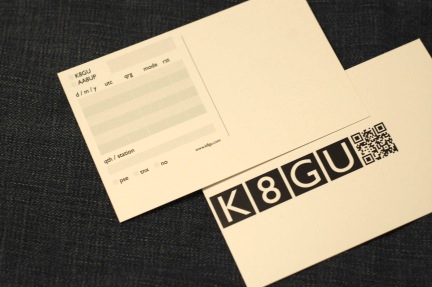
As I have bemoaned in the past, good QSL card designs are hard to come by. This is my attempt to remedy that situation. The front has my callsign, with a QR code linking the interested recipient to this web site. The reverse is postcard-friendly with space for six QSOs, corresponding to 1.8/3.5/7/14/21/28 or 50/144/222/432/903/1296 MHz. The address space can be used for a personal note if the card is mailed in an envelope. The card is also QTH-unaware. This means that I’ll have to write or sticker my way along, but I won’t be limited by my moves and travels. The font is Gil Sans everywhere. The cards were laid out using Adobe Illustrator CS4 and printed on 100-lb matte cover stock by Carlisle Printing, who printed my last cards as well.
One final note: one week after SS CW, I am already up to 43/50 states for my CW WAS from Maryland using LoTW. I’m not sure how many of these QSLs will actually make it into circulation at this rate. Be sure to work me so you can have your own copy of this rare collector’s item!
Ethan Miller, K8GU, is a regular contributor to AmateurRadio.com and writes from Maryland, USA. Contact him at [email protected].
2010 ARRL CW Sweepstakes
Last weekend I spent about 13 hours or so participating in the ARRL CW Sweepstakes contest. The last time I participated in this contest was in 2008, and although I started out slowly, I managed to finish with a final score just a bit higher than the 2008 effort. In 2008, I had 333 QSOs in about 15 1/2 hours with 79 out of the 80 possible multipliers, missing only NT (Northwest Territories in Canada) for a score of 52,614 points. This year, in 13 hours, I had 376 QSOs missing 3 multipliers (Nebraska, which I heard, but couldn’t work, South Bay, which I heard once, and didn’t work, and Newfoundland/Labrador, which I never heard), giving me a total of 57,904 points. Considering that I had fewer multipliers and a higher score in a shorter amount of time, I was pretty happy.
I didn’t try to “run” stations at all for the first day of the contest, there was just too much competition, but later on when things quieted down I was able to get run frequencies on 40m and 80m from time to time and really enjoyed working the stations calling. I did have a couple of things happen while running on 80m that I thought were noteworthy. First, in the middle of my run I got called by W1AW, the Hiram Percy Maxim Memorial station located at ARRL Headquarters. Although I’ve had contact with W1AW many times (they are not very far from here so are very easy to work on the lower bands), and have even operated from that station myself, it’s always fun to make contact with them, and even more special when they call me (rather than the other way around). The other thing that happened was that a bit later I was running on another 80m frequency at the bottom of the band (3.505mhz) and a station called and asked if I would QSY (change frequencies) because a DX station (5R8Z, I believe) was about to come on the air and that was the frequency that he’d announced he’d be moving to. I moved right away, because even though legally, since I was there first I could stay, it was in the “ham spirit” to move so that others could contact that DX station. (Frankly, I would have been very happy to make that contact myself, but I never heard him.) In any case, it was the right thing to do, and I was happy to do it.

David Kozinn, K2DBK, is a regular contributor to AmateurRadio.com and writes from New Jersey, USA. Contact him at [email protected].
Still Fine Tuning…
My apologies for the hideously long load times for this blog. I’ve been informed that the number of RSS feeds on the right is making the page take a long time to load. I’ve been trying to build something similar to the blogroll you get at Blogger, but unfortunately WordPress.com doesn’t offer a blogroll widget that sorts by last post date and shows the title of the last post. It’s either a full blown RSS feed for each blog you want to keep up with or a list of static links. So, most of the RSS feeds are deactivated for now until I can figure out another solution.
I consider blogrolls an important part of amateur radio blogademia. If you have me in your blogroll, thank you. I hope to get your blog back in mine soon….
(If anyone reading this has better WordPress fu than me, please give me some pointers!)
73
Goody


Heard on VHF/UHF from the mobile this week
Last week’s map of what I’d heard from the mobile seemed to cause a little interest (thank you!), so I thought I’d keep a mental note of what I heard over the week and put a map together. It gives an idea of what conditions have been like, which I hope you find of interest
View Heard this week 12/11/10 in a larger map
A couple of ‘spots’ that I didn’t hear last week. GB3LW in Central London came through on 433.150 (same as GB3DI near Didcot) a couple of times, with good signals. GB3SN on 145.725 was weak but audible this morning and GB3WR was consistent through the week, but a little louder than usual this morning.
Something as yet unidentified is coming through weakly on 145.750. I will keep an eye on this one and see what it turns out to be.
Most active repeater in the morning when I’m listening seems to be the GB3FN Farnham box with a good number on their commuter net. Rob, G4XUT and I do our best on GB3TD!

Tim Kirby, G4VXE, is a regular contributor to AmateurRadio.com and writes from Oxfordshire, England. Contact him at [email protected].
Switched capacitive audio filter projects
 With W1AW practically in my back yard, I get to play with some expensive toys. I volunteer there from time to time….. and really get to play with some toys! One thing I’ve learned (and try to teach new hams in my classes) is….. spend more time listening than transmitting!
So, on all my non homebrewed rigs, I have spent tons of time learning how to use, or installing filters and figuring out not only how they work, but how they truly help me on the air. Software defined radio has also shown me some really neat things that can be done just playing with bandwidth and CW (especially trying to work a DXpedition!).
To that end, I finally got to play with a few switched capacitive audio filters that really had me thinking, why do I not have one!
Today I’m going to show you a few projects that can get you going. First, the image on the right is from the NEQRP Club and their NESCAF project. The theory of operation, I’ll quote from their website: http://newenglandqrp.org/nescaf
The integrated circuit at the heart of the NESCaf is made up of two CMOS active filters. These filters are extremely configurable (low pass, band pass, notch etc).
We have chosen to set up both filters as Butterworth band pass filters and to cascade the filters. Butterworth filters have the characteristic of constant amplitude in the band pass region, while the cutoff knee is not be as sharp as if the filter were configured as a Chebychev. We considered this an acceptable tradeoff, wanting constant volume out regardless of the bandwidth or center frequency setting of the filter.
There are two on-board trimmer pots. One is used to “calibrate” the center frequency pot. This allows you to adjust the frequency at which the center detent occurs. If you are using a rig with a transmit offset and sidetone of say, 700 Hz, you can use this trimmer to make that the center-detent frequency. The other on-board trimmer adjusts the audio level into the filters output amp. Using this pot, you can set the overall gain of the filter. This can be used to set the filter for unity gain, if desired. This way, the filter could be switched in and out, and still maintain a comparable volume level in the headphones.
Pretty neat! This is a relatively simple kit that the club has been offering for quite awhile. Out of stock now, but will be available again soon and priced really inexpensively – under $35.00. If you want, all the information is available int he schematic and documentation if you want to “roll your own”.
There are some commercial offerings as well, many we have seen advertised like the one from Idiom Press (http://www.idiompress.com/scaf-1.html). This one works VERY well, and comes as a complete kit with an enclosure. There is some good information on the Idiom Press site that shows the response curve as well as why the filter doesn’t use DSP. This kit is a bit more, but has an extremely high quality/professional looking enclosure and sells for $89.95. I can’t afford one now, but when I can, I plan to build one and post details here with audio files (there is an audio file that can be played on their website to demonstrate the audio characteristics).
Here is a great video of NG9D’s build of the SCAF-1:
But, I don’t want to make this just a CW project…… how about AM?
Stewart (“Stu”) Personick, AB2EZ is a ham that wanted to work a bit on his transmitted and received audio. He took the SCAF-1 and modified it in true ham spirit. From his online writeup of the project:
My original objective was to demonstrate, to the AM community, the use of a switched capacitor filter for “brick-wall” bandlimiting of the output of an AM audio chain… in order to limit the bandwidth of the r.f. output signal produced by a vintage high-level-modulated vacuum tube transmitter, or a modern FET-based “Class E” transmitter.
What’s really neat, is this is a relatively easy mod to build in and expand the already excellent capabilities of a great kit/filter! You can find full details of this modification at: http://mysite.verizon.net/sdp2/id14.html I think the Idiom Press site has copied this info on their site as well.
 A little more research on the topic led me to “An Adjustable Audio Filter System for the Receiver” by Lloyd Butler VK5BR (Originally Published in Amateur Radio, March 1995).
This is also a “roll your own” project, but gives some detail on the use of the filter in CW, RTTY, voice and other narrow bands. This article was originally published 15 years ago and is still VERY relevant today.
I took a look at the schematic and it’s not entirely too difficult to build this in an evening or two and looks like a very useful and educational shack accessory.
You can find the article and schematic at: http://www.qsl.net/vk5br/SwCapFilter.htm
Hopefully this will whet your appetite and make you want to fire up your soldering iron and build a useful filter for your operating needs. I know after using a few of these filters I’m left to wonder, “how did I NOT learn about switched capacitive audio filters!”.
Jonathan Hardy, KB1KIX, is a regular contributor to AmateurRadio.com and writes from Connecticut, USA. Contact him at [email protected].
Curse Yaesu
… for making the power connector for the FT-817 a nonstandard and apparently unique size. I sacrificed the power cable of a multi-voltage wall-wart which had a set of interchangeable tips to make a cable I could use to run the ‘817 from my lab bench supply for an experiment. One of the tips looked to my eyes exactly the same as the one on the Yaesu charger, even down to having a yellow plastic insulator at the tip. But stupid me I didn’t think to check it would actually go in before severing the cable from the wall-wart and now I find that it doesn’t. So not only did the wall-wart lose its cable in vain but I now can’t do my experiement, since it would have taken longer than the ‘817’s woefully inadequate batteries would permit. Grrr!!
I can’t even find an FT-817 power cable on eBay.

Julian Moss, G4ILO, is a regular contributor to AmateurRadio.com and writes from Cumbria, England. Contact him at [email protected].
ATS-4 and SDR Cube
Two exciting new possibilities for portable HF have become available.

Steve Weber KD1JV's ATS-4
A few hours ago Steve Weber KD1JV announced that the ATS-4 kit was available again. These apparently sell out very quickly – so if you’re interested, act now!
Many people hanging around the AT_Sprint Yahoo group have been waiting patiently for many weeks for this morning’s announcement.
The ATS-4 is a “miniature 5 band CW rig with digital mode capabilities” designed for 80, 40, 30, 20 and 17 or 15 meter operation in the field. The AT stands for Appalachian Trail. It’s tiny – according to the KD1JV site, about 1/3 larger than an Altoids tin – the universal QRP standard of enclosure measurement – at 4.9″ wide, 2.7″ deep and 1″ tall.
ATS-4 features include a built-in Iambic A or B mode keyer with three message memories. The rig can convert Morse input via paddle to transmit as PSK31. And PSK31 and RTTY are possible using Pocketdigi software on a PC, laptop, netbook or PDA.
The other exciting portable possibility – which was designed to be independent of this kind of hardware – is the SDR Cube. George Heron, N2APB and Juha Niinikoski, OH2NLT developed this self-contained and portable SDR Transceiver using a Softrock front end and embedded Digital Signal Processing. One of the features of this design is that no PC is required. This follows naturally from George N2APB’s work developing the NUE-PSK modem which liberates portable PSK31 & RTTY ops from lugging along a laptop.

The SDR Cube
The SDR Cube is still available for ‘early-bird’ special prices, so again, not one to put off considering for too long. It’s also available in a range of different forms, from bare PC boards through to kits and assembled and tested. The design is deliberately open and flexible to accommodate experimentation. As the comprehensive SDR Cube site explains
The SDR Cube is a totally self-contained, embedded SDR transceiver for CW & SSB using a Softrock for the RF front end and a pc board implementation of an HF modem. A PC is not needed for using the SDR Cube, as all DSP processing is accomplished by an embedded DSP processor on the three internal pc boards. The Cube is designed to fit into an optional 4” x 4” x 4” pre-cut black powder-coated aluminum enclosure containing all controls, a blue graphic display showing the transceiver settings and an exciting 8 kHz-wide band scope of spectrum signals, and the popular Softrock RXTX v6.3 board.
Full ordering details for the SDR Cube can be found here.
Stephen Rapley, VK2RH, is a regular contributor to AmateurRadio.com and writes from New South Wales, Australia. Contact him at [email protected].
 Ham Radio Deluxe |
 W5SWL Electronics |
 Ham Radio Prep |
 KB3IFH QSL Cards  Hip Ham Shirts  HamRadioAuctions HamRadioAuctions Reliance Antennas Reliance Antennas Enigma Shop Enigma Shop |  morseDX  Ni4L Antennas  R&L Electronics R&L Electronics antennas.us antennas.us QRV QRV |
- Matt W1MST, Managing Editor
