 |
 Ham Nation 9
 20 July 2011 | by
 Teaching ham radio to kids in school, comparing ham radio to modern internet services, and George shows us the dos and don’ts of soldering.
Guests: Carole Perry, WB2MGP and George Thomas, W5JDX
Download or subscribe to this show at http://twit.tv/hn.
We invite you to read, add to, and amend our show notes at wiki.twit.tv.
Thanks to Joe Walsh who wrote and plays the Ham Nation theme.
Thanks to Cachefly for the bandwidth for this show.
http://dts.podtrac.com/redirect.mp4/twit.cachefly.net/video/hn/hn0009/hn0009_h264b_864x480_500.mp4
http://dts.podtrac.com/redirect.mp4/twit.cachefly.net/video/hn/hn0009/hn0009_h264b_640x368_256.mp4
http://www.podtrac.com/pts/redirect.mp3/twit.cachefly.net/hn0009.mp3
Dr. Bob Heil, K9EID, is the founder of Heil Sound and host of TWiT.tv's Ham Nation which streams live each Tuesday at 6:00pm PT (9:00pm ET) at http://live.twit.tv. Contact him at [email protected].
Handiham World for 20 July 2011
Welcome to Handiham World!

It looks like we will meet our goals for Radio Camp this summer. We have a healthy level of participants, and most have completed their paperwork and made their travel plans. Quite a bit remains to be done in preparation, though. We have an excellent tower and beam antenna on a hill behind the camp’s “Rotary Building”, where we plan to set up an HF station using a Kenwood TS-570SAT and a TS-2000. Having these rigs to choose from should help make more operators comfortable. Since the beam has not been used this past year and things have been moved around, I will need to locate the rotor control box and dress the wiring back into the shack for a test run. One thing I have learned about antenna systems over the years is that unexpected problems can show up at the most awkward times. It pays to do a little footwork in advance. In this case, I will need to do real footwork, too. The main Handiham Headquarters building rests in a storybook-like clearing surrounded by forest at the base of a hill. Built on and into the side of the hill is the Rotary Building, named for its benefactors, the Rotary Clubs. Long ago, when the Handiham System was very young, there was a ham radio station in the Rotary Building, which was used during the shorter “May Convocations” that would ultimately evolve into the full-fledged Radio Camps.
So you can imagine that there would need to be an antenna system near the Rotary building, and sure enough, there was. A 50 foot self-supporting tower and beam antenna were installed up at the top of the hill behind the building. The entire system fell into disrepair when the Radio Camps moved to Courage North, and it wasn’t until recent years that the antenna and wiring were refurbished as part of an Eagle Scout project by Peter Widin, KC0ENI. This excellent resource will once again be used at Radio Camp, and should provide us with the opportunity to work some real DX! What is different this year is that we plan to install a permanent station in the library of the Rotary building, an excellent gathering space with plenty of room for operating skills participants. In preparation for the use of this area, I have completed the installation of wireless Internet and done some preliminary planning of the station setup. Although we could set up temporarily as in the past, this year we will have one of the familiar equipment desks that we have used at Courage North. This cabinet will provide a place to lock up the stored equipment when non-ham radio users are in the space.
Meanwhile, back on the Woodland side of camp, which is where we will enjoy living in the modern cabins during the week, I have checked the Internet and done my walk through of the buildings. I am thinking that we may have only one HF station, if that, set up at the Woodland cabins. After all, we will have stations on the pontoon boat, at the Rotary Building, and at the Headquarters. We do plan to have a JAWS computer with Echolink and the Remote Base software available as a training tool. Since there are wireless Internet hotspots available in Woodland, the Rotary, Lakeside dining hall, the Lakeside Gazebo, and Handiham HQ, there should be no shortage of places for us to use the Internet-enabled stations. Furthermore, the camp repeater will be on the air and it is Echolink-enabled. One of our goals is to teach the use of these new tools to as many of our campers as possible. If we are successful in getting our new IRLP node that has been configured by Lyle, K0LR, set up on our Woodland Internet connection, we will be able to use that to connect to IRLP node 9008, the Vancouver BC system.
By the way, this month marks 60 years since the FCC created the Novice class license. I was reminded of this by Ron, K3PID, my co-editor of our local radio club newsletter, who was asking club members to send in stories about their Novice days. I thought that was such a good idea that I would like to steal it, so how about some of those Novice stories? I will tell you one of my own next week.
Patrick Tice
[email protected]
Handiham Manager
Thanks for your support!
The Owatonna Steele County (Minnesota) Amateur Radio club recently sent in a gift of $50 in support of the Dr. Dave Challenge Grant. Dr. Dave Justis, KN0S, has challenged us to raise at least $5,000, which he will match.
Help us win the Dr. Dave Challenge!
Money is tight these days and we desperately need your support. Now, thanks to a generous challenge grant by Dr. Dave Justis, KN0S, we have a chance to help fill the budget gap. Dr. Dave will donate $5,000 to the Handiham System if we can raise a matching amount. That means we need to really put the fund-raising into high gear! If you can help, designate a donation to Handihams, stating that it is for the “Dr. Dave Challenge”. We will keep you posted in our weekly e-letter as to the progress of the fund.
Nancy can take credit card donations via the toll-free number, 1-866-426-3442, or accept checks sent to our Courage Center Handiham address:
Courage Handiham System
3915 Golden Valley Road
Golden Valley, MN 55422
Be sure to put a note saying “Dr. Dave Challenge” somewhere in the envelope or on the note line of the check.
Thank you so much for your support!

Pat Tice, WA0TDA, is the manager of HANDI-HAM and a regular contributor to AmateurRadio.com. Contact him at [email protected].
K1OIK: Hamspeak
More levity from our friend Burt, K1OIK…
Matt Thomas, W1MST, is the managing editor of AmateurRadio.com. Contact him at [email protected].
LHS Episode #062: The Sound of Linux
 Okay, so we managed to take a two month hiatus and we didn’t even know it was going to happen. Happen it did, though. Because of that, Episode #062 and #063 will have some dated information but most of it has been edited out and the stuff contained within that will be timeless has been left in.
I (Russ) will admit to shirking my duties to some degree. Many things are going on in my life right now and I just didn’t want to deal with editing or recording of late. Richard has also had his share of life problems and we’ve both been out of pocket a few times between Episode #061 and now. I suspect our absence is coming to an end and regular production of LHS will soon resume.
Thanks to everyone for hanging in there with us. We now return you to your irregularly scheduled podcast.
73 de The LHS Guys
Russ Woodman, K5TUX, co-hosts the Linux in the Ham Shack podcast which is available for download in both MP3 and OGG audio format. Contact him at [email protected].
Farewell to Gerry Gearing G3JJG
It wasn’t until yesterday, browsing the Southgate ARC site that I learned of the death, on 21st June, of Gerry G3JJG. It was good to see that the Gloucestershire Echo had published a nice obituary for him, although it didn’t mention his amateur radio interests!
I’d known Gerry since my days as a new licencee in Cheltenham. Particularly in those days, I was very much in awe of his ability in CW operating and learned a very great deal from Gerry and Derek, G3NKS in the 1980s and early 1990s as we took part in RSGB’s NFD on behalf of the Cheltenham ARA. I remember Terry, G3JFH marvelling at Gerry’s ability to dig out weak signals on the 40m band in the last hour or so of the contest when many other groups were working nothing!
Gerry’s obituary mentions that he was tenacious! I can confirm that and had cause to receive more than one ‘tenacious’ e-mail when I was RadCom’s Contest Columnist and therefore perceived to be responsible for the RSGB’s Contest Calendar and Rules. Suffice to say that Gerry was not impressed with something (I completely forget now and he probably had a point in any case….) and I was TOLD about it!
Tenacious he was, but in my experience he was never rude and always a gentleman. He was a proud member of the First Class CW Operators Club and had served on their committee for several years.
I shall miss hearing G3JJG on the bands. Gerry, it was a pleasure to have known you.

Tim Kirby, G4VXE, is a regular contributor to AmateurRadio.com and writes from Oxfordshire, England. Contact him at [email protected].
OAFS failure
One of the things I had intended to do this year was install the external frequency reference module in my Elecraft K3 in order to get the best possible frequency accuracy for digital modes. To this end I had ordered an Off-Air Frequency Standard (OAFS) kit from Spectrum Communications so as to avoid wearing out my rubidium frequency standard. I had completed populating the OAFS board a couple of weeks before I ended up in hospital. So I thought I would try to see if it worked, as that would simply involve connecting up a speaker, ferrite rod antenna and power supply.
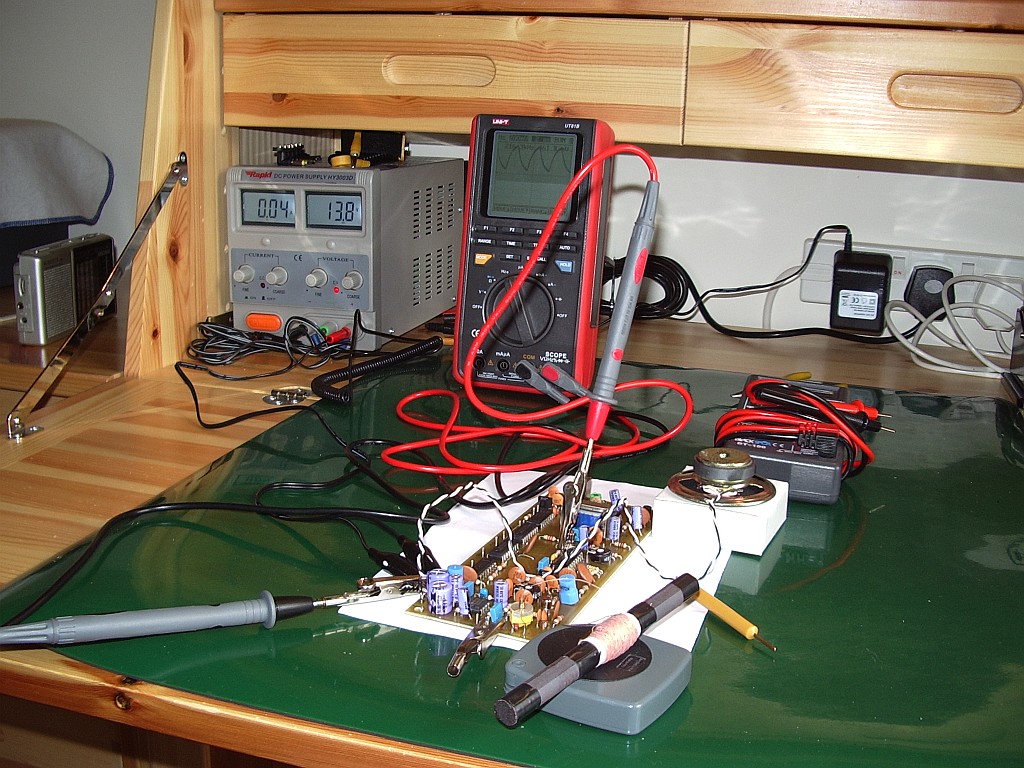
It began to look as if the predictions of the couple of people who commented or emailed when I first posted about the OAFS were going to be right. I could hear BBC Radio 4 long wave in the loudspeaker but it was very weak, presumably (as I had been advised) due to North Cumbria being a poor location to receive the transmission. When I checked the frequency of the phase locked loop it remained steadfastly on 216.4kHz regardless of the setting of the trimpot.
The instructions supplied with the kit suggested that it might be necessary to change a resistor value if the loop will not lock on to 198kHz so I wrote to Tony Nailer at Spectrum to see if he had a suggestion. Unfortunately his reply was that if the loop will not change frequency with the pot there must be a solder bridge or other assembly error. I checked my soldering as best I could and re-did any joints that looked suspect but the way my eyes are now any sort of cross checking between the schematic and the circuit board to look for errors is impossible.
I haven’t really figured out what is wrong with my eyes but it is as if they no longer have the ability to vary focus. I can only see clearly what is at the exact focal point of whatever spectacles I am wearing. When something is out of focus my head swims and I have to close my eyes for a few minutes to steady it again. So any sort of constructional work now is well-nigh impossible.
Tony offered to get the OAFS working for me for a fee if I sent it to him, but at this point I think it would be a waste of money. I can’t see myself installing the frequency reference boards in my K3 now even if I still had the same interest in doing so. So I think the OAFS is destined for the G4ILO junkbox.

Julian Moss, G4ILO, is a regular contributor to AmateurRadio.com and writes from Cumbria, England. Contact him at [email protected].
Revisiting the 50-MHz Transverter
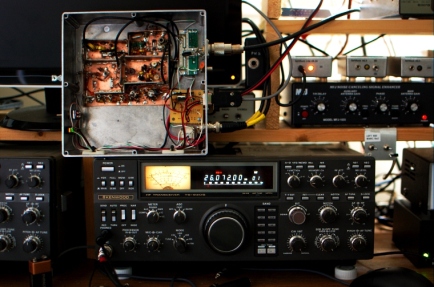
I recently resurrected the 50-MHz transverter project and have made good headway getting it working. On Friday night, I began the process of tapping holes in the PA module heat spreader. But, despite using plenty of “cutting fluid” (3-in-1 oil), I managed to break a (well-used) tap on the first hole. Since the maximum (linear) power out of the driver stage is 200 mW, I embraced my inner QRPer and put the PA project aside to give the transverter a try in the CQ WW VHF contest.
The 6-meter Yagi had come down in favor of Yagis for 222 and 432 when the loaner FT-736R showed up. So, I scampered up onto the roof and moved Yagis around. I had hoped that this moment would be accompanied by changing out RG-8 coax for LMR-600 and LDF4-50A that are taking up space in the shop and shack. But, I was not ready to commit to cutting that and I still don’t have LMR-600UF for the rotator loops. Plus, I should replace the rotator at the same time. That amounted to too much work for the available time. I really just need to bite the bullet and install a rotating mast for the VHF antennas that’s not so precarious.
Got everything hooked up late on Saturday afternoon, but had to tend to some domestic concerns and was QRT until later in the evening when I heard my neighbor W4EE calling CQ on six SSB. Did not know that he had six! Apparently, this is a new thing for him, too. He was surprised that I didn’t vibrate his radio off the desk like I usually do! Told him I was running 200 mW and everything made sense.
Ended up working a few other locals on Sunday including N3UM, who moved me from 6-meter CW to 2-meter SSB for a quick chat. He just completed the N1DPM active bias mod to his Mirage B2518G, so was eager for an audio report. Sounds good! He said my B3016G sounded good on-frequency, but I haven’t gotten the mod actually inserted into mine yet. Probably that Kenwood (TS-700S) audio making up for the amp’s inferiority…
Eventually, I will be posting more details on the circuit here. This is one of those projects that I would not encourage anyone to duplicate as I have constructed it. However, there may be useful features.
Ethan Miller, K8GU, is a regular contributor to AmateurRadio.com and writes from Maryland, USA. Contact him at [email protected].
 Ham Radio Deluxe |
 W5SWL Electronics |
 Ham Radio Prep |
 KB3IFH QSL Cards  Hip Ham Shirts  HamRadioAuctions HamRadioAuctions Reliance Antennas Reliance Antennas Enigma Shop Enigma Shop |  morseDX  Ni4L Antennas  R&L Electronics R&L Electronics antennas.us antennas.us QRV QRV |
- Matt W1MST, Managing Editor
