Archive for the ‘Uncategorized’ Category
 Digital Mobile Radio (DMR) Free PDF Guide
 January 18th, 2016 |
  Author:
For awhile now, I’ve been wanting to get a Tytera MD-380 or Connect Systems CS-750 (or CS-700) in order to learn more about how Digital Mobile Radio (DMR) really works.
To be honest, I’d been having a very hard time wrapping my head around the differences between analog FM and DMR. All of these (relatively) new terms for us old hams including tiers, talk groups, two-slot TDMA, zones, code plugs — they really didn’t make sense to me.
Last night I downloaded and read a free 28-page PDF guide called the Amateur Radio Guide to Digital Mobile Radio by John Burningham W2XAB available on the TRBO.org website. It made everything come together for me. If you’ve been interested in getting into DMR, download this and read it tonight. Well worth the hour it took!
The world of Digital Mobile Radio can be a little complicated, but it opens a whole new world once you understand it. Don’t let the future pass you by!
Thank you, John! What a service to the Amateur Radio community.
Amateur Radio Weekly – Issue 94

ISS SSTV activity today
The SSTV transmissions will be made from the amateur radio station located in the Russian Service Module of the ISS using the callsign RS0ISS.
AMSAT UK
Review: Heathkit Explorer Jr. GR-150 TRF AM radio receiver kit
The Explorer Jr. manual is very nicely done, spiral-bound, and very reminiscent of the old Heathkit manuals in terms of layout and detail.
The SWLing Post
Number of Ham Radio licenses to reach 750,000 by 2017
The number of unexpired amateur radio licenses in the United States was 733,594 in November 2015, an annual growth rate of 1.05% and five year growth rate of 4.52%.
KC4LMD
A stealthy HOA HamStick directional dipole
This is a sneak peek at the project and I will follow up with a very detailed build, tune and operation on 20 and 40 meters bands using both Phone and digital PSK31.
Prepared Ham
USB rechargeable AA batteries
Featuring the same lithium polymer chemistry of your smarthphone, these AA and AAA batteries can be plugged directly into USB for charging.
Macworld
Retirement and Ham Radio
What I have come to learn is that Monday is just as good a day as Saturday and weekend crowds are to be avoided. There are no crowds on Tuesdays.
amateurradio.com
MyAPRS: APRS app for iOS
A modern APRS app for iOS users with model detection, frequency detection, and C4FM highlights.
MyAPRS
Splat! scripts
Scripts to run the Splat! radio terrain mapping tool.
GitHub
Recent Ham attack
The weather station was taken down for test, and upon investigation, the source of the problem was quickly discovered to be a result of squirrel sabotage.
Essex Ham
Video
The Russian Woodpecker documentary now online
An enormous secret Soviet weapon that stands in the shadow of Chernobyl, and which Kremlinologists in the 1980s thought might be a giant mind-control device.
russianwoodpecker.com
Moonbounce/EME Project Diana 70th anniversary special event
This is a narrated compilation of videos taken on 10 January 2016 at a special event that commemorates the 70th Anniversary of the US Army Signal Corp’s Project Diana.
W2AEW
I Need You in My Log! SKCC K3Y/0 Special Event (January 2016)
I need your help!
Come meet me on the shortwave (HF) ham bands for the Morse code (CW mode) special event, the Straight Key Century Club (SKCC) celebration, with special callsign, K3Y. During the shifts (time slots) listed below, I am the control operator as K3Y/0.
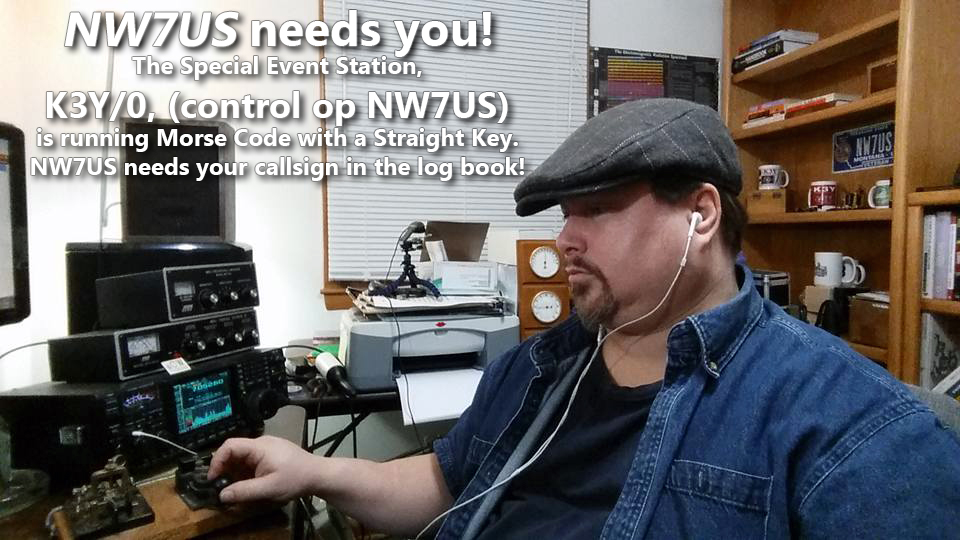 I need you to make a contact with me.
This special event takes place every year during January. We celebrate the legacy of Morse code, and promote Morse code and manual creation of the code by any non-electronic (digital) device and method. Which means that we love mechanical bugs, straight keys, two ends of a wire, or any other manual device, if Morse code is generated. The Straight Key Century Club is a free membership group. The link to their website is below.
I need you to make a contact with me, during my scheduled times, listed below.
NOTE: YOU DO NOT NEED TO BE A MEMBER OF THE (free) SKCC GROUP. To get into my logbook, you meet me on my frequency, and use Morse code to communicate with me. It is painless. If you must, you can use computer-generated Morse code. Or, you can tap it out on any Morse code signalling device, like a bug, a set of paddles, or a straight key; whatever you choose to make Morse code emanate from your HF transmitter.
HOWEVER: For those of you who want to get fully immersed in the spirit of this event, you are invited to use a straight key. And, as a bonus, you may and can join the SKCC group for FREE. Then, you would have your own SKCC number. That’d be cool; we SKCC members use that number in our exchange during our QSO information exchange. But, you don’t need that. Since it is free, why not?
What is needed is simply you, getting on the shortwave band, finding me, hearing me, and responding to me with Morse code. In other words, we need to have a QSO using Morse code. I am not a fast operator, so no problem if you are not very fast. I’ll meet your speed.
In any case, here are some of the times I will be on the air as K3Y/0… please dust off your straight key, bug, paddles, whatever, and make a QSO with me. Thanks!
My current schedule:
UTC Start/End (remember, these are NOT your local times, but are the UTC (GMT) times!)
(revised times, as of edit date)
 00:00 - 02:59 19-Jan-16
 00:00 - 02:59 20-Jan-16
 00:00 - 02:59 21-Jan-16
 00:00 - 02:59 22-Jan-16
 00:00 - 05:59 23-Jan-16
 14:00 - 18:59 23-Jan-16
 20:00 - 21:59 23-Jan-16
 00:00 - 02:59 24-Jan-16
 14:00 - 18:59 24-Jan-16
 21:00 - 21:59 24-Jan-16
 00:00 - 02:59 25-Jan-16
 00:00 - 02:59 26-Jan-16
 00:00 - 02:59 27-Jan-16
 00:00 - 02:59 28-Jan-16
 00:00 - 02:59 29-Jan-16
 00:00 - 05:59 30-Jan-16
 13:00 - 18:59 30-Jan-16
 20:00 - 21:59 30-Jan-16
 00:00 - 03:59 31-Jan-16
 13:00 - 23:59 31-Jan-16
Now, what frequency will I be on?
To find out what frequency I am on:
Visit http://g.nw7us.us/sched4SKCC and look on the right side for my callsign, NW7US. I usually post my frequency of operation right after my call sign.
Typically, evening operation is 30m, then 40m, and then possibly 80m.
If you are trying to alert me to your presence, you may message me on my personal Facebook profile, under my “Tomas David Hood” profile messages, but I may not see that right away.
Here is the detail covering the K3Y operation and the SKCC group: http://skccgroup.com/k3y
73 de NW7US
dit dit
This was last year:
https://www.youtube.com/watch?v=UfRvITFpTb4
..
..
Ham Radio University 2016
Sunday, January 10, 2016 at Briarcliffe College in Bethpage, NY
- D-Star and System Fusion
Randy Gutentag WA2RMZ and Scott Weis KB2EAR - DMR (Digital Mobile Radio)
Bernie Hunt K2YO - SDR (Software Defined Radios)
Neil Goldstein W2NDG - Keynote Address
ARRL Chief Executive Officer Dave Sumner K1ZZ - Building Your First Ham Station
Phil Lewis N2MUN - Basics of HF Operating
Phil Lewis N2MUN and Mel Granick KS2G
Winner Announcement: Skilman Giveaway

Here are the 10 winners of our Skilman Instroduction to Morse Code giveaway:
Darlene (Unlicensed)
British Columbia, Canada
John KB5HCT
Oklahoma
Jeff K3JRZ
Delaware
Scott K3BYU
Washington
George Porth NY4FD
Florida
Sean KC2LWX
New York
Scott W0SGM
Iowa
Paul AF7HL
Washington
Joe KC1BJG
New Hampshire
Joe W2DRS
New York
Congratulations to the winners and thank you to the 286 of you who entered! If you’re listed here, Skilman will contact you shortly to arrange for the shipment of your prize.
If you weren’t one of the winners and are interested in trying out the program, Skilman has sent us a 10% off coupon code ‘U4YDIFM’ (valid through 1/24).
Thanks again and stay tuned for our next (BIG!) worldwide giveaway in the next couple of weeks!
Pedestrian Mobile by the Moscow River

This Saturday me and my friend Stan UA3LMR (also RD2A) tried to work as pedestrian mobile (/PM) for the first time. We took my FT-817nd (running 5 W output power) and his AlexLoop Walkham antenna, and walked to the park near Moscow river.
Despite cold and windy weather of minus 16C, we had luck to make 11 QSOs with 6 DXCC countries (UA, UA9, G, F, I, OE) during an hour and a half. We used SSB QRP frequency on the 20-meter band (14285 kHz), hf-pack frequency on the 17-meter-band (18157.5 kHz), and one very popular among ex-USSR HAMs frequency for mobile and portable operations on the 40-meter-band, i.e. 7175 kHz.
Amateur Radio Weekly – Issue 93
Ten Tec: 2016 and Beyond
Ten Tec’s new owner outlines expectations going forward.
AmateurRadio.com
National Parks on the Air gets off to strong start
During the first three days of NPOTA, “Activators” were on the air from 78 of the 483 NPOTA Units.
ARRL
So sad
If that’s the definition of a “real Ham” then I’m not one, either.
W2LJ
Low noise yagis explained
If designed correctly, the Yagi will present an excellent SWR curve over a given operating range when directly fed.
G0KSC
Shortwave pirate radio 2015 – a year in review
As one might expect, Saturday and Sunday are the big winners, with Friday in third place.
30 Below
Time station CHU in The Empire Strikes Back
Here’s the clip from The Empire Strikes Back, Battle of Hoth: listen at 25 seconds and at 40 seconds.
The SWLing Post
LED lights in the shack
If you have been wondering how much RFI LED lamps might be producing, you may find these findings of value.
VE7SL
File RFI complaints directly with FCC
The FCC has made it easier for hams to file their own RF interference and other complaints.
ARRL
How to
Using the RFSpace Cloud-IQ with CuteSDR on the Raspberry Pi 2
I have been playing with CuteSDR on Linux and Mac and came to think, would this work on a Raspberry Pi?
OZ9AEC
Fixing the Ten-Tec Century/21 sidetone
The sidetone volume on the C21 is adjustable but the pitch is not.
Ham Radio QRP
Video
Building a simplex repeater
I explain the concept of a simplex repeater and how to assemble one out of an Argent Data ADS-SR1 and a Motorola Maxtrac.
The Life of Kenneth
Listening to the International Space Station
I show how easy it is to listen to the ISS using nothing more than a handheld radio.
M0TGN













