Archive for the ‘Uncategorized’ Category
 Final TX Factor of 2017
 November 18th, 2017 |
  Author:
 Yes, TX Factor episode 19 is now on the air at www.txfactor.co.uk
In part one of our reports from the UK’s Hamfest 2017 we have a sneak preview of the Icom IC-7610 and IC-R8600 rigs.
We meet the new owners of PW Magazine, and Pete tries his hand at the RSGB on-line exam. There’s also an update on the Society’s EMC Committee’s findings.
Bob finds his way back to New Broadcasting House in London where the Director General discovers he has amateurs working for the Corporation. Nevertheless, Lord Hall broadcasts from the shack of the newly resurrected club station G8BBC. And, Laurie Margolis G3UML recounts an historic QSO he had from the early 1980s.
Plus, you can win a mobile linear-amp for your handie in our free-to-enter draw.
Thanks you for your continued support and we hope you continue to watch and enjoy the show in 2018.
TX Factor Team
Amateur Radio Weekly – Issue 180

The ARRL International Grid Chase
The year-long event hopes to build on the success of the highly successful 2016 National Parks on the Air. The objective is to work stations on any band in as many different Maidenhead grid squares as possible.
ARRL
160m FT8 – The end of an era?
If you follow any of the numerous ham radio-related discussion groups then you know that every once in awhile a thread pops up that triggers some extended and often heated chat.
AmateurRadio.com
Become an APRS Weather Alert Station
noaacap uses the NOAA CAP (Common Alerting) protocol and the Atom feeds published by the National Weather Service. Installation is quick and simple if you have a running aprx system.
K2DLS
Flying with lithium batteries
As I made my way through the security line, the battery was naturally flagged for further inspection. Eventually the security folks cleared it, pending approval from the airline.
WB4RFQ
6m J-Pole antenna
The antenna is manufactured from square aluminium tube, welded and with a perspex spacer at the top of the J.
marxy’s musing on technology
Encounters with the dead
All this has gotten me to thinking about how I’d like my websites to be handled once I become an SK.
KB6NU
FA-VA4 antenna analyzer kit
The case is a brushed aluminum with attention to detail such as counter sunk screws for securing case, the LCD and buttons lined up perfectly and a nice touch was not having stick on rubber feet.
VE3WDM
Build a lightning detector
Basic lightning detector schematic.
AWSH.ORG
The Spirit of Knoxville
The Spirit of Knoxville is a high-altitude balloon project run by amateur scientists and University of Tennessee students, with the ultimate goal of successfully sending an unmanned balloon across the Atlantic Ocean.
Wikipedia
How the integrated circuit came to be
It may surprise you that the microchip that we all know and love today was far from an obvious idea.
Hack A Day
Cape San Blas Florida Lighthouse activation
Saturday, Nov. 11, 1500 UTC to 1900 UTC.
Southgate
Video
First look: New Ailunce HD1 dual band DMR radio
This brand new high power dual band DMR radio made specifically for amateurs is about to be released.
YouTube
DX Monster antenna
Even with the current solar cycle as it is, I am making more DX contacts now than I ever have over 25 years. Part of my luck must be given to the new digital mode called FT8, but I am also of the mind that my antenna is doing a fine job.
Radio Hobbyist
On How NCIS Maligned the Amateur Radio Service
EDIT: Please view the NEW article, in which the FULL VERSION of this video exists.
I’ve been reading some of the chatter regarding the NCIS episode in which they incorrectly portray the amateur radio service. I thought I would make a video (vlog) and express my thoughts.
I use my new headset mic to make the video. If you have a few moments, please check it out, and let me know how the mic sounds.
Of course, share your thoughts on the NCIS thing… thanks!
https://www.youtube.com/watch?v=rv5TsoE0AZQ
Yes, the video gets prematurely cut off. The editing software on my cell phone chopped off the ending, and I did not realize it until after it posted the video. I’ll record a follow-up video that includes the ending thoughts, but in a new vlog edition.
Cheers and 73 de NW7US
..
Your Opinion, Please (first of several)
I am asking for opinions on audio, in my videos. I am in the process of choosing the better of several mics. Right now, I have two comparisons. One is a lapel mic. One is a headset boom mic.
Your opinion is appreciated on the best of two microphones used in upcoming videos I hope to create on my channel on YouTube ( https://YouTube.com/NW7US ), during those times when I want to vlog from my moving vehicle.
I am assessing several things: background noise level, clarity of voice, ease of understanding my words in context to background noise, and, ease of listenability–you know, I am seeking opinions on which of the two mics makes the audio pleasant and not fatiguing.
The two videos are listed here:
http://blog.nw7us.us/post/167110007307/i-need-your-opinion-please
Please leave a comment on your preference of one or the other mic, and why.
Autumn Antenna Adventures Again….
…with Arduino.
I’m not well versed in mechanics. Motors, gears, bearings….not my forte. I know how to work with wood, but not with metal. However, as a ham you should posses some mechanical skills, right? How else will you get these antennas built, up in the air on a tower, with a rotor to move them?
So, for tuning my loop I decided to learn something new and use a stepper motor to turn the variable capacitor. Amazing things, these stepper motors! There was a lot to read about them, like the types (unipolar or bipolar), stepcount, gearing and wiring.
In the Arduino beginners kit I bought for my son there was a small stepper motor, the 28BYJ-48. It’s a 5 Volt motor, so a perfect fit for an Arduino.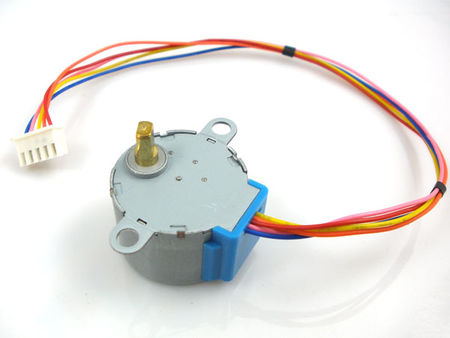
I “salvaged” it from my son’s room and hooked it up. Here is a web page about it with all the specs. There is also a code sample on that page and it shows that controlling a stepper motor is not difficult at all. But the code uses a lot of switch statements and that gets unwieldy very quickly.
In such cases a library will help out. A library is just that: a place to look up code to use in your own code. This is usually done by referencing to it and as long as your library is included in your IDE you are good to go. To understand more about how libraries work and how to write one yourself I found this tutorial on the web. I followed it and indeed ended up with my own library to control the stepper motor.
But don’t worry, you don’t have to write every library you need. For almost any input or output device there is a library available and the most basic ones are included in the Arduino IDE. If not, a quick search on the web will yield one you can use, but then you will have to install it yourself (not difficult if you use the Arduino IDE).
With the library installed code looks like this….

The first of the three block of the code has two lines:
#include StepperMotor.h
 StepperMotor myMotor(8,9,10,11);
The first line doesn’t need explaning, except that libraries usually end in “.h”. In this case my library is simply called StepperMotor.h.
Now I might have more than one stepper motor hooked up to my Arduino, so I have to make it clear which motor I’m using. Here I use only one motor, so my code reads:
StepperMotor myMotor(8,9,10,11);
In plain English this says that in my code any mention of “myMotor” will reference to the StepperMotor library and it will use the motor connected to pin 8 through 11. If I would have used two motors my code it would have been…
StepperMotor myMotorOne(8,9,10,11);
 StepperMotor myMotorTwo(4,5,6,7);
In the setup I add this:
myMotor.setStepDuration(1);
In the library there is a function to set the duration of one step. By simply referencing to is and adding a value between the brackets it has been set. I don’t have to worry about the code that sets the step duration, because the library takes care of it all. Ease and simplicity at its finest.
Now I can control my stepper motor in the loop block:
 myMotor.step(4800);
 delay(2000);
 myMotor.step(-4800);
 delay(2000);
myMotor.step() looks up the library function to move the motor and then moves it 4800 steps. After a delay of 2 seconds it moves the motor back 4800 steps. Another 2 second delay and the process repeats itself.
Fine and dandy, but this code might only be useful for moving an advertisement sign, not much else. In my case I needed to control a variable capacitor, so mounted everything on a piece of plexi glass, added a few push buttons and the result looks like this…..
In the end there was a lot more that needed to be added to get it working perfectly. Preventing button bounce was one thing, limit switches were another. Physical limit switches were not an option, so I devised a software solution. To go from maximum capacity (500pF) to minimum capacity (9pF) the stepper motor needs 11000 steps. In my code I therefore added a counter and as long as this counter stays between 100 and 10900 the stepper will work. Now I don’t have to worry about stressing the stepper motor when it reaches either end of the capacitor. By putting the counter’s value in the Arduino’s Eprom I can switch the loop off without losing its settings.
With this part of the project done it’s time to put everything together and box it up.
160m FT8 – The End Of An Era?

courtesy: https://pskreporter.info/pskmap.html
One such thread on the Topband reflector, is now finally starting to gasp its final breath but not before running through several dozens of well-thought replies and opinions. I can easily imagine a similar thread, had the Internet been around, when SSB quickly began taking over the phone bands!
The thread began when veteran 160m DXer Steve, (VK6VZ) posted an observation that also hit home with me … the seemingly overnight disappearance of a huge percentage of CW / SSB activity on the HF bands.
Steve’s comments are directed towards 160m, where weak signal work has always been an enjoyable but challenging activity but I have noticed the same effect on my other favorite band, 50MHz. With the sudden popularity of the new FT8 weak-signal fast-mode, the bands have changed.
As I and others have often stated about Topband DXing, 6m weak-signal DX as well as EME, “if it were easy, it wouldn’t be fun” … perhaps that is what has now happened. Both Steve and myself see many of the things we have cherished and enjoyed about ham radio for so many years now harder to find and wonder … is it the end of an era or not?
G’day
As a committed (yeah, that’s probably the right word – complete with white
jacket that laces up at the back) topbander since 1970, I’ve never been so
intrigued and disturbed by anything on the band as the emergence of the
Franke-Taylor FT-8 digital mode.
For me, radio has always been all about what I audibly hear. I love all the
sounds that radio signals make – and even miss the comforting sound of Loran that I grew up with around 1930kHz as a teenager in south-east England. Yeah, I am one sick puppy.
With the emergence of high resolution bandscopes through SDR technology over the last decade, I embraced that as it meant that I could find what DX stations I wanted to hear and contact quicker and more easily (and, in particular, before those stations who didn’t have the same technology).
It was really exciting and enhanced the sensual experience of radio by being
able to see what I could hear (and no dinosaur me, I was an SDR fan boy!).
During this period, there has also been an extraordinary development in digital
radio modes, in particular by Joe Taylor K1JT.
As a topbander I could see that these modes in which you ‘saw’ signals through the medium of computer screen or window as being a remarkable technical achievement, but had relatively little to do what I and the vast majority of active radio amateurs practiced as radio on 160m, as it had nothing to do with the audible.
The good thing was that I could see that good old CW and Silly Slop Bucket (you can see where my prejudices lie) that I like to use were still the modes of choice for weak signal DX topband radio contact as these fancy digital modes were either very slow or, if they weren’t, were not good at dealing with signals that faded up and down or were covered in varying amounts of noise.
While some amateurs seemed to have lost the pleasure of actually hearing
signals in favour of viewing them on their computer screens, I felt secure that
these digital modes were just a minor annoyance and any serious DXer or
DXpedition was never going to seriously going to use them, particularly on my
first and all-time love topband, for other than experimentation.
Then, out of the blue, along comes FT-8. Joe and Steve Franke K9AN have quietly created the holy grail of digital operation with a mode that can have QSOs almost as fast as CW and SSB and over the last eight weeks 160m DXing has changed, perhaps for ever.
Where once there were a few weak CW and SSB signals (I am in VK6, which is a looong way from anywhere with a population so we only ever hear a few), I can see that the busiest part of the band is 1840 kHz – FT-8 central. On some nights I can see FT-8 signals on the band but no CW or SSB.
There are countries I’ve dreamed for 20 years of hearing on 160m SSB/CW (for example, KG4) regularly appearing on DX clusters and I can see the heap of FT-8 activity on my band scope.
Frustration sets in and I even downloaded the FT-8 software but, when it comes down to it, I just can’t use it. My heart isn’t in it.
My computer will be talking to someone else’s computer and there will be no
sense of either a particular person’s way of sending CW or the tone of their
voice (even the way some my SSB mates overdrive their transceivers is actually creating nostalgia in me). The human in radio has somehow been lost.
I think back to my best-ever 160m SSB contact with Pedro NP4A and I can still
hear the sound of his voice, his accent, when he came up out of the noise and
to my amazement answered me on my second call, with real excitement in his
voice. Pure radio magic!
So I am sitting here, feeling depressed and wondering if overnight I have
become a dinosaur and this is the beginning of the end of topband radio as I’ve
always enjoyed it.
Now, over to you other topbanders, especially those who have dabbled with FT-8 and live in more populous areas. Has the world really turned upside down and what do you think the future holds?
Vy 73
Steve, VK6VZ/G3ZZD
Here are just a few of some of the comments elicited by Steve’s post:
… we are not forced to use the new modes. On the other hand, these new modes enable a whole new layer of operators. A new target rich environment for more opportunities to work new DX. The RF still has to go from A to B to be decoded
I think the game changing aspect of FT8 is that many folks who would normally be available to work on CW or SSB will now be on FT8. The amount of activity on the FT8 frequency of any band is phenomenal.
… he was sending (me) a text message that he was sending me RRR and I needed to be sending him 73! Who needs a radio?
I turned off the radio and uninstalled WSJT-X.
Pure and simple —- No skill, no thrill.
I hear a lot of moaning that there is not any cw ……. well quit moaning and call CQ for a while … do it often, not just listen .
Stu W1BB had the attitude of do whatever you have to to make the DX contacts. There is no doubt in my mind that he would be using JT9, FT8, spark or whatever it took to make new country contacts.
FT8 is already falling victim of its own success. In my case, the number of incomplete QSOs is increasing, due to QRM caused by ‘over population’ in the FT8 segment.
There was a time when SSB was considered evil.
If using a digital mode keeps someone involved in ham radio or generates new interest, then I’m all for it.
On the other hand, these new modes enable a whole new layer of operators. A new target rich environment for more opportunities to work new DX. The RF still has to go from A to B to be decoded.
A similar situation regarding digital modes took place on 50 MHz this summer. In the case of 6 meters, JT65 and FT8 are now the predominant modes for DX work on 6 meters. During terrestrial sporadic-E openings, there are very few DX stations now operating CW or SSB on 6. Meteor scatter is the realm of MSK144. If you want to work DX on 6 meters now – digital is where it is at.
Like FT8 or dislike it, it’s really not the end of Ham Radio.
Technology is constantly changing. Get on the air. Do your thing. Have fun. When it ceases to be fun for me, then I know I’ll move onto something else.
I’ve been licensed for over 60 years, and have been a thankful participant in ham radio’s golden years, but if continuing on means having to make qso’s that I don’t hear and that I can’t understand without a computer, then it’s of no further interest.
I almost bought the new transceiver I’ve been wanting this year …. until I saw the reflector post about the gentleman who “worked 20 new ones this season, and I couldn’t hear any of them!” The new purchase is now on hold, until I see how this plays out. If there is a rapid change to digital only DXing on 160, I’m going to be happy I saved my money for one of my more interesting hobbies.
The problem is not the type of mode but the Internet. We’re spending too much time ragchewing on these groups instead of tickling the ether.
However, the trouble with the computer-based Digital modes is that there is no SKILL involved in having a contact – it’s your Computer having a contact!
You still need to set up a radio, antenna, and, of course, the computer and software to do the digital modes. Making QSOs after all of that is not a given. Different skills than CW or SSB I’ll grant you but skills none the less.
Put me in the group who of those who arrived kicking, screaming and being drug from Tubes to Solid state. From AM to SSB. From Analog to Digital. It is called advancements in technology. I still dislike cellphones. But I use them. And also all other forms of Ham Radio.
You guys should have been around for the AM versus SSB discussions/wars without the use of the instant communication internet.
VERY SORRY, BUT if 50 mc and also 1.8 mc is going to be the same this and coming 2018 season, I stop my ham-radio and will do something else. I give it to end of 2018 to see if any changes will come.
Well said. . .I totally agree.
I’m sure there will be people who say FT8 is just “progress.” But some psychologists divide people according to whether their preferred mode of experience is auditory, visual or kinesthetic (touch). I think most of us who are addicted to radio are primarily auditory – on one level, that’s why we’re in this hobby. So, no surprise that we find radio without the auditory component to be unfulfilling.
… let’s all maintain our ham licenses and continue using our favorites modes.
… don’t give up. There is still plenty of magic in ham radio.
I’m not knocking the guys using the digital modes. It’s obviously a new and interesting technology and they are having fun, which is the reason we do this, right? I just have ZERO interest in it all and still get my fun actually hearing and working another station.
When it comes to actually making a QSOs, I really don’t know what you get out of the process where two computers communicate with each other using signals that are not audible.
The new digital mode is an evolution of doing nothing. Skype would be more fun … digital mode is boring and soon the FT8 user will feel that way too.
Call CQ 5 times and then turn your computer on, every day, if all of us do it once a day, the band will be fun again.
JT modes were originally designed for VHF. No reason to use them on HF and especially on Top Band.
I guess I don’t understand what makes the new Digital modes any different from old RTTY. There will always be a place for CW and voice modes in ham radio for those that want to practice those … and remember one of the major facets of ham radio is to “advance the state of the radio art” which surely describes the new digital modes.
People should be excited that there are now so many signals on 160!
It is allowing people who have smaller stations the opportunity to get on and use their radios and a computer to make contacts they never would have been able to make. This is great for ham radio!
Steve’s final comments summed-up his thoughts:
G’day
Thanks very much to all those who contributed to the thread following my ‘FT8 – the end of 160m old school DXing?’ post. Here is a summary of what appeared in my ‘In Box’.
First, special thanks to CJ Johnson WT2P for bravely giving the ‘new school’ perspective and actually taking radio, in FT-8 form, into his workplace . As CJ says, FT-8 is just another natural progression of the hobby, which actually appeals to the ‘20-somethings’ we need to join us (and who just happened to be brought up with lots of screens rather than cardboard loudspeakers and bakelite headphones). Vive la difference!
In regard to the emails received via the reflector or privately, there were three things that came through very loud and clear (actually deafening).
1. There are lots of long-time, old-school topbanders (and 6m users) like me who enjoy chasing weak signal DX on CW and SSB and are now worried about the future of this activity because of the current high usage rates of FT-8 on those bands. Always better when you aren’t alone!
—————————————
2. We can band together and do something about this – the solution for us old school ops who want to keep CW and SSB vital on the two magic bands is to go back to first principles – lots of CQing, tuning the band regularly and answering CQs – rather than just watching our bandscopes and DX clusters. We all know that only activity breeds more activity. Duuh! (I feel really stupid now).
As JC N4IS said:
”With the computer our habits are different. Nowadays we turn [to] the PC first and if we see a spot or a RBN entry we try to call…. We should [go] back to call[ing] CQ for the fun to work someone. Call CQ five times and then turn your computer on, every day. If all of us do it once a day, the band will be fun again.”
We’ve all got CW memory and/or voice keyers – if we don’t want to actually CQ manually, we can use them for lots of daily CQing and make sure we answer anyone who calls us.
We also need to answer those who we hear calling CQ to keep the band alive, even if we worked them the day before – as we did in the older, less hurried, more polite days of yore.
——————————————–
3. The ARRL could be encouraged to change the DXCC program and add a new mode-specific category for the evolving ‘new wave’ (i.e. WSJT) family of digital modes, where contacts can be made with stations that are basically inaudible (i.e. as Hans SM6CVX suggested, where the signal levels are –1dB or more below the noise).
To keep the peace with existing DXCC holders, one potential solution is those traditional modes which generally need audibility – typically CW, SSB, RTTY and PSK-31 – would count for the long-standing Mixed mode, but the inaudible ‘new wave’ digi modes would not.
However, the growing and evolving family of inaudible ‘new wave’ digital modes could have a whole, bright, shiny new DXCC category to themselves, for which all the current WSJT modes and their evolving, successor modes would count.
This ‘new wave’ digital award could have a new cool, 21st century-looking certificate (are holograms 21st century?) , would give new wave digital operators the chance to be among the first to get this award and would also give the ARRL DXCC program the chance to potentially get some extra revenue in issuing these awards. Of course, all the contacts would be submitted electronically. 😉
Another different but related idea came from Mark K3MSB – why not ask the ARRL to consider awarding band-specific DXCC awards with mode endorsements (i.e. 160M DXCC-CW, 160M DXCC-FT8, 40M-Digital, 17M-SSB etc).
If we want to get this kind of change to the ARRL’s DXCC program, then as Mark suggests we need to make our voices heard. This could be simply done by creating an electronic petition to the ARRL signed by as many current members of the DXCC program as possible, clearly spelling out what sort of change the petitioners think is needed. There is a great website which can be used for this purpose – see https://www.change.org/start-a-petition – and it should be easy to publicise a petition of this kind, using reflectors.
For many years I was involved in administrating amateur soccer and have experience of using electronic petitions as a means of showing an administrative body the level of support for specific changes to the way the game is run. In my experience, electronic petitions are a viable way to get rules changed these days. Some people hate them, but BIG petitions actually do get results.
Hope the above summary of ideas was of interest. Please excuse me now and I’ll get along to the low end of 160m, start doing something practical like CQing and stop worrying about the demise of old school radio (which I’ve probably greatly exaggerated).
Vy 73
Steve, VK6VZ/G3ZZD
All-in-all, some food for thought! Personally I exploit the weak-signal properties of the WSJT JT9 mode on 630m, but only when conditions are too poor for CW. I dearly miss the drop-off of CW DX activity on Topband and on the magicband. For now anyway, I will continue to avoid the use of FT8 on the HF and 6m bands, keep flogging CW, and hope that things are not as dire as some have suggested. Times are indeed interesting and changing … and as always, eventually time will tell.
Amateur Radio Weekly – Issue 179
HAARP transmits Bitcoin, SSTV
The assistant professor at the UAF’s Geophysical Institute transmitted two UAF logos, a photo of his cat, and a QR code granting the recipient 0.001 Bitcoin.
ARRL
RadioShack offers Maker Space
This open area of the store will be home to the many classes the store now offers, such as soldering classes, drone classes and monthly training sessions on how to set up and use a cell phone.
Citizen Tribune
APRStweet: Tweeting APRS packet information
APRStweet is a light weight script that posts your location and a link to APRS.fi so that people can see your track and location on the map.
KC8QCH
APRS telemetry dashboard
Data is beautiful. With the FaradayRF Telemetry service you can track your High Altitude Balloon Telemetry in real-time.
FaradayRF
The speed of light is not fast enough
As illustrated by the Voyager spacecraft, the success of any radio system lies with the antennas.
Microwaves&RF
Homemade digimode interface
I decided to make another modem, a very simple one that uses the VOX in the FT817 for TX switching.
PE4BAS
Man fined $15,000 for running illegal FM station
Dudley was confronted twice last year for sending music through the airwaves on 103.9 FM.
WAFF
Setting the record straight on FM radio in iPhones
Apple purposefully does not connect the antenna.
National Association of Broadcasters
Squeeze Keying – Iambic mode operation
Electronic keyers provide Iambic modes to allow for fewer strokes while keying, thus improving keying efficiency.
Ham Radio QRP
WSJT-X and linear satellites
Here we examine the effect of TLE age on the accuracy of the Doppler computation.
destevez.net
UT Amateur Radio Club looks to future
The UT Amateur Radio Club started in 1947 in response to a rise in public interest in satellite and radio following the end of World War II.
The Daily Beacon
Video
How to bend PVC the right way
I had to bend some pvc for an upcoming project and I had some trouble just using a heat gun, so I had to come up with another solution.
YouTube
MSK144 QSO with KJ6KO on 6 Meters
This was a completely random QSO with KJ6KO on the night of the 2017 Orionid Meteor Shower.
N1SC













