Archive for the ‘Uncategorized’ Category
 Scratching the SDR itch
 May 18th, 2010 |
  Author:
  One of the blogs I regularly read is that of Larry W2LJ. Larry has been watching some of the streamed video presentations about software defined radio (SDR) coming out of Dayton and believes that SDR is now mainstream and the shape of things to come.
I would be dishonest if I said that I have never looked at some of the SDR products and wished that I had one to try. SDR is becoming an itch that many of us would like to scratch. But I suspect that, in my case at least, it is an itch that once scratched would go away. Although I’m sure that software defined radio technology will find increasing use in tomorrow’s radios – as it already does in the Elecraft K3 – I hope that “black boxes” controlled via a computer console never completely usurp standalone hardware radios.
Dedicated hardware “just works”. General purpose computers are just too much hassle. There are the security issues, the updates, the driver incompatibilities, the crashes, the unfathomable problems. You switch on a radio and it is ready to use. You switch on an SDR and you must then start the computer and wait for it to boot, then start the SDR application and wait for it to load. Is this progress?
Dedicated hardware works until it dies. Computer based devices only work until a new version of Windows comes out that doesn’t support it. How many perfectly good printers and scanners have you had to throw away because they wouldn’t work with your new computer?
Real radios have an aesthetic and provide a sensory experience that simply cannot be matched by a computer interface. Isn’t turning a knob preferable to moving a slider with a mouse? Isn’t making a real audio cable easier than trying to configure a virtual one? Many of us prefer a real S-meter to a graphical simulation. Most of us spend far too much time staring at computer screens already.
With real radios you can look at the schematic and get in there with your soldering iron and make modifications or fix faults. With SDR you are dependent on somebody else unless you are a skilled programmer and have access to the source code and development tools.
I can’t see myself swapping any of my radios for a black box and a computer application interface any time soon. I’ll still work the same bands and the same modes, so what benefits would an SDR give me? A hardware radio is instant-on, intuitive, virus-proof and crash-proof, can’t be broken by some application I install on my PC, doesn’t lock me into using a particular brand of operating system and won’t be made obsolete by the next version.

My 10,000 Hour RadioSport Challenge | 9,804 – 1 = 9,803 Hours To Go
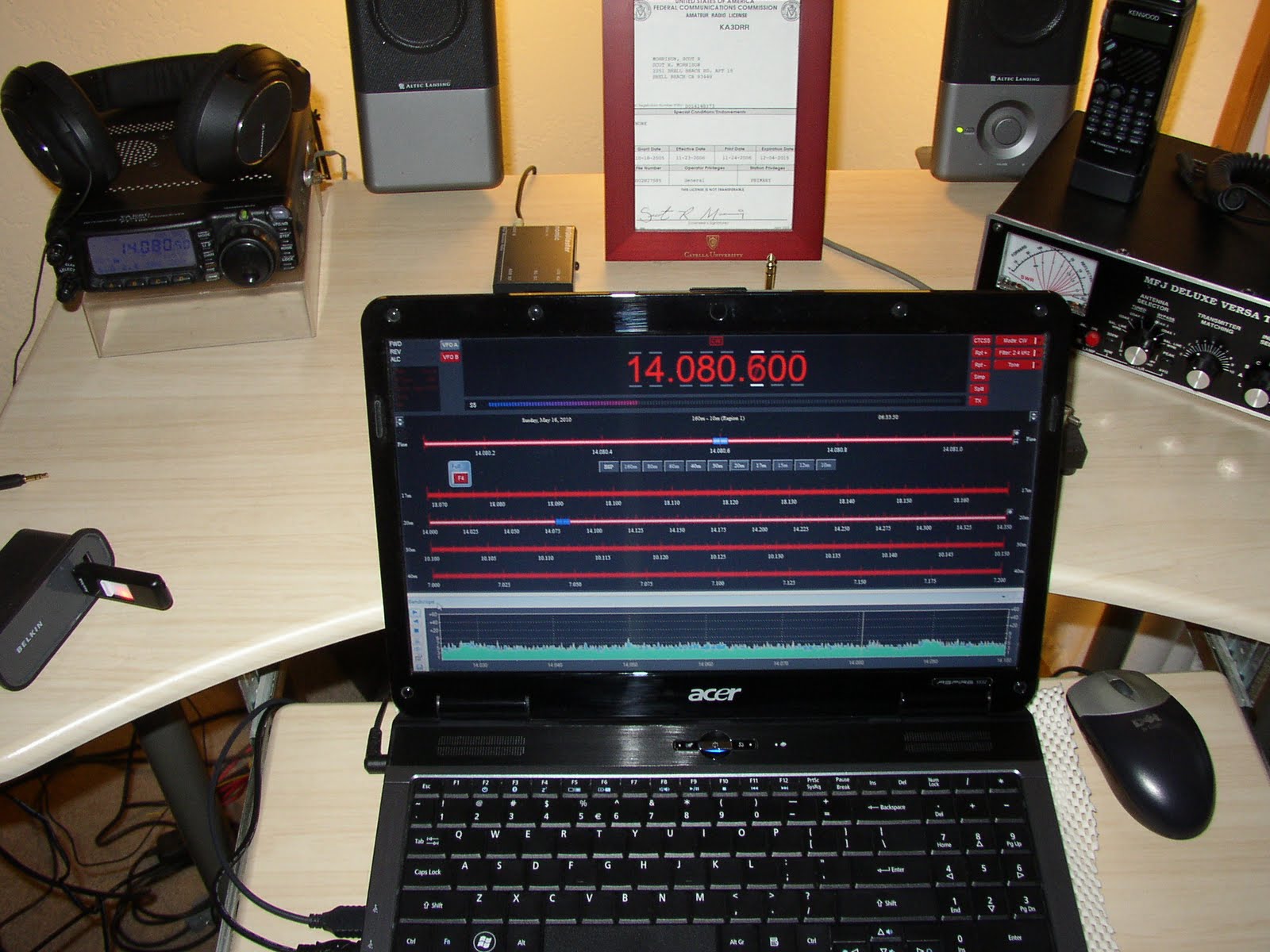 The lull between solar cycle sets allowed me an opportunity to configure Ham Radio Deluxe with bandscope capability. I’m impressed with its user interface and continuous scanning. The scope settings range between 6 dB through plus 60 dB in addition I’m monitoring 75 KHz of bandwidth.
QSO Party.
Recently, I operated in the 7th Call Area QSO Party, for an hour prior to a social commitment. The recent downward sunspot trend suppressed most signals, normally, signals from 7-land range between s5 through plus 10dB on the meter. This season seems exceptionally different unlike previous years.
The Beach Boys Amateur Radio Club is wondering where all the sunspots have gone?
Software Control.
I have reached a milestone inside the shack that is additional software controlling of the Yaesu FT100 because of Ham Radio Deluxe. However I have not completed the project that is interfacing my radio because of port issues. My goal is to resolve the conflict at the end of the month although not in time for CQ WPX CW.
Currently, both N1MM Contest Logger and Ham Radio Deluxe compete on port four, which is assigned to the CAT62 cable off of the FT100.
The DM780 program runs in CW mode and I’m fascinated by the spectral intensity of signals. I feel like ham radio moved to another level because, not only am I hearing the signal, it is also visualized on the liquid crystal display. Likewise, one can watch the Morse code interpreter and I’m curious how it will function at the end of the month for example; can I cut and paste a callsign from the interpreter into N1MM’s dialogue box when searching and pouncing?
CQ WPX CW.
I’m looking forward to the late Spring mega RadioSport event given WPX growth over the past few years. Likewise, I will have an opportunity at using the bandscope and waterfall although WPX is a rate competition. Perhaps, the big question is, will a set of sunspots flow across the solar disc later this month?
73 from the shack relaxation zone.

More ash disruption – hams stranded
 British and European hams who are in the US to visit the Dayton Hamfest may find it a bit tricky to get back next week. Changing weather conditions are likely to cause ash clouds from the Eyjafjallajokull volcano to return to the UK. The Department of Transport is predicting that UK airspace – including the busiest airports in the south east of the country – may be closed from Sunday until Tuesday. Travellers are advised to check with their airlines before setting off for the airport.

RadioSport History | CQ World Wide DX CW 1980

RadioSport is fun although the level of fun one seeks is another matter. Certainly, the sport where wireless technology meets human skill and intellect, is my favorite niche within ham radio. My passion remained even during those days in uniform or while attending graduate school. Whatever the measure of one’s station, what really counts at the end of the day, is how one shares their enthusiasm for the game.
Perhaps, after all the trophies and certificates are won, what really matters is the moment when a rookie operator gets it.
The measure of our success is best exemplified by Doug, N6DFY and his smile.
Nuts and Bolts.
I hope a frank and earnest discussion begins regarding the trajectory of RadioSport and a bold vision is developed. Afterall, this is Dayton weekend, when the movers and shakers of the game gather for pizza inside the Contesting Suite. I believe such a vision is beginning to develop out of the genesis of the World Wide Radio Operators Foundation (WWROF).
I’m not going to besiege with a list of complaints neither do I want to point a finger at anyone organization, institution, or individual. What I want is leadership, bold vision, courage, and something to believe in again.
The task before WWROF is not an easy one, in fact, why create a non-profit dedicated to improving the skills of amateur radio operators, if there was not a need?
Brockman and Cox (1981) pointed out padding in the logs, excessive dupes, sloppy copy, and operating outside one’s privileges to mention a few as problematic. However there something called honor, courage, and duty.
Please, if one is reading my blog in Dayton, take a moment and reflect about qualities rarely discussed anymore. Leadership. Honor. Courage.
I hope that in between all that is going on in Dayton that our movers and shakers take time to reflect as well. I believe WWROF is a good step forward in addition they are willing to confront the challenges ahead with leadership, vision, and courage.
73 from the shack relaxation zone.
Reference: Cox, B. K3EST, Brockman, L. N6AR (1981, October). CQ Magazine: 1980 CQ World Wide DX Contest: C.W. Results. pp. 13 – 16, 18 – 20, 22 – 27.

Fun on 10 FM
 As some of you know, I’m a bit of a sucker for hand-held radios. Whilst browsing eBay I’d often come across the Intek H-520 Plus CB hand-held and thought what a nice looking rig it was and wouldn’t it be nice if it could be converted to amateur 10m usage. A couple of days ago I stumbled across a site that gave the details of how to convert it for amateur 10m use so I decided to order one. It arrived this morning.
Never has a radio been taken apart so soon after its arrival. (Real hams don’t care about warranties!) Unfortunately, no matter how hard I tried, I couldn’t find again the site that had the modification information, but I vaguely remembered the details. Beneath the battery compartment there is a loop of wire. Snip it and push the ends apart. I’m not sure what that does. Now put the batteries back in and turn on the radio whilst depressing the Menu button. You can then select the option “Po” by pressing the down arrow button. Press Menu again, then press and hold the up arrow button until the frequencies displayed are in the 29MHz region. You now have a 10m FM / AM hand held.
Whilst I was doing this I was WSPRing on 10m and I saw some very strong traces from stations in Germany indicating that there was short-skip Sporadic-E on 10m. Were conditions such that I would actually be able to make some contacts with the new radio today?
The antenna supplied with the Intek H-520 Plus is about 15cm long so I suspect it will be less than useless for making any DX contacts. Clearly what I need in order to use this as a portable radio is some kind of long BNC 10m antenna, but at the moment I don’t have one. The H-520 comes with a “car kit” which screws to the bottom of the radio and allows you to power it from an external supply and connect an antenna with a PL-259 plug. So I hooked it up to the shack supply and the attic dipole.
I tuned around and there seemed to be things going on, so I found a clear frequency, 29.520MHz, and called CQ. After a few seconds jack PE1JRP called CQ on the same frequency. I called him and we made contact. He found my signal was up and down, as I did his, but he gave me a 53 report. He said that Leo PA3ELQ was waiting on the frequency and he then called, for my second contact. My report in this case was 57. They were both pretty impressed with my signal running – as I thought – 4W output.
I decided to check the H-520 Plus on my power meter and found that, far from putting out the advertised 4 watts, it was only radiating a whisker over 2. I took it down to the CB channels and even there it was giving barely 3W output. I also recalled that the web page that I could no longer find mentioned the need to turn up the deviation for 10 FM use.
 I managed to locate and download a service manual for the H-520 Pro and this gave a procedure for adjusting the power. I had to turn the power control pot all the way up and I still only got about 3.6W on battery power (and just about 4W when running from the car adapter.) That’s good enough, though. From the block diagram I also was able to identify the FM modulation pot and turned that up a bit, though neither of the Dutch stations had complained about my audio. In the picture above, the red circle shows the wire loop that you cut, the green circle shows the power out pot and the blue circle the modulation control.
With the radio back together I hooked it up to the dipole again and worked Oliver DH5PK, receiving a 53 report. I am quite happy with my three contacts considering that I only opened the box after lunch and the radio spent much of the time disassembled. I saw from VHFDX.info that there was a great opening on 6 metres at the same time, but making contacts with less than 4W of FM is more challenging.
What I’m hoping, of course, is that I can make some contacts like this using the H-520 Plus as a hand held radio with a whip antenna!

Why the shack-in-a-box?
There is speculation at the moment about whether Icom will release the new IC-9100 top band to 23cm transceiver at Dayton, and what the price will be.
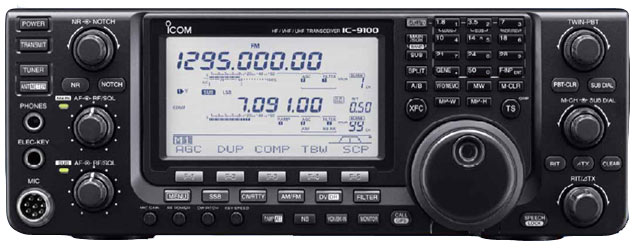 I wish someone could tell me why there is this trend towards do-everything shack-in-a-box radios instead of separate VHF/UHF rigs like the now discontinued IC-910H which I just bought? One of the reasons I switched from using a transverter to having a separate rig for VHF is that I can’t use HF and VHF at the same time. An all-in-one radio would have just the same limitation.
Just because technology makes it possible to cram everything into one box doesn’t mean that there is no longer a reason to have separate radios. If you want a new multimode radio for 2m or 70cm you have to buy an FT-817, FT-857, FT-897 or TS-2000 – which are all compromise rigs with fairly poor performance – or wait for the IC-9100. No wonder good single VHF band multimode rigs like the IC-275H are now worth their weight in gold bullion.

No service
I phoned up Radioworld this afternoon to ask why I hadn’t received the 2m 5/8 vertical I ordered a week ago. After looking up the order the girl told me that the stock hadn’t come in yet. “We sent you an email yesterday” she said. That was presumably in response to my shirty enquiry yesterday. I checked through my Spam folder and I didn’t receive any email from Radioworld. I mentioned twice that I had received an email saying the item was despatched on the day I ordered it, but there wasn’t the slightest hint of an apology, just a repetition of the fact that the stock hadn’t come in yet. Radioworld goes on my list of dealers to avoid.
 LAM Communications by contrast has been a pleasure to deal with. After failing to win any VHF multimodes on eBay I decided that rather than gamble my money on the stock markets or leave it in the back at an almost zero rate of interest I might as well buy any radio gear I want, so I treated myself to an Icom IC-901H. LAM had a used one for sale so I phoned up to ask about it. I was told it was in really nice condition but when I asked its age the salesman (Dave) didn’t know, so he promised to phone Icom UK to find out when the guarantee ran out and call me back.
This he did after a few hours. He was a bit apologetic, saying that it was made in 2003 so there was “a bit of age behind it” and in view of that he would knock an extra £50 off the price and throw in carriage for free. I decided to go for it and he then warned me that the FedEx courier had already called so it wouldn’t go out until the following day. Fine, so it would arrive today. It did, well-packed (the Icom box was bubble wrapped and inside a larger box) and was exactly as described. Better, in fact, I can’t see a single mark on it. I am well pleased, and would be more than happy to buy from LAM Communications again.
The worst offenders in my experience for service have been Waters and Stanton. I forget the details of all the times I had to hassle them to send things I ordered, such as when I bought a rig advertised as with a free desk mic in RadCom and they didn’t send the free desk mic. A classic example of dealing with W&S was when I ordered the MFJ magnetic loop a few years ago. I didn’t receive any email or acknowledgement and no money was taken from my account so I decided that the online order hadn’t gone through. I started to have second thoughts about needing the antenna so I decided to forget about it, which I did until one day, more than three months later, without any prior warning, a courier knocked at the door with a very large box…














