Archive for the ‘Uncategorized’ Category
 KComm updated
 November 3rd, 2010 |
  Author:
 Today I released a new version of my logging and data communications program for Elecraft transceivers, KComm, on my website. The program is developed in Lazarus / Free Pascal and is released under the GPL.
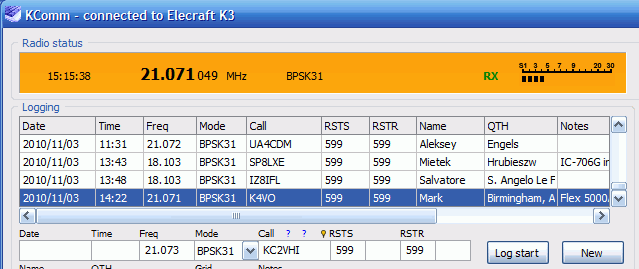
Apart from numerous bug fixes and small improvements I have made in the months since the last release, the new version 1.9 allows the receive and transmit sound devices to be selected separately. This is something that is becoming increasingly necessary, though users will have to play “guess the device number” as I don’t know how to find out the names of the sound devices in Free Pascal in order to display them in a list box. The program also supports the K3 “TB” command which allows it to get the text decoded by the K3 DSP in CW, PSK or RTTY modes and display it on the screen just the same as if you were using a sound card program.
Although I have given up developing ham radio programs in general, I am continuing to update and maintain KComm as it is the only one of my programs that I continue to use regularly. However this will be the last version for which I will be able to provide a compiled Linux binary. The screen of the old Linux laptop that I used to compile it has almost failed so I will not in future have a computer on which I can do this.

Being prepared
We Brits and our friends across the Atlantic may share a common language but sometimes it seems as if we live on different planets. One of the most obvious examples of this is that Americans sometimes seem to act as if Armageddon could happen at any minute, something that doesn’t seem to cause much lost sleep over here.
Perhaps I’m jumping to the wrong conclusion based on the higher emphasis given in the USA to the use of ham radio for emergency communications. Read some issues of QST these days and you might think that “emcomms” is what amateur radio is really all about. Many American hams maintain “go kits” – portable radio stations that they keep charged up and ready to go the moment they are needed. Over here we have something called Raynet, but I get the distinct impression that it is a bunch of people who would like to use ham radio to help in an emergency rather than a volunteer emergency service on the lines of, say, Mountain Rescue that has a clearly defined purpose and meets a genuine need.
In his latest blog “Smoke Curls” Jeff, KE9V recently posed the question of whether a portable QRP HF station was really useful in the context of emergency preparedness. Most of the replies seem to illustrate the extent to which the thought of a major disaster is never far away from the American consciousness. My comment that the only benefit I could see in having battery powered HF ready to use was so I could take advantage of the noise-free bands while the power is out – which in fact I did during the outage that occurred during the local floods a year ago – probably seemed rather flippant, though that wasn’t the intention.
My opinion is that emergency communications is a job for the experts and the last thing they need is a bunch of amateurs trying to help but more than likely getting in the way. The Cockermouth floods were the nearest I have ever come to being directly affected by a disaster and it never even entered my head that as a radio amateur I might be able to help. As for needing HF or any other kind of ham radio for personal emergency communications I still feel the likelihood of something happening in which my radio gear might end up being my only means of getting in contact with anyone I needed to is so remote that I’d cross that bridge if I ever came to it.
I would never assemble a “go kit”. And if I did, I know for sure that I would forget to charge the batteries or raid it for parts I needed for something else so it would never work in the unlikely event it was needed.
Is there a cultural difference between us and Americans in this regard, or is it just me?

Not the CQWW SSB weekend…or shouting Elephant at contest stations!
Over the years, I’ve developed an aversion to having anything to do with major HF SSB contests unless I’ve got at least a beam antenna. Of course, you don’t *need* a beam antenna and you *can* make contacts and good ones at that, with a dipole or vertical and perhaps 100w or less. The trouble is that each contact seems to go something like this
DX Station: QRZ Contest
Me (enthusiastically): Golf Four Victor Xray Echo
DX Station: QRZ the X-RAY
Me: Golf Four Victor Xray Echo
DX Station: Gee Four Vee Ex I you’re five nine twenty eight.
Me (starting to lose enthusiasm for this): No, it’s Golf Four Victor Xray Echo, Golf Four Victor Xray Echo, OK?
DX Station: QSL, Golf Four Victor Xray India you’re five nine twenty eight. What’s my report?
Me (thinking why did I bother….): No, the last letter is Echo, Echo Echo. Like Espana, Ecuador, Elephant (actually, I’ve never used Elephant as a phonetic, but I might now I’ve thought of it)… QSL
DX Station: QSL – Golf Four Victor Xray Echo – you’re five nine twenty eight OK?
Me: Roger roger (Thinking thank heavens for that…) you’re five nine one four. OK?
Disclaimer: I’m not singling out zone 28 stations! I was just listening to one last night. They’re super operators with great ears…
So, you can see that each contact, even with a semi decent setup is a bit of a trial of patience and I have learned it’s not good for my blood pressure. I’m quite happy to accept that I could put up a bigger antenna (but then it works ok most of the time for CW and data contacts) and that perhaps my voice isn’t that clear (well, sorry, I’m stuck with that).
It’s not that I don’t like contests – I love hearing the activity generated, and I love hearing DX coming through from all parts of the globe. I’m inclined to think, though that there is now so much interference and general aggro that anyone with a normal suburban station is unlikely to have a great time in the major SSB events (CW and data are usually better options).
Anyway, that’s a long way of telling you that I didn’t have any contest QSOs over the weekend. Still, I did have a listen on 7MHz last night about 2100z and very interesting it was too. In between the very loud Europeans there was some great DX from the Far and Middle East. JA3YGP (from memory) and 9K2HN were doing great business and good signals on the vertical and there was an Indonesian station coming through too..
Having switched the HF rig on, I listened around a little more. The 5MHz channels were quiet, though I did hear some Spanish fishermen on 5398khz! Listened on 27.555MHz too – someone told me recently that this is a CB frequency that shows activity even when the 28MHz amateur band is quiet. Not much doing there, though I heard some meteor bursts!
It was nice to listen on HF again though. I realise that I have missed playing HF recently, although not shouting Elephant at contest stations!

Telling Terry What’s New
About a week or so ago, I had the opportunity to visit the Cheltenham Amateur Radio Association and give the Terry Russell, G3JFH Memorial Lecture.
This was a particular pleasure for two reasons – I grew up in Cheltenham and CARA was the first amateur radio club that I ever attended. I received a lot of support there as I learned the ropes and made a lot of good friends. It was simply wonderful to see many of them last week – they must be doing something right as they didn’t look any different!
Secondly, I knew Terry Russell, G3JFH pretty well. He was an influential member of the club and indeed he was my first contact on the air! He’d also been a friend of my Dad and they’d done lots of cycling together.
When I was trying to decide what to talk about, I thought it might be nice to ‘Tell Terry’ about the trends and developments in amateur radio since he’d passed away a few years ago. So that was what I did. I thoroughly enjoyed the evening and I hope that people found at least something of interest.
Here are the Powerpoint slides in case anyone wants to take a look.

SDR needs more UX
Spotted a very interesting post from Tobias, DH1TW on his blog ‘Contesting & SDR‘ titled Does SDR really suck?. He wonders out loud if the performance, flexibility and cost of SDR is so excellent, why hasn’t it taken off? What possible barriers might there still be to it assuming a place matching its promise and achievement?
He identifies the missing link as adequate user interface. He mounts a case arguing for a similar level of investigation and development on the user experience front to match the investment and experimentation on RF and signal processing.
And he acknowledges that there may be more than one user interface solution. Contesting and HFPack have different UX demands as other experts understand. Look at Elecraft‘s K3 and KX1, or the Steve Weber, KD1JV designs, especially the ATS series. And now Tobias argues, SDR gives us the opportunity to re-think user interface design from the ground up.
Who says that the radio controls must be on the front of a black box and located perpendicular to your shacks desk? SDR allows us for the first time to completely redefine and optimize the radios User Interface! Are you serious into contesting? If so, you want to pay special attention to ergonomics. Why not having the control console directly next to your keyboard? Or do you prefer portable, backpack operations? Then your focus will lie on the limited physical dimensions. N2ABPs SDR-Cube is a nice example on this.
A very timely – and well illustrated – read.
On whether it is more blessed to receive than transmit…
If you come from a DXing background like I do, then one of the lessons that will have been drummed into you is that you listen, listen some more and then listen again! The great DXer listens and makes his/her transmissions count. And that makes perfect sense if you’re combing the bands looking for new ones.
But how does that translate into our activity on the ‘day-to-day’ chat bands, like VHF/UHF or even some of the HF bands. Quite often you hear people saying, ‘I listen an awful lot but I don’t transmit very much’. And of course, I know that sometimes it isn’t convenient to transmit – it might be an RFI thing – you might not have time – you might not want to disturb the household…. these are all good momentary reasons.
But sometimes, I think we could all be a bit more active on the bands within the constraints of our day-to-day lives. It was Sunday afternoon and I was sat in the lounge entertaining the cats (if you have young cats, you’ll know how important this is to avoid curtains being swung on and bookcases scaled….). I had my iPhone with me and I dialled up a few interesting looking repeaters on Echolink and called through them. Perhaps no-one wanted to speak to me – but certainly no-one called. D-STAR was a bit more productive and I had a couple of nice chats. But even so, the systems I listened to were hardly buzzing with activity!
Perhaps we are spreading our activity too thinly across many bands/modes/repeater systems/digital modes? I think there’s some of that and I’ve certainly heard the view expressed that on D-STAR it’s easy to lose the activity with so many different reflectors (remember D-STARUSERS.ORG is your friend).
Sometimes though, I think there is a sense of wanting our leisure time activities to be laid on for us and for us just to ‘watch’. I get disheartened seeing people sitting in front of the TV apparently endlessly. They may well be watching informative programmes (or they may not). But what bugs me about it is that it’s a one way street. There’s no engagement or activity. I’ve seen a similar trend on Twitter with people who signup and look at other people’s tweets but never share what they are doing or thinking.
If there’s one thing I’ve learned about Social Media it’s that you must engage to make a success of it and get the best of it.
And so it is, I think, with amateur radio which was probably the world’s first social media platform. To me, just listening does not equal engagement.
So get out there. Call CQ and answer a few more calls through the repeater or on the bands. Have fun and I’ll see you on the air!

Update on the DX code of conduct
I was pleased to receive the following e-mail from Randy, W6SJ this morning.
You were among the dedicated operators to show your support of the DX Code of Conduct project. You and the other respondents energized me to really get some effort behind a project to change things. We gradually attracted a committee of high profile people, many of whom you might know as dedicated HF operators.
The result is that the DX Code of Conduct has been translated into over two dozen languages. Many of the national societies have featured in in their magazines and have links at their websites.
We developed a section for DXpeditioners and have gotten incredible support from them. All have supported us and they are listed too. After all, they are the real beneficiaries of polite operating.
We also have spread the word through a number of clubs and we just developed a Power Point that is designed to be shown at club meetings.
Please take a look at our website www.dx-code.org and see our progress. Note that we have had over 5500 unique visitors.
Your enthusiasm was important to me and the others on the team and you should feel pride at having given us the courage to try to change the situation.
Please take this opportunity to tell the rest of your friends about the project and encourage them to support it as well..
Please let me know if your club would be interested in seeing the Power Point once it is ready for release.
Randy also goes on to say “PS – This site and the Power Point were developed with my pretty feeble HTML 3.0 skills and both it and the PPT could benefit from some enhancement by a person with “artistic website skills.” If that describes you, perhaps you might want to volunteer to help us create a 21st Century look. “
It’s great to see that the DX Code of Conduct is receiving plenty of support. I hope that will translate to plenty of support on the bands too. We can but hope. And if you can help Randy with the web presentation of his excellent ideas, then I hope you’ll get in touch.














