Archive for the ‘Uncategorized’ Category
 Minor update for KComm
 November 29th, 2010 |
  Author:
 I have just uploaded a minor update to the Windows version of KComm, my logging and digital modes program for Elecraft K2 and K3 transceivers. Version 1.91 now supports the ability to specify the receive and transmit sound devices using the device name rather than a number which Windows appeared to change at will.
I had been unable to find a way to get the sound card device names from Windows using Free Pascal and happened to mention this during a discussion in the Yahoo digital modes group about how so many sound card programs seemed to lose the sound card settings under newer versions of Windows. Patrick, F6CTE, who is the author of MultiPSK, very kindly responded with some Delphi Pascal code to list the installed sound devices. This has now been incorporated in KComm and makes sound card selection much easier – especially for me as I am always adding and removing USB audio devices on the shack computer which changes the numbering.
My grateful thanks to Patrick for his help with this little problem.

The 1W CW v 1W WSPR question – and the excellent KC1XX receiver
Last weekend I enjoyed running my 1W WSPR system up on 7MHz and was surprised by just how far it went. I wondered how a 1W CW signal would fare this weekend on the same band, given the activity in the CQWW CW contest. The activity of course is both a good thing; plenty of people to call and a bad thing; lots of interference.
After I’d finished writing my Practical Wireless column today I tuned up 7MHz and checked the output was set at 1W. I did what the low power guys recommend and called the loud ones. After all, if they’re way over S9, I shouldn’t be *that* many dB down!
First in the log was EA2EA, quickly followed by DF0HQ. RX4W, 9A1A, YL9W and OG2A all get the ‘Golden Ears’ award! By that stage I’d lost interest, having proven that it worked, but made a note to try 7MHz later when it opened to the USA.
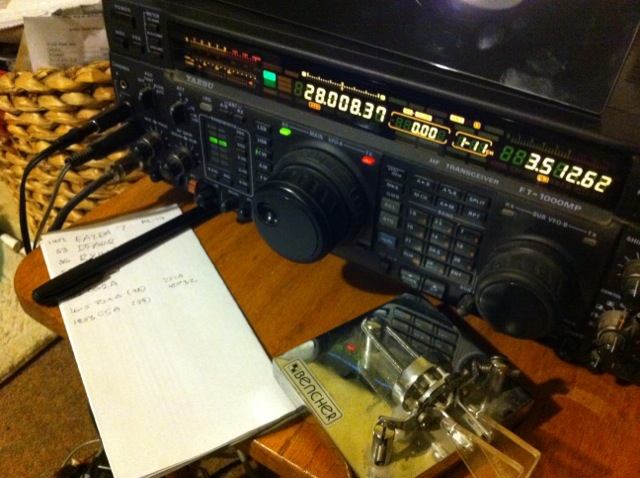
I was curious whether 28MHz would be open. Certainly not in a major way, but I could hear some African activity and some meteor bursts from European activity. I kept tuning up and down waiting to see what would appear. What appeared was PJ4A. They took a little working, but after a minute or two I had them in the log. Also coming in from the Caribbean were ZF1A (great to hear, as I’ve operated from there!) and KP3Z though I only heard those two briefly. Some US stations were heard, though not worked; KC1XX, W4SUL, AD4ES and K1TO amongst others. An hour or so later, I checked the band again and was interested to hear C5A coming through. To my surprise, and how often does this happen when you run 100W to a vertical, they came back first call.
After supper, I thought it was time to see if I could work the US on 7MHz with 1W. KC1XX was the poor unfortunate I picked. But we did it! It took a few repeats but the team there pulled all the information out and I was glad to hear that they took a lot of care to make sure they’d got the information ok. Next time guys, I promise I’ll call with higher power and make an easier QSO for you.
I enjoyed the 1W challenge. No doubt Justin will be pleased I played ‘real radio’, but I suspect that my next 1W operation will probably be on WSPR again!

Jam tomorrow
I have not been keeping up with the development of the controversial ROS digital mode as for reasons given in earlier posts I decided it was not something I wanted to use. However a recent post in the Yahoo digital modes group brought to my attention a development that seems rather alarming. The ROS software has recently included an anti-jamming switch the purpose of which is described as “improves rejection against strong CW and Beacons interferences.”
Polite usage of the amateur bands require that you check the frequency is in use before making a call so no-one should be jamming anybody. Furthermore, no-one should be using ROS in the CW or beacon sub bands. So what exactly is the purpose of this switch and why should anyone need it?
Perhaps an inkling of what may be going to happen can be drawn from some of the comments relating to the performance of the anti-jam switch, for example:
- “The New ROS/2000 passed the test successfully during the CW Contest last weekend.”
- “More test with the New ROS/2000 in other hostile environment. This time during a PSK63 Contest on Sunday.”
As I said all along (indeed, this was my original objection to the use of this mode) ROS is just too wide for use in the narrow digital allocations of the HF bands. There just isn’t the space for it, unless it remains a niche, occasionally used mode, which clearly its developer and supporters don’t intend it to be. As another comment in the ROS forum states: “The bands will fill up once people realize how good this mode is.”
The development of anti-jam techniques suggest that ROS is being readied to engage in war with users of other modes. When users can’t find a clear frequency they will just operate on top of other modes. The principal claimed advantage of the wide ROS mode is that it enables contacts to be made under similar weak signal conditions to JT65A but that it permits keyboard chats to take place rather than the basic exchange of signal reports and locators. So it appears that a vast swathe of spectrum space is going to be made unusable for other modes simply so that people can exchange brag files.
We need strict regulation of digital modes on the amateur bands. The days of gentlemen’s agreements are over. There are too many modes competing for limited spectrum space, and too many hams who aren’t gentlemen.

Allow WSPR to ‘frequency hop’
Not too much time to spend here today, but I just saw an interesting blog from Sivan, 4X6IZ about getting WSPR to ‘frequency hop’. In other words, you could operate on several bands at the same time!
Clever!

An afternoon’s WSPR on 7MHz
It’s a long while since I spent a whole afternoon on a single HF band, but it’s quite an interesting thing to do, watching the propagation change. I decided I would try my 1W WSPR tests again. I started off at around 1230z.
Reports from around the UK and near Europe were constant, with distances as little as 20km (thanks to Peter, 2E0SQL just over the hill in Oxford!) and further into Germany. Interestingly, Peter, running 5W was heard at consistently further afield than me, as you’d expect, but I was keen to stick at the 1W power level and see how it performed.
As the afternoon wore on, some of the UK stations faded, and I started to be heard by LA9JO in the far north of Norway at just under 2200kms. Late afternoon too, I heard UA3ARC in KO85 (though he did not report hearing me until much later in the day). After around 1815z or so, I stopped copying very much at all and wondered whether I should continue transmitting.
I was glad I did though, as around 1915z I was reported in Spain and Portugal and I wondered whether this was a precursor to the path to the USA opening. Sure enough it was and on the next transmit period, I was very pleased to be heard by K1JT and WB2JEP. After a few minutes more, reports dried up for a while, though then things seemed to swing around to the east with reports from EW1LN and UA3ARC, as well as some Italian stations.
Just before I closed at around 2230z, there were more reports from further into the USA, with AD3X at 5683kms and most distant for the day’s trials was W3GXT at 5747kms.
Lots of fun and I was pleased to see how the 1W signal propagated. With the CQWW CW contest set to take over the bands next weekend, I think I can guarantee it won’t be worth playing WSPR, But it might be interesting to spend some time at the 1W power level and see just how many contacts I can make on CW. I’m guessing not many, but I’d love to be proven wrong!

VHF/UHF QSOs of the week
Continuing my idea of plotting up what I hear on VHF/UHF from the car, here’s the map from last week. Nice to get back on GB3FX (Farnham 50MHz) for a couple of QSOs with Roger, G4HZA who I used to work often in the mornings. I was also pleased to work M1ELK/M on Beacon Hill near Newbury on 145MHz simplex (those simplex contacts are gold-dust) and interested to hear a mobile on the hills near Bromsgrove in Worcestershire, which is a good haul from here
View Heard this week 19/11 in a larger map
Not shown on the map are D-STAR QSOs made from home, of course. But I had a particularly enjoyable QSO on Wednesday evening with Keith, WD8AFB in Orlando. I’ve spoken to Keith a couple of times before and we share an interest in low power HF portable operating which it’s always fun to talk about. Keith had just got an FT817 and was trying to find the optimum antenna to use from hotel rooms when he’s out on the road.

WOTA day
What a day it has been for activity in the Lake District fells! Although the day isn’t over the light is beginning to fade as I write this and I’m guessing there won’t be any more activations today. But a quick count of the spots on the Wainwrights On The Air website shows there have been a total of 22 different fells activated by 6 different people which is probably a Wainwrights record.

At times the spots were coming so thick and fast that there was a danger of missing someone because you spent too long calling another station. And the fell-top stations had a hard job finding a clear frequency. Many had to QSY two or three times from their original chosen frequency because they landed on top of someone else’s contact. Perhaps we need to consider moving to 70cm for WOTA?
I myself made 16 contacts and added 7 new summits to my chaser total. I wish I could have been out on the fells myself to gain a bit of elevation and work some of the more distant ones. But this has still been my most productive day of WOTA chasing. Thanks to Phil G4OBK, Geoff GM4WHA, Phil M0AYB, Richard G1JTD and Colin G4UXH for the contacts. Visit Phil G4OBK’s Wainwrights blog where he will no doubt be posting an account of today’s activity with pictures shortly.














