Archive for the ‘Uncategorized’ Category
 Balloon foxhunt 2011
 September 15th, 2011 |
  Author:
 It was balloon foxhunt day today. A yearly event I always try to participate in you can find some more information on  http://www.ballonvossenjacht.nl. I always try to improve my station to connect via the balloon transponder. And as always try to get my call into the logbook on 80m. Well, the propagation was very low today on 80m I could hardly copy PI4VRZ/A who was this time on USB instead of the normal LSB. But I finally managed to get my call into the log. I wanted to improve a little since last year so I removed the rotor from below my vertical and placed it on a tripod with on top horizontally my dual band Maspro beam with about 5 degrees elevation. Overall I noriced about 3dB improvement in favor of the Maspro beam. Not bad considering it was on about 4 Mtr above ground behind the house and the vertical nearly 6 Mtr above ground with free sight to the south. Last year I recorded a QSO between PD5DP and G4RUL, this year I succeed to make a QSO via the transponder with G4RUL. So I made a improvement for shure. I did use both radios to see the difference between the two antennas instantly. I noticed that all radio equipment was covered by a pile of dust an the Icom gets very old it switched off twice without touching anything and FM output was only there after 30 minutes. But who cares, I’ve been radio active again.
Malware at TWiT’s Ham Nation?
I tried to visit the Bob Heil’s Ham Nation show homepage on the TWiT.tv site today and received this error:

Hopefully they’ll be able to get this resolved soon. Ham Nation is a great show and provides needed exposure to ham radio to quite a large tech audience.
UPDATE:
From Graham Cluley at Sophos:
The website run by internet celebrity Leo Laporte, TWiT.tv, has been hit by a malware infection intended to infect visiting computers.
Hackers have managed to inject a line of malicious code, in the form of an iFrame, at the very top of the TWiT website pointing to a webpage with a .cz.cc domain name.
Ham Radio and a Long Life
Hardly a day goes by when you don’t read some new health report. More coffee, less coffee, more wine, less wine, fish oil pills, vitamin E, raw food, some old world fruit that no one has ever heard of – these are all cited by one expert or another as a potential, partial solution to much of what ails us. Especially as we grow older. The indomitable human spirit wants to live forever while the old clay jar is a whole lot less willing.
One of the effects of the many advances in health care that we’ve seen is that there are now enough chemicals, procedures and micro-gadgets to keep our hearts beating longer than that of most of our ancestors who were considered to have lived to a ripe old age if that made it to 50.
Living 80, 90 or even 100 years has become much more common these days but with that advance we’ve seen an epidemic of the ills that regularly attend old age.
Evolution has best equipped humans to be pattern seekers. We look for order in all sorts of chaos – which is why a fluffy white cloud so often looks like a dog or a dead President. Seeing a human face in the random pattern of bark colors on the side of a tree comes naturally to us since it served our survival needs best to see a vine and think it was a snake than to ignore the deadly serpent.
If not the most horrible, then certainly one of the most horrible diseases humans can face is Alzheimer’s. While science continues to look for a miracle drug for that terrible disease, humans look for patterns of behavior that result in lower incidence of disease or a later onset.
For instance, we often promote diet and behaviors that reflect the way people live in a particular part of the world where they live longer and healthier lives. I’m not suggesting that this is a bad idea, but it at least partially explains why coffee is good for you one day and bad for you the next.
Alzheimer’s disease is of particular interest to me because my Mother suffered with it for five years before it claimed her life in 2005. Because of that, I tend to read more news articles about this breakthrough or that hopeful new treatment in the disease.
Nothing is certain at this point but one thing does surface in almost every medical report about Alzheimer’s.
Those who lead more active lives and who remain more mentally active seem to have a higher probability of escaping life without a visit from this disease or the onset of it is delayed. There are all sorts of ideas of what constitutes healthy brain exercise – from playing chess to reading to learning a new language.
Having been a radio amateur since 1977 I have to tell you that I have seen a lot of old hams, I’m talking about a lot of fellows who are over 80 years of age and it occurs to me that they share certain attributes. Things like maintaining a close cadre of friends – either over the air, via the local club, or at hamfests, etc. Most of the older hams have used CW for decades and continue to do so. And most remain fairly inquisitive about the nature and properties of radio – and in the last few decades, many of them have taken to personal computers which offers a new learning challenge.
If you think about the mechanics of Morse, one must hear the sound of it and decode it, often out of the noise. It must then be mentally translated into words – and many operators choose to either hand copy 100% of a message or at least make notes on paper. When it’s their turn to send, they have to think about what they want to say and translate those thoughts into mechanical motion in a particular pattern.
It seems to me that this constitutes as much, and probably a whole lot more brain exercise than almost any other mental function that I can imagine.
Amateur radio is probably too far outside the mainstream for scientists to target it for serious research in this matter. But given the advice that seems to have become standard in this regard I don’t think it’s far out of line to suggest that being an active radio amateur could be an effective weapon in the battle for a clear mind and a higher quality of life for those who have lived beyond the median age.
Frequent medical advice for brain health includes staying physically active, maintaining proper body weight, controlling blood pressure, enjoying a glass or two of red wine each day, and maybe, just maybe they should add – making a few CW contacts each and every day.
After all, there’s absolutely no downside in adopting all of the above.
hamQTH.com
It was a week in which I tried to get some loose ends fixed. I finished the SLA battery charger after I got the 1R8 resistors from my favourite supplier, did the family finances and tried to get the home-directory on my laptop cleared of some junk. In the process I upgraded my logging software, which is CQRlog. It was a major upgrade since the author switched to another back-end database, so it messed up my log quite a bit. I sorted that out and now everything is back in order again.
In the process I noticed that there was an option to look up data on hamQTH.com. Having never heard of this site I checked it out and found it to be a light-weight version of QRZ.com, or as they claim on the web site: Free Hamradio Callbook. It was set up by the authors of CQRlog, Petr (OK2CQR) and Martin (OK1RR). The reason, according to their web site:
Since the owner of one popular server decided to hide all addresses until you are not registered, I decide to write my own. This callbook provides all information for free because you entered data to callbook for free and didn’t get paid for it. So it won’t be right to ask for a payment if you want to publish your data.
Petr’s English is a little crooked, but he means: “At QRZ.com you have to register (and pay) to get access to data that you and others gave for free. With us your info remains free.” You might recall that QRZ.com restricted the xml access to their database last June, shutting out some logging software from auto-filling in some data fields. They also limited
look-ups by registered and non-registered users and hide address details to non-registered users on their web page.
I usually steer clear of web sites that are set up because of frustration about another web site. But this one got me thinking and there is an analogy that came to mind. About 18 years ago a couple of guys set up a CD database, with users contributed content, called CDDB. It grew phenomenally and a company was formed to manage it, which was sold off and made the owners rich men. The new owners then said the info in the database would stay freely accessible, but in
the end the database (with data which users gave for free) was closed for most software packages which accessed it. And if you ever ripped a CD you know how annoying it is to not have access to a database with song titles. Luckily the database had already been cloned and freedb had been set up to replace CDDB.
Now I am not a lazy person and I have always typed in my logs by hand. But with hamQTH.com I now have an auto-fill function available for CQRlog, something I have to pay US$29.95 for with QRZ.com. You could argue that there is no such thing as a free lunch and that QRZ.com has grown to be the default standard. I agree that bills have to be paid and money has to be made. But I also come from a free world and believe in creating and sharing your work for every one’s benefit. As a result I have been using and contributing to the GNU/Linux operating system for over a decade already. My contribution may not have been big, but it doesn’t have to be so: many small contributions do make a huge difference. A contribution of US$29.95 a year is kind of steep in my world. So I give hamQTH.com a thumbs up and have updated my profile with the latest info. If only I had discovered them last weekend when the All Asian contest was going on. Would have saved me a lot of typing.
This weekend is Mid-Autumn Festival in the Chinese world. Look out for some extra activity from East Asia and don’t choke on your moon cakes.
73 de Hans (BX2ABT)
Paradoxes
An interesting news item on Taiwanese television: people were complaining that they had to run USB extension cables from inside their home, through the kitchen, over the washing machine, onto the balcony, to get some decent wireless internet access from their dongle. Why couldn’t Chunghua Telecom provide decent coverage inside their apartments? “Because this is not why it is called wireless, is it?”
I love these NIMBY (not in my back yard) paradoxes: people don’t want antenna towers close by, but still expect a perfect service from their mobile phone or WiMax providers. But it made me ponder and come up with a theory.
We recently moved into our own semi-detached house. After emigrating from the Netherlands to Taiwan we were living-in with mother-in-law. It wasn’t that bad, but there’s no home like your own home, right? Back in the Netherlands we had a 90 year old town house. The kind of a house where you point your finger at the brick wall and there is a hole in it. Despite the soft walls, I could take any radio or HT and have clear reception throughout the house. So late at night I monitored 40 meters, practised taking morse code or talked some on my HT in bed before going to sleep. Heaven!
Here in Taiwan I am lucky to get any radio signal inside our new home. Shortwave is completely empty. Mediumwave too, apart from one or two local stations. FM is not much better, even though we live only kilometres from the nearest broadcasting facility. And it wasn’t much better in mother-in-law’s apartment. On the roof top or balcony things are fine and I can hear the world and some more. In the reinforced concrete cage that we live in now it is no dice.
So what is my theory? Radio is dying because we can’t receive it any more! We amateur radio operators know how to, but we are being curtailed by antenna restrictions. And potential hams? They don’t even get to discover the magic of radio waves, because they live in boxes that keep radio waves out. I started out with shortwave listening after accidentally finding Radio RSA on an old radio I found in the attic. I doubt that my son will ever make such a discovery on his own. But luckily he has a father who is heavily into radio, so he will turn out right, don’t worry.
For now I put up an old CB antenna on the balcony – with the railing acting as a counter poise – and I am enjoying myself. I was just testing the whole set-up when KA5PNX called me, so the first QSO was some good DX as well. Things are looking good so expect more reports from the Far East in the future.
73 de BX2ABT a.k.a. Hans “Fong” van den Boogert
For Sale: Tune-A-Tenna
I was perusing eBay a few weeks ago and stumbled upon an interesting listing:
 What is it? According to the listing, it’s a remote adjustable half-wave dipole antenna with an SWR of less than 1.5:1 from 1.8 MHz to 55 MHz. How does it work? From the listing:
By Extending or retracting the 2 Antenna elements until you have reached the point of Resonance for the desired operating frequency. There by providing maximum forward power and little if any reflected RF power.
You have effectively built a custom cut to frequency dipole antenna each and every time you change frequency with out leaving the equipment operating position.
The Antenna is controlled by the flip of a switch, or could possibly be controlled by the micro processor in most modern day transceivers and could possibly track the VFO as you move up and down in frequency so it would always be at its resonant point.

A little intrigued, I e-mailed the creator, Frank McGinley, WB4NWV, to inquire about it. I asked how he developed it and told him that I’d be interested in doing a little post on his antenna design.
THE TITLE OF THE THE STORY IS HOW FAR HAVE WE COME.
LOCATION FORT BRAGG NORTH CAROLINA, UNIT OF ASSIGNMENT, 50TH SIGNAL BATTALION ( AIRBORNE ), FIELD TRAINING EXERCISE.
IT WAS DARK EXCEPT FOR THE LIGHT FROM THE STARS, THAT SHOWN THROUGH THE CLOUDS , IT WAS BITTER COLD AND THE WIND WAS HOWLING , THE RAIN AND SLEET WAS INTENSE, AS I STUMBLED THROUGH THE BUSHES TRYING NOT TO GET THE DIPOLE ANTENNA ELEMENTS TANGLED UP IN THE SAME BUSHES, UNSUCCESSFULLY I MIGHT ADD,THE TIME 23:45 HOURS I HAD TO CHANGE THE LENGTH OF THE DIPOLE FROM THE DAY FREQUENCY TO THE NIGHT FREQUENCY, AFTER A HECK OF A FIGHT TO LOWER THE ELEMENTS TO THE GROUND AND SPENDING 3 OR 4 MINUTES TRYING TO UNTANGLE THE HALYARDS, THE FLASH LIGHT WITH THE RED LENS HELD IN MY MOUTH AND MY GLOVES REMOVED, MY FINGERS SO COLD THAT THEY DID NOT WANT TO COOPERATE I WAS SHAKING SO BAD FROM THE COLD THAT THE LIGHT WAS HAVING A HARD TIME STAYING ON THE SPOT WHERE I NEEDED IT, MAKING IT EVEN MORE DIFFICULT TO UNTIE THE TANGLED MESS ALL THE TIME TRYING TO HURRY TO BE BACK UP ON THE AIR BY 24:00 HOURS
WELL AFTER WHAT SEEMED LIKE FOREVER I GOT IT BACK UP,AND RETURNED TO THE WARMTH OF THE RADIO TELETYPE SHELTER, AND BEGAN THE PROCESS OF CHECKING THE SWR, ONLY TO FIND THAT IT WAS TOO HIGH, WELL BACK OUT INTO THE COLD AND RAIN I WENT, THE ANTENNA WAS TO SHORT, ROUND 2 WENT ABOUT LIKE ROUND 1 NOT VERY SMOOTH, AS THE WIND HAD BLOWN THE ANTENNA ELEMENTS INTO THE BUSHES, IT TOOK ME QUITE A WHILE TO UNTANGLE THEM, LENGTHEN THEM AND PULL THEM BACK UP, BACK TO THE RADIO VAN, CHECK THE SWR AGAIN, NOT FLAT BUT GOOD ENOUGH, I WAS SOAKED AND FROZEN AND WAS NOT GOING TO TRY IT A THIRD TIME, NOT TO MENTION THAT IT WAS 00:24 HOURS,AND TIME FOR ME TO CHECK IN WITH THE NET CONTROL STATION, I HAD NO TRAFFIC AND THE RADIO CHECK WENT WELL, IT WAS NOW TIME FOR ME TO GET OUT OF MY COLD WET UNIFORM AND INTO A DRY WARM ONE, WELL AS YOU CAN IMAGINE I WAS NOT A VERY HAPPY CAMPER, AND TO THIS DAY I DO NOT ENJOY CAMPING OUT, THERE WERE MANY DAYS AND NIGHTS LIKE THESE THAT FOLLOWED , EXTREME HEAT,EXTREME COLD, WET AND SOGGY, BITING FLY’S, MOSQUITOES, YOU NAME IT AND ALWAYS THE SAME PROBLEM, TO LONG OR TO SHORT, KNEE DEEP IN MUD, UP AND DOWN BACK TO THE VAN, UP AND DOWN AND BACK TO THE VAN,AND NEVER COULD I GET THE SWR FLAT, CLOSE BUT NEVER FLAT.
TIME FLY’S WHEN YOU ARE HAVING FUN, SOON 20 YEARS OF FUN TRAVEL AND ADVENTURE HAD COME TO AND END, AND IT WAS TIME TO ENJOY H. F. RADIO AS A SERVICE, WELL THE MORE THINGS CHANGE THE MORE THEY STAY THE SAME, MY DIPOLE ANTENNA CUT FOR THE HIGH END OF THE BAND WITH A CLIP LEAD EXTENSION TO MAKE IT RESONANT AT THE LOW END OF THE BAND, WELL YOU GUESSED IT, BACK OUT INTO THE NIGHT IN THE SNOW IN MY BEDROOM SLIPPERS P.J.’S AND HOUSECOAT, NOT A GOOD THING, I KNOW I COULD HAVE USED AN ANTENNA TUNER OR COUPLER AS IT IS CALLED, BUT ALAS I AM A PURIST, AND DO NOT LIKE THEM, EVERY TIME I HAD TO DO THIS, I KEPT HAVING FLASH BACKS OF MY MANY FIELD TRAINING EXERCISES , THAT WAS WHEN IT STRUCK ME THERE, HAS GOT TO BE A BETTER WAY.
WELL I TRIED EVERY THING, G5RV’S, OFF CENTER FED DIPOLES, YOU NAME IT I TRIED IT, WAS I HAPPY, TO PUT IT MILDLY, HECK NO, SO IT WAS TIME TO PUT ON MY THINKING CAP, MY MIND WANDERED BACK TO WHEN I WAS THE NONCOMMISSIONED OFFICER IN CHARGE OF THE MARS RADIO STATION AT FORT BRAGG, WE HAD A DIPOLE MADE FOR COLLINS BY HYGAIN THE TD-1 IT WAS MADE OUT OF TAPE MEASURE TAPES, IT WAS A POOR DESIGN, IF YOU USED MORE THEN 100 WATTS IT WOULD ARC INTERNALLY , BUT THE CONCEPT WAS THERE, CHANGE THE DESIGN SOME ADD A 13.8 VOLT D.C. MOTOR, SOME LIMIT SWITCHES AND A CONTROL BOX AND , YOU HAVE A MOTORIZED ONE HALF WAVELENGTH DIPOLE THAT CAN BE REMOTELY ADJUSTED FROM INSIDE THE RADIO OPERATOR’S LOCATION, WITH NO NEED TO SEE IT OR GO OUTSIDE TO ADJUST THE ANTENNA.
YES 1.8 MEGAHERTZ TO 55 MEGAHERTZ AND EVERYTHING IN BETWEEN WITHOUT COMPROMISING, PERFECTLY FLAT SWR 1 TO 1, AND NO NEED FOR THE INFAMOUS ANTENNA TUNER, IN THIS AGE OF ALL MODE ALL FREQUENCY H.F. TRANSCEIVERS, THERE WAS A NEED FOR AN ANTENNA THAT WOULD COVER THE ENTIRE H,F, SPECTRUM WITHOUT COMPROMISE, MANY THOUGHT THAT DAY WOULD NEVER COME, ARE YOU SICK OF DUMMY LOAD ANTENNAS AND ANTENNA TUNERS, GENERAL COVERAGE TRANSCEIVER MEET GENERAL COVERAGE ANTENNA, I GIVE YOU THE AMAZING TUNE-A-TENNA.
Frank has a fascinating story and I salute his service to our country.
Pretty neat. But… well, $25,000 is a lot of money for an antenna. What do you get? A patent (7,286,100B1), trademark (3,336,489), domain names, and a few prototypes. According to the eBay listing, Mr. McGinley believes that the right buyer could base a business around this antenna design and manufacture them for about $300 each:
Our best estimate, the cost to produce the final product for sale should be around $300, Possibly lower.
Our best Estimate of the retail price of the semi-auto version would be $825, which equates to $525 per unit. If you advertise wisely on Ebay, Qrz.com and QST Magazine you should have no problem netting $500 per unit profit, possible more?
Our best estimate of the retail price of the auto version would be $1,225 which equates to $700 net per unit possibly more?
What do you think? Is there a market for such an antenna? If you think so, check out the eBay listing or contact Frank. I’m sure he’d like to hear from you.
Baofeng UV-3R Review
Following the success of the Wouxun radios, we have a new Chinese handheld transceiver that has many hams excited – the Baofeng UV-3R. The UV-3R is a dual band (UHF/VHF) 2W “micro” transceiver manufactured by Vero Global Telecom and sold by Baofeng. While the Baofeng brand is the most popular, the radio is also sold as the Comtex UV-3R, the Magiksu UV-3R, and the Zastone ZT-UV3R. (Baofeng also sells the UV-100 and UV-200 models that share common internals with the UV-3R, but have some cosmetic differences. Also, on ebay.com you can find speaker mics for these models that are unavailable for the UV-3R.) One reason the UV-3R is so popular is its relatively low price – less than $50 via ebay and slightly more from the US suppliers. At this price and small form factor, it makes a great back-up radio to keep in a truck glove box or a laptop bag.
Cosmetically, the UV-3R is very similar to the Yaesu VX-3R.
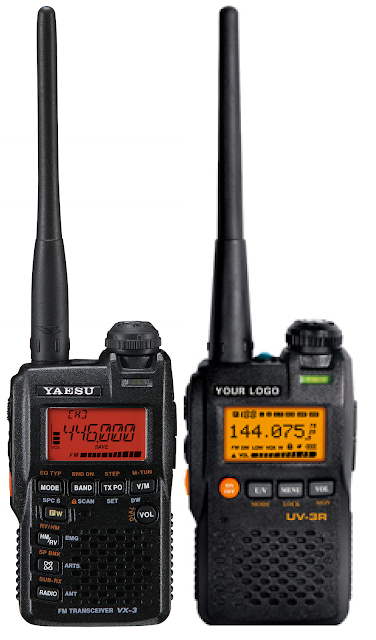
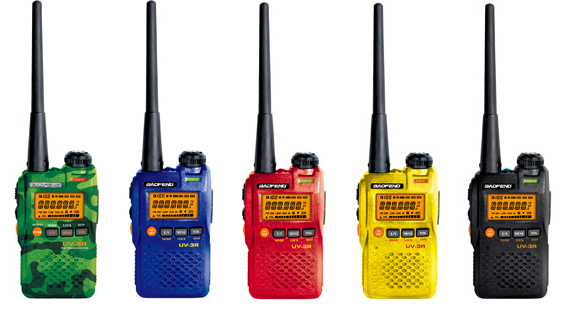
The dimensions are the same, but the UV-3R is missing a few buttons on the front panel and the functions of the duplicate buttons are not the same as the VX-3R. The UV-3R, in the fine tradition of Chinese radios, adds an LED flashlight. The radio also is available in red, yellow, blue, and camouflage in addition to the standard black. When holding both the Yaesu and Baofeng in my hand, it is easy to see and feel the superior quality of the Japanese radio.
A quick review of the technical specifications reveals that this radio is dramatically different from the VX-3R. The UV-3R is a 2M/440 MHz transceiver and FM broadcast receiver. An abbreviated list of its features/functions/specs is below. (A full list can be found here.) The radio is built by levering the power of the RDA1846 by RDA Microelectronics. This single transceiver chip provides most of the radio functionality – essentially making it a SDR.
Functions and Features
– 50 CTCSS, 104 CDCSS
– Time-out Timer (Off/30/60/90/120/150/180 secs)
– Shift Frequency
– VOX (Off/1-9 Levels)
– Call Tone (1750 KHz)
– Squelch Set (1-9 Levels)
– Electronic Volume Adjusting (8 Levels)
– Keypad Lock
– Backlight (On/Off/Key)
– Tail Tone Elimination
– Battery Save
– Restore to Factory Default
– PC Programming
– FM Radio Channel Storage
Technical Specification – General
Frequency Range | 136-174/400-470 MHz
Channel Capacity | 99
Channel Spacing | 5/6.25/12.5/25 KHz
Operated Voltage | 3.8V
Standard Battery | 1500 mAh
Battery Life | 10 hours
Dimensions | 1.9″ x 3.2″ X .9″ (Approximate)
Weight | 140g
Technical Specification – Transmitter
RF Power Output | 2W
Early adopters were “treated” to a version that appeared to be rushed to market – the units only had twelve menu options, the s-meter was worthless, and it came in a rather plain box. The subsequent version added six more menu options, improved the signal meter, and now comes in a more polished box.
The menu options are:
| Menu # | Name | Description | Options |
| 1 | RXCODE | Receive Tone | Off, CTCSS, DCS |
| 2 | TXCODE | Transmit Tone | Off, CTCSS, DCS |
| 3 | SQL | Squelch | 0-9 |
| 4 | LIGHT | LCD Illumination | Off, On, Key |
| 5 | K TONE | Keypad Beep | Off, On |
| 6 | VOX | VOX/Handsfree | Off, 1-9 |
| 7 | POWER | RF Output Power | High, Low |
| 8 | DW | Dual Watch/UHF & VHF | Off, On |
| 9 | STEP | Freq Size Step | 12.5/25KHz |
| 10 | OFFSET | Repeater Offset | 0-37.995, 0-69.995M |
| 11 | SHIFT | Repeater Shift | 0,+,- |
| 12 | STE | Squelch Tone Elimination | Off, On |
| 13 | W/N | Wide/Narrow Receive | Wide/Narrow |
| 14 | SAVE | Battery Save | Off, On |
| 15 | TOT | Timeout Timer | Off, 30, 60, etc. |
| 16 | SCANM | Scan Memory | TO Time based – time out/ CO Carrier (present) based – carrier out |
| 17 | RELAYM | Relay Message | |
| 18 | BCLO | Busy Channel Lock | Off/On (No Tx when receiving) |
In addition to the cost and size, hams give the UV-3R favorable reports for both transmitted and received audio. On July 20, 2011, the UV-3R became Type 90 accepted by the FCC. The FCC documents can be found here.
The UV-3R is easy to use in spite of a somewhat confusing manual. ZL2GVA mitigated that short-coming by releasing an easy to use cheat-sheet. While most folks find it easy to program the memories from the radio itself, the UV-3R can be programmed from a computer using a USB cable and software from Baofeng. In addition to the factory software, the UV-3R is also supported by the CHIRP cross radio programming application. (CHRIP may not program all features for all radios; it is intended to allow hams to transfer memories from one device to another with little effort.)
In addition to the USB programming cable, the radio has several accessories. It comes with the manual, charger, a charger adaptor (if needed), a charging stand, wrist strap, an UHF antenna, a VHF antenna, an ear bud/mic combo, and a belt clip. The shorter antenna (with a red ring) is for UHF. The longer antenna is for VHF. The UV-3R requires an antenna with a SMA-M connector. The antennas perform well, but many folks have wished for a dual band antenna. The Nagoya NA-701 and Nagoya NA-666 both seem to be popular choices. The antenna connector is fairly close to the LED, so some trimming may have to be done to get a good fit.
Car chargers, cases, and the USB programming cable are available as options or sometimes included as a bundle with the radio. The battery is a common NP-60 (FUJI compatible), so picking up an extra one is easy to do. Also, with a slight modification to account for the belt clip mount, the AA battery pack (FBA-37) for the Yaesu VX-3R can be used to run the UV-3R. For me, the car charger and the AA battery pack are the must have accessories for the UV-3R in its role as a backup radio.
The radio is not without some minor problems and quirks. For example, one oddity is that it uses the less common negative tip for the power plug. As for the problems, hams have reported issues with fit and finish – specifically plugs/sockets that result in loose connections. If pushing the plug with all your might doesn’t work, then try backing it out a little. Also, hams have found spurious emissions on harmonic frequencies. There was a lot of debate about the severity of this issue on the UV-3R Yahoo group – bench vs. real world, letter vs. spirit of the FCC regulations, Type 90 Acceptance impact, etc. Whatever the severity of the emissions, it did not prevent the UV-3R from meeting the requirements of the FCC. Another common complaint was with the loud receive volume. Even at the lowest setting, the radio is quite loud. For that reason, I don’t like using it where it will bother others.
One of the advantages of an inexpensive radio is that you don’t risk much when trying to modify it. Disassembly mostly involves removing screws, but you will have to unsolder the antenna connector. Two mods seem to be the most common as they address some of the issues mentioned above. The first adds a capacitor to reduce spurious emissions on the harmonics. The second also involves adding a capacitor to reduce the loud receive volume issue. More frivolous mods include turning the LCD blue – but then you can have a blue radio with a blue screen.
For me, this little radio has provided a great learning experience as well as a good value for my money. It may not be the best radio ever, but the price, size, and overall good performance make it a good choice for backup radio or even one for a new ham to get on the air. It also has been interesting to see:
- the debates that sprung up around the severity of the spurious emissions,
- the wisdom (or not) of using a dual band antenna,
- the variety of applications from simple transceiver to APRS and tracking satellites
Credit goes to a lot of the guys on the UV-3R Yahoo group – I don’t have the knowledge, tools, or time to do a lot of the research/testing/playing that they have done. I highly recommend the Yahoo group – although it has now reached a point where a lot of the same questions are being asked.
Editor’s note: I personally follow Brick’s blog and find it very worthwhile. While not all content is Amateur Radio related, I encourage you to check it out. -Matt W1MST
Brick O’Lore wrote this guest post and blogs regularly about a variety of topics at http://www.brickolore.com. Contact him at [email protected].













