Archive for the ‘Uncategorized’ Category
 6m – WSPR spots from 4X1RF (3519km) yet again
 July 3rd, 2014 |
  Author:
 My 6m 1W ERP WSPR signals are yet again being spotted in Israel.
I think this is now 5 days this season he has spotted me at this incredible distance. In all I must have had around 20 spots if not more from him? The considered wisdom is this is Es, but I do sometimes wonder what the propagation mechanism is. The lack of stations at intermediate distances may be because few are active on WSPR, but it “feels” like a single long hop, not unlike F2. My station and antenna are basic.
People who know better than me tell me it is not F2. Whatever, I am very pleased to have my QRP station being spotted so often in Israel.
Today, starting at 0704z, he has spotted me 6 times already by 0846z.
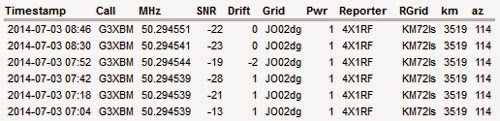 |
| 6m spots by 4X1RF (1W ERP here) to 0830z today |
Most Es spots seem to be from Scandinavia currently, just 1 from Italy.
UPDATE 0942z: Just Scandinavian Es for the last hour here.
UPDATE 1530z: Another spot from Israel of my QRP 6m signal at 1314z. That makes it 7 just today!

OK ….. Wait …… What?
Wow! It was hot here today! It got up into the upper 90s (36C) today and I was loving it! Well, maybe not “loving” it, but I wasn’t hating it or wishing it away. I was in my element as I went out to the Jeep and proceeded to try a little QRP.
I wasn’t hearing too much on 15 Meters and everyone on 17 Meters seemed to be involved in a ragchew, so I proceeded down to the good ol’ standby – the 20 Meter QRP Watering Hole. It was there that I heard a station calling CQ rather slowly. I set the KX3’s keyer for about 13 WPM and waited for him to sign. I am guessing that this person is a relatively new Ham because of the slower code speed and because he had a 2X3 callsign and the prefix was KK. I think in the #2 call district we’re still at KD as a newly issued prefix.
I sent his call twice followed by mine, three times. He had a decent 579 signal, and he gave me a 549. OK, not the strongest, but in my book, a 549 signal is decent enough to have a ragchew with. After the preliminaries, I thought we were going to get into the heart of a nice chat. That’s when I got, “BANDS SEEM TO BE UNSTABLE. YOU ARE UP AND DOWN. 73 DE KKXXXX”. Just like that, he was gone.
OK …. wait a second ….. what just happened?

It seems to me that one of the attributes of short wave communications is QSB, i.e. fading. It’s a rare conversation where it doesn’t occur, even mildly. It’s something you learn to adapt to and overcome in all but the severest cases, as you build up your skills. I feel bad for this guy, because if you’re going to limit yourself to only 599 signals, you’re going to miss out on a lot of fun. And you’re not going to develop yourself as an experienced operator, either.
The antennas are unplugged tonight. As a result of the hot weather and a cool (not cold) front moving through, we are getting some hellacious thunderstorms. No hail, but the downpours have been heavy and even though the rains have stopped for now, it’s still lightning. A lot.
72 de Larry W2LJ
QRP – When you care to send the very least!
The Spectrum Monitor – July, 2014

Here are the featured stories from our July, 2014 issue:
Monitoring NATO War Games
by Tony Roper
Twice each year the United Kingdom hosts NATO’s Operation “Joint Warrior,” a combined military exercise that includes major European countries as well as the US, Canada and often non-NATO countries such as Australia, New Zealand and Brazil. For monitors who follow such exercises closely, it’s a chance to tune in via HF, VHF and UHF to monitor some fairly exotic modes. It also offers some dramatic photo opportunities for those lucky enough to be close by. Longtime military monitor, Tony Roper, tells us how it’s done, where to listen and what you’ll hear. (Pg. 9)
From Plane Spotter to Air Traffic Controller
by Tony Roper
You might think that growing up just four miles from runway 10R at London’s Heathrow airport, it would be mandatory for a kid to be interested in aircraft communications. But it wasn’t until a teenage Tony Roper was given an analog VHF radio that featured the aviation band, that he connected those countless flights overhead with what he heard on that radio. It sent him on a 25-year career path as both a Royal Air Force and civilian air traffic controller. He also became a writer and photographer specializing in military monitoring. (Pg. 16)
Moonbounce: Earth-Moon-Earth Basics
by Bob DeVarney W1ICW
As with most space-related communications, bouncing radio signals off the surface of the Moon, a distance of almost a quarter-million miles, has usually been the domain of NASA, the military, or a few of the world’s most well-heeled hams. But, thanks to inexpensive, high-powered computers, exceedingly capable software and relatively cheap antennas, Earth Moon-Earth (EME) transmissions are now possible for average hams. Bob DeVarney W1ICW traces the origins of EME and his own efforts that have netted him 53 DXCC entities and counting! (Pg. 20)
Monitoring the Chesapeake Bay by Sea and Air
by Dave Kelly
America’s Chesapeake Bay is the world’s largest estuary, with a watershed that encompasses 64,000 square miles. It’s also home to nearly constant state, local, federal and military communications on an amazing assortment of frequencies. It’s also home to Wallops Island Flight Center, Virginia’s own spaceport. From Navy Seal training in the Bay’s backwaters to the thunder of rocket launches on the shore, the Chesapeake Bay offers an abundance of radio monitoring and the best crab cakes you’ll ever eat. (Pg. 25)
Dixon, California: America’s Shortwave Mecca
by John Schneider W9FGH
The incredibly flat land around Dixon, California, was not only good for raising crops out to the horizon, it also proved a great launching point for shortwave signals that went thousands of miles beyond that same horizon. Radio historian and former Monitoring Times feature writer, John Schneider W9FGH, relates the amazing story of the rise and fall of this legendary West Coast shortwave city. (Pg. 29)
The Spectrum Monitor is available in PDF format which can be read on any desktop, laptop, iPad®, Kindle® Fire, or other device capable of opening a PDF file. Annual subscription (12 issues, beginning with the January 2014 issue) is $24. Individual monthly issues are available for $3 each.
Field Day 2014 in Texas

This past weekend was the ARRL Field Day, and was my first time to attend one of these events. I just upgraded my license to General last November, so I never had much interest in HF before now. Lots of hams would cringe to hear me say that, but I always enjoyed the VHF/UHF operations and building relationships with local hams who I could talk to on a normal basis.
However, I am very glad that I attended the Field Day Event this year. I was able to learn some good information about band limits, what times of day each band is better, etc. I was also able to try some digital contacts on PSK31 and RTTY, which I had never done before.
I spent this Field Day with the Hurst ARC out at Chisolm Park in Hurst. Our class was 3A and our section was NTX. The 3 stations we had setup were a Icom IC-7000 running 15-meters on a homebrew Buddistick Vertical; a Kenwood TS-2000 on a Fan Dipole, which could jump between 20-40-80-meters, and a Icom IC-7200 attached to a 3-half-wave (1.5 waves total, 102′) for 20-meters.
I must say, above all else, the 15-meter station on the vertical antenna made the most contacts, which also impressed me the most. I was expecting the 20-meter dipole to out-perform everything, and its performance was fantastic, but the 15-meter vertical station made more contacts than any station. Most of that was probably due to the operator, KE5SBP. He is quite good at finding contacts on HF, and is very experienced. But the performance of the vertical antenna astounded me.
I was a bit disappointed that 40-meters and 80-meters didn’t open up more-so during the night. We made several contacts on each of those bands, and 40-meters continued well into the next morning, but I was expecting more. Maybe that is just my lack of experience with these bands, though.
The farthest contact that I personally made was on 20-meters to the U.S. Virgin Islands. I also made 1 or 2 contacts into Puerto Rico, and several into Canada. I heard some DX stations on 20-meters, but I was never able to get back to them, due to the pile-ups. Hawaii was also a popular location, and while several others at our location made those contacts, I did not.
Next year, W5HRC is already talking about upgrading to 4 or 5 stations. I’d like to see a 6-meter station, as well as maybe 10 and 12 meters. If 10 and 12 are like 15, they should do well during the daytime.
Keep it simple: A creative case for the Ham It Up upconverter

KK4JDO’s son made a Lego enclosure for the Ham It Up upconverter
Richard, KK4JDO, shared a proud dad moment on Reddit. His son created a Lego enclosure for his Ham It Up upconverter board.
The lesson? Sometimes the simplest solutions are right in front of you (or at least in your kid’s toy box)! 🙂
Gaining interest in radio
A big friendly welcome to my new readers who will be reading my blog entries via AmateurRadio.com – I hope my articles will provide insightful reading.
If you are not already “in the know” im based in the UK and provide distant learning course for UK amateurs alongside Steve (G0FUW) and Lewis (G4YTN) along with home based learning we also provide in class education as well.
 |
| PSK Receiver No. 001 with Raspberry Pi |
The education element of the hobby really interests me and not content with the 3 tier license, we also provide buildathons for anyone who is interested in electronics, radio or construction.
Our very successful PSK receiver kit (Instructions here) has now been used up and down the UK and orders are still coming in for the kit via the RSGB all over the world. Its a perfect kit for newcomers or students wanting to build a radio related project for their intermediate practical assesment.
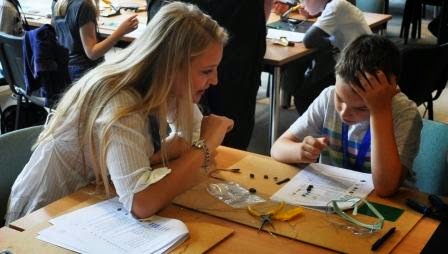
A couple of weeks ago we were asked to provide a buildathon for 21 young scientists at the BRLSI in Bath. And when I say young I really mean 8 – 14 years of age.
All but 3 kits went away working that afternoon and one of the first was a young 8yr old girl who had never held a soldering iron or had any clue what was really going on. But by the end of the day not only had she completed a build of the receiver but was decoding PSK signals on 20m in less than perfect conditions.
That was a particular highlight of mine on that day, seconded only by persuading her father to pop along to some of the in-class lessons and see what it was all about. It seems that there is a little bit of curiosity in radio in all of us. even today !!
Whereas we are keen to knock ourselves for not connecting with the youngsters, and gaining interest in the hobby, it actually seems to be that we are not that great at following up and converting the curious mind into a radio hobbyist.
Field Day on Mt. Kearsarge
Dave Benson K1SWL and I did Field Day at Winslow State Park part way up Mt. Kearsarge. We only operated for 3 hours, but we had a fantastic time and worked stations in Washington, Oregon, California and New Mexico among many others.
Our view was the best!

We met at 11:00 am at the gas station in Wilmot Flats. Then we headed up the Kearsarge Valley Road toward the mountain. We weren’t sure what to expect… but we really lucked out. We had a spot all to ourselves at the end of a small field. We had suitable antenna trees on all sides, and hardly any bugs. A slight breeze kept us cool most of the time.

I put up an inverted L with 65 feet of wire. It went up about 30 feet and then over. I used the earchi.org 9:1 unun. The KX3 tuned perfectly on 15 meters.
Dave used a K2 with a resonant 20 meter dipole up about 35 feet. He fed it with coax and didn’t need a tuner.
We operated with solar charged batteries using Dave’s call (K1SWL) as 2B battery. Remarkably, we didn’t interfere with each other at all. A few keying remnants was all I could hear. Dave got a very slight bit of hash now and then.
Here’s Dave testing his setup before the 2:00 pm gun.

We feasted on freshly picked strawberries and cookies in between contacts. (thanks Judy!) It seemed to us that activity was down this year, but maybe it was just band conditions.
I started out using 9 AA cells with the KX3 at three watts. I didn’t have any trouble making QSOs with this setup. I just wanted to see how it would work in a competitive environment. After 30 Qs, I switched up to five watts and a LiPo battery.
The park closes at 6:00 pm and we started packing up shortly after 5:00. (We’d had enough… How do these kids go all day and half the night?) Thanks for all the Qs… see you next year.













