Archive for the ‘radio’ Category
 LHS Episode #159: Digital Mode Interfaces
 January 11th, 2016 |
  Author:
 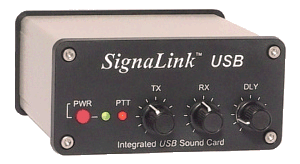 Hello, dear listeners! Thank you for tuning into another episode of Linux in the Ham Shack. In this week's episode, your hosts discuss a variety of topics from 600-meter operation to Linux in cars to Star Wars. Our featured segment tonight is a look at PC-to-radio interfaces for digital mode communication. Thanks for tuning into, and hope to see you next time.
73 de The LHS Team
Open Web RX
If, like me you have an rtl dongle, there is another ‘thing’ you can do with them that I bet you never knew. Ok you did but I’ll bet all of you didn’t know. Its called OpenWebRX

You can also arm yourself with one of those old netbooks you’ve got loafing about in the corner and put it to use into the bargain.
To tell the truth I’d not heard about it until Daniel, 2E0DNX mentioned something in passing as I was driving him back from the club night last Monday. I can’t remember what started it but we got onto the subject of putting receivers on the web a la WebSDR and the well known Hack Green SDR. This time, as we are both cheapskates, it was around the use of the cheapo dongles.
So, after downloading a copy of Lubuntu (A lightweight ubuntu distro) I installed it onto an old netbook. I thought I followed the instructions on the website and but I hadn’t and after a false start with some rubbish spelling had a receiver running on the local host. I did get some pretty speedy support from the developer though who helped to narrow down my incompetence.
Getting it on line is a little more complicated and needs a bit of fettling. In order to get it listed on the site it needs a web presence. To get that you can pay for it and host it or you can be a cheapskate and use a service like N0-IP. Guess which route I went? They provide a web address that you can use and some really handy instructions for linux installations, if, like me, its not a natural environment to work in but you can largely follow instructions.
After all instructions followed correctly (there are no spelling mistakes in your config file  ) then the last thing to do is make sure your router lets the traffic through (port forwarding). This can be a pain if you’re on BT like me and can lead to no end of frustration that was eventually fixed with a new, non BT router. I’ve got my head round this and will now look to set up a more permanent installation, perhaps with a RPi2 if its got the right mojo.
All in all you’ve got to hand it to people who set out these environments as they are becoming a great way of distributing amateur radio to a wider audience. Thanks Andras, HA7ILM and well done!
NPOTA: ARRL’s Best Idea?
 The National Parks on the Air (NPOTA) is off and running. Making contact with a handful of stations currently operating from NPOTA locations has made me wonder if the ARRL has had a good idea with NPOTA as a way to help celebrate the anniversary of the National Park Service.
From ARRL: “Throughout 2016, Amateur Radio will be helping the National Park Service celebrate their 100th anniversary. Hams from across the country will activate NPS units, promote the National Park Service and showcase Amateur Radio to the public.”
I am a huge fan of both the National Parks and the National Park Service. Anyone who is interested in the history of our National Parks would be well rewarded to start with the Ken Burns documentary The National Parks: America’s Best Idea. Yellowstone generally gets credit for being the first National Park back in 1872. However, the National Park Service was not established until 1916. That period in between provides us a very good reason that there are times when we need a government organization to protect us from ourselves. During that in between period, the Army was given the mission of attempting to protect both Yellowstone and Yosemite. Like most missions the Army received, they were underfunded, under equipped, and undermanned. They did, however, do the best they could to protect these amazing areas. Many Americans saw these new National Parks as areas for economic exploitation. If it wasn’t for many individuals working long and hard for the establishment of the National Park Service, it is very likely we would not be able to enjoy the parks we have today. Stephen Mather and Horace Albright were the two primary individuals who secured the establishment of the National Park Service. Ken Burns talks about these two individuals in his documentary and there are also a few books that do a great job telling the story (Creating the National Park Service: The Missing Years and The Birth of the National Park Service: The Founding Years, 1913-33).

The National Parks exist for our enjoyment. Generally that enjoyment manifests itself in some type of hiking, camping, fishing, watching for wildlife, or learning about history. This interaction between Park and citizen can be passionate, emotional, revitalizing, inspirational, and an educational experience.
With all that being said, I was a bit surprised to hear stations making contacts for NPOTA locations like it was a contest. Each NPOTA location is identified by a letter-number combination. No discussion of where they actually were. No description, no discussion. It is a bit sad to see there is a Leader Board – which only facilitates looking at NPOTA as a contest rather than an actual celebration.
I also wonder how these activations are impacting those non-amateur radio enthusiasts who are visiting a NPOTA site. Is this putting amateur radio in the best light?
Are these NPOTA activations promoting the National Park Service or showcasing Amateur Radio to the public?
If so, how?
What would Stephen Mather and Horace Albright think about NPOTA?
It will be interesting to see how NPOTA progresses over the coming weeks and months.
Notes from the shack
 Over winter break I have been putting in a lot of time behind the radio. Here’s the wrap up:
First – more DX. In general, this is a good time of year to catch hams behind their rigs. Some contacts that I am particularly proud of:
4U1WB, The World Bank in Washington D.C.
ZD7DL, St Helena Island
WH6S, Kauai
C5YK, The Gambia
9H5BZ, Malta
MI5AFK, Northern Ireland
FG5GP, the island of Guadeloupe
ZS6TVB, South Africa
EA8DAZ, Canary Islands
VP2ETE, Anguilla
Second – working a lot of DX. There is the 90th anniversary of the International Amateur Radio Union (IARU) special event activations. Plenty of good DX participating in this and working multiple bands.
Cuba
Bermuda
Finland
Germany
Aruba
Venezuela
Jamaica
Ireland
Italy
Slovenia
Brazil
Third – working Santa (aka AA4EE) on Christmas Eve. The girls really enjoyed telling Santa what they wanted. Thank you Santa!
Four – joining the OMISS and the 3905 Century Club nets. I am not sure if I fully understand these nets. I get the convenience in pursuing Worked All States awards. That makes sense. However each club also has an additional bevy of other types of awards. The actual contacts during the nets seem a bit unfulfilling. But I may not yet fully understand these nets. I need to thoroughly read all the literature.
Five – Log of the World: I have uploaded the vast majority of my logs. I mentioned before about uploading my YI9MI logs. I also went back and uploaded my log from KD7PJQ back in Virginia. The logs from Korea (HL2/AD7MI and HL9MI) are now uploaded. All my logs using AD7MI have been uploaded.
Time to get in Line
 Excitement in the shack! We’ve had a new addition. I have had my Elecraft K3 for quite a while. Nothing but positive words about it. It has never let me down.
We’ve all heard about the K-Line. I am assuming that the term K-Line is an omage to the Collins S-Line.

Through my research of MARS, I know that the Collins S-Line was the choice of MARS stations. Collins even had a repair shop located at the major air base outside of Saigon.

Although I have never operated any Collins gear, from what I’ve read it was built like a tank but clearly was designed to have aesthetic appeal. Elecraft is aiming to achieve the same.

I’ve started my attempt at building my K-line with the addition of the Elecraft amp and tuner. Both easily interface with each other and the K3. This allows for seamless band switching and tuning.
While only a 500 watt amplifier, I have already noticed an notable increase in my ability to make contacts and get to the top of the pileup. Band conditions helped, I’m sure – but it was still enjoyable making contacts with South Africa, Findland, the Canary Islands, and Aruba. Stateside contacts have also seemed to be easier to make with a little extra punch.
Get Ready: Month-long Special Event for SKCC, the 2016 K3Y Celebration
Are you ready for the annual, month-long special event by the Straight Key Century Club (SKCC)? The SKCC Group membership is free, and celebrates the longest tradition of amateur radio: Morse code. But, not just any Morse code. The manual creation of Morse code by “straight” keys means no electronic origin, only mechanical. This is a month-long event, during January 2016, modelled after the ARRL Straight Key Night.
Here’s a video that I made showing my activity as the control operator of the special event station, K3Y/0, during one of the many shifts during January (2015). K3Y is the special event callsign of the Straight Key Century Club (SKCC). The special event operates each January. I’ll be doing this again, this coming month, January of 2016.
K3Y, the Straight Key Century Club’s annual January celebration, commemorates the club’s founding in 2006 following the American Radio Relay League’s Straight Key Night. A small group of participants wanted to extend the fun of SKN throughout the year. The SKCC is the result.
For the first three years, the club’s founders used K1Y, K2A, and K3Y as the celebration’s special-event calls. But someone cleverly noticed that a 3 is nothing more than a backwards, curvaceous E. This “KEY” event has operated under the K3Y call ever since.
The on-air party is open to members and non-members alike. It runs from 0000 UTC Jan. 2 through 2359 UTC Jan. 31. It’s a great time to introduce others to the joys of hand-crafted Morse code using straight keys, bugs, and side swipers.
This year, January 2016, we’ll be fielding K3Y operators in each of the 10 US call areas, plus KH6, KL7 and KP4, along with specially scheduled stations in each of six IARU continental regions. Your QSOs with event operators in all these 19 areas will be tabulated in the Statistics section and can be confirmed with a K3Y QSL card and Sweep Certificate.
+ The SKCC website is at http://skccgroup.com
+ The K3Y special event page is http://www.skccgroup.com/k3y/
73 de NW7US
dit dit
WW1USA
I had the opportunity to be a guest operator at WW1USA today. WW1USA is a special event station located at the National World War I Museum in Kansas City, MO.
There was a request for operators that I saw on Larry’s List. Larry’s List is an awesome resource for hams in the greater Kansas City area. Not just another email list-serv, but a truly valuable resource in understanding what is happening in the area. From community events, swap-n-shop, club meetings, weekly nets to nearby hamfests – Larry’s List is one stop shopping for everything you need to know about amateur radio in Kansas City.
I read about the opportunity to sign up for operator/logging slots during this weekends activation of WW1USA and thought it would be a neat opportunity.
Arriving about 10 minutes before my shift started, I was immediately directed to a position and asked to start logging for an operator working contacts on 20 meters. The brief instructions I received was to log the callsign, name, and state of the contact. I think I recognized the logging program as N3FJPs logging program for Windows. I had used this program before during Field Day 2009 with my dad, KD6EUG.
As I adjusted into the chair, my ear turned towards a speaker, my fingers pecking away entering callsigns… I noticed there were not any radios here! Each of the operating positions were laptops, using HRD to control a rig at a remote location. Pretty cool. As I believe it would have been fairly difficult to raise antennas on top of the museum and then route feedlines down to an operating room, the planners of this special event used internet connectivity. To be honest, as an operator, the fact that I was not in front of the rig was really not even apparent.
After twenty minutes, I slid into the operators chair and proceeded to work contacts for the next two hours. Again, the planning effort of this operation became evident when I saw a short script in front of me for calling CQ as well as providing answers on how calling stations could QSL the contact. When a station at the distant end asked for more information about the reason for the special event, I was handed another card which talked about commemorating the failed Gallipoli campaign.
I had a great time making contacts: stations all over Canada and the United States. What a fun time!













