Archive for the ‘radio’ Category
 The Day The Computer Died
 February 14th, 2016 |
  Author:
 I have been using small footprint computers in ham shack for a while. It started with the Dell Zino. Always a bit under powered, but enough to get the hamming done. The latest computer driving everything was one of those barebones models that was the size of a shoe box. The first sign of decline was when the fan kept getting louder and LOUDER. The the drive (500GBs of SATA) then decided to give up the ghost.
An immediate lesson learned… back up my log. I have been good at uploading my logs (almost daily, when on the air) to LOTW, QRZ.com, and eQSL. But I would only export that days contacts, consistently replacing the previous days exported log.
I choose not to abandon the small footprint computer and went back to the Shuttle. Newegg.org was my one stop shopping:
The case and motherboard: Shuttle XH81 Intel Core i7 / i5 / i3 / Pentium / Celeron 65W Intel H81 1 x HDMI Barebone system
– small form factor, fits neatly underneath monitor.
– 2x RS-232 connections on the back. Perfect for connecting to the Elecraft amp and tuner.
– Plenty of USB connections
Intel Core i7-4770S Haswell Quad-Core 3.1 GHz LGA 1150 65W BX80646I74770S Desktop Processor Intel HD Graphics
– not the fastest, but fast enough.
– comes with a super quiet fan.
Transcend JetRam 8GB 204-Pin DDR3 SO-DIMM DDR3 1600 (PC3 12800) Laptop Memory Model JM1600KSH-8G
– I got two DIMMs to keep things moving… 16GBs = snappy!
SAMSUNG 850 EVO 2.5″ 250GB SATA III 3-D Vertical Internal Solid State Drive (SSD) MZ-75E250B/AM
– Good bye disk, hello solid state. Faster. Silent.
The actual build was plug and play. The Shuttle line has come a long way since my last experience with their product. I think these specific computers are designed to operate older types of technology (hint…. 2x RS-232 connections?) which works great with most amateur radio needs.
The next step was loading the OS. LiLi USB Creator is my go to solution for installing linux when I don’t have an optical drive (which is more often the case). This allows you to load the OS through booting directly from the USB stick.
The linux flavor of the day: Mint with the MATE edition. I was an Ubuntu man until Unity. Then made the jump to Mint. The OS loaded without issue and I was off and running.
Amazingly enough, I was able to install TQSL-2.2. In the past, I have been able to install TQSL from the Software Manager. But this has been an older version of TQSL. The newer versions ALWAYS gave my problems with dependency issues during attempted installs. I stayed with it this time and finally got it working. Phew!
The install of fldigi went smoothe, but configuring it to work with my Elecraft K3 was giving me fits. In my past setup, I’ve always used hamlib for rig control and the trick was just finding which USB number was being used for my USB Microham III. But this time, the USB Microham III was identified by name as a choice. Great! But it didn’t initialize. I tried USB0 (…. nothing), combed over the results of lsusb…. not… working. After some intense Googling, I ran across a command I had never seen before:
sudo adduser [username] dialout
Dialout!? Who knew? But that did the trick.
Now, here is something funny. We all have our junk boxes. As hams, we are pack rats. We hang on to stuff that has no current use, but may someday. I had a box RS-232 cables. When Fall Cleaning swept through the ham shack, I looked at the RS-232 cables. I am really going to need 15 RS-232 cables ranging in length between two and 15 feet? The box headed to the dump.
Now, with my growing K-Line, I can use Elecraft software (linux versions available) to monitor data from the amp and tuner. But the connections are serial. SERIAL. I turned the ham shack upside down and not an RS-232 cable to be found. I really don’t want to have to actually go out and BUY a serial cable.
Minima Digital Board
After procrastinating for a very long time I finally summoned up the ‘whatever it was I needed to summon up’ to get a move on with the Minima transceiver. I planned on tackling the digital board first as it seemed logical. It did however need me to solder an Si570 onto the board without any solder paste. So it was going to be a bit of a struggle.
The method I chose was to put a healthy load of flux on the pads and a blob on both of the ends. Align the chip then solder one end, applying a small amount of pressure onto the chip. Then the other end, then back to the first and then to the second again. Making sure I had seated it correctly. after that the other pads seemed dead easy.
The result was that it worked (I think). Although I am unsure as to why is does stay on a single frequency. This will need a bit of looking at. Here’s a very brief video.
It’s chilly in here
I’m going to use it as an excuse but really it isn’t….The shack is cold (Its a garage really) and the thought of going in there really wasn’t that appealing. We’ve had some pretty miserable weather since the end of November and its been a full time effort just to go out and walk the dog. I’d also taken on the mechanical build of the SatNOGS project as part of the club project and that took up way more time that I thought. Now that’s finished it was time to get on with a few things of my own.
First things first, looking at the Minima digiatl board it seemed like something that could be built and tested in an afternoon. I was nearly right, in the interim I had lost / put in a safe place, the LM1117 3.3v regulator and didn’t have a spare (Like I keep spares of stuff like that, I’m not a professional you know).

Built what I could and here is the result. Stone me it actually powered on an worked first time, but there isn’t any power to the Si570 and that’s a whole different ball of solder.
Onwards and upwards
I Need You in My Log! SKCC K3Y/0 Special Event (January 2016)
I need your help!
Come meet me on the shortwave (HF) ham bands for the Morse code (CW mode) special event, the Straight Key Century Club (SKCC) celebration, with special callsign, K3Y. During the shifts (time slots) listed below, I am the control operator as K3Y/0.
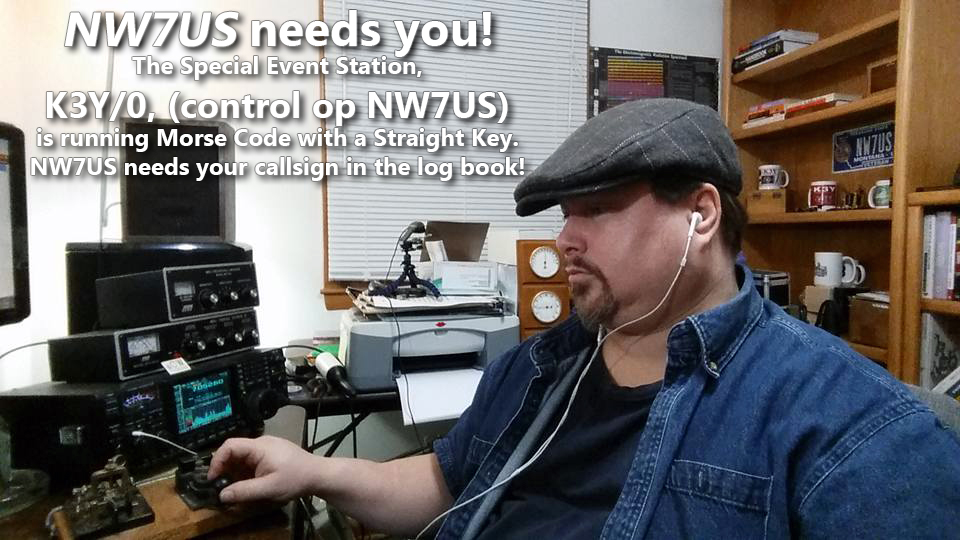 I need you to make a contact with me.
This special event takes place every year during January. We celebrate the legacy of Morse code, and promote Morse code and manual creation of the code by any non-electronic (digital) device and method. Which means that we love mechanical bugs, straight keys, two ends of a wire, or any other manual device, if Morse code is generated. The Straight Key Century Club is a free membership group. The link to their website is below.
I need you to make a contact with me, during my scheduled times, listed below.
NOTE: YOU DO NOT NEED TO BE A MEMBER OF THE (free) SKCC GROUP. To get into my logbook, you meet me on my frequency, and use Morse code to communicate with me. It is painless. If you must, you can use computer-generated Morse code. Or, you can tap it out on any Morse code signalling device, like a bug, a set of paddles, or a straight key; whatever you choose to make Morse code emanate from your HF transmitter.
HOWEVER: For those of you who want to get fully immersed in the spirit of this event, you are invited to use a straight key. And, as a bonus, you may and can join the SKCC group for FREE. Then, you would have your own SKCC number. That’d be cool; we SKCC members use that number in our exchange during our QSO information exchange. But, you don’t need that. Since it is free, why not?
What is needed is simply you, getting on the shortwave band, finding me, hearing me, and responding to me with Morse code. In other words, we need to have a QSO using Morse code. I am not a fast operator, so no problem if you are not very fast. I’ll meet your speed.
In any case, here are some of the times I will be on the air as K3Y/0… please dust off your straight key, bug, paddles, whatever, and make a QSO with me. Thanks!
My current schedule:
UTC Start/End (remember, these are NOT your local times, but are the UTC (GMT) times!)
(revised times, as of edit date)
 00:00 - 02:59 19-Jan-16
 00:00 - 02:59 20-Jan-16
 00:00 - 02:59 21-Jan-16
 00:00 - 02:59 22-Jan-16
 00:00 - 05:59 23-Jan-16
 14:00 - 18:59 23-Jan-16
 20:00 - 21:59 23-Jan-16
 00:00 - 02:59 24-Jan-16
 14:00 - 18:59 24-Jan-16
 21:00 - 21:59 24-Jan-16
 00:00 - 02:59 25-Jan-16
 00:00 - 02:59 26-Jan-16
 00:00 - 02:59 27-Jan-16
 00:00 - 02:59 28-Jan-16
 00:00 - 02:59 29-Jan-16
 00:00 - 05:59 30-Jan-16
 13:00 - 18:59 30-Jan-16
 20:00 - 21:59 30-Jan-16
 00:00 - 03:59 31-Jan-16
 13:00 - 23:59 31-Jan-16
Now, what frequency will I be on?
To find out what frequency I am on:
Visit http://g.nw7us.us/sched4SKCC and look on the right side for my callsign, NW7US. I usually post my frequency of operation right after my call sign.
Typically, evening operation is 30m, then 40m, and then possibly 80m.
If you are trying to alert me to your presence, you may message me on my personal Facebook profile, under my “Tomas David Hood” profile messages, but I may not see that right away.
Here is the detail covering the K3Y operation and the SKCC group: http://skccgroup.com/k3y
73 de NW7US
dit dit
This was last year:
https://www.youtube.com/watch?v=UfRvITFpTb4
..
..
LHS Episode #159: Digital Mode Interfaces
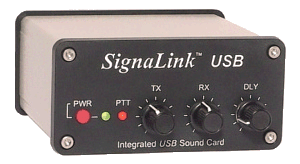 Hello, dear listeners! Thank you for tuning into another episode of Linux in the Ham Shack. In this week's episode, your hosts discuss a variety of topics from 600-meter operation to Linux in cars to Star Wars. Our featured segment tonight is a look at PC-to-radio interfaces for digital mode communication. Thanks for tuning into, and hope to see you next time.
73 de The LHS Team
Open Web RX
If, like me you have an rtl dongle, there is another ‘thing’ you can do with them that I bet you never knew. Ok you did but I’ll bet all of you didn’t know. Its called OpenWebRX

You can also arm yourself with one of those old netbooks you’ve got loafing about in the corner and put it to use into the bargain.
To tell the truth I’d not heard about it until Daniel, 2E0DNX mentioned something in passing as I was driving him back from the club night last Monday. I can’t remember what started it but we got onto the subject of putting receivers on the web a la WebSDR and the well known Hack Green SDR. This time, as we are both cheapskates, it was around the use of the cheapo dongles.
So, after downloading a copy of Lubuntu (A lightweight ubuntu distro) I installed it onto an old netbook. I thought I followed the instructions on the website and but I hadn’t and after a false start with some rubbish spelling had a receiver running on the local host. I did get some pretty speedy support from the developer though who helped to narrow down my incompetence.
Getting it on line is a little more complicated and needs a bit of fettling. In order to get it listed on the site it needs a web presence. To get that you can pay for it and host it or you can be a cheapskate and use a service like N0-IP. Guess which route I went? They provide a web address that you can use and some really handy instructions for linux installations, if, like me, its not a natural environment to work in but you can largely follow instructions.
After all instructions followed correctly (there are no spelling mistakes in your config file  ) then the last thing to do is make sure your router lets the traffic through (port forwarding). This can be a pain if you’re on BT like me and can lead to no end of frustration that was eventually fixed with a new, non BT router. I’ve got my head round this and will now look to set up a more permanent installation, perhaps with a RPi2 if its got the right mojo.
All in all you’ve got to hand it to people who set out these environments as they are becoming a great way of distributing amateur radio to a wider audience. Thanks Andras, HA7ILM and well done!
NPOTA: ARRL’s Best Idea?
 The National Parks on the Air (NPOTA) is off and running. Making contact with a handful of stations currently operating from NPOTA locations has made me wonder if the ARRL has had a good idea with NPOTA as a way to help celebrate the anniversary of the National Park Service.
From ARRL: “Throughout 2016, Amateur Radio will be helping the National Park Service celebrate their 100th anniversary. Hams from across the country will activate NPS units, promote the National Park Service and showcase Amateur Radio to the public.”
I am a huge fan of both the National Parks and the National Park Service. Anyone who is interested in the history of our National Parks would be well rewarded to start with the Ken Burns documentary The National Parks: America’s Best Idea. Yellowstone generally gets credit for being the first National Park back in 1872. However, the National Park Service was not established until 1916. That period in between provides us a very good reason that there are times when we need a government organization to protect us from ourselves. During that in between period, the Army was given the mission of attempting to protect both Yellowstone and Yosemite. Like most missions the Army received, they were underfunded, under equipped, and undermanned. They did, however, do the best they could to protect these amazing areas. Many Americans saw these new National Parks as areas for economic exploitation. If it wasn’t for many individuals working long and hard for the establishment of the National Park Service, it is very likely we would not be able to enjoy the parks we have today. Stephen Mather and Horace Albright were the two primary individuals who secured the establishment of the National Park Service. Ken Burns talks about these two individuals in his documentary and there are also a few books that do a great job telling the story (Creating the National Park Service: The Missing Years and The Birth of the National Park Service: The Founding Years, 1913-33).

The National Parks exist for our enjoyment. Generally that enjoyment manifests itself in some type of hiking, camping, fishing, watching for wildlife, or learning about history. This interaction between Park and citizen can be passionate, emotional, revitalizing, inspirational, and an educational experience.
With all that being said, I was a bit surprised to hear stations making contacts for NPOTA locations like it was a contest. Each NPOTA location is identified by a letter-number combination. No discussion of where they actually were. No description, no discussion. It is a bit sad to see there is a Leader Board – which only facilitates looking at NPOTA as a contest rather than an actual celebration.
I also wonder how these activations are impacting those non-amateur radio enthusiasts who are visiting a NPOTA site. Is this putting amateur radio in the best light?
Are these NPOTA activations promoting the National Park Service or showcasing Amateur Radio to the public?
If so, how?
What would Stephen Mather and Horace Albright think about NPOTA?
It will be interesting to see how NPOTA progresses over the coming weeks and months.













