Archive for the ‘qrp’ Category
 Hendricks 41dB attenuator built and added to the mix
 July 13th, 2012 |
  Author:
 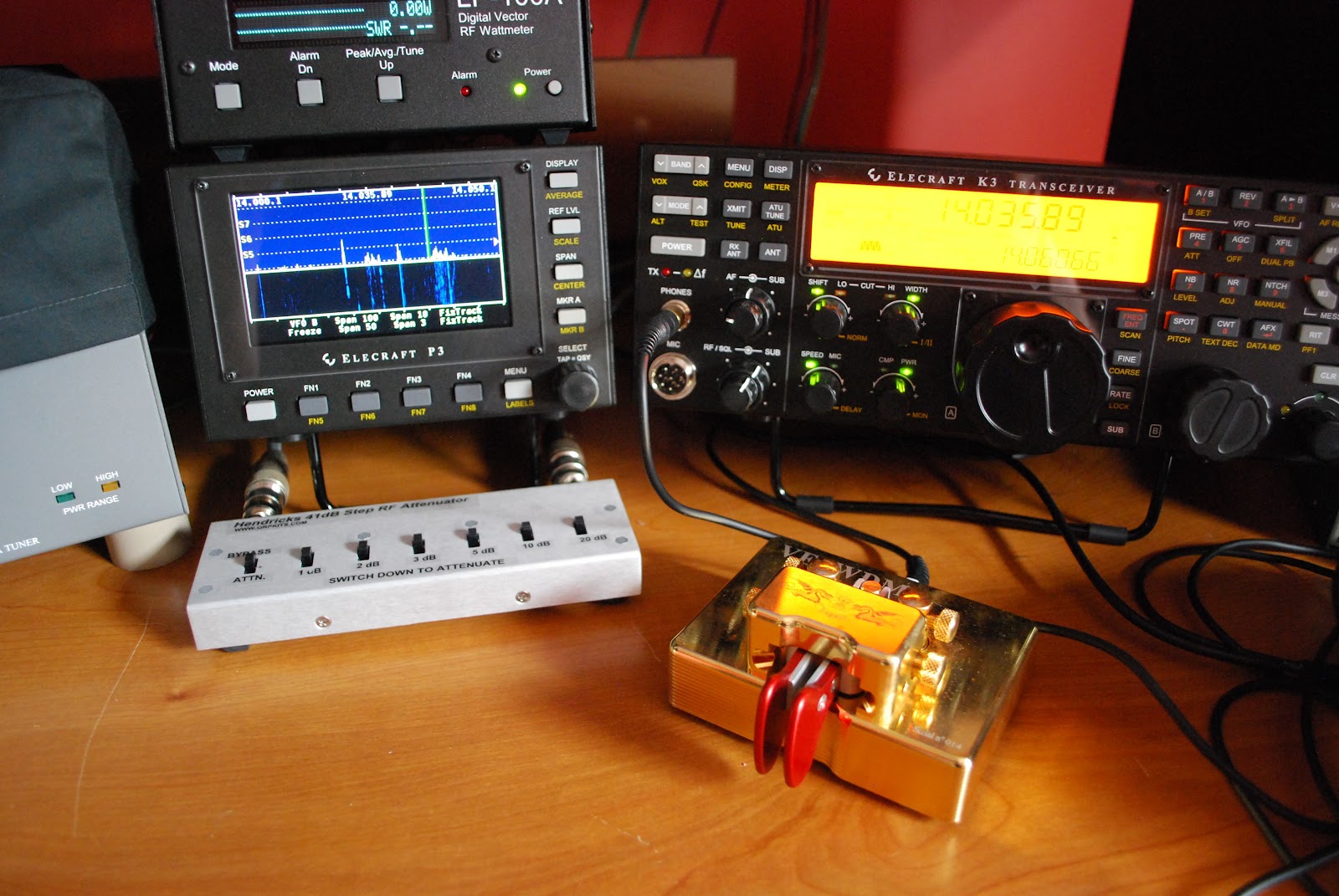 |
| Hendricks attenuator in service |
 |
| Final testing |
Now when I want to use the attenuator it's a matter of selecting antenna B on the K3 and Ant B selected on the DTS-4 and I am ready to go with all the setting on the K3 done.
- Have fun and enjoy!!
- Look for DXCC's I do not have so I can add to my ARRL Diamond count.
- See if I can beat my miles per watt record of 45,868 miles.
- Have fun and enjoy!!
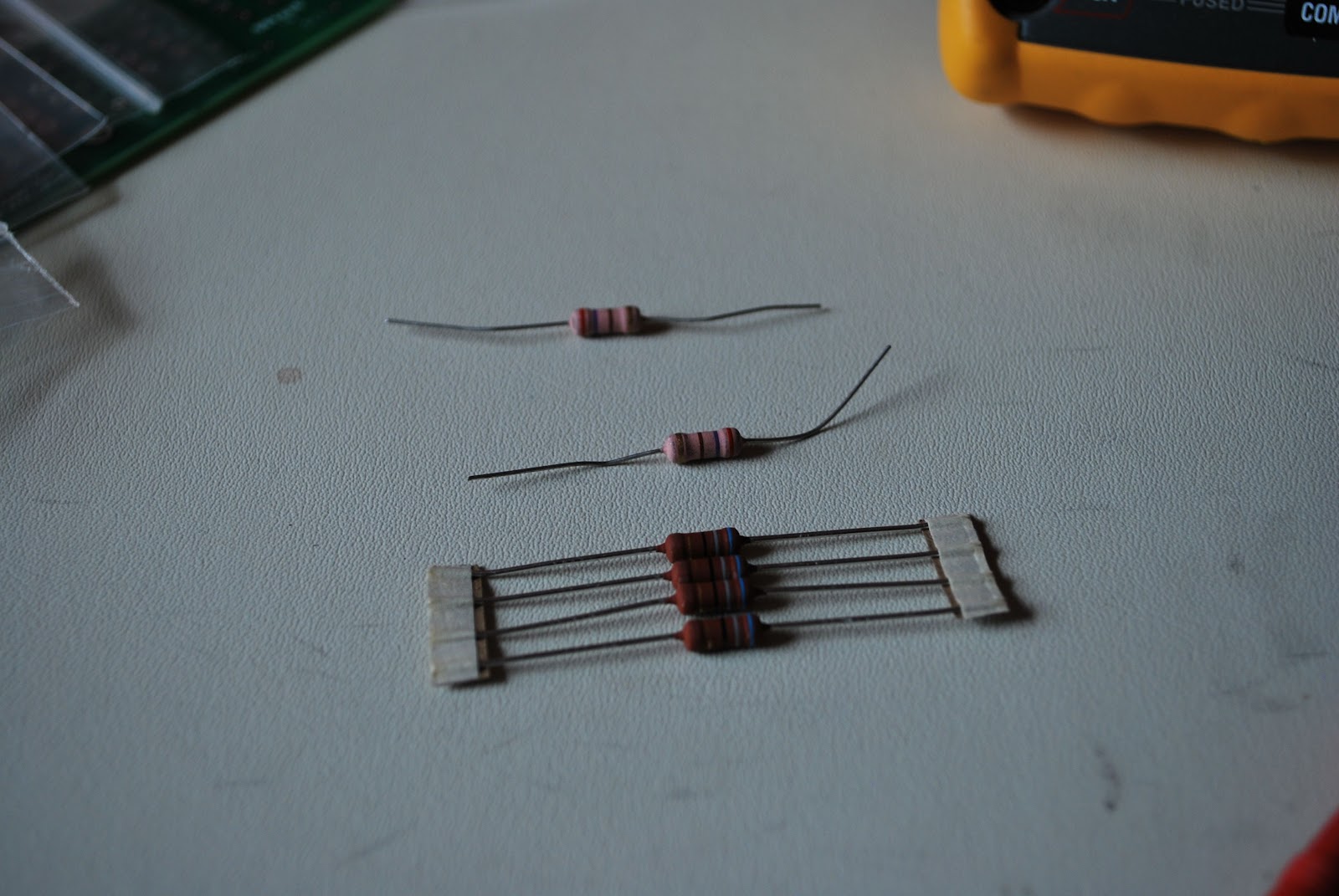 |
| Some of the extra parts |

Solar storms VS QRPp
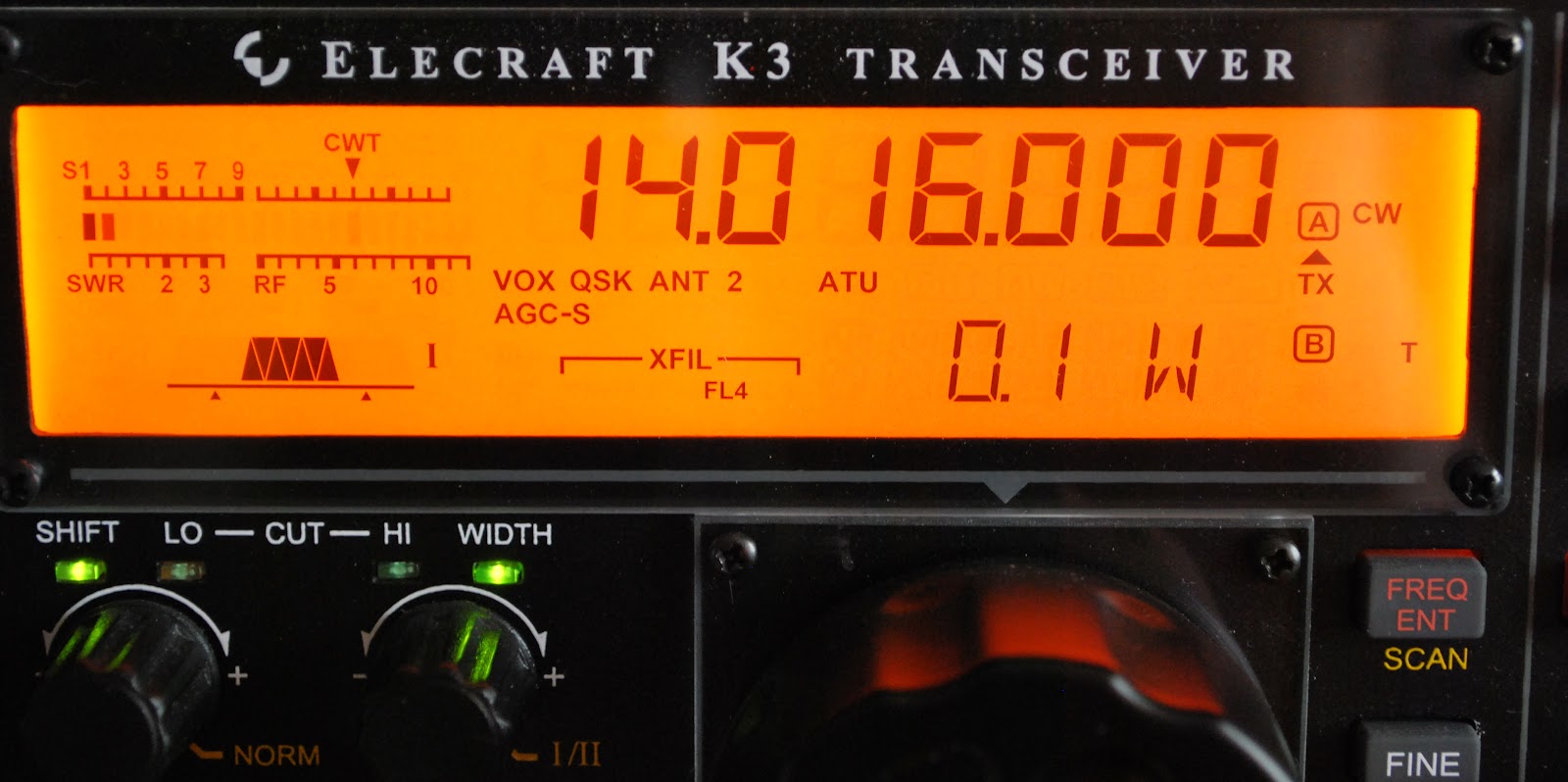
K3MM in M.D. 21dB
WZ7I in P.A. 18dB
K1TTT in M.A. 11dB
KB9AMG in W.I. 9dB
Most of the time I would be heard in Europe but with conditions the way they are the U.S. seems to be my DX destination for the time being. I fired up the K3 along with DxLabs. Right off the bat I saw lots of spots for Europe but was not able to hear them on this side of the pond. I then heard an S5 signal from SM5EPO from Sweden. I knew conditions were not that great and after all the RBN confirmed that on 20m's it was the U.S only.........So I dropped the K3's power to 100mW's Heee Heee Heee and gave it a go. SM5EPO came back to me and with a few repeats the contact was complete at 39,111 miles per watt. In the past when conditions were good and I was making QRPp contacts and logging the miles per watt I wanted to see how I would do if conditions were not ideal.

K8GU/5 Field Day 1B1Op Battery
I found myself in Santa Fe, NM, for Field Day this year to attend a conference. As I have shared before, I have mixed feelings about Field Day, but this was a genuinely good time. I first checked ARRL’s Field Day finder map and the local club’s web site for activity. Zilch. So, I remembered staying at the Fort Marcy Hotel Suites on several previous visits to Santa Fe. These condos are up on a hill overlooking town. Across the street is Hillside Park, with a couple of scraggly trees that might be suitable for antennas.
Instead of bringing the “usual” portable station, I brought a Small Wonder Labs SW-40, a K1EL K12 memory keyer (assembled especially for this trip), Palm Mini paddles, a 40-meter dipole, and a AA battery pack. The whole station took up less space in my luggage than my notebook computer and set up in 15 minutes. I got the dipole center about 4-5 meters off the ground and the ends sloped down to about 2-3 meters high…just enough to allow cars and small trucks to pass under them in the parking lot. Apologies for the photographs…they were taken with my cell phone (which is a regular old “dumb” phone).
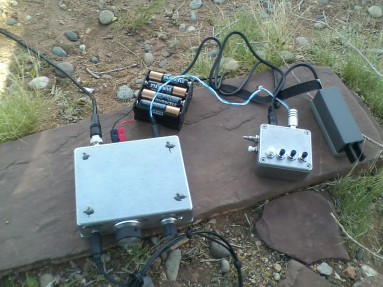
The SW-40 did not appear to be transmitting correctly when I first hooked everything up. So, I pulled the cover off (packing a Leatherman tool is another good reason to check a bag) and wiggled some wires around until it fired up. Not an auspicious sign.
But, I did manage to operate for about an hour and make 12 or 15 QSOs. They’re logged in a notebook, but I haven’t looked at it since making the contacts. Virtually every QSO was a struggle. Low power (1.5 watts), wrong band (20 meters would have been better), a low antenna, and the fact that I hadn’t used the SW-40 for any QSOs in over 10 years, conspired to make thing difficult. Most operators pulled me right out once I was in the clear and zero beat (which I think was a serious challenge with the slightly drifty and definitely touchy SW-40).
My final QSO was with my old radio club from my college days, W8FT. The operator was my good friend Bill, AD8P, who worked hard to pull me out once he got my call right. After I packed up, I noticed that I had a missed call on my phone…sure enough it was from Bill. So, I gave him a call and we talked for a couple of minutes. “When he answered the phone, he said, `New Mexico?!?! I told Kelsey (N8ET) that’s what I had copied.’” We had a nice chat as I hiked back down the hillside into town and he pulled into his driveway after his FD shift.

I don’t think I’ve ever been so delighted with a Field Day effort of so few QSOs (except maybe my first Field Day, which was much more work for about twice the number of QSOs). Including the walk from my hotel to the park, setup, tear-down, and operating, I think the whole exercise took about 3 hours, and was tremendously FUN.
A QRP Family Holiday on Prince Edward Island, Canada

VY2 portable K4SWL!
This year, during our family’s summer holiday, I’m enjoying the hospitality of Prince Edward Island, Canada (hence, the lack of recent posts). This is our family’s second visit to the maritime island, and each time we’ve been fortunate to stay at the same off-the-grid cabin on the eastern coast, less than twenty meters from the water.
Of course, staying in an off-grid cabin comes with its radio challenges—namely, supplying power—but also comes with one supreme advantage: no noise from the typical electrical devices that plague most of our homes. What’s more, this cabin sits on 60 acres, so not even a neighbor’s home appliances disturb my RX ears.
On our previous visit, I brought my (then) Yaesu FT-817, a 9aH gel cell, Micro M+ charge controller, 10W Solarex PV panel, some 300 ohm window line, loads of 22 AWG wire and an LDG ATU. Unfortunately, I found I had very little time for radio, and propagation was dismal. Indeed, it was during that trip that I discovered my FT-817’s finals had blown, so part of the time I was transmitting less than QRPpppp levels.
This year, since I knew the site well, I came better prepared.
My full 2012 setup consists of the following:
- An Elecraft K2/10
- An Elecraft KX1 (4 band w/built-in ATU)
- Elecraft T1 ATU
- LDG 4:1 Balun
- One 35 aH gel cell
- Two 9.5 aH gel cells
- Two PowerFilm Solar foldable 5 W PV panels
- My radio toolbox with various connectors, crimpers, cutters, wires, caps, multi-tester, etc.
- Enough wire and 300 ohm antenna line to make a couple of wire antennas
So…how’s it all working out? Brilliantly!
In the past few years I’ve done a lot of QRP CW—mainly rag-chews with some buddies on the lower bands. I’ve done less QRP SSB phone. When I first arrived at the cabin and began the process of unpacking, I couldn’t find the jumper cable to attach to my Vibroplex single-lever paddle (the paddle being a Dayton 2012 find, by the way). So, I plugged in a microphone and tuned to the phone portion of the 17 meter band.
Talk about radio fun!
I’ve once again re-discovered the joy of operating QRP SSB. It’s challenging to make those DX contacts and to transmit a long call sign (“VY2 portable K4SWL”) across the ether, but occasionally the propagation gods smile upon you, and you’re able to participate in a good rag-chew or quick DX with a 57 to 59 signal report.
Being 20 meters from the salt water is a bonus I don’t usually enjoy in my US hermitage. Due to its excellent propagation characteristics, despite my lower power set-up, I have easily worked stations from Russia to North Africa, from the Caribbean to Japan. I am thoroughly reveling in it, and the process has re-connected me with my ham radio roots.
As Gunter, VA3GA, told me in a recent Canadian rag-chew, “ham radio holidays give you a chance to explore areas of the hobby you don’t normally think to enjoy.”
So true, Gunter. That’s what I love about ham radio in general– the hobby is so broad, you constantly discover and re-discover favorite elements about it.
Evening radio time

2) HA6OA On 20m contact made with 5watts. He was only S2 but using the Diversity receive option on the K3 along with the Audio Peak filter (APF) really helped.
On 17m I did have a very good copy on CO8LY from Cuba so I gave him a go with 1 watt.....but nothing. I eventually rolled the power up to 5 watts but he was still unable to hear my signal. Funny how Poland and Hungary were no trouble with 5 watts but Cuba was a no go for me this time.
I also heard 6Y5WJ from Jamaica again on 20m but there was a huge pileup waiting to contact him so I moved on.
Tuesdays events
1) HA6OA On 20m was heard again but this time I reduced my power to 1 watts and gave him a go. With a solar flux of 94 and sunspots at 14 I thought..."what the heck" He came back to me on the first call and that gave me 4463 miles per watt contact.
2) SP3GXH on 20m this time I was feeling giddy from my last QRP contact so I dropped my power down to 500mW's and tried my luck!! He came back to me on my first attempt and that made it 8338 miles per watt contact.
I was only able to make 2 short contacts as I got home late from work and lots had to be done at home before any radio time so it was late and I do have to get up early so I pulled the plug for the night. It was good to know that even with the disappointing propagation I was still able to make at least one QRPp contact. My Hendricks 41dB attenuator kit has not come in as of yet but when it does I am going to go for contacts with less than 100mW's and see how that works out for me.

Looping the loop
Whenever I have taken a rig to operate in the Great Outdoors using a wire antenna I have often been disappointed. This is probably due to my use of inadequate antennas – Miracle Whips and the like. When I have tried wire I usually fail to get it up high enough. Usually when hurling a rock attached to a string into the trees, the rock rebounds off a branch and narrowly avoids hitting me on the head. If I do manage to get it up high the rock irremovably entwines itself with a branch just out of reach. There has to be a better way!
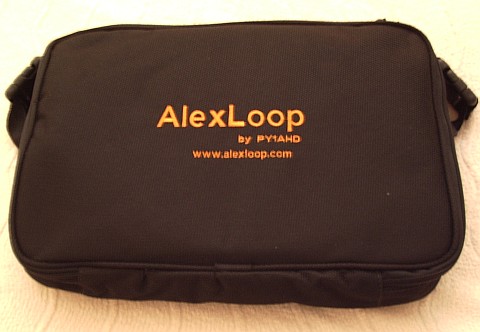 |
| AlexLoop WalkHam carrying case |
I have long been an enthusiast for magnetic loop antennas and have often wished I could use one as a portable antenna. My Wonder Loop was an attempt to make such an antenna, but it was less portable than transportable (by car) and has seen more use as a spare antenna from inside the shack.
I looked longingly at the WalkHam made by Alex PY1AHD and wished I could make a portable loop as neat and compact as that. If I had to make it myself it might never get done so I decided to bite the bullet and buy one of Alex’s ready-made loops.
There are two versions of the AlexLoop. One is a kit using copper tube for the radiating element and costs $199 US. The other version, called the WalkHam, uses stout coaxial cable for the main loop and comes ready built in its own custom made carrying case similar to a laptop case. The price of the AlexLoop WalkHam is $299 US. Shipping to the UK by express courier to the UK is a further $82 US. The total cost to me using PayPal was just over £250 at the present exchange rate.
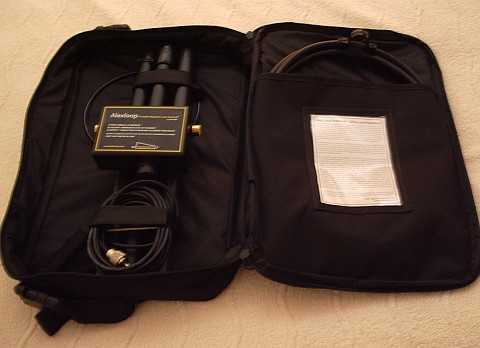 |
| AlexLoop WalkHam in its case |
The WalkHam is well made with gold plated connectors for the loop element. It is easy to assemble, though not so easy to pack away unless you have a photo to show how the parts go back! The mast is made of black plastic tubing and is in three push-together sections. Once assembled the antenna may be used whilst held aloft – hence the name. Most users will probably prefer some sort of mast.
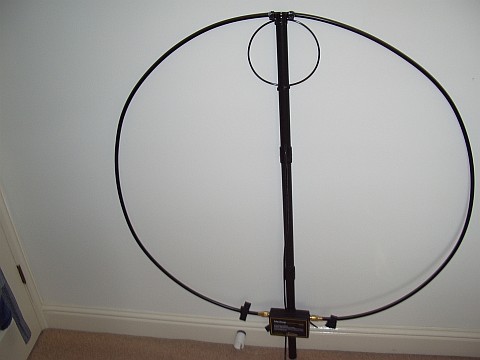 |
| The AlexLoop WalkHam ready for use. |
The loop is 1 metre in diameter and tuned using an air spaced variable capacitor with a 3:1 reduction drive giving a 4 : 1 tuning range: 10m – 40m. Most magnetic loops including home-made ones only manage a tuning range of 3:1: 10m – 30m or 15m – 40m. My MFJ magnetic loop is the 40m – 15m version as it was bought during the last solar minimum when 12m and 10m were not much use!
The coupling loop has a diameter of about 20cm. The maximum power handling is 20 watts PEP, 10 watts continuous wave, making the WalkHam perfect for use with QRP radios like the FT-817 or Elecraft’s new KX3!
Tuning as expected of a magnetic loop is extremely sharp but I noticed little or no hand-capacitance effect. With a little practice the loop can be tuned by peaking for maximum noise in the receiver. If the SWR isn’t low enough then the tuning may be touched up using transmit and the rig’s built-in SWR meter if it has one (both the FT-817 and KX3 do!) If not, a simple SWR indicator as I used in my Wonder Loop would be a big help.
Subjectively the AlexLoop seems to work as well as my MFJ magnetic loop in the attic, which itself is comparable to a full-size dipole. There are not many portable antennas that would beat the AlexLoop WalkHam for performance, unless you are able to erect a couple of 40-foot masts!
One thing that would improve the package would be a way of erecting the antenna so that it will stand on its own. I think my arm would soon get tired holding the WalkHam aloft! Possibly a short guyed mast made of sections of electrical conduit would do the job: magnetic loops don’t need to be far above ground in order to work. Some users are reportedly using photographic tripods so I’ll probably investigate that in due course.

FT-790R, 1W of Forlorn Hope? Part II
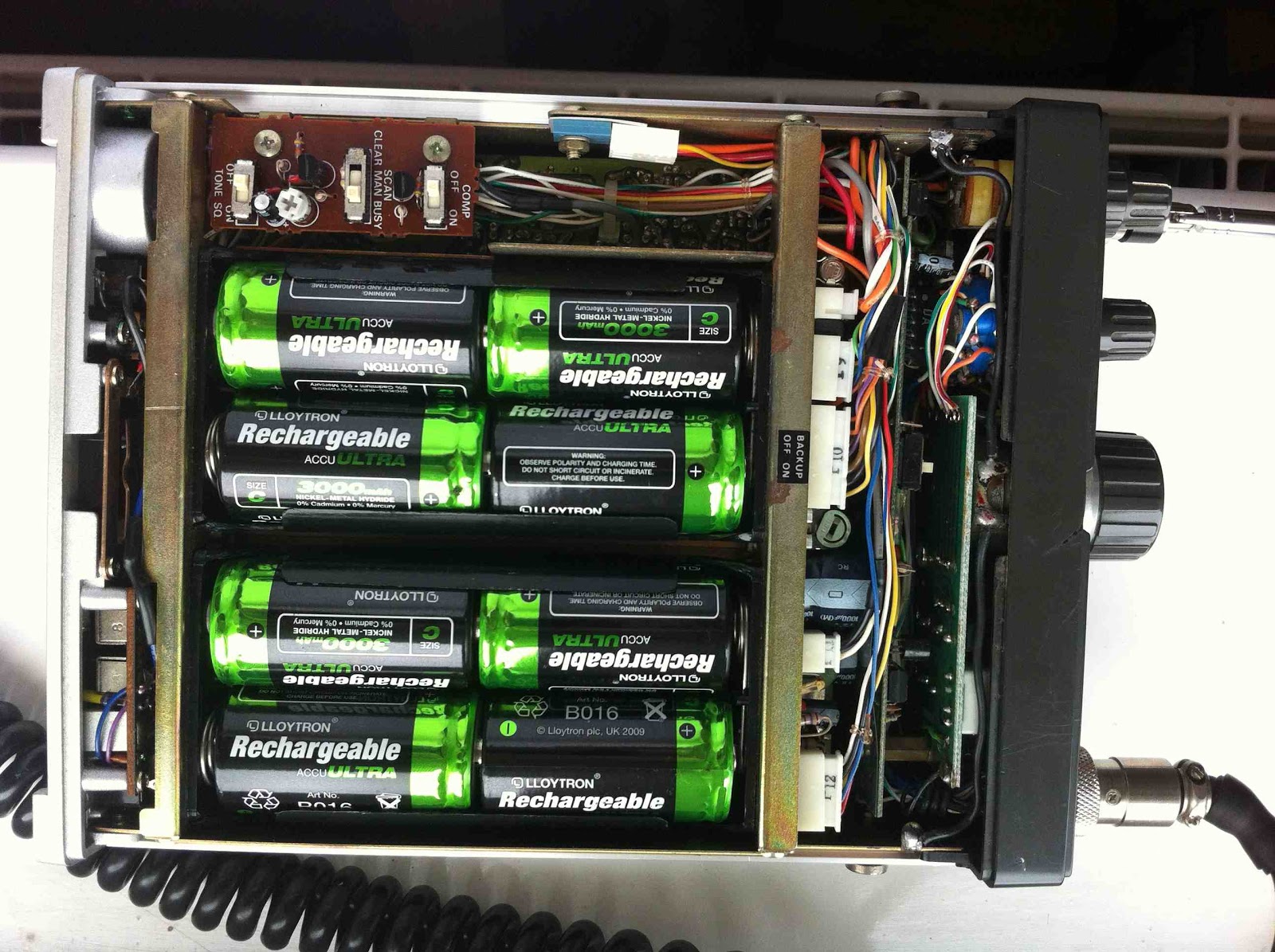 |
| Powered by 8 'C' cells |
 |
 |
| Anglesey to the Isle of Man |














