Archive for the ‘hf’ Category
 Weekly Propagation Summary – 2015 Apr 06 16:10 UTC
 April 6th, 2015 |
  Author:
Here is this week’s space weather and geophysical report, issued 2015 Apr 06 0133 UTC.
Highlights of Solar and Geomagnetic Activity
30 March – 05 April 2015
Solar activity was at low levels throughout the period. Region 2303
(N19, L=066, class/area=Hkx/400 on 17 Mar) produced low to mid-level
C-class activity early in the period while Regions 2318 (N10, L=199,
class/area=Dao/199 on 05 Apr) and 2320 (S12, L=212,
class/area=Dai/140 on 05 Apr) each produced only low-level C-class
flare activity throughout the remainder of the period.
A filament eruption centered near S29E28 was observed in SDO/AIA 193
imagery between 04/2225-2330 UTC. A long-duration C3/1f hyderflare
was measured during this event and had an associated Type-II radio
emission. The subsequent fast-moving coronal mass ejection (CME) was
first observed in SOHO/LASCO C2 coronagraph imagery beginning at
04/2336 UTC. WSA-ENLIL model output suggests a glancing blow arrival
of this CME late on 07 April.
No proton events were observed at geosynchronous orbit.
The greater than 2 MeV electron flux at geosynchronous orbit was at
normal levels on 30 Mar and normal to moderate levels on 31 Mar-05
Apr.
Geomagnetic field activity was at quiet to unsettled levels on 02-04
Apr with an isolated period of active conditions observed between
2100-2359 UTC on 02 Apr due to the effects of a positive polarity
coronal hole high speed stream. Quiet to unsettled levels were
observed on 30 Mar-01 Apr, and 05 Apr under a mostly nominal solar
wind environment.
Forecast of Solar and Geomagnetic Activity
06 April – 02 May 2015
Solar activity is expected to be low (below NOAA Scale event
thresholds) with a slight chance for M-class (R1-Minor) flare
activity throughout the outlook period.
No proton events are expected at geosynchronous orbit.
The greater than 2 MeV electron flux at geosynchronous orbit is
expected to reach high levels on 22-24 Apr and 02 May, moderate
levels on 06-08, 11-14, 17, 20-21 Apr, and 27 Apr-01 May, and at
normal levels for the remainder of the period.
Geomagnetic field activity is expected to be at G1 (Minor)
geomagnetic storm levels on 15-16, 18-19, and 25-27 Apr due to
coronal hole high speed stream effects. Active conditions are
expected on 07-09 Apr due to the anticipated arrival of the 04/05
Apr CME. Active conditions are expected on 17, 20 Apr, and 28 Apr-01
May due to coronal hole high speed stream effects with generally
quiet to unsettled levels likely for the remainder of the period.
Don’t forget to visit our live space weather and radio propagation web site, at: http://SunSpotWatch.com/
Live Aurora mapping is at http://aurora.sunspotwatch.com/
If you are on Twitter, please follow these two users:
+ https://Twitter.com/NW7US
+ https://Twitter.com/hfradiospacewx
Get the space weather and radio propagation self-study course, today. Visit http://nw7us.us/swc for the latest sale and for more information!
We’re on Facebook: http://NW7US.us/swhfr
CQ WPX, LoTW and the End of QSL Cards
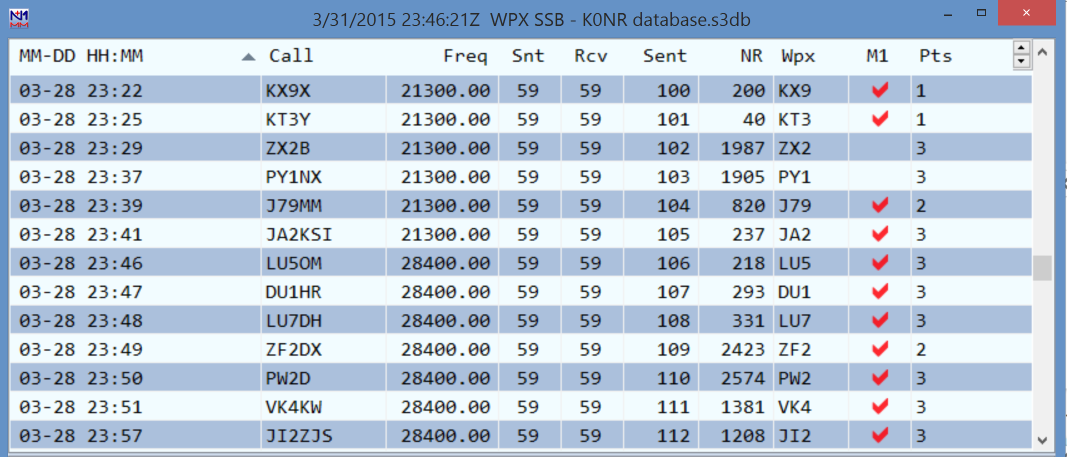 Last weekend, I had a fun time working the CQ WPX contest on SSB. I’ve always liked the format of the contest with the callsign prefix as the score multiplier (e.g., K1, K2, W1, W2, VE1, VE2 are all multipliers). Its like every new contact is a multiplier. This contest attracts plenty of DX but unlike some DX contests, everyone works everyone.
Consistent with the contest, the CQ WPX Awards Program issues operating awards based on callsign prefixes. The initial mixed mode (CW, SSB, digital) award requires confirmed contacts with 400 different prefixes. Back in the 20th century, I kept track of my confirmed contacts for WPX but lost interest along the way. I am sure I’ve worked more than 400 prefixes but the challenge was getting them all confirmed. More recently, the ARRL Logbook of the World (LoTW) added support for the CQ WPX Awards, so I started paying attention again, watching my CQ WPX total grow. I am not a big awards chaser but I have found value in using them as a specific goal to motivate me to get on the air.
Right before the CQ WPX contest, I had 380 prefixes confirmed via LoTW, so I figured that if I worked a few new ones during the contest, I could punch through 400 without too much trouble. I used my signature HF slacker approach at the cabin, using the Yaesu FT-950 to push 100 watts of RF power to wire antennas in the trees. For 40m, 20m and 15m, I used a trap-dipole antenna and for 10m I used a newly built ladder-line j-pole mounted vertically.
On Saturday, the propagation on the 10m band was smokin’ hot, strong signals from all continents. The 10m j-pole performed well. It was an absolute blast to easily work into Africa, Europe, South America, Australia, New Zealand and Asia. The 15m and 20m bands were also very productive. My approach was to tune around, looking for new prefixes to add to my confirmed total. Propagation was not as good on Sunday but still respectable but I only operated a few hours.
After the contest, I submitted my log to the contest web site and loaded my contacts into LoTW (188 QSOs and 157 prefixes). Immediately, I received two new confirmed prefixes. Over the next few hours, I checked back to watch my CQ WPX confirmed total climb on LoTW. It did not take long before it passed through 400 (and the total is still climbing). I will admit that I really liked the instant gratification of seeing my QSOs immediately confirmed.
That’s when it hit me: I am done with paper QSL cards. The amount of time and effort it takes to get 400 paper cards in my hand is just not worth it. It is soooooo 20th century.
Disclaimer: Actually, I still enjoy and use paper QSL cards…they are now just a secondary activity for me.
The post CQ WPX, LoTW and the End of QSL Cards appeared first on The KØNR Radio Site.
Today’s Space Weather Forecast Discussion (2015 Mar 31 1230 UTC)
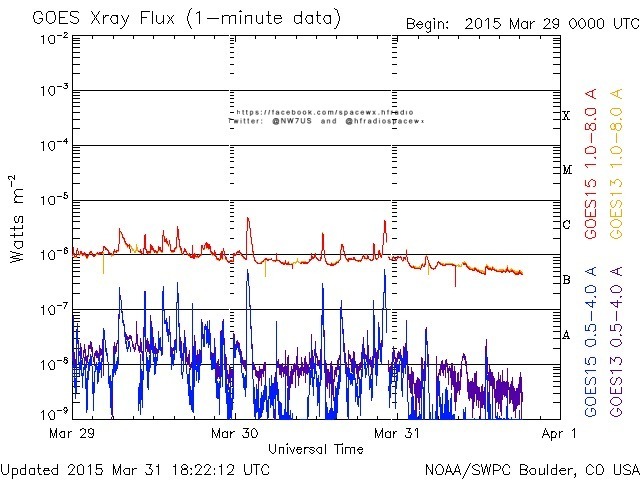
Here is the current forecast discussion on space weather and geophysical activity, issued 2015 Mar 31 1230 UTC.
Solar Activity
24 hr Summary: Solar activity was at low levels with C-flare activity from both Regions 2303 (N18, L=065) and 2305 (S10W58, Dho/beta). The largest flare of the period was a C4 at 30/2205 from Region 2303 just beyond the NW limb. Slight decay was observed in the leading spots of Region 2315 (S20W36, Dro/beta) and the trailing spots in Region 2305. No Earth-directed coronal mass ejections were observed.
Forecast: Solar activity is likely to be at low levels with a slight chance for an isolated M-class (R1-R2, Minor-Moderate) flare for day one (31 Mar). An increased chance for M-class activity is expected by days two and three (01-02 Apr) as old Regions 2302 (N12, L=189) and 2297 (S17, L=196) are expected to return.
Energetic Particle
24 hr Summary: The greater than 2 MeV electron flux at geosynchronous orbit was at normal levels. The greater than 10 MeV proton flux at geosynchronous orbit remained at background levels.
Forecast: The greater than 2 MeV electron flux at geosynchronous orbit is forecast to be at normal to moderate levels all three days (31 Mar -02 Apr) The greater than 10 MeV proton flux at geosynchronous orbit is expected to be at or near background conditions (Below S1-Minor) for the forecast period.
Solar Wind
24 hr Summary: Solar wind speed at the ACE spacecraft for the majority of the period was in the mid-300 km/s range but increased to near 400 km/s after 0730 UTC. Phi was negative. Bz was at or above -4 nT and Bt was less than 7 nT through 0730 UTC when it increased to near 16 nT. The increase in activity is likely due to the onset of a coronal hole high speed stream (CH HSS).
Forecast: Continued enhancement of solar wind parameters is anticipated on day one (31 Mar) and remain enhanced through day three (02 Apr) as the CH HSS becomes geoeffective.
Geospace
24 hr Summary: The geomagnetic field was at quiet levels.
Forecast: Unsettled to active conditions are expected to dominate through day three (02 Apr) due to CH HSS effects. trans-equatorial high speed stream becomes geoeffective.
Don’t forget to visit our live space weather and radio propagation web site, at: http://SunSpotWatch.com/
Live Aurora mapping is at http://aurora.sunspotwatch.com/
If you are on Twitter, please follow these two users:
+ https://Twitter.com/NW7US
+ https://Twitter.com/hfradiospacewx
Get the space weather and radio propagation self-study course, today. Visit http://nw7us.us/swc for the latest sale and for more information!
We’re on Facebook: http://NW7US.us/swhfr
Today’s Solar and Geophysical Activity (2015 Mar 31 18:30 UTC)
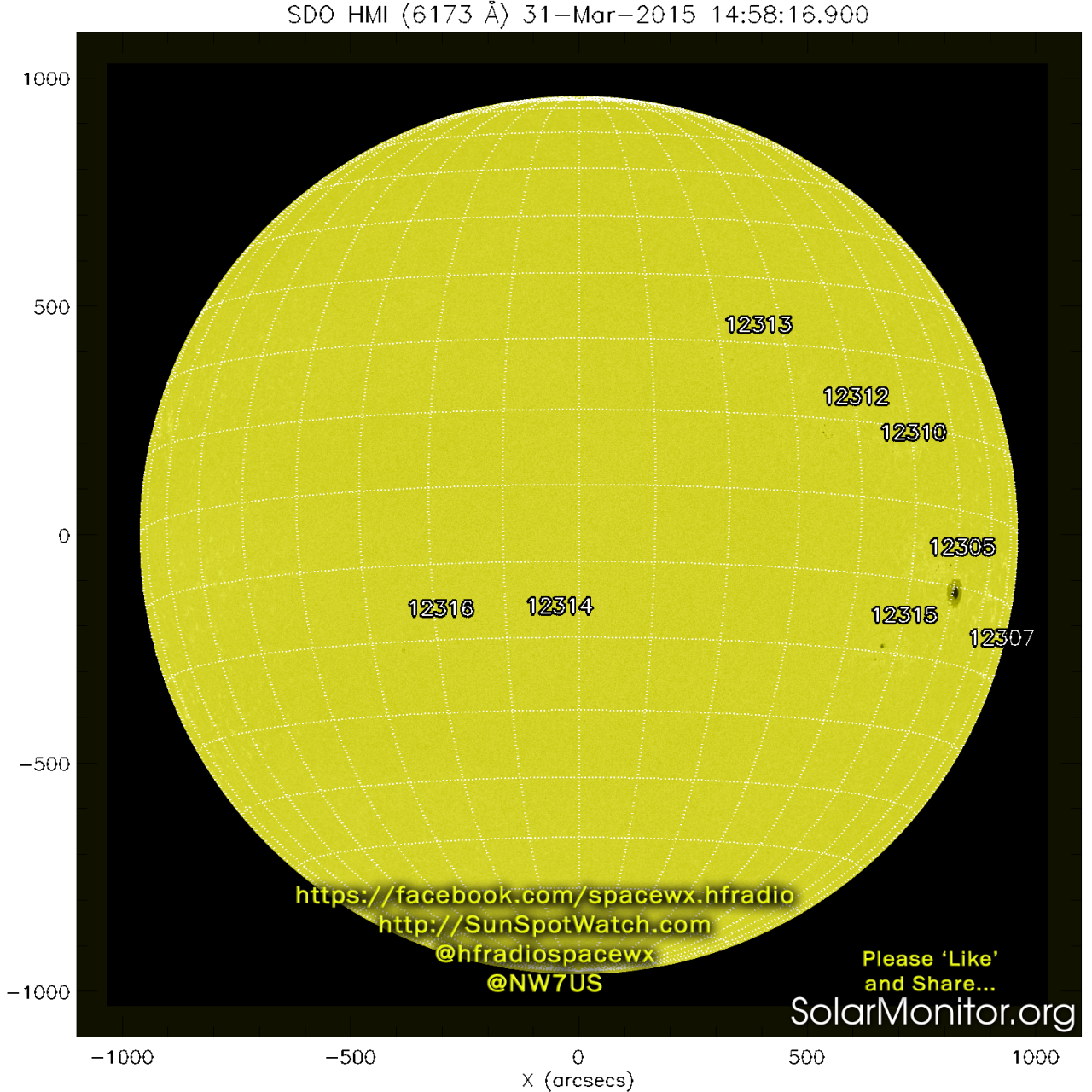
Daily solar report: Current Sunspot Cycle 24 Activity and Space Weather
Sunspot count: Sun Spots: 56 as of 03/30/2015
10.7-cm Radio Flux: 134 SFU (SFU=Solar Flux Units)
Estimated Planetary A-index (Ap): 5 | K-index (Kp): 2
Solar Wind: 405 km/s at 16.0 protons/cm3, Bz is 2.0 nT
(Mar 31, 2015 at 1820 UT)
X-ray Solar Flares:
6h hi [C4.7][0138Z 03/30] 24h hi [C4.7][0138Z 03/30]
Background X-ray Level, Last Six Days
Mar 30 2015 :: B6.6
Mar 29 2015 :: B9.1
Mar 28 2015 :: B7.9
Mar 27 2015 :: B5.0
Mar 26 2015 :: B4.5
Mar 25 2015 :: B5.4
Global HF Propagation Conditions for 1800Z on 31 Mar, 2015
High Latitude: Fair
Middle Latitude: Normal
Low Latitude: Normal
Geomagnetic Latitude Ranges: High: 60-90 degrees, Middle: 20-60 degrees, Low: 0-20 degrees
For live data and images, visit http://SunSpotWatch.com
Get the space weather and radio propagation self-study course, today. Visit http://nw7us.us/swc for the latest sale and for more information!
This report has been prepared by your space weather and radio propagation reporter, Tomas ( amateur radio operator, NW7US, http://NW7US.us )
We’re on Facebook: http://NW7US.us/swhfr
Today’s Plot-Graph of Solar, Ionospheric, and Geomagnetic Indices (31 March 2015)
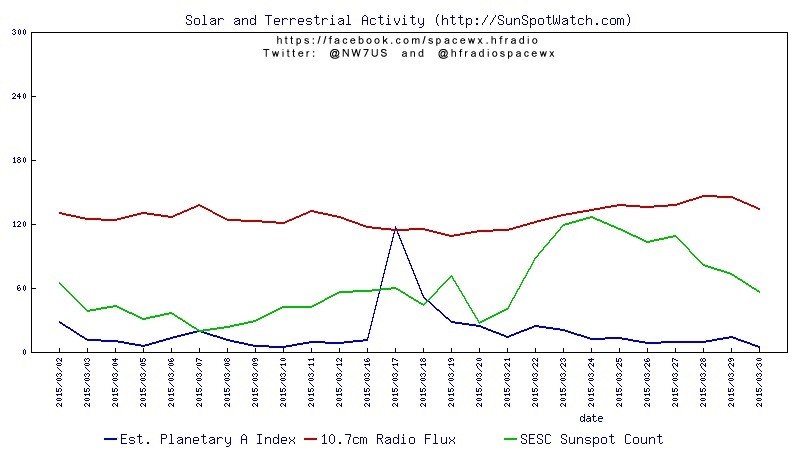
Today’s graph, plotting the SESC sunspot number, the 10.7cm Radio Flux, and the Estimated Planetary A Index, for the last 30 days.
The numbers are:
Date | Sunspots | 10.7-cm Flux | Ap
==========================================
2015/03/30 | 56 | 134 | 5
2015/03/29 | 73 | 145 | 14
2015/03/28 | 82 | 146 | 9
2015/03/27 | 109 | 138 | 9
2015/03/26 | 103 | 136 | 8
2015/03/25 | 115 | 138 | 13
2015/03/24 | 127 | 133 | 12
2015/03/23 | 119 | 128 | 21
2015/03/22 | 88 | 122 | 24
2015/03/21 | 40 | 114 | 14
2015/03/20 | 27 | 113 | 24
2015/03/19 | 71 | 109 | 28
2015/03/18 | 44 | 115 | 52
2015/03/17 | 60 | 114 | 117
2015/03/16 | 57 | 117 | 11
2015/03/12 | 56 | 127 | 8
2015/03/11 | 42 | 132 | 9
2015/03/10 | 42 | 121 | 5
2015/03/09 | 29 | 123 | 6
2015/03/08 | 23 | 124 | 11
2015/03/07 | 20 | 138 | 20
2015/03/06 | 37 | 127 | 13
2015/03/05 | 31 | 130 | 6
2015/03/04 | 43 | 124 | 10
2015/03/03 | 38 | 125 | 11
2015/03/02 | 65 | 130 | 28
For complete live data and images visit http://SunSpotWatch.com
Be sure to share this post, to spread the love!
We’re on Facebook: http://NW7US.us/swhfr
The future of HF broadcasters
Deutsche Welle (DW) is closing its last relay station, which is in Kigali, Rwanda. In recent years DW like many shortwave broadcasters, has been facing financial cutbacks. Also there are far fewer broadcasters using shortwaves these days.
As a youngster in the 1960s, I recall shortwaves crowded with AM broadcast stations, many from all over the world transmitting in English, with their distinctive interval signals. There was a magic about shortwave broadcasting back then. Quite a few could be copied with very simple receivers too. There is something quite nostalgic about listening again to those long-gone interval signals from behind the Iron Curtain. I remember getting some excellent freebees from China back in the early 1980s. Of course, it was all to spread the propaganda. All I really wanted was their QSL card!
These days, users are often reached using the internet. Of course, it begs the question, “who is now filling the empty, vacated channels?” In the long run amateur radio might gain some allocations, although the noise floor on HF is increasing too. SMPUs, cable TV and numerous other sources are mainly to blame.
See http://www.dw.de/deutsche-welle-closes-kigali-outpost/a-18340960.

Pixie Files
 |
| My assembled 40m Pixie |
The Pixie is a very simple HF transceiver. Usual power out is in the 200-1000mW region, depending on band and DC power source. It was first developed some years ago but the basic concept is using a PA transistor as a mixer in a simple direct-conversion receiver. On TX this is used as the TX PA.
Being simple, it has a number of limitations but it certainly works. A major issue can be AM broadcast breakthrough, although my 40m version is perfectly usable. I was very impressed with my little kit that came with all parts including a silk-screened PCB, all sockets and a crystal. It needed low-Z Walkman type headphones, a morse key and battery – that was all. On 40m the sensitivity is pretty good with 0.5uV clearly audible and my RF power out is around 400mW. A lack of both RF and AF RX selectivity is also noticeable.
Kits are available from several sources at prices that are hard to beat. I recently bought a kit for $10 with free airmail from China. It is available for less than half this price I subsequently found out. Unbelievable for a fully functional HF transceiver. Of course, being so simple you may prefer just to build it dead-bug fashion. I bought a kit as I wanted to see how my building skills were.
As a mature design, it has been through several iterations, some improve the basic design, but most do so at the expense of increased complexity. You’d be hard pressed to find a circuit for a complete HF CW transceiver much simpler.














