Archive for the ‘hf’ Category
 Weekly Propagation Summary – 2016 Apr 25 16:10 UTC
 April 25th, 2016 |
  Author:
Here is this week’s space weather and geophysical report, issued 2016 Apr 25 0446 UTC.
Highlights of Solar and Geomagnetic Activity 18 – 24 April 2016
Solar activity was high on 18 Apr due to an M6/1f flare observed at 18/0029 UTC from old Region 2529 (N09, L=342, class/area Eki/850 on 11 Apr). Type II (1869 km/s) and Type IV radio sweeps were observed in conjunction with this event, as well as a 120 sfu Tenflare. Activity dropped to low levels on 19 Apr with a C1/Sf observed at 19/2302 UTC. Very low levels were observed for the remainder of the period after the region departed the disk.
No proton events were observed at geosynchronous orbit.
The greater than 2 MeV electron flux at geosynchronous orbit was at normal to moderate levels throughout the period.
Geomagnetic field activity was mostly quiet on 18-21 Apr. Quiet to unsettled conditions were observed on 22-24 Apr. Isolated active periods were observed on 22 and 24 Apr along with an isolated minor storm period on 23 Apr due to CH HSS effects.
Forecast of Solar and Geomagnetic Activity 25 April – 21 May 2016
Solar activity is expected to be very low to low for the majority of the period with a chance for M-class flares from 03-16 May due to the return of old Region 2529.
No proton events are expected at geosynchronous orbit.
The greater than 2 MeV electron flux at geosynchronous orbit is expected to be at normal to moderate levels with the exception of 01-03 May and 10-13 May following recurrent CH HSS events.
Geomagnetic field activity is expected to be quiet to unsettled on 25-26 Apr as CH HSS effects subside followed by quiet conditions on 27-28 Apr. Quiet to unsettled conditions are expected on 29 Apr to 01 May with active periods likely due to effects from a recurrent, negative polarity CH HSS. An isolated minor storm period is possible on 30 Apr. Mostly quiet conditions are expected on 02-08 May with unsettled to active periods possible on 04 May due to a SSBC. Quiet to active levels are expected on 09-11 May with minor storm periods likely due to negative polarity CH HSS effects. Mostly quiet conditions are expected from 12-18 May. Isolated unsettled to active periods are possible on 14 May due to another SSBC. Quiet to unsettled conditions are expected from 19-21 May with isolated active periods possible due to effects from a recurrent, positive polarity CH HSS.
Don’t forget to visit our live space weather and radio propagation web site, at: http://SunSpotWatch.com/
Live Aurora mapping is at http://aurora.sunspotwatch.com/
If you are on Twitter, please follow these two users: + https://Twitter.com/NW7US + https://Twitter.com/hfradiospacewx
Get the space weather and radio propagation self-study course, today. Visit http://nw7us.us/swc for the latest sale and for more information!
Check out the stunning view of our Sun in action, as seen during the last five years with the Solar Dynamics Observatory (SDO): https://www.youtube.com/watch?v=zXN-MdoGM9g
We’re on Facebook: http://NW7US.us/swhfr
Weekly Propagation Summary – 2016 Apr 18 16:10 UTC
Here is this week’s space weather and geophysical report, issued 2016 Apr 18 0325 UTC.
Highlights of Solar and Geomagnetic Activity 11 – 17 April 2016
Solar activity was at low levels throughout the period. Region 2529 (N09, L=342, class/area Eki/850 on 11 Apr) produced all of the C-class activity, the largest event a C5/Sf at 16/1958 UTC. An associated CME was observed off the west limb but was determined not to be Earth-directed.
No proton events were observed at geosynchronous orbit.
The greater than 2 MeV electron flux at geosynchronous orbit was at normal levels on 11 and 12 April. High levels were reached from 13-18 April following coronal hole high speed stream (CH HSS) effects.
Geomagnetic field activity was at quiet levels on 11 April. Unsettled to minor storm conditions were observed on 12-14 April due to effects from a negative polarity CH HSS. Active conditions continued into early 15 April but decreased to mostly quiet levels through midday on 16 April. A weak CME moved through late on 16 April increasing activity to unsettled to active levels. Quiet to active conditions continued into 17 April as CME effects subsided and a co-rotating interaction region (CIR) ahead of an approaching positive polarity CH HSS.
Forecast of Solar and Geomagnetic Activity 18 April – 14 May 2016
Solar activity is expected to be low with a slight chance for M-class flares on 18-20 April. As Region 2529 exits the west limb, activity is expected to decrease to very low levels with a chance for C-class activity from 21 April to 02 May. Low levels are expected to return from 03-14 May due to the return of old Region 2529.
No proton events are expected at geosynchronous orbit.
The greater than 2 MeV electron flux at geosynchronous orbit is expected to be at normal to moderate levels with the exception of 26-28 April, 01-03 May and 10-13 April following recurrent CH HSS events.
Geomagnetic field activity is expected to be unsettled to active on 18-19 April followed with quiet to unsettled levels on 20 April due to effects from a positive polarity CH HSS. Mostly quiet conditions are expected on 21-22 April. Unsettled conditions are expected on 23-26 April with isolated active periods likely due to a second recurrent, positive polarity CH HSS. Mostly quiet conditions are expected from 27-28 April. Unsettled to active conditions are anticipated on 29-30 April with minor storm periods likely on 29 April as a negative polarity HSS becomes geoeffective. Mostly quiet conditions are expected from 01-08 May with the exception of possible unsettled to active periods on 04 May due to an SSBC that has affected us the last few rotations. Unsettled to active conditions are expected on 09-11 May with minor storm periods likely as a recurrent negative polarity CH HSS moves into geoeffective position. Mostly quiet conditions are expected on 12-13 May followed by possible unsettled to active conditions on 14 May as a CIR impacts the Earth.
Don’t forget to visit our live space weather and radio propagation web site, at: http://SunSpotWatch.com/
Live Aurora mapping is at http://aurora.sunspotwatch.com/
If you are on Twitter, please follow these two users: + https://Twitter.com/NW7US + https://Twitter.com/hfradiospacewx
Get the space weather and radio propagation self-study course, today. Visit http://nw7us.us/swc for the latest sale and for more information!
Check out the stunning view of our Sun in action, as seen during the last five years with the Solar Dynamics Observatory (SDO): https://www.youtube.com/watch?v=zXN-MdoGM9g
We’re on Facebook: http://NW7US.us/swhfr
Thirty Minutes of Dazzle: The Sun in UHD 4K by SDO (NASA)
Take a front-seat view of the Sun in this 30-minute ultra-high definition movie in which NASA SDO gives us a stunning look at our nearest star.
This movie provides a 30-minute window to the Sun as seen by NASA’s Solar Dynamics Observatory (SDO), which measures the irradiance of the Sun that produces the ionosphere. SDO also measures the sources of that radiation and how they evolve.
SDO’s Atmospheric Imaging Assembly (AIA) captures a shot of the sun every 12 seconds in 10 different wavelengths. The images shown here are based on a wavelength of 171 angstroms, which is in the extreme ultraviolet range and shows solar material at around 600,000 Kelvin (about 1 million degrees F.) In this wavelength it is easy to see the sun’s 25-day rotation.
The distance between the SDO spacecraft and the sun varies over time. The image is, however, remarkably consistent and stable despite the fact that SDO orbits Earth at 6,876 mph and the Earth orbits the sun at 67,062 miles per hour.
Scientists study these images to better understand the complex electromagnetic system causing the constant movement on the sun, which can ultimately have an effect closer to Earth, too: Flares and another type of solar explosion called coronal mass ejections can sometimes disrupt technology in space. Moreover, studying our closest star is one way of learning about other stars in the galaxy. NASA’s Goddard Space Flight Center in Greenbelt, Maryland. built, operates, and manages the SDO spacecraft for NASA’s Science Mission Directorate in Washington, D.C.
Charged particles are created in our atmosphere by the intense X-rays produced by a solar flare. The solar wind, a continuous stream of plasma (charged particles), leaves the Sun and fills the solar system with charged particles and magnetic field. There are times when the Sun also releases billions of tons of plasma in what are called coronal mass ejections. When these enormous clouds of material or bright flashes of X-rays hit the Earth they change the upper atmosphere. It is changes like these that make space weather interesting.
Sit back and enjoy this half-hour 4k video of our Star! Then, share. 🙂
73 dit dit
Weekly Propagation Summary – 2016 Apr 11 16:10 UTC
Here is this week’s space weather and geophysical report, issued 2016 Apr 11 0439 UTC.
Highlights of Solar and Geomagnetic Activity 04 – 10 April 2016
Solar activity was at very low levels on 04-05 April with low levels observed from 06-10 April as Region 2529 (N09, L=341, class/area, Eki/820 on 10 April) began its transit across the solar disk. The region emerged as a large bipolar group that produced 15 low level C-class flares during the period. The largest flare was a long-duration C2 at 09/1342 UTC, however it also produced another long-duration C1 flare at 10/0934 UTC. Other activity included a 10 degree filament eruption, centered near N18E29, that erupted beginning at approximately 10/1000 UTC. An associated CME was observed off the NE limb at 10/1100 UTC. The CME is currently being analyzed, however it is likely that little to no impacts will occur given its location and direction.
No proton events were observed at geosynchronous orbit.
The greater than 2 MeV electron flux at geosynchronous orbit was at high levels from 04-07 April with normal levels observed from 08-10 April. The highest flux value observed for the period was 3,924 pfu at 05/1605 UTC.
Geomagnetic field activity ranged from quiet to (G1) minor storm levels. Solar wind parameters were at mostly nominal levels through the period until a solar sector boundary crossing (SSBC) occurred around 07/1737 UTC. During this time, total field increased to a maximum of 13 nT while the Bz component deflected southward for approximately 8 hours reaching a maximum of -13 nT. The geomagnetic field responded with G1-minor storm levels late on 07 April through early on 08 April.
Forecast of Solar and Geomagnetic Activity 11 April – 07 May 2016
Solar activity is expected to be at low levels with a slight chance for M-class (R1-R2, Minor-Moderate) flares until Region 2529 rotates off the NW limb on 21 April. Very low levels are expected from 22 April through 03 May. Low levels are expected once again from 04-07 May with the return of Region 2529.
No proton events are expected at geosynchronous orbit.
The greater than 2 MeV electron flux at geosynchronous orbit is expected to be at high levels on 15-18, 24-28, and 30 April – 02 May due to coronal hole high speed stream (CH HSS) influence. Normal to moderate levels are expected for the remainder of the outlook period.
Geomagnetic field activity is expected to be at unsettled to active levels on 12-15, 23-26, and 29-30 April with G1-minor storm levels likely on 13-14 and 29 April due to recurrent CH HSS activity. Unsettled to active levels are also likely on 04 May due to activity associated with an SSBC.
Don’t forget to visit our live space weather and radio propagation web site, at: http://SunSpotWatch.com/
Live Aurora mapping is at http://aurora.sunspotwatch.com/
If you are on Twitter, please follow these two users: + https://Twitter.com/NW7US + https://Twitter.com/hfradiospacewx
Get the space weather and radio propagation self-study course, today. Visit http://nw7us.us/swc for the latest sale and for more information!
Check out the stunning view of our Sun in action, as seen during the last five years with the Solar Dynamics Observatory (SDO): https://www.youtube.com/watch?v=zXN-MdoGM9g
We’re on Facebook: http://NW7US.us/swhfr
DX, Artificial Scarcity and The List
 Economists see scarcity, supply and demand as fundamental forces in a market. Items that are scarce demand a higher price while items that are easy to obtain tend to have a lower price. A diamond is an example of something that is relatively scarce (and in demand) so it commands a high price. In contrast, wood is generally available and is much less expensive than diamonds.
Then there’s the concept of artificial scarcity. If some items can be made scarce (or even just appear scarce), the price will tend to increase. For example, if I own all of the banana trees on an isolated island, I could reduce the available supply of bananas and command a higher price from all of the banana eaters there. Or maybe I start screening bananas for quality and I put a special sticker on them to brand them as special.
 We have a case of artificial scarcity in ham radio, called the DXCC list. This list defines what is considered a separate country when chasing DX. (Actually, the correct term is entity, not country.) For example, Hawaii (KH6) and Alaska (KL7) are considered separate entities even though they are part of the United States. (See Is Alaska a Country?) For someone chasing DXCC entities, because Alaska is on The List, a radio contact with Alaska becomes more desirable. It’s kind of like putting a “premium sticker” on a banana to indicate that it is special.
In my imagination, the DXCC list resulted from a bunch of hams sitting around drinking beer and bragging about how many countries they had worked. One guy, Larry says he just worked Hawaii, bringing his total to 125 countries. His buddy Leroy says, “You can’t count Hawaii because it’s part of the US of A.” To which Larry says, “You bet I can count Hawaii…and Texas too. It’s a whole ‘nuther country.” Clearly, we are going to need an official list to keep track of what counts as a country. A more credible version of how the list got established is captured in this article from the October 1935 QST.
Of course, the two main factors that drive scarcity of DXCC entities is the ham radio population and ease of access. Radio contacts are easy to make with entities that have an active ham population. If an entity doesn’t have many active hams but is easy to get to, someone will probably put that location on the air once in a while. On the other hand, some locations are unpopulated and really difficult to get to. These are not only on The List, they are on The Most Wanted List.
Kingman Reef (KH5) was just deleted from The List, instantly changing it from one of the most desired contacts in amateur radio to a big giant Why Bother. You see, there used to be 340 countries on the list but now there’s only 339. Kingman Reef will now be considered part of Palmyra/Jarvis, so it still has value for DXCC, just a lot less.
As I write this article, there is a major DXpedition (VKØEK) operating from Heard Island, an unpopulated island near Antartica. The only reason those guys are there is that Heard Island is on The List. Take a look at their web site and you’ll see how much time and energy has gone into activating this lonely island. Drop it from the list and suddenly a radio contact with this location is a lot less in demand.
So try to keep this all in perspective. There are lots of radio contacts out there to be made, some more interesting and desirable than others. It is appropriate and necessary that we have the DXCC list, to provide consistency in how we count countries, I mean entities. But really, it all traces back to Larry and Leroy arguing about who worked the most countries.
Thanks to the dedicated DXpeditioners that put these rare locations on the air.
73, Bob K0NR
The post DX, Artificial Scarcity and The List appeared first on The KØNR Radio Site.
Weekly Propagation Summary – 2016 Apr 04 16:10 UTC

Here is this week’s space weather and geophysical report, issued 2016 Apr 04 0340 UTC.
Highlights of Solar and Geomagnetic Activity 28 March – 03 April 2016
Solar activity was at low levels on 28 March due to an isolated C2 flare from Region 2524 (N15, L=277, class/area Eho/340 on 19 March) at 0228 UTC. The rest of the period was dominated by very low levels as Region 2526 (S05, L=178, class/area, Cso/200 on 29 Mar) was the only spot group on the disk until the emergence of new flux on 03 April. No Earth-directed coronal mass ejections were observed during the period.
No proton events were observed at geosynchronous orbit.
The greater than 2 MeV electron flux at geosynchronous orbit was at normal to moderate levels throughout the period.
Geomagnetic field activity ranged from quiet to major storm levels (G2-Moderate) during the period. From 28-31 March, solar wind parameters indicated the influence of a positive polarity coronal hole high speed stream (CH HSS). Solar wind speeds increased from near 450 km/s at the beginning of the period to around 590 km/s by early on 30 March before declining to a low around 330 km/s by 02 April. Total field slowly declined from 8 nT early in the period to 3 nT by 01 April. The geomagnetic field responded with quiet to active levels on 28 and 30 March with quiet to unsettled levels on 29 and 31 March. Quiet conditions were observed on 01 April through midday on 02 April. At approximately 02/1344 UTC, a solar sector boundary crossing occurred into a negative (towards) sector followed by an increase in total field to a maximum of 18 nT at 02/1406 UTC while Bz reached a maximum negative deflection of -14 nT at 02/1522 UTC. Solar wind speed increased to near 540 km/s around 02/2131 UTC indicating the arrival of a co-rotating interaction region followed by another CH HSS. The geomagnetic field responded with unsettled to major storm levels (G2-Moderate) during the second half of 02 April. By 03 April, solar wind speed was in decline to around 400 km/s while total field measurements were near 6 nT. Quiet to active levels were observed on 03 April.
Forecast of Solar and Geomagnetic Activity 04 April – 30 April 2016
Solar activity is expected to be at very low to low levels for the forecast period.
No proton events are expected at geosynchronous orbit.
The greater than 2 MeV electron flux at geosynchronous orbit is expected to be at normal to moderate levels with high levels on 04, 06-10, 14-18, and 26-29 April in response to recurrent CH HSS activity.
Geomagnetic field activity is expected to be at unsettled to active levels from 05-08, 11-15, 24-27, and 30 April with (G1) minor storm levels likely on 13-14 and 30 April and (G2) moderate storm levels likely on 12 April due to recurrent CH HSS activity.
Don’t forget to visit our live space weather and radio propagation web site, at: http://SunSpotWatch.com/
Live Aurora mapping is at http://aurora.sunspotwatch.com/
If you are on Twitter, please follow these two users: + https://Twitter.com/NW7US + https://Twitter.com/hfradiospacewx
Get the space weather and radio propagation self-study course, today. Visit http://nw7us.us/swc for the latest sale and for more information!
Check out the stunning view of our Sun in action, as seen during the last five years with the Solar Dynamics Observatory (SDO): https://www.youtube.com/watch?v=zXN-MdoGM9g
We’re on Facebook: http://NW7US.us/swhfr
The Joys Of HF
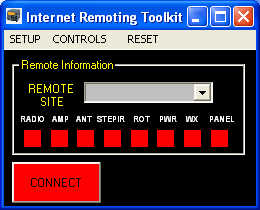 It seems that contesting clubs in Manitoba and New England want to show non-hams, new hams and all hams, the 'joys of HF radio'. In a beta test of their idea, called 'Discover the HF Experience', participants in Manitoba will have the opportunity to get on HF by operating K1K, in Massachusetts, remotely, from the Garden City Canada Inn located in Winnipeg, Manitoba, on Saturday, April 2nd.
Future events will take place in Massachusetts from the Yankee Clipper Contest Club's venue on April 10th and a much larger operation, featuring four operating positions at Dayton in May, at the ARRL's Expo site. Full details of all operations can be found here.
The idea was the brainchild of Gerry Hull, W1VE who, along with Cary Rubenfeld, VE4EA, has brought his idea to life.
“Our amateur population is at an all-time high, but most new hams are getting a Technician ticket, getting on VHF and UHF, and hanging out with like-minded friends,” Hull said. The limitations on what Technician licensees can do often leads to boredom, Hull said, “and they drop out of the hobby. They never get the exposure to HF ham radio, and as any veteran radio amateur can tell you, that’s a lifelong exploration.”
Now I fully concur that far too many of our newest amateurs land on VHF or UHF and never move, almost totally unaware of what HF radio is all about. Being exposed to HF radio is a great idea, yet ... and maybe I'm just old-fashioned, but I'm not sure that this 'first experience' is best done via remote operation. From my own initial exposure to ham radio, seeing the magic happen in a basement or attic radio shack, complete with glowing dials and a wall full of QSL's from all over the world, was enough to hook me for life. I'm pretty sure that same feeling can't be conveyed by sitting in front of a laptop and pushing a few keys.
I am not a fan of 'remotes' but from what I have seen, this may be one of the better examples and if it grabs and convinces even a few to explore HF on their own, that would be a good thing ... then all we'd have to do is get them on CW !













