Archive for the ‘hf’ Category
 Weekly Propagation Summary – 2016 Aug 22 16:10 UTC
 August 22nd, 2016 |
  Author:
Here is this week’s space weather and geophysical report, issued 2016 Aug 22 0524 UTC.
Highlights of Solar and Geomagnetic Activity 15 – 21 August 2016
Solar activity was at low levels on 15 August due to an isolated C1 flare at 15/0023 UTC from Region 2578 (N09, L=084, class/area Cro/020 on 18 Aug). Very low levels were observed from 16-21 August. Although Regions 2574 (N05, L=173, class/area Dho/290 on 09 Aug), 2576 (S15, L=160, class/area Hsx/140 on 10 Aug), 2577 (N03, L=164, class/area Dso/130 on 12 Aug), and 2578 were on the visible disk during the period, the regions appeared to be in slow decay. No Earth-directed coronal mass ejections were observed.
No proton events were observed at geosynchronous orbit.
The greater than 2 MeV electron flux at geosynchronous orbit was at high levels on 15-16 August, moderate levels on 17 and 19-21 August and normal levels on 18 August. The largest flux of the period was 9,570 pfu observed at 15/1605 UTC.
Geomagnetic field activity was at mostly quiet to unsettled levels with an isolated active period observed on 21 August due to a pair of weak, negative polarity coronal hole high speed streams (CH HSS). Quiet levels were observed on 15 August under a nominal solar wind regime. By early on 17 August, solar wind speed increased to 435 km/s while total field increased to near 9 nT. Quiet to unsettled levels were observed from 16-18 August with quiet levels on 19-20 August. Solar wind speed decreased slowly until midday on 21 August when another CH HSS became geoeffective. The geomagnetic field responded with quiet to active levels on 21 August.
Forecast of Solar and Geomagnetic Activity 22 August – 17 September 2016
Solar activity is expected to be at very low to low levels through the forecast period (22 Aug-17 Sep).
No proton events are expected at geosynchronous orbit.
The greater than 2 MeV electron flux at geosynchronous orbit is expected to be at normal to moderate levels with high levels likely on 26-28 August and from 31 August-12 September as a result of recurrent CH HSS activity.
Geomagnetic field activity is expected to be at unsettled to active levels from 23-25 August, 29 August-08 September, 13-14 September, and again on 17 September with G1 (Minor) storm levels likely on 30-31 August due to recurrent CH HSS activity.
Don’t forget to visit our live space weather and radio propagation web site, at: http://SunSpotWatch.com/
Live Aurora mapping is at http://aurora.sunspotwatch.com/
If you are on Twitter, please follow these two users: + https://Twitter.com/NW7US + https://Twitter.com/hfradiospacewx
Get the space weather and radio propagation self-study course, today. Visit http://nw7us.us/swc for the latest sale and for more information!
Check out the stunning view of our Sun in action, as seen during the last five years with the Solar Dynamics Observatory (SDO): https://www.youtube.com/watch?v=zXN-MdoGM9g
We’re on Facebook: http://NW7US.us/swhfr
Weekly Propagation Summary – 2016 Aug 15 16:10 UTC
Here is this week’s space weather and geophysical report, issued 2016 Aug 15 0115 UTC.
Highlights of Solar and Geomagnetic Activity 08 – 14 August 2016
Solar activity was at very low to low levels with C-class activity observed on 08, 09, 11 and 14 Aug. Region 2574 (N05, L=173, class/area Dho/290 on 09 Aug) was the most active region recording six C-class flares. The largest of these was a C8/Sf observed at 09/0042 UTC. Regions 2571 (N13, L=268, class/area Dac/200 on 08 Aug) and 2572 (N13, L=320, class/area Dao/110 on 07 Aug) each produced weak C-class flares on 08 Aug. The period ended with a C1 flare observed at 14/1936 UTC from an unnumbered region on the NE limb. A few CMEs were observed during the period, but none had an Earth-directed component.
No proton events were observed at geosynchronous orbit.
The greater than 2 MeV electron flux at geosynchronous orbit was at high levels throughout the summary period. A maximum of 12,032 pfu was observed at 13/1745 UTC.
Geomagnetic field activity was at quiet to active levels on 08 Aug through early on 12 Aug due to effects from a positive polarity CH HSS. Quiet levels were observed for the remainder of the period. Solar wind speeds reached a maximum speed of about 675 km/s at 10/0830 UTC. Bt ranged between 3-8 nT while the Bz component varied between +7 to -5 nT early in the period. The phi angle was in a predominately positive sector throughout the period.
Forecast of Solar and Geomagnetic Activity 15 August – 10 September 2016
Solar activity is expected to be very low with a chance for C-class activity through the outlook period.
No proton events are expected at geosynchronous orbit.
The greater than 2 MeV electron flux at geosynchronous orbit is expected to be at high levels on 15, 19-23, 26-28, 31 Aug and 01-10 Sep. Normal to moderate levels are expected for the remainder of the outlook period.
Geomagnetic field activity is expected to be at G1 (Minor) storm levels on 16 and 30-31 Aug due to recurrent CH HSS activity. Unsettled to active levels are expected on 15, 17-19, 24-25 Aug and 01-08 Sep, all due to recurrent CH HSS activity. Mostly quiet conditions are expected for the remainder of the outlook period.
Don’t forget to visit our live space weather and radio propagation web site, at: http://SunSpotWatch.com/
Live Aurora mapping is at http://aurora.sunspotwatch.com/
If you are on Twitter, please follow these two users: + https://Twitter.com/NW7US + https://Twitter.com/hfradiospacewx
Get the space weather and radio propagation self-study course, today. Visit http://nw7us.us/swc for the latest sale and for more information!
Check out the stunning view of our Sun in action, as seen during the last five years with the Solar Dynamics Observatory (SDO): https://www.youtube.com/watch?v=zXN-MdoGM9g
We’re on Facebook: http://NW7US.us/swhfr
Remembering The ‘Woodpecker’
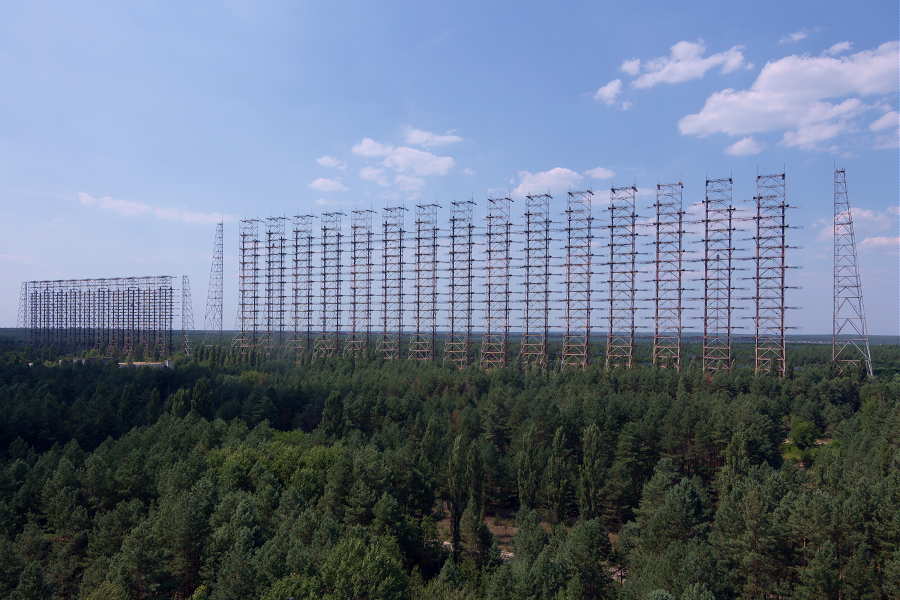
Those of you that have been hams for a long time will no doubt recall the Russian 'Woodpecker'. The 'Woodpecker' was a strong, fast repeating signal / racket that often wiped out amateur communications on 20m here in North America ... maybe other parts of the world as well.
Amateurs with yagis eventually determined that the signals (yes there was more than one it seemed) were coming from the USSR. The QRM was persistent and in spite of formal complaints being lodged via diplomatic channels, continued for many years ... from 1978- 1989. Some of the new transceivers built during the time actually had a 'WOODPECKER' position on the noise blanker switch, hopefully offering some relief to the problem.
For you younger folks, here's what Duga usually sounded like:
Several web searches brought up numerous descriptions of the Duga (Russian for 'arc' or 'bow') project, some with conflicting information. From what I can sort out, there were three Duga sites ... one near Chernobyl, another near Chernihiv and a third, much later, in Siberia. The first two (Duga and Duga-1) were in the Soviet Ukrainian SSR (now Ukraine) while the third was located near Komsolmosk-on-Amur in the Russian far east. One source indicates that the second Chernobyl site is often misidentified as the Duga-3 array and should be referred to as Duga-1, with Duga-2 being the Siberian location.
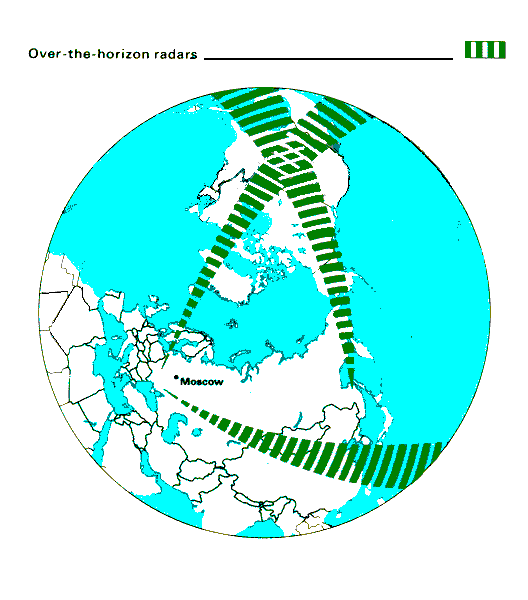
Initial speculation suggested this intrusive signal was some form of 'jammer' ... very common during the Cold War. It wasn't long before the true nature of Duga was thought more likely to be an 'over-the-horizon' (OTH) long-range radar system for detecting the launch of North American missiles aimed at the USSR. The three radar sites gave the Soviets good over-the-pole coverage as well as to the east, where it could also be utilized for tracking domestic rocket launches.
 |
| courtesy: http://www.globalsecurity.org/wmd/world/russia/steel-yard.htm |
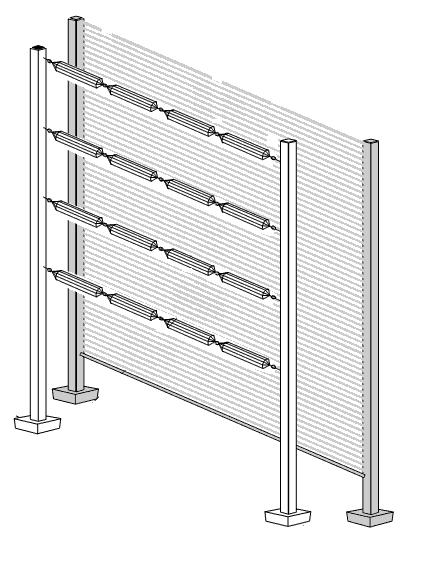
The antennas themselves appear to be phased dipole curtain arrays, commonly used in various configurations by shortwave HF broadcasters.
 |
| courtesy: http://www.antenna.be/hr.html |
Each site was paired with a receiving array ... remember, this was a radar system, with two of the three systems having the receiving array located tens of kilometers from the transmitter. The Chernobyl Duga is said to have had the receiving antenna located on site. Sources discussing physical size indicate the dimensions for the receiving array to be larger than those of the transmitting antenna. It seems possible then, that the pictures and videos commonly found are those of the receiving array and not of the transmitting antenna. It might make sense to have more gain on 'receive' than on 'transmit' as echoes from small targets many thousands of miles away would not be easy to detect. No matter what the actual case, I can only imagine the fun of hooking up an HF transceiver to one of these arrays during a DX contest on 20m CW!
The Chernobyl site shows two arrays, side-by-side ... possibly the larger being that used for receiving and the smaller one for transmitting. This antenna has been noted as a 30/10/2 array ... 2 bays, 30 dipoles wide and 10 high, 600 elements in all!
Further research tends to indicate that each dipole is what is called a 'Nadanenko' dipole. The main feature of this style was its cage-styled construction, giving the element a large diameter resulting in a broad bandwidth.
 |
| courtesy: https://shema.info/en/antenna/ |
 |
| courtesy: englishrussia.com |
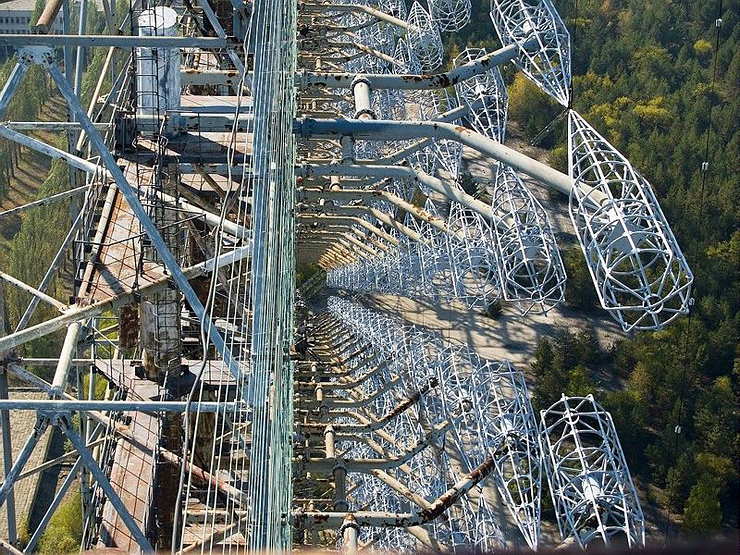
First, you see that there are two sets of arrays 15 driven elements wide by 10 driven elements high for a total of 600 elements! They are intermeshed and offset from each other by 1/2 wavelength both vertically and horizontally. There is a horizontal wire screen reflector behind the driven elements.
Some of the other things I noticed are ...
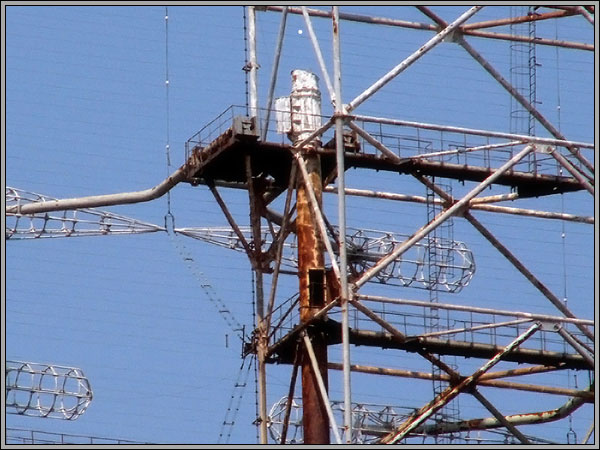
... you can see the open-wire feeds and reflector screen. Each set of collinear elements is fed individually with open wire line. There is a support line between each two bays of driven elements.
... that the reflector screen is supported on the sides by the stand-alone free-standing towers at each side of the array. (I had been wondering why they would have those towers next to the array like that. Now I know.)
... that the element supports are steel pipe instead of fiberglass (or something similar). Apparently, the shape of the radiators allows for the pipe supports to enter the element cages at the element low-impedance point which made the supports invisible to the antenna and also allowed for the supports to not radiate themselves.
 |
| courtesy: http://anzee.livejournal.com/65530.html |
The Duga system was operative between 7 and 19MHz, with 40kHz wide pulses, usually lasting for about seven minutes. The most common pulse rate was at ~10Hz but this sometimes varied. Power levels used often mention 10 megawatts but it's not clear if this was RF output, peak pulse power or ERP.
It's somewhat gratifying after all these years, to actually see close-up, where the Woodpecker signal started its journey around the world and to appreciate the superb engineering that went into these impressive structures ... but sad to see the last one in such a rusted state of decay and abandonment. It would be nice to hear it just one more time ... but please, only for a couple of minutes.
Weekly Propagation Summary – 2016 Aug 08 16:10 UTC
Here is this week’s space weather and geophysical report, issued 2016 Aug 08 0119 UTC.
Highlights of Solar and Geomagnetic Activity 01 – 07 August 2016
Solar activity was at very low to moderate levels. Very low levels occurred on 01-04 and 06 Aug with low levels on 05 Aug and low to moderate levels on 07 Aug. Region 2572 (N13, L=320, class/area Dao/110 on 07 Aug) produced a C1/Sf flare observed at 05/1012 UTC. On 07 Aug, activity increased to moderate levels with an impulsive M1 (R1-Minor) x-ray event observed at 07/1444 UTC from an active region just beyond the SW limb. 07 Aug also saw numerous C-class flares. Region 2571 (N12, L=267, class/area Dai/150 on 07 Aug) produced a C5 event at 07/2232 UTC. New Region 2573 (N08, L=177, class/area Dso/060 on 07 Aug) produced a C8/Sf at 07/1509 UTC. No Earth-directed CMES were observed during the summary period.
No proton events were observed at geosynchronous orbit.
The greater than 2 MeV electron flux at geosynchronous orbit was at moderate flux levels on 02-03 Aug and high flux levels on 01 and 04-07 Aug. The highest flux reading was 16, 206 pfu observed at 06/1445 UTC.
Geomagnetic field activity was at quiet to minor storm levels. The period began on 01 Aug at quiet levels under a nominal solar wind regime. Midday on 02 Aug, activity levels increased to unsettled to minor storm (G1-Minor) levels due to shock enhancement from the arrival of the 28 Jul CME coupled with a CIR in advance of a recurrent, positive polarity CH HSS. Solar wind speeds increased from about 310 km/s early on 02 Aug to near 550 km/s by midday on 03 Aug. Unsettled to minor storm levels persisted through 03 Aug.
Wind speeds increased further on 04-05 Aug with a peak speed of near 675 km/s recorded late on 05 Aug. Winds speeds began a slow decay on 06 Aug. Mostly unsettled to active conditions were observed on 04-06 Aug. By 07 Aug, wind speeds decreased to about 500 km/s as effects from the CH HSS waned. Mostly quiet to unsettled levels were observed on 07 Aug.
Forecast of Solar and Geomagnetic Activity 08 August – 03 September 2016
Solar activity is expected to be at low levels with a chance for M-class flares (R1-R2, Minor-Moderate) on 08-20 Aug due to the flare potential from Regions 2573 and 2574. Very low to low levels are expected on 21 Aug – 01 Sep. An increase to low levels with a chance for M-class flares (R1-R2, Minor-Moderate) are expected on 02-03 Sep with the return of Regions 2573 and 2574.
No proton events are expected at geosynchronous orbit.
The greater than 2 MeV electron flux at geosynchronous orbit is expected to be at high flux levels on 08-15, 22-23 and 26-28 Aug and again on 31 Aug-03 Sep due to recurrent CH HSS activity. Normal to moderate levels are expected for the remainder of the outlook period.
Geomagnetic field activity is expected to be at unsettled to G1 (Minor) storm levels on 08 Aug and again on 31 Aug due to recurrent CH HSS activity. Unsettled to active levels are expected on 09-11, 15-16, 18-19, 24-25, 29 and 30-31 Aug along with 01-03 Sep, all due to recurrent CH HSS activity. Mostly quiet conditions are expeced for the remainder of the outlook period.
Don’t forget to visit our live space weather and radio propagation web site, at: http://SunSpotWatch.com/
Live Aurora mapping is at http://aurora.sunspotwatch.com/
If you are on Twitter, please follow these two users: + https://Twitter.com/NW7US + https://Twitter.com/hfradiospacewx
Get the space weather and radio propagation self-study course, today. Visit http://nw7us.us/swc for the latest sale and for more information!
Check out the stunning view of our Sun in action, as seen during the last five years with the Solar Dynamics Observatory (SDO): https://www.youtube.com/watch?v=zXN-MdoGM9g
We’re on Facebook: http://NW7US.us/swhfr
Weekly Propagation Summary – 2016 Aug 01 16:10 UTC
Here is this week’s space weather and geophysical report, issued 2016 Aug 01 0511 UTC.
Highlights of Solar and Geomagnetic Activity 25 – 31 July 2016
Solar activity was very low throughout the period with the exception of a single C1 flare at 25/0909 UTC from departed Region 2567 (N05, L=166, class/area Dki/380 on 21 July). Region 2570 (N10E24, Axx/alpha) was the sole numbered sunspot for the majority of the period but was unimpressive and did not contribute any significant flaring. A 25 degree filament, centered near N01E06, was observed lifting off of the visible disk in SDO/AIA imagery beginning at 28/1620 UTC. ENLIL analysis showed an Earth-directed component with CME arrival expected early on 02 August.
No proton events were observed at geosynchronous orbit.
The greater than 2 MeV electron flux at geosynchronous orbit was at moderate levels on 25, 28-29 July and high levels on 26-27 and 30-31 July.
Geomagnetic field activity was at quiet to active levels on 25 July due to residual influence from a weak transient that arrived at Earth on 24 July. This shock enhancement was likely associated with flare activity from 20 July. Geomagnetic field activity was quiet on 26-27 July under a nominal solar wind regime. Quiet to active conditions were observed on 28-29 July after the arrival of a CIR followed by a transition into a negative polarity CH HSS. Wind speeds reached 600 km/s while total field (Bt) measurements were as high as 17 nT. Geomagnetic field activity returned to quiet conditions on 30-31 July.
Forecast of Solar and Geomagnetic Activity 01 August – 27 August 2016
Solar activity is expected to be at very low levels from 01-04 August. Low levels with a chance for M-class (R1-R2, Minor-Moderate) flares are expected from 05-19 August with the return of Regions 2565 and 2567. A return to very low levels is expected on 20-27 August.
No proton events are expected at geosynchronous orbit.
The greater than 2 MeV electron flux at geosynchronous orbit is expected to be at high levels on 08, 5-15, 18-22, 25-27 August due to recurrent CH HSS activity. Normal to moderate levels are expected for the remainder of the forecast period.
Geomagnetic field activity is expected to be at unsettled to active levels on 04-05, 10-11, 15-16, 24-25 August with G1 (Minor) storm levels likely on 03 August due to recurrent CH HSS activity. A CME associated with the eruptive filament from 28 July is likely to arrive early on 02 August causing unsettled to G2 (Moderate) storm levels. Quiet to unsettled conditions are expected for the remainder of the period.
Don’t forget to visit our live space weather and radio propagation web site, at: http://SunSpotWatch.com/
Live Aurora mapping is at http://aurora.sunspotwatch.com/
If you are on Twitter, please follow these two users: + https://Twitter.com/NW7US + https://Twitter.com/hfradiospacewx
Get the space weather and radio propagation self-study course, today. Visit http://nw7us.us/swc for the latest sale and for more information!
Check out the stunning view of our Sun in action, as seen during the last five years with the Solar Dynamics Observatory (SDO): https://www.youtube.com/watch?v=zXN-MdoGM9g
We’re on Facebook: http://NW7US.us/swhfr
Weekly Propagation Summary – 2016 Jul 25 16:10 UTC
Here is this week’s space weather and geophysical report, issued 2016 Jul 25 0218 UTC.
Highlights of Solar and Geomagnetic Activity 18 – 24 July 2016
Solar activity was low on 18-20 and 22 July with multiple C-class flares from Regions 2565 (N04,L=175, class/area Dho/320 on 16 July) and 2567 (N05, L=166, class/area Dki/380 on 21 July). The largest flare during that period was a C4.6 from Region 2567 at 20/2215 UTC. Moderate solar levels were observed on 21 and 24 July with four M-class flares observed from Region 2567. The largest flare during that period was an M2.0 observed at 24/0620 UTC. Activity reached high levels on 23 July with three M-class flares from Region 2567. The first was an M5.0, which peaked at 23/0211 UTC. The second was an M7.6/2b flare with an associated 310 sfu Tenflare. The final was an M5.5/3b, which peaked 15 minutes later at 23/0531 UTC had accompanying Type II (729 km/s shock velocity) and Type IV radio emissions, as well as a 900 sfu Tenflare. Two CMEs were observed in coronagraph imagery lifting off the west limb at 23/0524 UTC and 23/0548 UTC. Both CMEs were determined to not have an Earth-directed component.
No proton events were observed at geosynchronous orbit. However, a slight enhancement to near 1 pfu was observed at 23/0725 UTC due to the flare activity from early on 23 July.
The greater than 2 MeV electron flux at geosynchronous orbit was at high levels on 18-19 July, normal levels from 20-23 July, and moderate levels on 24 July.
Geomagnetic field activity reached minor storm levels on 19-20 and 24 July due to the shock arrival of two CMEs. The first shock arrival was likely associated with flare activity on 16 July and was observed at the ACE spacecraft at 19/2310 UTC with a speed of approximately 450 km/s. The Bt component increased from near 5 nT to 17 nT and Bz reached a maximum southward deviation of -12 nT. Minor storm levels were observed from 19/2355 until 20/0600 UTC. The second shock enhancement was observed near 24/1450 UTC and likely associated with flare activity on 20 July. Wind speeds increased from near 400 km/s to 470 km/s accompanied by a Bt enhancement from 5 nT to 13 nT and southward deflection of Bz to -9 nT for nearly three hours. Minor storm conditions were observed with this event during the 24/1800-2100 UTC synoptic period. Geomagnetic field activity was quiet on 18, 21-23 July with a nominal solar wind.
Forecast of Solar and Geomagnetic Activity 25 July – 20 August 2016
Solar activity is expected to be very low to low for the first half of the period with a chance for M-class flares from 05-19 August due to the return of old Region 2567.
No proton events are expected at geosynchronous orbit.
The greater than 2 MeV electron flux at geosynchronous orbit is expected to be at normal to moderate levels for the majority of the period with high levels from 05-15 August due to recurrent CH HSS events.
Geomagnetic field activity is expected to reach active levels on 25-27 July due to lingering CME effects and the arrival of a positive polarity CH HSS. Active to minor storm levels are expected on 29 July, 03-05, 08, and 10 August due to recurrent CH HSS activity. Mostly quiet to unsettled conditions are expected for the remainder of the period.
Don’t forget to visit our live space weather and radio propagation web site, at: http://SunSpotWatch.com/
Live Aurora mapping is at http://aurora.sunspotwatch.com/
If you are on Twitter, please follow these two users: + https://Twitter.com/NW7US + https://Twitter.com/hfradiospacewx
Get the space weather and radio propagation self-study course, today. Visit http://nw7us.us/swc for the latest sale and for more information!
Check out the stunning view of our Sun in action, as seen during the last five years with the Solar Dynamics Observatory (SDO): https://www.youtube.com/watch?v=zXN-MdoGM9g
We’re on Facebook: http://NW7US.us/swhfr
Weekly Propagation Summary – 2016 Jul 18 16:10 UTC
Here is this week’s space weather and geophysical report, issued 2016 Jul 18 0416 UTC.
Highlights of Solar and Geomagnetic Activity 11 – 17 July 2016
Solar activity was at very low levels from 11-14 July with only a few simple sunspot regions. Region 2565 (N05, L=175, class/area Cko/350 on 17 Jul) rotated onto the east limb on 11 July as a simple Hsx spot class with a simple alpha magnetic class. By late on 14 July, another spot group began to emerge behind Region 2565 and was numbered 2567 (N05, L=165, class/area Dhi/330 on 17 Jul). Region 2567 quickly grew to over 300 millionths in area and was initially classified as a beta-gamma-delta magnetic group before some magnetic simplification occurred on 16 July. The region was downgraded to a beta-gamma magnetic class for the remainder of the period. Region 2567 became the most active region during 15-17 July producing 13 C-class flares. However, the close proximity of the two regions, as well as an active inversion line between the two, resulted in several flares to be attributed to Region 2565 on 17 July. The first was a long duration C1/Sf flare at 17/0803 UTC which was responsible for two CMEs observed in SOHO/LASCO C2 imagery beginning at 17/1124 UTC and 17/1248 UTC. The first was a faint asymmetric halo CME while the second was directed mostly off the east limb. Initial WSA-Enlil model output of the events showed a slow transit with effects possible on 21 July. The largest flare of the period, however, was a C6 at 17/2335 UTC which also occurred on the inversion line and was subsequently attributed to Region 2565.
No proton events were observed at geosynchronous orbit.
The greater than 2 MeV electron flux at geosynchronous orbit reached high levels throughout the period with a maximum flux of 5,512 pfu observed at 17/1630 UTC.
Geomagnetic field activity ranged from quiet to G1 (Minor) storm levels. The majority of the period was under the influence of high speed solar wind streams from a large, positive polarity, polar connected coronal hole as well as an isolated, positive polarity coronal hole. Solar wind speeds reached highs around 550 km/s early on 11 July, 650 km/s late on 12 July, and 700 km/s early on 15 July before finally decreasing to around 440 km/s by the end of the period. Total field during the period only managed to reach a maximum of 9 nT at 12/0552 UTC. Prolonged periods of southward Bz reaching -8 nT on 12 July and -6 nT on 14 July resulted in periods of G1 (Minor) storm levels on 12 July and active periods on 14 July. The rest of the period was at quiet to unsettled levels with quiet conditions observed on 17 July.
Forecast of Solar and Geomagnetic Activity 18 July – 13 August 2016
Solar activity is expected to be at low levels with a chance for M-class (R1-R2, Minor-Moderate) flares from 18-24 July as Regions 2565 and 2567 transit across the visible disk. Very low levels are expected for 25 Juy-04 August. A return to low levels with a chance for M-class flaring is expected for 05-13 August with the return of Regions 2565 and 2567.
No proton events are expected at geosynchronous orbit.
The greater than 2 MeV electron flux at geosynchronous orbit is expected to be at high levels on 18-19, 23-27 July, and again on 05-13 August due to recurrent CH HSS activity. Normal to moderate levels are expected for the remaining forecast period.
Geomagnetic field activity is expected to be at unsettled to active levels on 19-20, 22-24, 28, 30 July and on 03-08, 10-11 August with G1 (Minor) storm levels likely on 03-04 and 08 August due to recurrent CH HSS activity. A CME associated with the 17 July long-duration C1 flare is likely to arrive early on 21 July causing unsettled to active levels.
Don’t forget to visit our live space weather and radio propagation web site, at: http://SunSpotWatch.com/
Live Aurora mapping is at http://aurora.sunspotwatch.com/
If you are on Twitter, please follow these two users: + https://Twitter.com/NW7US + https://Twitter.com/hfradiospacewx
Get the space weather and radio propagation self-study course, today. Visit http://nw7us.us/swc for the latest sale and for more information!
Check out the stunning view of our Sun in action, as seen during the last five years with the Solar Dynamics Observatory (SDO): https://www.youtube.com/watch?v=zXN-MdoGM9g
We’re on Facebook: http://NW7US.us/swhfr













