Archive for the ‘ham radio’ Category
 My first contest
 January 29th, 2014 |
  Author:
 I am a complete novice at using HF, in fact I am a complete novice at transmitting anything!
My Chinese Baofeng handhelds have pretty much collected dust since getting my licence. However with the purchase of the FT-857D I must, despite my trepidation, step up to the microphone.
I had hit a snag when testing out the new radio, my antenna was showing high VSWR on 6m, even with the ATU I was struggling to get it to 2:1, therefore I decided to construct a simple dipole and sling it up with an ugly choke 'balun' I had constructed.
Due to some unexpected delays I was running out of time but eventually did manage to get something up, it was only around 2 meters off the ground and the VSWR still wasn't ideal, but I was ready.
At the appointed time, well nearly an hour late I started turning the dial and was met with a load of static, wasn't hearing anything! This continued for a quite a time then suddenly I started hearing "CQ Contest CQ Contest" I listened in for a while to try to get the gist of the exchanges, wandering up and down the band.
Then I decided to have a go at a QSO, giving my callsign out, I waited nothing! "QRZ CQ Contest CQ Contest" another go.. still nothing.. and so on..
Changed frequency to another stations, tried again and I was heard, but they couldn't make out my call sign despite several attempts.. another change of frequency and the same results.
Now I know I had only got it set a 5W, the lowest I can till I get some confidence in my set up and am not going to damage anything! But I was a little disappointed, but I persevered until suddenly I was in the middle of my first contest QSO and my brain turned to jelly..
Thanks to M0MDY and his patience and prompting I successfully completed the QSO, details suitably written down. I carried on with no luck and called it a night just after 10pm, and went back in the house and manually entered the details of my solitary contact on the RSGB Contest website www.rsgbcc.org
Checking this morning and there I am at the bottom of the list, but not the very bottom, with a whopping 48 points.
http://www.rsgbcc.org/cgi-bin/claim.pl?Contest=50MHz%20UKAC&year=2014
Roll on next week, it is the 144MHz UKAC and I have a proper 2m YAGI... just got to work out how to mount it up on the poll and how to rotate it..
73s
Morse Code Ring Tones for Your iPhone
 I recently came across this iPhone app that generates Morse Code ring tones called…wait for it…Morse Code Ringtone. I’ve used some other methods for generating Morse ring tones but I’ve found this one to be particularly easy to use. The app costs $1.99 so it is quite affordable.
Well, there is one thing that is kind of tricky: actually getting the ring tone onto your iPhone. It appears that Apple has not made this very easy for app programmers, so it is a little tricky to do. The method I found to work is 1) use the app to create the ring tone on the iPhone 2) email it to my computer 3) save it somewhere on the computer 4) import it into iTunes using “File” “Add File to Library”. At this point, the ring tone should appear in iTunes and will be transferred to your iPhone the next time you sync.
After playing around with Morse Code tone and speed, I found that I really liked the sound of a 700 Hz tone sent at 30 wpm. My code speed is a somewhat reliable 15 wpm, so 30 wpm is well above my normal copy speed. Still, I like the sound of this quick burp of CW. I set up these short Morse bursts to indicate various messages:
CQ CQ  - default ring tone
TXT    - text message
VM     - voice mail
MAIL   - email message
You can play these ringtones by clicking on the name above, or do a right-click to download them to your PC. Windows Media Player can play these files, but it gave me an error when I tried it. I just clicked through and it worked fine.
But you should really get the app and create some ring tones of your own.
73, Bob K0NR
What? A Record Level of US Ham Licenses?
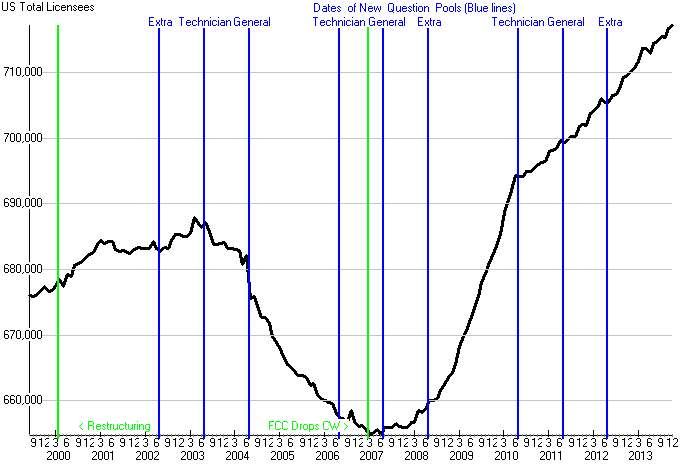
The ARRL just reported that the number of FCC amateur radio licenses hit an all time high of 717,201 at the end of 2013. Since we all know that the interwebz has made ham radio communication obsolete :-), this is a difficult statistic to comprehend. Joe Speroni AH0A keeps a useful collection of ham licensing statistics including the ability to generate plots of the data. I used Joe’s site to generate this plot of total US amateur licenses versus time. Note that the vertical axis does not start at zero, so the plot tends to exaggerate the amount of change.
Click to expand
From this plot, we see that the number of licenses was in decline from about 2003 to 2007. The no code Technician license was introduced in 1991 which is earlier than the data on this chart. The FCC completely dropped the Morse Code requirement from all license classes in 2007, as indicated on the chart. (See Wikipedia for the exact dates.) The decline in licenses was reversed at that time and has been growing ever since. There is an interesting inflection point in 2010 that coincides with the release of a new Technician License question pool. The line is noticeably less steep after this point, which seems to imply that something happened to slow down the rate of new licenses.
Over the last ten years, Technician licenses have grown slightly as a percent of the total, going from 47% to 49%. So about half of US licenses are Technician. The grandfathered Novice and Advanced class licenses are in a slow decline and currently represent 2% and 8% (respectively) of the total licenses. The percent of General licenses has grown slightly over the past ten years, from 21% to 23%. Extra class licenses showed the most growth over the decade, going from 15% to 19% of total licenses.
While it’s encouraging to see continued growth in the number of ham radio licenses, these statistics immediately raise a number of questions:
- How many of these licensees are Silent Keys and their FCC license is just clocking time until it hits the 10 year expiration date?
- Given the aging ham population, when will we hit a demographic brick wall and see the number of licenses decline?
- How many of these licensees are actively involved in ham radio? I have a number of friends that keep their FCC license current but are never on the air.
Clearly, the 10 year license term will tend to mask any decline for a while but it seems that sooner or later the numbers will flatten off and probably start to decline. I don’t know of anyone that has collected and analyzed the age distribution of hams, so I am basing this on what I see at radio club meetings and major ham radio events.
How many of these licensees are active? Really difficult to say. It seems that in the 21st century, people have many activities to choose from and their interest in any one of them may fade in and out. Not everyone is a Full Up 24/7 Ham Radio Enthusiast.
In the mean time, I am going to keep teaching Tech license classes and helping people get started in a hobby that I find to be a lot of fun. Remember the The Universal Purpose of Amateur Radio: To Have Fun Messing Around with Radios.
73, Bob K0NR
75% Chance of M-class Flares, 30% For X-class
Solar Flare Alert:
Active Sunspot Region 11944 has a 75% chance of producing an M-class flare, and a 30% chance of producing an X-class flare, in the next 24 hours. Smaller flares are also possible.
We are expecting a glancing blow from a Coronal Mass Ejection (CME) sometime in the next 24 hours.
The Earth’s polar regions are under a proton event (Polar Cap Absorption, or PCA, event). This is degrading HF communications over polar regions.

(Live data and more info at https://Facebook.com/spacewx.hfradio or http://SunSpotWatch.com/ )
Top Five K0NR Blog Posts for 2013
 Here’s the top 5 blog postings for 2013 on the K0NR Blog, based on number of views.
1. The Updated Incomplete List of Ham Radio iPhone Apps – my short list of preferred iPhone apps for ham radio use
2. Digital Voice at Pacificon – a report on a few of the presentations at the Pacificon ham radio convention in Santa Clara
3. Yet Another HT From China (Baofeng UV-B5) - a look at one of the best low cost HTs from China
4. A Great Bag for the FT-817 – description of a really good bag for the Yaesu portable QRP rig
5. When All Else Fails or SHTF? – a discussion of “preppers” getting interested in amateur radio for emergency use
Also, these articles continue to get a large number of hits, even though they are a bit older:
FM/VHF Operating Guide – a guide to ham radio activity on 2m FM and other bands
Choose Your 2m Frequency Wisely – an explanation of the 2 meter band plan with Colorado emphasis
— 73, Bob K0NR
Announcing April 2014 Technician License Class
 Ham Radio Two-Day License Class
Monument, Colorado
Sat April 12 and Sat April 19 (8 AM to 5 PM) 2014
Location: Tri-Lakes Monument Fire Station 1
The Technician license is your gateway to the world-wide excitement of Amateur Radio …
- Earn your ham radio Technician class radio privileges
- Pass your FCC amateur radio license exam right in class on the second day
- Multiple-choice exam, No Morse Code Required
- Live equipment demonstrations
- Learn to operate on the ham bands, 10 Meters and higher
- Learn to use the many VHF/UHF FM repeaters in Colorado
- Find out how to participate in emergency communications
There is a $25 registration fee for the class.
In addition, students must have the required study guide:
HamRadioSchool.com Technician License Course $19.95
Advance registration is required (no later than one week before the first session, earlier is better!)
To register for the class, contact: Bob Witte KØNR
Email: [email protected] or Phone: 719 659-3727
Sponsored by the Tri-Lakes Monument Fire Radio Association
For more information on amateur (ham) radio visit www.arrl.org or www.wedothat-radio.org
Adios to CQ VHF
 Another “dead trees” publication is coming to an end. CQ VHF Magazine is ceasing publication, with some content being rolled into a new online publication.
From the ARRL web site:
CQ Communications Inc has announced plans to realign its publications lineup and to launch a new online supplement to its flagship magazine, CQ Amateur Radio.
“The hobby radio market is changing,” said CQ Communications President and Publisher Dick Ross, K2MGA, “and we are changing what we do and how we do it in order to continue providing leadership to all segments of the radio hobby.”
Effective with the February 2014 issue of CQ, said Ross, content from the magazine’s three sister publications — Popular Communications, CQ VHF and WorldRadio Online — will be incorporated into CQ’s digital edition as a supplement to be called CQ Plus. The print editions of Popular Communications and CQ VHF will be phased out, and WorldRadio Online will no longer exist as a separate online publication. Current Popular Communications, CQ VHF and WorldRadio Online subscribers will be converted to CQ subscribers and receive CQ Plus at no additional charge. Details will be posted on each magazine’s website.
As the name implies, CQ VHF was focused on amateur radio activities above 50 MHz, which was well aligned with my interests. I’ve been writing the FM column for CQ VHF magazine since the summer of 2005 (wow, has it really been eight years?). I have really enjoyed this opportunity and found the four-times-a-year schedule to be just about right for me as an author.
All good things come to an end and it was not a surprise that CQ VHF would cease publication. Clearly, print media is struggling in most markets and a niche publication like CQ VHF was feeling the pressure. My thanks go to Joe Lynch N6CL for his leadership as editor and also to my fellow authors for the great content they produced over many years. I am going to miss having the magazine around but it is time to move on.
73, Bob K0NR
Update Jan 2, 2014: See this information at cq-vhf.com













