Archive for the ‘ham radio’ Category
 On the Road With D-STAR
 July 9th, 2014 |
  Author:
 Part 1 of 2
I’m traveling this week with a DHAP and the Icom ID-51A dual-band handheld. This combination of hardware permits me to stay connected with my friends on the D-STAR network from wherever I happen to roam – no local digital repeater required. The DHAP is a custom-built enclosure and battery supply for a Raspberry Pi and DV Access Point – a DVAP.
If all this sounds like too much alphabet soup (it is!) let’s first break it down in pieces.
The DVAP is a small USB powered D-STAR transceiver that runs about 10mW of power on UHF. VHF is also available. It’s manufactured by Internet Labs. The concept here is that you plug the DVAP into a USB port on your Windows, Mac or Linux computer, running the proper software and connected to the Internet, and it looks a lot like a D-STAR repeater to your radio — albeit a micro-repeater with only about 100 yards of coverage.
With this arrangement, a user can connect to other repeaters and reflectors on the network. While it’s an effective solution, it’s not elegant or efficient to keep a desktop or laptop computer running all the time just to maintain that connection.
Enter the Raspberry Pi, a single board computer that’s smaller than a pack of cigarettes, costs $35, supports networking, and runs Linux. It didn’t take long for users to see the advantages of this arrangement over the desktop PC and the rapid migration was underway.
You can put all this together for the price of the DVAP and another $50-100 for a Raspberry Pi, memory, associated cables, power brick, and all that jazz. It will work perfectly well setting on your desk or workbench like that, but if you want to take it outside with you, an enclosure to house and organize it all is a really good idea.
Which gets us to the DHAP. Manufactured by Hardened Power Systems, this contraption is a robust enclosure for the DVAP and the Pi that conveniently brings all of the on-board connections out to the front and back panels. NiMH batteries run the show for several hours between charges while a front panel display shows the battery level.
It’s not waterproof, and I suppose you could break it if you tried. But it is a hardened, machined case that’s slightly smaller than a football. Once it’s configured and charged, you just pick it up and carry it with you wherever you go.
Of course, it requires a network connection that can be provided from a hardwired Ethernet cable or via a Wi-Fi network. That Wi-Fi link means it can be easily tethered to your cell phone, which is how I use it on the road, when I bring it home, it automatically connects to my home Wi-Fi.
It’s the ultimate in convenience and portability for the D-STAR enthusiast though it’s not cheap. $300 [US] for the unit with a Raspberry Pi, a little less if you’re bringing your own Pi. And that doesn’t include the DVAP…
More about how I use all this on the road, and a few tips about the DHAP in the next post.
Filed under: Ham Radio Tagged: dhap, dstar, dvap, hr, icom, id51a


Making Plans for the Colorado 14er Event
 The Colorado 14er Event (Aug 3) is less than a month away so it is time to get ready. This event was born out of the basic observation that many hiking hams were taking along their radios (typically, a VHF/UHF handheld) when they climbed the Colorado 14,000 foot mountains. So we thought “let’s all climb on the same day and see who we can contact.” The typical 2m FM contacts have expanded to other frequencies and modes, including the high frequency bands, with the potential for worldwide propagation. We’ve also embraced the Summits On The Air (SOTA) program, opening up over 1700 summits in Colorado for ham radio activity.
How can you join in the fun? The most active way to participate is to operate from a summit. If you are interested in climbing 14ers, then you may want to operate from one of the 54 14,000 foot mountains. In my opinion, all of the 14ers are strenuous hikes, so be sure to assess your ability and check out the challenge of any summit you attempt. There are a few that you can drive up, Pikes Peak, Mount Evans and Mount Bross (4WD only). Note that a “non-motorized final ascent” is required if you want to qualify as a SOTA activation, which is encouraged. See this web page for some great tips on activating a SOTA peak. If you want to try something less difficult, consider one of the easier SOTA peaks (more than 1700 in Colorado). Everyone can find a SOTA peak that fits their particular hiking ability.
If you can’t get out and operate from a summit, you can still have fun trying to contact the radio hams on the various summits. There will be quite a bit of activity on 2m FM, starting with 147.42 MHz and moving up from there using the standard Colorado band plan. You’ll want to be roughly within “line of sight” to as many peaks as possible for working them on VHF. Many radio operators will be on the HF bands, too. See the recommended frequency list here.
Summits On The Air has some great infrastructure that we can use during the event. The SOTAwatch web site is using for “spotting” SOTA stations so that you know who is on the air. Spotting yourself is encouraged and can be done from many peaks using a mobile phone. SOTA Goat is a great iOS app for making and tracking spots.
Take a look at this posting for some additional SOTA resources. There’s quite a bit of information out there so take advantage of it. Remember, the Colorado 14er Event is based on the fundamental purpose of ham radio: to have fun messing around with radios. But be careful out there, we don’t want anyone to get hurt.
Questions, comments, let me know.
73, Bob K0NR
Disclaimer: Climbing mountains in Colorado can be dangerous. Only you are responsible for your safety. In particular, be very aware of the lightning danger if you are hiking above treeline.
Check out the sunspots!
Just before the 4th of July, several sunspot regions rotated into view. Today, they are significant players in elevating the solar output of Extreme Ultraviolet energy — the energy helpful in ionizing the F-region of our Earth’s ionosphere. That, in turn, means better propagation conditions, even on higher shortwave frequencies.

As seen by the Solar Dynamics Observatory, the Sun is sporting quite a few sunspots, today. These are helping elevate the 10.7-cm flux, which is a proxy for solar output that strengthens the ionospheric propagation of higher frequencies in the shortwave spectrum. Expect good conditions on HF, this weekend.
73 and best DX!
Space Weather, HF Radio Propagation – The Interview on ‘Ham Radio Now’
Why would an amateur radio operator be interested in space weather? Is it worth the time and resources to forecast propagation, in the daily operation of a typical ham radio station?
Gary, host of the popular ‘Ham Radio Now’ video podcast, talks with Tomas Hood (NW7US), propagation and space weather columnist for CQ Amateur Radio Magazine (and in the late ‘Popular Communications Magazine’ as well as ‘CQ VHF Quarterly Magazine’) and The Spectrum Monitor Magazine. Gary discusses with Tomas how scientists forecast space weather, and how the average ham radio operator can also make predictions, and what propagation forecasting can bring to the daily operations of an amateur radio enthusiast.
Watch on YouTube: ‘Ham Radio Now’ Episode 156: Propagation…

Tomas, NW7US, talks about radio propagation on shortwave (HF) as well as space weather.
Hello Kuwait

Atlas 210X
After living here in the new house since January, I haven’t had a lot of chances to use the radios, even though I now have a room for my hobby (shared, of course with KD2CHE’s sewing). The shack has been piled with things to sort through, requiring some digging and re-arranging to get to the Atlas 210X. A few days ago, I finally went through the pile and did some major organizing. I now have a nice work surface, and all of the radios set up and working (including a recent flea-market find, a snazzy FRG-7). Tonight after tuning around on 20 meters I answered a couple of calls. The second call was from 9K2UU in Kuwait. This contact is now my second-best distance since I got my license (about 6800 miles), and the best from home (the no 1 was Namibia from my 10 meter mobile here at the beach). Barrak gave me a 5-7, and he got a 5-9 from me. All of this with an old Atlas 210X, and a 35 foot end-fed sloper into a 9:1 UnUn. I’m happy with that.
SOTA Activation: W0C/SP-089 Unnamed Summit
With the summer season definitely here, Joyce (K0JJW) and I climbed W0C/SP-089, an unnamed summit east of Buena Vista near Trout Creek Pass, for a Summits On The Air activation. This summit is also referred to by its elevation: 10525. The mountain is quite majestic with a large rock face that rock climbers enjoy climbing.
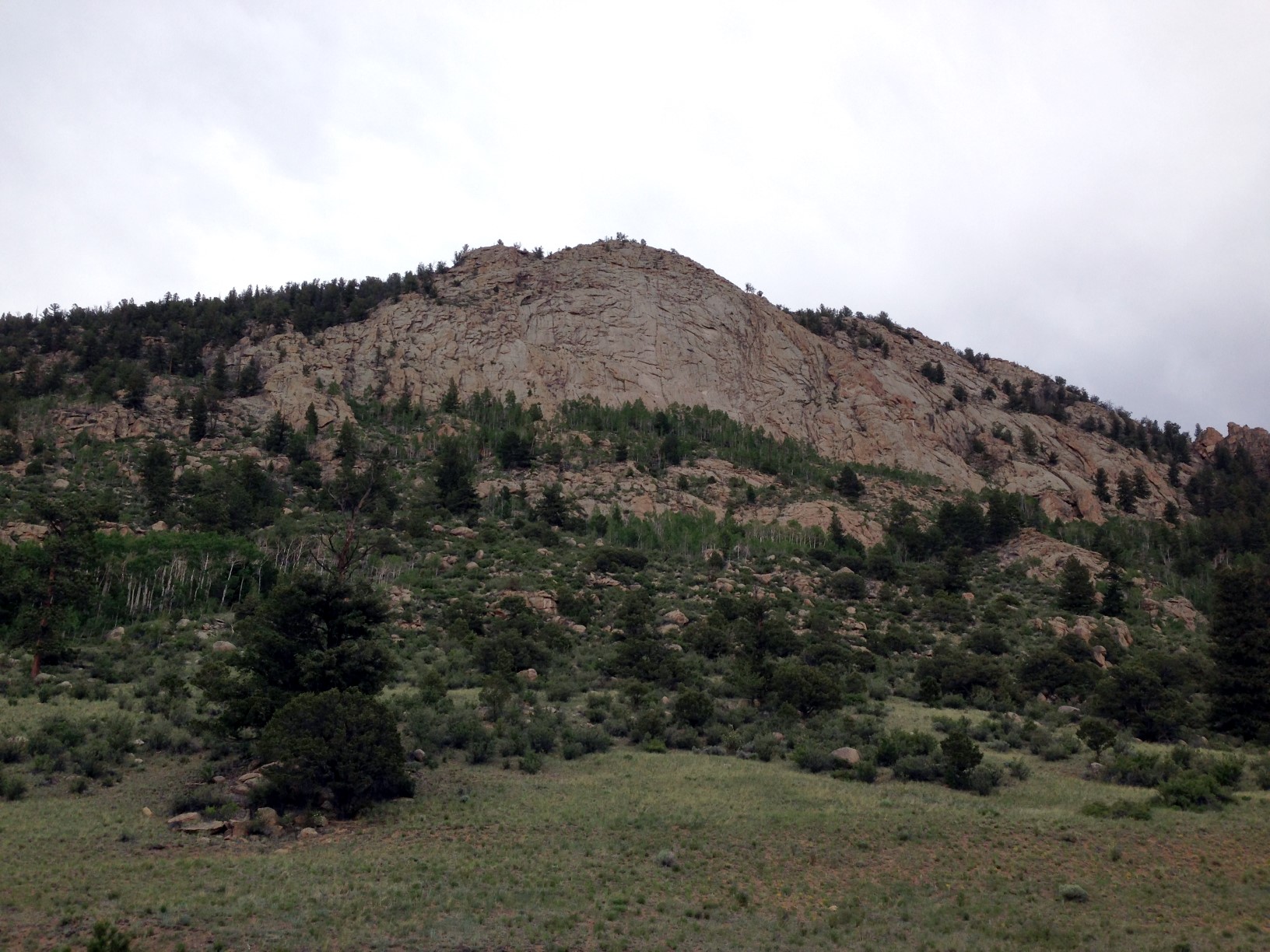
View of W0C/SP-089
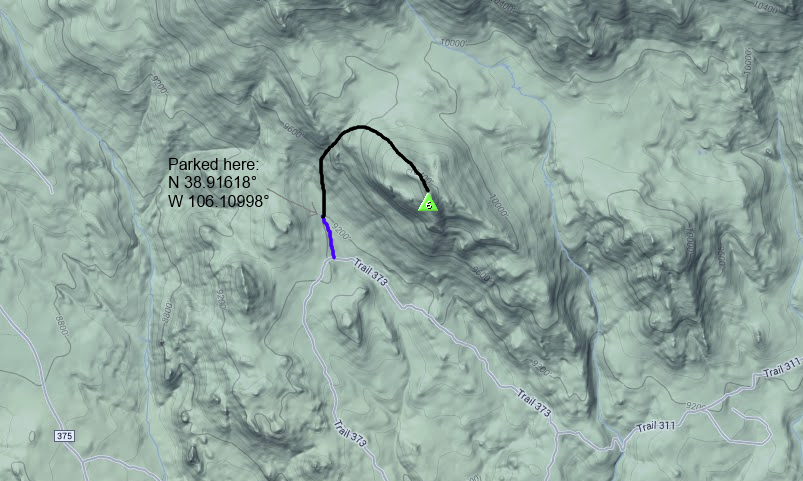
To reach the summit, we drove a 4WD truck from Trout Creek Pass on Forest Service Road 311, connecting to FS Road 373. Four wheel drive is required for this road due to the steep sections, which may not be passable in muddy conditions. You can also approach from the Buena Vista side, see the San Isabel Forest Service Map. From 373 we took a side road (shown in blue on the map below) that is not always shown on maps. I believe it is marked 373A but I am not sure. We parked the truck at the lat/lon shown.
From there we hiked a non-technical route to the west of the summit, working our way up through the draw shown on the map. There were a few faint game trails here and there but mostly it was some challenging bushwhacking up that draw. The willows and sticker bushes made us glad that we had long pants on. Also, there was quite a bit of downed timber to step over. The route got quite a bit easier once we got to the top of the draw, but still no trail. The elevation gain was only 1100 feet but it felt like a lot more work than that.
 As we neared the summit, I heard Bob (W0BV) calling me on 146.52 MHz. I had put out an email alert to some of the hams in the area so Bob and some others knew I was going to be out climbing. Once I got to the summit, I contacted Bob (W0BV) and quickly had a mini-pileup with several stations calling me. Mark (KF5WCY) visiting from TX gave me a call, followed by Carl (K5UK) near Mount Yale. Then I worked Jim (KD0MRC) in Buena Vista and Larry (KL7GLK) in Leadville. Thanks, guys, for getting on the air and contacting me!
I used my Yaesu FT-60 handheld transceiver and a 1/2-wave vertical antenna for these contacts. While I had my 3-element Yagi antenna with me, I did not bother to set it up.
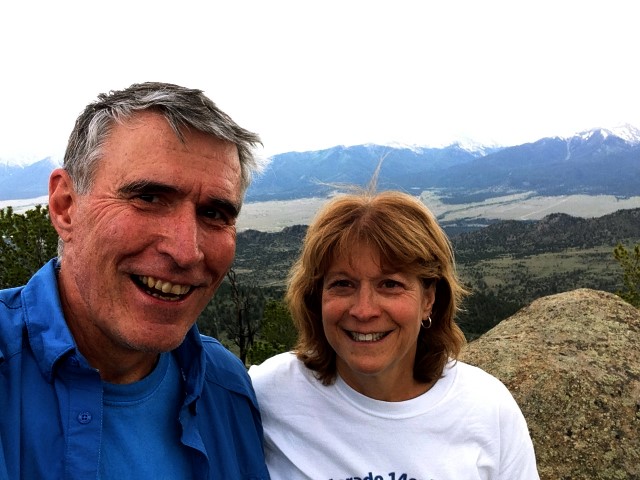
Bob (K0NR) and Joyce (K0JJW) on the summit
My spouse and hiking companion Joyce (K0JJW) and I have worked out a standard SOTA activating procedure. As we get close to the summit, she stops below the activation zone and I continue to the top. Then I work her on 146.52 MHz which guarantees a successful activation. It is possible to get skunked on 2m fm in the backcountry, so this is good insurance. This one QSO does not result in any SOTA points, since the rules require a minimum of four contacts for activation points. Next, Joyce joins me on the summit and we work whoever is out there. Lately, I’ve had pretty good luck getting at least 4 contacts on 2m fm. On the descent, she stays on the summit and I go down the mountain and work her once I am outside of the activation zone. That way, I am able to work the summit, too. Then she leaves the summit, catches up with me and we descend the rest of the way together.
For more information on VHF SOTA activations, see How To Do a VHF SOTA Activation.
73, Bob K0NR
The One Frequency You Should Never Use on Field Day
 “Based on Actual Events”
At the local radio club meeting, I encouraged everyone to get on the air during Field Day, which led to this conversation:
New Tech: I just have a 2 meter fm radio. Can I still make Field Day contacts?
Me: Sure, VHF contacts are encouraged during Field Day.
New Tech: So I just call on 146.52 MHz and see who’s out there?
Me: Well, no, the 2m fm calling frequency is not allowed for Field Day.
New Tech: Really? We can’t use any of the calling frequencies we learned during our license class?
Me: Well, no, all of the other standard calling frequencies are fine, just 146.52 MHz is prohibited.
New Tech: That seems really dumb.
Me: No comment.
Complete Field Day information is here : http://www.arrl.org/field-day
73, Bob K0NR













