Archive for the ‘ham radio’ Category
 Coming Soon: 146.52 MHz in ARRL VHF Contests
 July 26th, 2015 |
  Author:
  I’ve been known to
 whine complain comment about the prohibition against using 146.52 MHz during ARRL radio contests. For example, see The One Frequency You Should Never Use on Field Day and Mt Herman: SOTA plus VHF Contest.
During my presentation on Mountaintop VHF for SOTA at the Central States VHF Society Conference in Denver today, I mentioned this is an issue. Basically, I pointed out that Summits On The Air (SOTA) operators often default to the 2m fm calling frequency, which is prohibited for use in the ARRL contests. This gets in the way when mountaintop stations do a combination SOTA and VHF Contest operation.
During my presentation, Brian Mileshosky N5ZGT, ARRL Director of the Rocky Mountain Division, reported that the ARRL has decided to remove the prohibition of 146.52 MHz in VHF contests. It will take some time for this to work its way into the actual rules, so stayed tuned for further developments.
This is great news…a cleanup of an unnecessary impediment to VHF contesting. Now, will the CQ Worldwide VHF Contest do the same?
73, Bob K0NR
The post Coming Soon: 146.52 MHz in ARRL VHF Contests appeared first on The KØNR Radio Site.
Self-serving post…but not entirely
Yes, I am trying to sell books. I admit that right up front. That is how I feed my family and pay for Ham gear!
But I also have another purpose in the two new Amateur Radio books I have just published. I continually meet folks who either have considered joining the Ham Radio ranks but simply never followed through. And others who did all the work to get a license, maybe bought a two-meter HT, but never really went any farther in getting the most from our wonderful hobby.
OK, I realize what we all love so much is not everybody’s cup of tea. But I also believe that many who never develop into active Hams drop by the wayside because of four basic roadblocks…real or perceived. (And I am NOT including trepidation about passing the license exam. Anyone too timid to try the test probably wouldn’t take the next steps anyway.)
They are:
1) Putting together a station that would offer a complete and satisfying on-air experience.
2) Putting up an outside antenna.
3) Knowing what to say and do once on the air that would not get them ridiculed.
4) The jargon that has developed over the first century of Ham Radio’s existence.
In my new book, GET ON THE AIR…NOW!, I try to give practical, realistic advice on each of these stumbling blocks. I hope I have been successful because I want to see our hobby continue to grow and prosper.

One way I tackled obstacle #4–the one about jargon and gobbledygook–was to include in the book a complete Amateur Radio dictionary. As I compiled that section, I came up with far more terms than I expected–more than 1400 terms, 1600 definitions, and hundreds of web links–so I decided to not only make the dictionary a part of GET ON THE AIR…NOW! but publish it as a separate stand-alone book. It is cleverly titled THE AMATEUR RADIO DICTIONARY and is, I am confidently claiming, the most complete ham radio glossary ever compiled.

You can see info on both books at www.donkeith.com/hamradio/amateur-radio. The books are available wherever books are sold and in all e-book formats as well as in paperback.
But please consider my thoughts on those four hurdles that I believe keep many prospective Hams on the sidelines. If you agree, jump in and become a mentor, advise newcomers (or old-timers who never get on the air) on overcoming them, and help our wonderful hobby to continue to grow as we dive head-foremost into its second century.
73,
Don N4KC
www.n4kc.com
www.donkeith.com
Five X-class (Major) X-ray Flares in a Row (plus more!)
Well, thankfully, this is not happening during this contest weekend: one of the largest sunspot regions during this Sunspot Cycle 24, and one of the biggest in several decades, gave us quite a show, back in October 2014.
Five major X-class (very strong) and a number of moderate and “mild” solar x-ray flares erupted from a single sunspot region – this video covers the time period of October 19-27, 2014, as captured by NASA’s SDO spacecraft. This is from what has been one of the biggest sunspot regions in a number of decades.
Between October 19 and October 27, 2014, a particularly large active region on the Sun dispatched many intense x-ray flares. This region, labeled by NOAA as Active Region (AR) number 12192 (or, simply, NOAA AR 12192, and shortened as AR 2192), is the largest in 24 years (at that point in Solar Cycle 24).
The various video segments track this sunspot region during this period (Oct. 19 – Oct.27, 2014), during which we can see the intense explosions. There are five X-class flares during this time, and NASA’s Solar Dynamics Observatory (SDO), which watches the sun constantly, captured these images of the event.
Solar flares are powerful bursts of radiation. Harmful radiation from a flare cannot pass through Earth’s atmosphere to physically affect humans on the ground, however — when intense enough — they can disturb the atmosphere in the layer where GPS and communications signals travel.
When referring to these intense solar eruptions, the letter part of the classification, ‘X’, means, ‘X-class’. This denotes the most intense flares, while the number, after the classification letter, provides more information about its strength. For example, an X2 is twice as intense as an X1, an X3 is three times as intense, and so forth.
Solar Images Credit: NASA’s Goddard Space Flight Center & SDO
http://SunSpotWatch.com ~ http://NW7US.us
73 de NW7US
2015 Colorado 14er Event
 Amateur Radio operators from around Colorado will be climbing many of Colorado’s 14,000-foot mountains and Summits On The Air (SOTA) peak to set up amateur radio stations in an effort to communicate with other radio amateurs across the state and around world. Join in on the fun on the first full weekend in August and see how many of the mountaintop stations you can contact. The prime operating hours are on Sunday August 2nd from 9 AM to noon local time (1500 to 1800 UTC), but activity can occur throughout the weekend.
Now including Summits On the Air (SOTA), which adds over 1700 potential summits! If you aren’t up to climbing a 14er, there are many other summits to choose from (with a wide variety of difficulty). See the W0C SOTA web page at w0c-sota.org
Radio operators who plan to activate a summit should set an “Alert” on the SOTAwatch.org web site. To subscribe to the “ham14er” email list, visit the yahoo groups site at http://groups.yahoo.com/group/ham14er/. Also, be sure to check out the event information at http://www.ham14er.org
Frequencies used during the event
Activity can occur on any amateur band including HF and VHF. The 2m fm band plan uses a “primary frequency and move up” approach. The 2m fm primary frequency is 147.42 MHz. At the beginning of the event, operators should try calling on 147.42 MHz. As activity increases on that frequency, move on up the band using the 30 kHz steps. Don’t just hang out on 147.42 MHz…move up! The next standard simplex frequency up from 147.42 MHz is 147.45 MHz, followed by 147.48, 147.51, 147.54 MHz.
Frequency (MHz)
 147.42 Primary 2m FM Frequency, then up in 30 kHz steps
 223.5 Primary 222 MHz FM frequency
 446.000 Primary 70 cm FM frequency
 446.025 Alternate 70 cm FM frequency
 52.525 Primary 6m FM frequency
 144.200 2m SSB calling frequency
 50.125 6m SSB calling frequency
 14.060 20m CW Frequency
 14.345 20m SSB Frequency
 18.092 17m CW Frequency
 18.158 17m SSB Frequency
 21.060 15m CW Frequency
 21.330 15m SSB Frequency
 28.060 10m CW Frequency
 28.350 10m SSB Frequency
 Other Bands/Modes:
 Standard calling frequencies and/or band plans apply.
Warning: Climbing mountains is inherently a dangerous activity. Do not attempt this without proper training, equipment and preparation.
Sponsored by The Colorado 14er Event Task Force
The post 2015 Colorado 14er Event appeared first on The KØNR Radio Site.
Nifty I Phone Morse Code Decoder
HOT PAW
MORSE CODE DECODER FOR I PHONE

Screen Snap of Hot Paw Morse Code Decoder
I recently installed a ham radio station in my truck. Since then I’ve been having a lot of fun with it, using SSB mostly, since that is a novelty for me. Most of my operating has been using CW, but taking a side trip into PSK occasionally. Logging is somewhat cumbersome in a truck. I used big elastic bands to attach a small clip board to my leg so I could quickly write down a call sign and very basic information. This information would be then transferred to a computer log at home. I tried using the computer in the truck also, and that proved even more cumbersome, having the laptop jammed into the steering wheel.
I like to use a keyboard to send code but no matter what I used, it was a bit awkward in the truck. At the very least, the laptop stays put when its jammed into the steering wheel. Using the passenger seat would require my changing the radio head orientation, the antenna control and paddles which are all set up for easy use from the drivers seat.
Occasionally I’d switch to CW and fumbled for a pen to write down a call sign, time, and band. The guy I was chatting with on 40 meter CW was running just a tad too fast for me to copy ‘everything he sent’, so I missed some of it. It seems that the ‘buffer in my brain’ is smaller than I’d like it to be and with FIFO being the rule, the beginning of a word vanishes as I copy the ending.
(FIFO, First In, First Out’) Some folks may complain that using a ‘decoder’ is cheating somehow. Yes, for a contest, but for every day QSO’s its not cheating at all. If you don’t like it, don’t use it!
I discovered this app and tried it last night for the first time. Wowzah, can it copy code! Just lean it up against your radio, or just near it, and it copies CW. This is a really great help when someone is sending just a ‘tad faster’ than my ability to copy ‘everything’! Its also handy to ‘get the entire call sign’, while I was fumbling with other things in the truck! It works pretty well even in poor band conditions, and has Farnsworth Method as well as regular copy. It has ultra high speed copy, but I have not tried it. 1oo WPM code is hard to come by on the air.
This proves very useful in the truck, but my guess is that other hams will find it handy in other ways.
Use SSB on VHF For Better Range on SOTA Peaks
Previously, I had written about how the use of SSB made the difference while activating Prospect Mountain (W0C/FR-069) for Summits On The Air (SOTA). This time I was the SOTA chaser, trying to work Brad WA6MM as he activated two peaks near Breckenridge, Colorado.
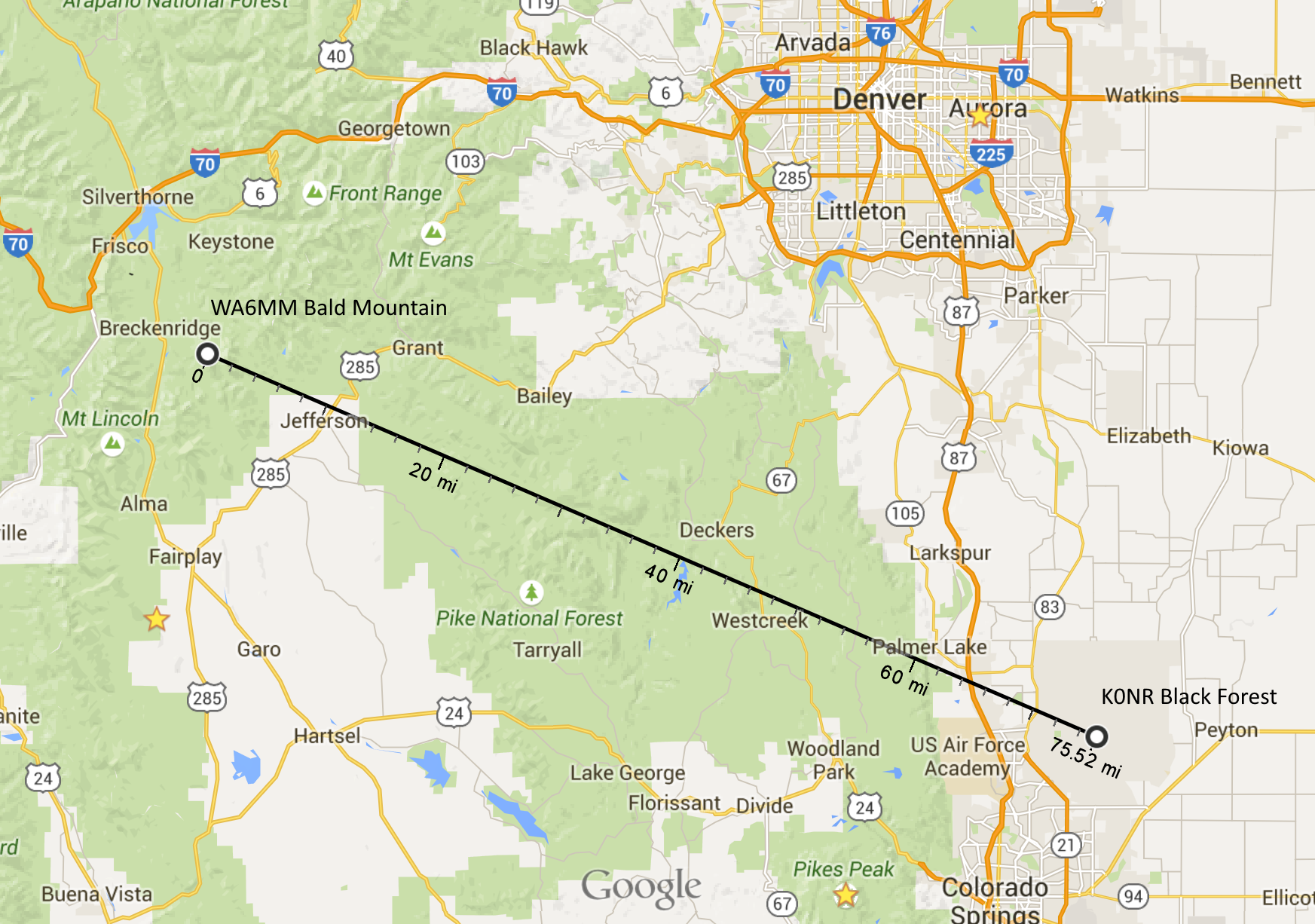
Bald Mountain to Black Forest (click to expand)
It was the Saturday of ARRL Field Day, so I planned to be out at our FD site in Black Forest. Brad and I had coordinated in advance and pretty much concluded that it would be difficult or impossible to make the contact on FM. Brad decided to take his FT-817 along with a homebrew 4-element yagi to give him 2m SSB capability. Out at the FD site, I saw that Brad was spotted on Bald Mountain (W0C/PR-019) via SOTAwatch early in the morning, so I borrowed the FD VHF station to try to work him. It was an FT-897 pushing 50 watts to a 4-element yagi up about 30 feet. I heard Brad clearly on 144.200 MHz (SSB calling frequency) and we made the contact.
I estimate that the contact was about 75 miles. I did not do a careful analysis of the terrain but the the signal had to get over the Rampart Range and quite a few other mountains to get from Black Forest to Bald Mountain. The summit of Bald Mountain is at 13,684 feet, so that certainly helps.
A few hours later, Brad showed up on the summit of Boreas Mountain (W0C/SP-030), another 13er near Breckenridge. By now, the Field Day station was in use, so I pulled out my own FT-817 and a 3-element Arrow yagi. Holding it in my hand, I pointed it towards Boreas Mountain and tuned to 144.200 MHz USB. This time Brad was even weaker but still readable, so we completed the contact.
In both cases, Brad was fair to good copy but just above the noise, I am sure that using FM would not have gotten the job done. For serious VHF work, 75 miles is not that great of a distance but we were running QRP power levels with small yagi antennas.
Brad and I are both concluding we need to encourage the use of SSB for 2m SOTA here in Colorado. It is common to end up on a high peak in the Colorado backcountry and not have enough range to reach the larger population centers. Sure there are more people active on 2m FM, but if no one is within range, it does not matter.
Congratulations to WA6MM for first activations of two more challenging summits in Colorado and thanks for 18 chaser points!
73, Bob K0NR
The post Use SSB on VHF For Better Range on SOTA Peaks appeared first on The KØNR Radio Site.
Announcing: Oct 2015 WØTLM Technician License Class
 Ham Radio Two-Day License Class
Sat Oct 3 and Sat Oct 10 (8 AM to 5 PM) 2015
Location: Black Forest Fire Station 1, Black Forest, CO
The Technician license is your gateway to the world-wide excitement of Amateur Radio …
- Earn your ham radio Technician class radio privileges
- Pass your FCC amateur radio license exam right in class on the second day
- Multiple-choice exam, No Morse Code Required
- Live equipment demonstrations
- Learn to operate on the ham bands, 10 Meters and higher
- Learn to use the many VHF/UHF FM repeaters in Colorado
- Find out how to participate in emergency communications
There is a non-refundable $25 registration fee for the class.
In addition, students must have the required study guide and read it before attending the two-day class: HamRadioSchool.com Technician License Course $20.95
(make sure you get the most recent edition of this book, updated for the new FCC exam questions)
Advance registration is required (no later than one week before the first session, earlier is better! This class usually fills up weeks in advance.)
To register for the class, contact: Bob Witte KØNR
Email: [email protected] or Phone: 719 659-3727
Sponsored by the Tri-Lakes Monument Radio Association
For more information on amateur (ham) radio visit www.arrl.org
The post Announcing: Oct 2015 WØTLM Technician License Class appeared first on The KØNR Radio Site.













