Archive for the ‘ham radio’ Category
 Colorado 14er Event – Now With SOTA!
 July 7th, 2012 |
  Author:
  Amateur Radio operators from around Colorado will be climbing many of Colorado’s 14,000-foot mountains to set up amateur radio stations in an effort to communicate with other radio amateurs across the state and around the world. The prime operating hours on August 5th are from approximately 9 AM to noon local time (1500 to 1800 UTC), but activity may occur at other times during the day.
New this year: Summits On the Air (SOTA) activity, which adds 1700 additional potential summits! If you aren’t up to climbing a 14er, there are many other summits to choose from (with a wide range of difficulty). See the W0 SOTA web page for details.
Radio operators that plan to activate a summit should register their name and intended peak at the ham14er Yahoo! group. To subscribe to the event mailing list, visit the yahoo groups site at . Also, be sure to check out the event information at 14er.org
Frequencies used during the event
Activity can occur on any amateur band including HF and VHF. The 2M FM band plan uses a “calling frequency and move up” approach. The 2M FM calling frequency is 147.42 MHz. At the beginning of the event, operators should try calling on 147.42 MHz. As activity increases on that frequency, operators should move up the frequency using the standard channel spacing used in Colorado (15 kHz). Don’t just hang out on 147.42 MHz…move up! The next standard simplex frequency up from 147.42 MHz is 147.435 MHz, followed by 147.45, 147.465, 147.480, 147.495, 147.51, 147.525, 147.54, 147.555, 147.57 MHz.
Don’t just hang out on 147.42 MHz…move up and share the band.
| Frequency (MHz) | Comments |
| 147.42 | Primary 2M FM Frequency, then up in 15 kHz steps |
| 223.5 | Primary 222 MHz FM frequency |
| 446.000 | Primary 70 cm FM frequency |
| 446.025 | Alternate 70 cm FM frequency |
| 52.525 | Primary 6M FM frequency |
| 1294.5 | Primary 1.2 GHz FM frequency |
| 144.200 | 2M SSB calling frequency |
| 50.125 | 6M SSB calling frequency |
| 14.060 | 20M CW Frequency |
| 21.060 | 15M CW Frequency |
| 28.060 | 10M CW Frequency |
| 14.260 | 20M SSB Frequency |
| 18.1575 | 17M SSB Frequency |
| 21.330 | 15M SSB Frequency |
| 28.350 | 10M SSB Frequency |
| Other Bands/Modes | Standard calling frequencies and/or band plans apply. |
Warning: Climbing mountains is inherently a dangerous activity.
Do not attempt this without proper training, equipment and preparation.
Sponsored by The Colorado 14er Event Task Force
Zero Ohm Resistors
Mark Frauenfelder innocently (or cleverly) asks the question “What are zero ohm resistors for?” on BoingBoing. The fun really starts in the comments section, with replies such as “They’re a novelty gift for electronic engineers.”
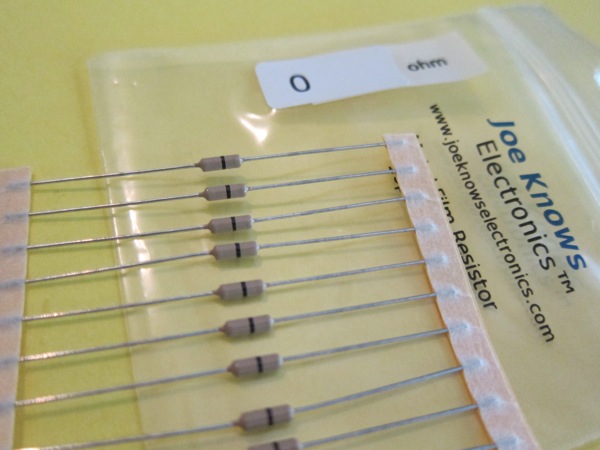
Take a look at the article here.
Yes, zero ohm resistors really do exist. Think of them as jumpers on a PC board.
73, Bob K0NR
Field Day on Holiday
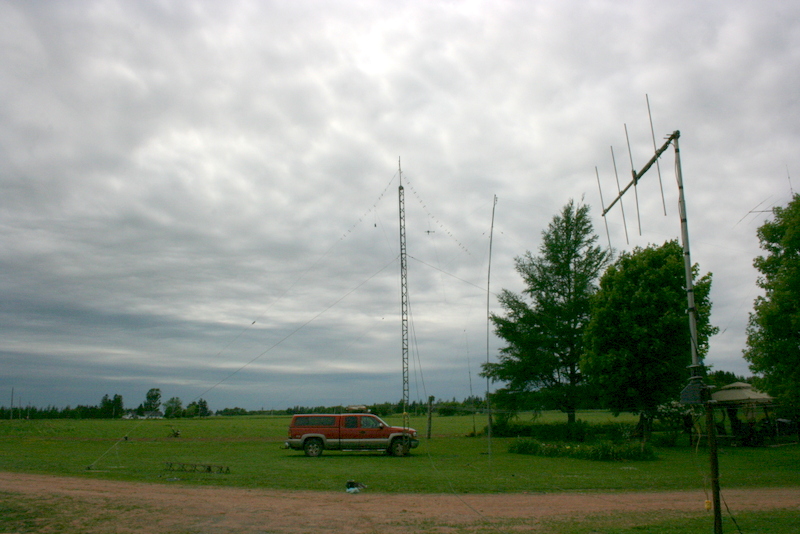
Field Day 2012 with VY2CRS
As I mentioned in a previous post, I’ve been on vacation in Prince Edward Island Canada.
This year, our vacation coincided with my favorite annual event, Field Day.
Sadly, I missed an opportunity to experience Field Day QRP-style with the NC-based QRP club, the Knightlites, on the Blue Ridge Parkway, along with my buddy, Vlado (N3CZ).
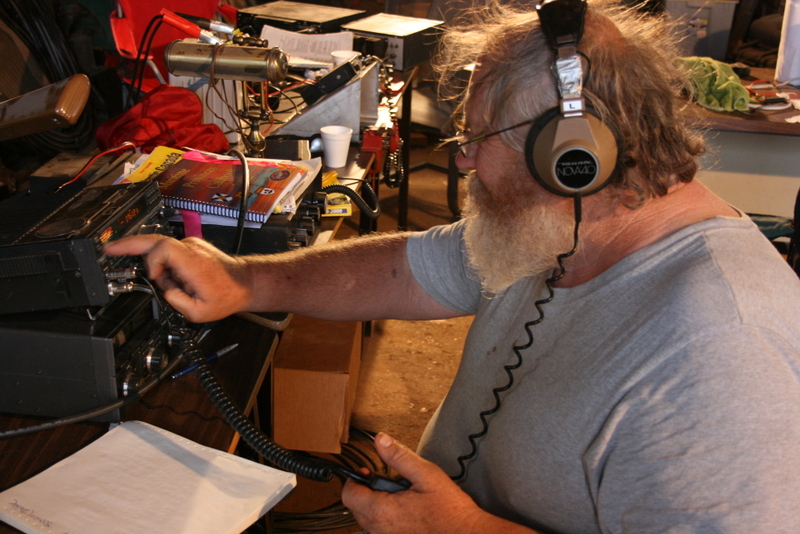
Ron Morris, VY2RM, working 20 meters
Before I left my trip up north, I contacted the Charlottetown, PEI, Amateur Radio Club (VY2CRS) and was glad to learn that they had planned a Field Day event on the farm of their club President, Andy Speelman (VA2AS). Better yet, the location was just forty minutes from the cabin where we were staying on PEI.
Perhaps one of the benefits we enjoy as amateur radio operators is that we’re all part of one enormous event, an all-inclusive fraternity of like-minded individuals. When I arrived on site at the Charlottetown Field Day location, I was greeted as if I was expected. The large sign at the end of Andy’s driveway was a great advertisement for the FD location.
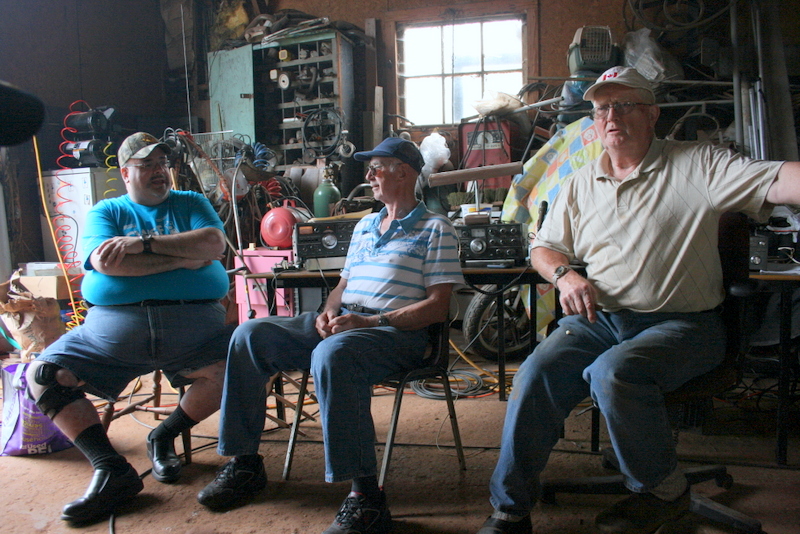
(Left to Right) Chris Vessey VY2CRV, Richard Burke VY2RB and Andy Speelman VY2AS
They instantly put me to work…eating a hamburger. After all, you can’t work a radio rig without a little something in your fuel tank, right?
“Islander” hospitality is legendary, and frankly, reminds me of the way it was when I was growing up in rural North Carolina where “no one’s a stranger,” and you’re free to accept invitations (and meals) without hesitation. This local club went a step further, and from the moment I arrived, included me in their jokes, making sure to laugh not just at but with me. I felt utterly at home.
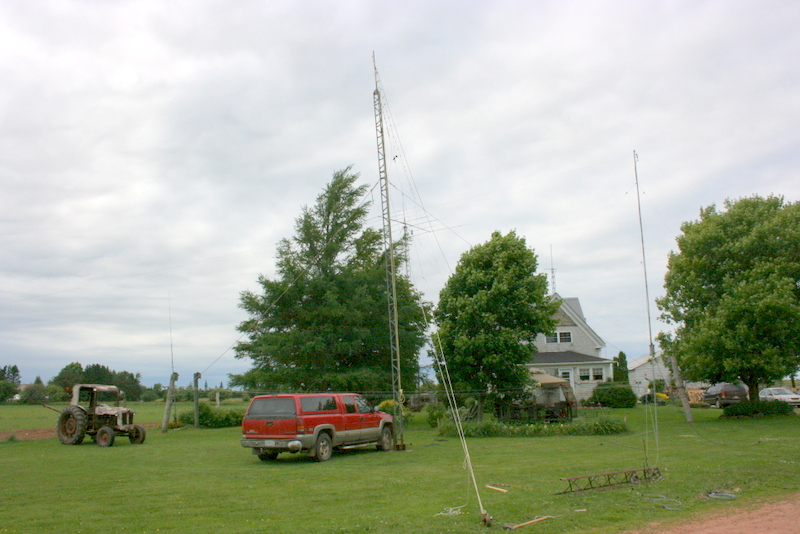 The club had a wide array of antennas up by the time I arrived. All of them had been constructed just prior to the beginning of the contest, and all were field-deployable. Andy’s farm is a wide-open space and with no limitations to big antlers, thus they even fit a 160M “V” doublet out in front of the barn where we operated.
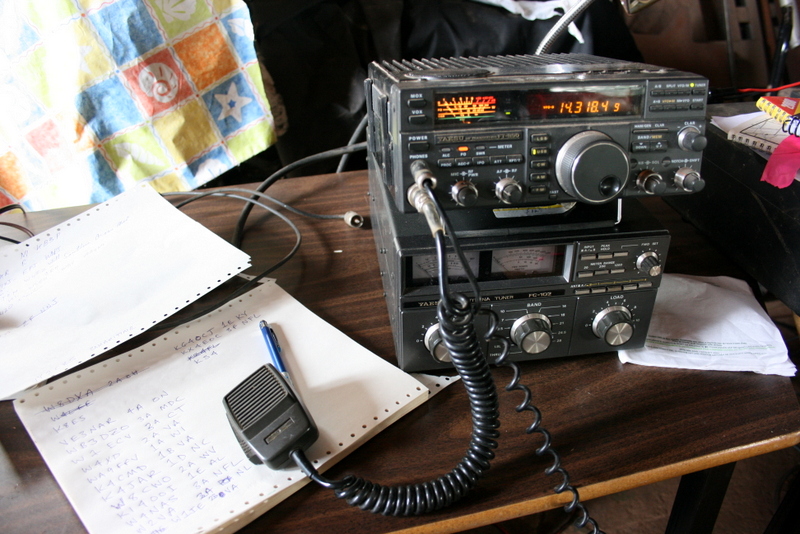
My view as I worked station after station on 20 meters
Though I had only a few hours to play radio before heading back to my family at the cabin, they put me on the 20M almost immediately. In perhaps an hour, I chalked up 100+ contacts on that band. The guys got a kick out of hearing me call “CQ Field Day, CQ Field Day, this is VY2CSR” and then offering up our “3 Alpha Maritime” in my North Carolina accent.

Though not great for identifying dupes, paper logs will work even if the power goes out
It was also fun to get a quick word in with those NC stations I worked from the island, many of whom were set up only a few miles from my home QTH.
I made sure I saved plenty of time for chatting with the club members, too. After all, this Field Day event– like many others I’ve attended–was more about comraderie and fun rather than about raking in the scores and multipliers (not that taking it to a contest level is objectionable, of course).
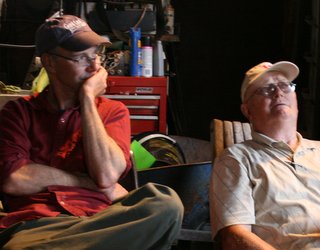
Darin Gay VY2GAY (left) and Andy Speelman VY2AS (right)
Fellows in Charlottetown: if you’re reading this post, I surely thank you for including me in FD 2012, Charlottetown-style.
Readers, if you happen to be on vacation during Field Day, search for a local event. There’s sure to be one and you’ll most likely make some new friends and create some notable radio memories.
I Posted This Using 40 Meters!
Wow! Would you believe I’m posting this by email using WINMORE and Winlink 2000? That’s right, the words you’re reading were transmitted over HF.
My laptop is hooked up to my Kenwood TS-440S with a DigiMaster Pro+, and as soon as I finish this email I’m going to send it over 40 meters. RMS Express will send it off to a Radio Mail Server (RMS) station, which will then send it over the Internet.
For all you CW lovers, I’m still with you. This technology doesn’t hold a candle to the feel of a key in my hand! But it is tremendously valuable for ARES work, no doubt about it. If you lose cell phone, long distance service and Internet in your area during a disaster (as happened just a few days ago up on the North Shore of Lake Superior during the catastrophic flooding in Duluth), this is the only way to get an email out — and email is perhaps the single best way to convey detailed information to the outside in a situation like that. The software is free, and it’s easy to use. What a great way to cover that “extra mile!”
That’s all I have time for right now because I have a bunch of things waiting for me that are more important than ham radio. But I wanted to take a few minutes to give this a whirl since I just got my WL2K account last night before hitting the sack. Have you used Winlink 2000 to some good purpose, perhaps in an emergency? If so, please share your story.


A QRP Family Holiday on Prince Edward Island, Canada

VY2 portable K4SWL!
This year, during our family’s summer holiday, I’m enjoying the hospitality of Prince Edward Island, Canada (hence, the lack of recent posts). This is our family’s second visit to the maritime island, and each time we’ve been fortunate to stay at the same off-the-grid cabin on the eastern coast, less than twenty meters from the water.
Of course, staying in an off-grid cabin comes with its radio challenges—namely, supplying power—but also comes with one supreme advantage: no noise from the typical electrical devices that plague most of our homes. What’s more, this cabin sits on 60 acres, so not even a neighbor’s home appliances disturb my RX ears.
On our previous visit, I brought my (then) Yaesu FT-817, a 9aH gel cell, Micro M+ charge controller, 10W Solarex PV panel, some 300 ohm window line, loads of 22 AWG wire and an LDG ATU. Unfortunately, I found I had very little time for radio, and propagation was dismal. Indeed, it was during that trip that I discovered my FT-817’s finals had blown, so part of the time I was transmitting less than QRPpppp levels.
This year, since I knew the site well, I came better prepared.
My full 2012 setup consists of the following:
- An Elecraft K2/10
- An Elecraft KX1 (4 band w/built-in ATU)
- Elecraft T1 ATU
- LDG 4:1 Balun
- One 35 aH gel cell
- Two 9.5 aH gel cells
- Two PowerFilm Solar foldable 5 W PV panels
- My radio toolbox with various connectors, crimpers, cutters, wires, caps, multi-tester, etc.
- Enough wire and 300 ohm antenna line to make a couple of wire antennas
So…how’s it all working out? Brilliantly!
In the past few years I’ve done a lot of QRP CW—mainly rag-chews with some buddies on the lower bands. I’ve done less QRP SSB phone. When I first arrived at the cabin and began the process of unpacking, I couldn’t find the jumper cable to attach to my Vibroplex single-lever paddle (the paddle being a Dayton 2012 find, by the way). So, I plugged in a microphone and tuned to the phone portion of the 17 meter band.
Talk about radio fun!
I’ve once again re-discovered the joy of operating QRP SSB. It’s challenging to make those DX contacts and to transmit a long call sign (“VY2 portable K4SWL”) across the ether, but occasionally the propagation gods smile upon you, and you’re able to participate in a good rag-chew or quick DX with a 57 to 59 signal report.
Being 20 meters from the salt water is a bonus I don’t usually enjoy in my US hermitage. Due to its excellent propagation characteristics, despite my lower power set-up, I have easily worked stations from Russia to North Africa, from the Caribbean to Japan. I am thoroughly reveling in it, and the process has re-connected me with my ham radio roots.
As Gunter, VA3GA, told me in a recent Canadian rag-chew, “ham radio holidays give you a chance to explore areas of the hobby you don’t normally think to enjoy.”
So true, Gunter. That’s what I love about ham radio in general– the hobby is so broad, you constantly discover and re-discover favorite elements about it.
Handiham World for 27 June 2012
Welcome to Handiham World.
Net wrangler WA6DKS starts us out with a Field Day report:
A wonderful Field Day was had by all on the Handiham conference server on Saturday, June 23 and Sunday June 24, 2012 whether you were using Echolink, IRLP, ICQ, WIRES®, cell Phones, the internet, or plain old RF radios. During the two-day period, we had over 500 contacts which included over 12 countries and all 50 of the U.S. states.
The Handiham Field Day ran longer than the official ARRL event, but a good time was had by all whether it was net control operators, backups, check-ins, or just listeners.
Now, isn’t this what the ham radio hobby is all about? Contacts were made with stations from Azerbaijan to China, Nova Scotia to South Africa, and of course Canada and the United States. Wonderful discussions on many topics added to the fun during the two-day event. It was all about laughter, interaction, and fun times. A very special contact occurred with a station in the State of Florida that was “bicycle mobile” using one tenth of a watt of power! (Did I say QRP?!!)
Many of our Net Control Operators and Assistant Net control operators supported each other by recording all of the contacts with the names, callsigns and locations while at the same time making sure that the text box information was recorded during the day and the night. SouthCARS connected to Handiham Conference Server and the Van-IRLP throughout the two-day period after their own net sessions concluded.
This was our second Field Day, and the credit should be attributed to three individuals –Ken Schwartz (W6KHS), Pat Tice (WA0TDA), and Susi White (WA6DKS). The decision among these individuals was that there are lots of ham radio operators throughout the world who do not have an opportunity to attend an ARRL sanctioned Field Day. Therefore, an opportunity should be provided to those who would like to experience the event because (after all) there should never be a distinction made between “able-bodied” and people with challenges not being able to communicate.
All methods of communication were used so that we were assured of making as many state and country contacts by simply sending out e-mails, connecting to other conference servers through the internet, and having the help of Southcars and The Coffee Shop by using their e-mail membership lists and help in sending e-mails to those in that particular region and requesting contacts.
The Handiham organization wishes to thank everyone who participated in our successful 2012 Field Day event whether you were a net control operator, a backup, from Southcars, The Coffee Shop, The World, or any other conference we contacted . Without those of you helping in the background or even checking in, we could not have had a successful event without YOU. The success of the 2012 Handiham Field event is owed to each and every one who helped and we all look forward to next year.
Thank you to Susi, WA6DKS, for that report.
Email me at [email protected] with your questions & comments.
Patrick Tice, WA0TDA
Handiham Manager
Station Check at Camp Courage North
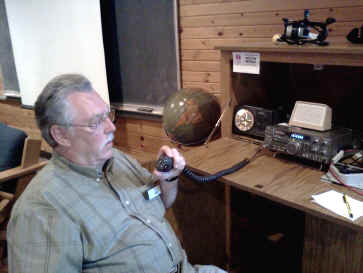
Bill, N0CIC, checks out the Kenwood TS-440 station that has been stored several years, since our last Courage North Radio Camp in late 2009. We were pleased to find that the rig worked perfectly and the G5RV and beam antennas were all operational. The rotator also worked and trees were still well clear of the antenna’s rotating radius. An Icom dual band FM rig did not work because of a faulty microphone, so that unit was packed up and brought back to the Twin Cities for assessment and possible repair by a volunteer. Bill and I (WA0TDA) opened the station at Courage North as part of a Veterans open house weekend. While there, I also gave remote base station W0EQO a once-over and found it to be in excellent condition. Our thanks to Bill for his help at Courage North. If you look carefully, on the top of the radio cabinet you will see Bill’s golf ball slingshot, used to launch antenna wires up into the trees. We didn’t have to use it, though.
Speaking of trees, several of you have asked if the tree we planted in memory of Dick Chrisman, AB7HW, is alive and well. Indeed it is, so here is a photo of me (WA0TDA) standing by the once tiny tree which now towers to over twice my height. I sure look like a doofus in this picture, but the tree looks great. We sure miss Dick and Scotty, the Wonder Guide Dog. This photo was taken last Saturday. The tree is just outside the main Dining Hall at Courage North.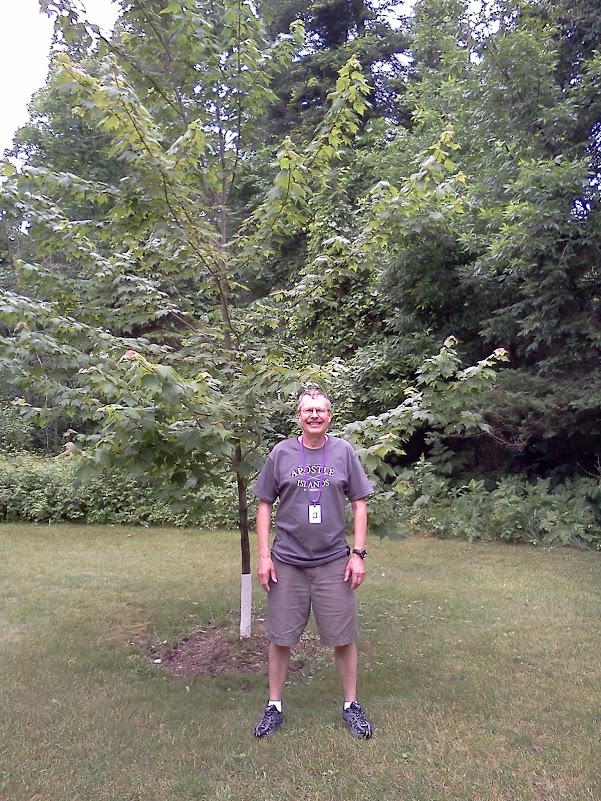
Inexpensive Programming Cable for Kenwood Mobiles


I bought this HOSA cable to connect my Kenwood TM-D710A 2M/70CM ham radio transceiver to my shack computer. Hosa advertises this cable for use in connecting a computer to various electronic musical instruments. They need to widen this recommendation – the cable will work on any device that uses a 8-pin mini-DIN connector for an RS-232 port that is wired in the standard Apple layout (crossover of data & control signals from the DB-9 end to the mini-DIN end).
I’ve seen cable from other vendors for this purpose, and some of the prices are just nuts (Kenwood wants $38 for an equiv. cable!!) and the construction quality of some of the other cables I’ve looked at is a bit suspect. The Hosa cable is well built with good strain reliefs on both ends & uses good quality shielded cable. That last item is very important when the cable is to be used in a radio shack, since one does NOT want to get RF feedback back into the radio’s control ports, especially when you are doing packet radio.
I’d HIGHLY recommend this cable to any ham that has a radio or other equipment that requires such a cable – it is a HIGH quality cable at a very attractive price.
Since the Kenwood TM-D710A takes the same cable as the TM-V71A, I figured this was the solution for me. I went with the longer version, though: the $12.75 Hosa DBK-110 10 Foot Synthesizer Controller Cable, 8-pin Mini-DIN to DE9
To make serial cables work with my laptop I need a serial-to-USB adapter. These adapters have a chipset in them that require a driver on your computer. The two most common chipsets are the FTDI and the Prolific. I’ve had mixed success with Prolific before (if you’re using Ham Radio Deluxe, stay away from it or you’ll get the blue screen of death!) so I went with the excellent FTDI chipset and purchased this adapter
After the UPS truck arrived this morning I went out to my pickup, plugged these cables together and connected my laptop to the Kenwood. They work great!















