Archive for the ‘ham radio’ Category
 Handiham World for 29 August 2012
 August 29th, 2012 |
  Author:
 Welcome to Handiham World.
New Tech Net Begins Next Week!

It isn’t every day that we launch a new net. The official start date is on Thursday, 6 September 2012. The net will meet at 7:00 PM each Thursday United States Central Time and will remain true to local time throughout the year.
Here are some key things to remember about the new Tech Net:
- It is perfectly okay to simply listen to learn. You are participating just by listening.
- You should check in if you have a comment or question related to a technical topic. (Checking in to get on a net roster is not part of this net.)
- When it is clear that a particular topic is under discussion and the discussion is not finished, please do feel free to add to the discussion if you have additional information on that topic. If you have some other technical question not related to the topic at hand, please wait until the current topic has been discussed and it is time to move on.
- The net will be moderated and the discussion facilitated by the Net Control Station (NCS).
- The Handiham Tech Net will meet each Thursday evening at 7:00 PM USA Central Time and last around an hour.
- The net is heard on the following nodes and links:
HANDIHAM conference server Node 494492 (Our preferred high-capacity node.)
KA0PQW-R, node 267582
KA0PQW-L, node 538131
N0BVE-R, node 89680
IRLP node 9008 (Vancouver BC reflector)
WIRES system number 1427
Email me at [email protected] with your questions & comments.
Patrick Tice, WA0TDA
Handiham Manager
Handiham remote base station report
Thanks to Jose, KK4JZX, we are making some great progress on some of the software issues that our users have been experiencing. One such issue is some pretty noticeable lag in the response of the software to user input. For example, I can press the space bar to toggle the transmit/receive and I have counted delays up to six seconds! Other times the response will be nearly instant, as it should be. This was found to be caused by the code in the software telling it to reference a website that was no longer available. While the software waited for a response from a website that was never going to answer, the delay appeared. Echolink users who regularly use public proxies are familiar with how the application is unresponsive when it is querying a proxy that either does not exist or is already in use. This is a similar deal, so we are working on a way to fix it.
HOSTS file Phone Home fix
Remote Base Update: After a couple of weeks of code analysis, a workaround was found by KK4JZX. It has been found that the W4MQ client wants to “Phone Home” for some reason and, thus, the workaround requires that Handiham remote base users implement the HOSTS file Phone Home fix. Once the Phone Home fix is implemented, the W4MQ client will function much faster for both sighted and non-sighted users. Reports are coming in and we are getting feedback indicating that the experience is a much more rewarding one. The delays encountered with the PTT function are gone and it is now much more responsive. Stay tuned for additional fixes that we plan to release as part of the Handiham remote Base client software bundle!
You may visit the remote base website to download the current installation files, which do not yet contain this fix.
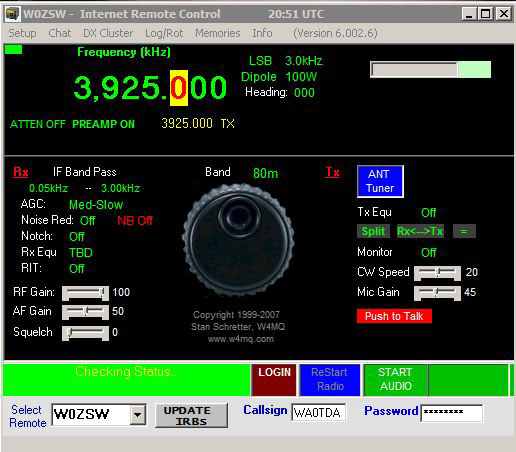
W0EQO at Courage North is in service. W0ZSW is in service.
Solar Activity Forecast: Solar activity is expected to be very low to low with a slight chance for moderate activity for the next three days (29-31 August).
Geophysical Activity Forecast: The geomagnetic field is expected to be predominately quiet for days 1-3 (29-31 August).
Credit: NOAA Space Weather Prediction Center
Please contact me directly at [email protected] if you have a remote base comment.
New Transceiver from ICOM: IC-7100
ICOM has shown the new IC-7100 at the JARL show in Tokyo. The interwebz is buzzing with information, including a preliminary data sheet.
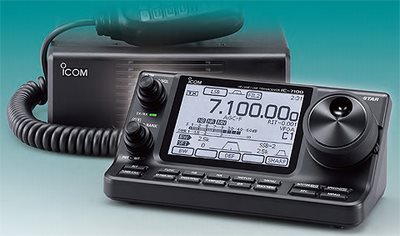
My scan of the preliminary datasheet indicates that this radio is in the class of the IC-7000 or even the IC-706. It covers all modes on HF plus 6 Meters, 2 Meters and 70 cm. (It also has the 70 MHz band which is a nice add for the European countries that have that band.) The radio includes DV (D-STAR) modulation capability and has a new touchscreen user interface. The slanted control panel is meant to make the touchscreen more accessible.
A new HF plus VHF/UHF radio always gets my attention (see my plea for an FT-950 with 2 Meters). I am starting to think that the real benefit of this rig is the addition of D-STAR capability, which would a good but not essential feature to have.
What do you think?
73, Bob K0NR
Update (30 Aug 2012): Universal Radio has the radio on its website.
There’s a good video look at the radio here.
Antenna Restrictions on Mt. Evans? The Conclusion
I finally received a letter from the Clark Creek Ranger District regarding my encounter on Mt. Evans (read the first part of the story if you are not familiar with it). It took me almost six weeks and several e-mails to get an official statement from the Ranger District. I guess an underfunded federal agency has more pressing issues to deal with.
The good news is that it was an over-eager FS employee who kicked me off the mountain.
The bad news is that, according to the letter, the Federal Code of Regulation [36 CFR 261.10(a)], which applies to communication equipment, is written with some built-in ambiguity and might be interpreted differently in other Forest Service units.
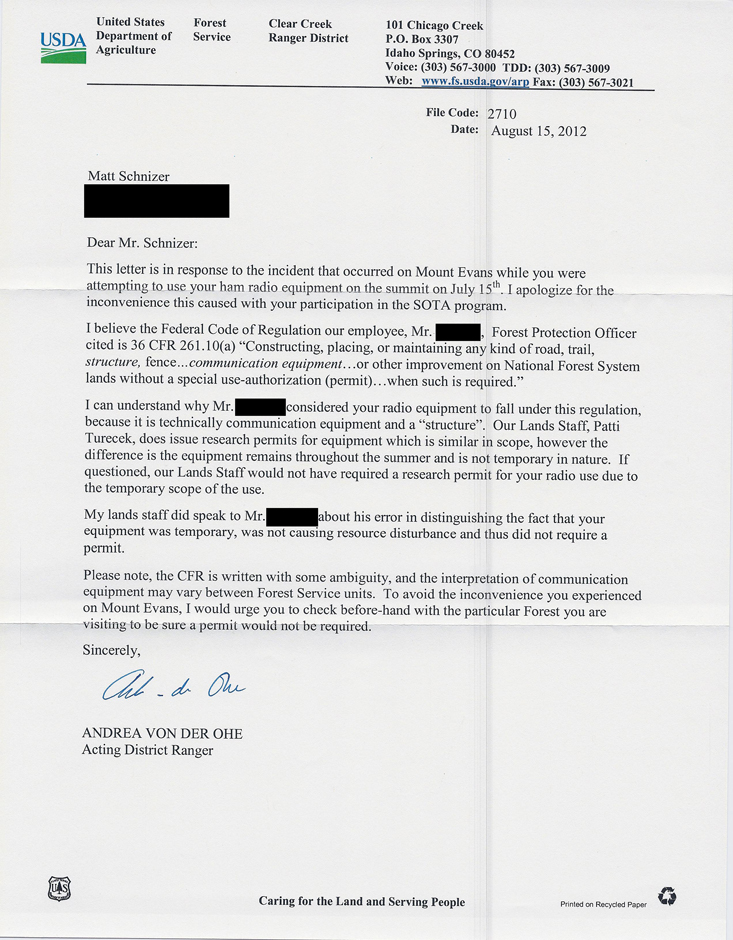
Official Response
Well, I will deal with another interpretation if and when I run into another issue. The Clear Creek Ranger District interpretation however makes sense to me – chapter closed!
I really appreciate the clarification.
Read the entire letter by clicking on the thumbnail to the right.
That’s my last post from Mt Evans but there are two more pictures I wanted to share. The first one was shot at the Summit Lake trail-head early in the morning. The trail starts on the right side of the picture, goes up the ridge to Mt. Spalding and over to Mt. Evans.
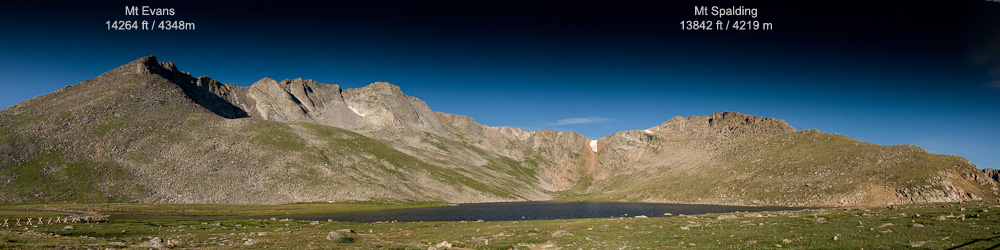
Panorama of the Mt. Evans Area

Mountain goat on Mt. Evans
The second picture is from a close encounter of the third kind… well, not quite but is was remarkable. This unflinching mountain goat approached me. The picture is shot with a 52mm lens, not a tele-photo lens. He came up to me at arms lengh… too close for my taste. I normally try to keep a save distance between wild animals and myself, but this guy was not shy at all. Since I had never heard about occurrences of rabies in mountain goats and since I received some goat combat lessons earlier in the year (courtesy of Rooster) on my trip to Mt. Herman, I took the chance to take some real close-up shots instead of retreating.
73, Matt/KØMOS
FCC Says “What Restrictive Covenant Problem?”
From the ARRL web site:
On August 20 — in response to a Spring 2012 Congressional directive — the Federal Communications Commission released its findings on the Uses and Capabilities of Amateur Radio Service Communications in Emergencies and Disaster Relief: Report to Congress Pursuant to Section 6414 of the Middle Class Tax Relief and Job Creation Act of 2012.
There was hope that the thousands of comments from amateur radio operators concerning the restrictions that homeowners associations place on the use of antennas would get the FCC’s attention. Maybe the FCC would see that the overall effectiveness of the amateur radio service for emergency use is being limited by these arbitrary, overly restrictive rules? (See a summary of my comments here.)
But, the FCC responded with this simple statement:
Moreover, while commenters suggest that private land use restrictions have become more common, our review of the record does not indicate that amateur operators are unable to find homes that are not subject to such restrictions. Therefore, at this time, we do not see a compelling reason for the Commission to revisit its previous determinations that preemption should not be expanded to CC&Rs.
I am not surprised by this response but still disappointed.
73, Bob K0NR
Handiham World for 22 August 2012
Welcome to Handiham World.
New Tech Net Offers a Chance to Get Questions Answered
We all run into technical problems with our amateur radio equipment, antennas, computers – you name it. Ham radio is a highly technical activity, so we all need resources to help us answer questions and figure out how to track down solutions. Of course there are on line forums for such things, but having an on the air “tech net” gives us a much more spontaneous and interactive way to participate in a group discussion that may well help us learn new things. The idea is for the Tech Net to facilitate discussions about technical topics. It is not a lecture series, nor is it a “check in for the count” kind of net. We welcome participants whether they simply want to tune in and listen or whether they want to transmit to ask or answer a technical question.
It isn’t every day that we launch a new net. The official start date is on Thursday, 6 September 2012. The net will meet at 7:00 PM each Thursday United States Central Time and will remain true to local time throughout the year. To be sure we are clear about this, the net will meet at 7:00 PM Minnesota time summer and winter, regardless of the change between Standard Time and Daylight Time. This means that there will be a one hour shift relative to GMT each Autumn and again in the Spring. It is just easier to stick to the same indicated local time than to use a static GMT hour.
In the summertime, when the Tech Net is on the air at 7:00 PM (19:00 hours), the GMT hour will be 19:00 + 5, making the net time 24:00 (or 00:00) GMT. In the winter, when Minnesota goes to Standard Time, the difference between Minnesota time and GMT becomes + 6 hours. In that case, the net is heard at 0:100 hours GMT.
Please feel free to get on the HANDIHAM conference the next couple of Thursdays at what will be our official net time for pre-Tech Net anticipation discussions!
Here are some key things to remember about the new Tech Net:
- It is perfectly okay to simply listen to learn. You are participating just by listening.
- You should check in if you have a comment or question related to a technical topic. (Checking in to get on a net roster is not part of this net.)
- When it is clear that a particular topic is under discussion and the discussion is not finished, please do feel free to add to the discussion if you have additional information on that topic. If you have some other technical question not related to the topic at hand, please wait until the current topic has been discussed and it is time to move on.
- The net will be moderated and the discussion facilitated by the Net Control Station (NCS).
- The Handiham Tech Net will meet each Thursday evening at 7:00 PM USA Central Time and last around an hour.
- The net is heard on the following nodes and links:
HANDIHAM conference server Node 494492 (Our preferred high-capacity node.)
KA0PQW-R, node 267582
KA0PQW-L, node 538131
N0BVE-R, node 89680
IRLP node 9008 (Vancouver BC reflector)
WIRES system number 1427
Email me at [email protected] with your questions & comments.
Patrick Tice, WA0TDA
Handiham Manager
Handiham World for 15 August 2012
Welcome to Handiham World.
Changing times, changing Radio Camp
Radio Camp has been a core part of the Handiham program, but it has not always been the same over the years. How can it change with the times? How is ham radio changing?
For the two decades plus that I have worked for Courage Center, the Handiham Radio Camps have been changing, but they have always included licensing classes and have been around a week long. I think the shortest was five full days; most were seven or even eight if you counted the two halves of the travel days. We offered a California camp and a Minnesota camp each year. The last California session was in 2008, just as the Great Recession was peeking above the horizon. Little did we know at that time how devastating that recession would be and how it would cause us to pull back some of our services. California camp was an early casualty, but we have managed to keep the Minnesota camp intact. Now, with the June 2012 camp session behind us, we must consider what we can do to make Radio Camp successful in 2013.
Before I tell you my ideas, I’d like to take a look at some trends in ham radio and life in general, so bear with me. Remember that what constitutes a “trend” isn’t always easy to define. Sometimes things change gradually over a long period of time – many years or decades, even centuries or millennia – while others change over a matter of months or a few years. It can be hard to tell when something is a short term trend or whether it is “permanent” for all practical purposes. Here are some trends that I have noticed:
- It is harder than ever to get people to commit to club meetings and organized group activities.
- The city parks and playgrounds are often nearly empty on a nice summer day.
- There are many two meter amateur radio repeaters with almost no activity.
- It seems as if every driver I see is talking on a cell phone.
- Two things that are getting hard to find are cassette tapes and photographic film.
- “LOL” has entered the vernacular.
- There is a lot of gray hair at ham club meetings.
- There is a lot of gray hair at lots of non-ham meetings.
- Most of us throw stuff out rather than getting it fixed.
- Social networks like Facebook are growing.
So what do I make of this and how does any of it relate to ham radio today and Radio Camp in particular?
Community:
Consider this: Ham Radio is a social network, and it predates Facebook by nearly a hundred years. It has many of the elements that web-based social networks do, including making friends and communicating with them on a regular basis, sharing news and information about other interests, and building technology. The “Amateur’s Code” was originally written by Paul M. Segal, W9EEA. in 1928. One of its main tenets is that the amateur is “BALANCED… Radio is a hobby never interfering with duties owed to his family, job, school or community.” Even in the early days of Amateur radio, it was observed that one could go overboard and miss out on real life by becoming too engaged in radio. Perhaps this wisdom should be applied to the digital distractions that empty out the city parks and playgrounds, and drain away participation from civic engagement. People are really, really connected these days. They cannot even drive around the block without making a phone call. Children have cell phones, and they communicate through interactive features in video games.
Computers:
Digital technology has married portability with computing. And NOTHING has escaped the long reach of the computer. It has gobbled up technologies like cassette tapes and photographic film and replaced them with digital audio and digital photography. It has transformed most areas of human endeavor. It has even changed our language to accommodate the compactness of texting. And with digital cellular service, all of this is available to nearly everyone near urban areas (which is most of us), at any hour of the day or night.
Overload!
Yes, we are digitized and connected. We can stay in touch with our circle of friends without ever being in the same place.
Is that good?
Well, yes, to a point. But the problem is that we are so connected that we get overloaded. No wonder we don’t look forward to a club meeting or a night out to dinner with friends. No wonder the playground is empty when the kiddos are thumbing away at their video game controllers in the family room. And no wonder the age of amateur radio operators is on the rise – there is lots of competition for engagement by other social networks and our ever-connected culture. Other clubs – not just radio clubs – have also seen their average age go up and up as young people just don’t engage as much as they once did in a pre-digital era.
How has ham radio changed?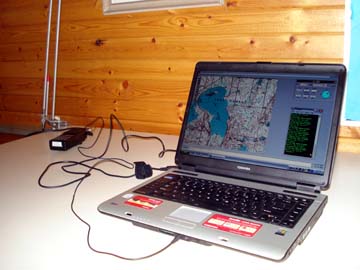
Ham radio is still a social network, but it is augmented by web-based social networks. Every ham radio operator on Facebook or Google Plus eventually uses these networks to discuss ham radio. Computing has transformed ham radio, with rig control, VoIP communications linking repeaters and computer users with smartphone users, and much more – too much to mention here. Digital technology has also made things cheap enough to replace rather than repair – and sometimes even to replace just because the new gear is magnitudes better, even though nothing is wrong with the old rig! All in all, while digital technology has been good to ham radio, it has sometimes been bad for ham radio in that it has buried everyone in constant connectivity that saps our will to participate in yet more communications. This gives us dead repeaters and sometimes poorly-attended meetings and events.
What about Radio Camp?
Radio Camp is quite a commitment for the campers, who have to take a week of their time at sometimes considerable expense if a lot of travel is involved, to attend. The camp session is also expensive to host, considering the preparation and camp rental along with a laundry list of other costs. Volunteers also incur similar expenses. Clearly this is a high-stakes event, so we need to make sure we are understanding the trends here. Is increased ever-connectedness growing and here to stay? It seems so. Is digital technology here to stay, along with increasing miniaturization and consolidation of functions? That seems a solid long-term trend as well. Is the marriage between ham radio and computing going to last? I’d say yes to that one, too. As I type this, I’m listening to 2O12L special event station calling CQ. The signal is being received by the Handiham TS-590S radio, remotely controlled via the internet.
Trending at Radio Camp…
So what seems to be trending at Radio Camp? For at least 10 years we have seen interest in the Operating Skills courses grow while in recent years it has become obvious that licensing courses are struggling. 2012 became a year without anyone attending camp to earn the Extra Class license. Operating Skills campers far outnumbered those who attended to study for a first license or upgrade. Let’s summarize and speculate on two camp trends:
- It is harder to attract campers who are interested in the licensing courses. We have to be careful here because we can’t assume that our Handiham members are no longer interested in licensing and upgrades to higher licenses, but they are less interested in doing so at a camp session and more likely to do it by using the on line audio lectures we offer at Handiham.org.
- There is growing interest in Operating Skills. This is at least a 10 to 15 year trend, and it may be driven by the new technologies and the desire to learn more about them as well as the need to simply meet other Handiham members in person and to have a week of fun. Camp has always been a place to meet old friends and make new ones, and our electronic connectivity can keep us connected after the camp session ends. Campers understand the balance between the real and the virtual and know that virtual cannot be a substitute for the real-life experience of attending camp in person. People are wanting to build real communities again!
A possible response:
So what do we learn from these trends?
Let’s put it this way: “The customer is always right”, as the old saying goes. Smart businesses listen to their customers and give them more of what they want. And what our campers want is more ham radio fun and less studying for licenses. What I propose is this:
- We continue to serve all of our Handiham members with our audio lectures for licensing or upgrades. Even those without computers can get our audio on Library of Congress digital player cartridges.
- This frees us to build and expand Operating Skills in the camp sessions.
- With more classrooms free because we don’t offer licensing classes, we can get our op skills people into separate spaces in small groups that make it easier to use the radios or have a discussion.
- Our instructors don’t have to worry about cramming an entire licensing class into a week and can concentrate on teaching operating procedures.
- We will have more time for traditional camp activities and the pontoon boat, plus field trips.
- We can set up more stations so that people with different skill levels and interests can get on the air more without waiting so long for a seat at the operating position.
- The Technician course would be replaced with a “Technician study group”. This would be a way to include a small number of unlicensed Handiham members in the week of Radio Camp, but it would only be a study group, not a complete course. There would be no more “Go to camp and get your license in a week.” Everyone there would have to be studying elsewhere prior to camp.
- VE Session: Maybe we have one, maybe not. We will see how this idea develops, but dropping the VE session gives us more time on the last day of camp to do our regular activities. The low pass rates in recent years do show that our traditional model of licensing classes is not effective. It might be better to review at camp and send the Tech students home to finish their studies and take the exams from their local VE teams.
- The emphasis will be on having fun through the week and being part of a community of friends. Learning can be fun, so we will learn about new things in Amateur Radio and learn how to be better radio operators.
Email me at [email protected] with your questions & comments.
Patrick Tice, WA0TDA
Handiham Manager
Pikes Peak to Mt Sneffels – 160 Miles
Here’s a video of my contact from Mt. Sneffels with Stu W0STU on Pikes Peak during the Colorado 14er Event. The QSO was made on 2M FM with 5W of transmit power on both ends.













