Archive for the ‘dx’ Category
 CQ WWDX Results
 November 26th, 2013 |
  Author:
 My CQ WWDX results are insignificant. I spent probably a half hour at the most (more like 20 minutes) behind the key last Sunday morning.
I am used to the contest being held on Thanksgiving weekend. Since November 1st was a Friday this year, that meant that this year, the contest was held the weekend BEFORE Thanksgiving. I have way too much to do the weekend before Thanksgiving, getting the house ready for the guests who will visit on Thanksgiving Day. I didn’t have much time to breathe, let alone sit behind the radio for an extended period of time. When the contest is held on Thanksgiving weekend (like next year), the house has been cleaned, for the most part chores are done, it’s the one weekend that grocery shopping is a real quick trip – ideal for sitting behind the radio and giving out points.
As I said earlier, I managed to sit down for about 20 minutes on Sunday morning before leaving for church and worked these stations:
OP4A
G2F
S52OP
OC4CW
LX1NO
ED7A
T7T
G4BJM
And it looks like T7T was a pirate, a fake …… I got “slimmed” as they used to say. T7T shows up in none if the callbooks and shows up on DX Summit and the Reverse Beacon Network maybe once or twice. So it was either a fake, or someone whose fist was so shaky that I totally got it wrong. It was suggested to me that perhaps it was TM2T, but man – even that’s a stretch. If I heard it wrong and got the number of dits wrong, MAYBE it could have been TM5T, because – – … (7) sounds a lot closer to – – . . . . . (M 5) than – – . . – – – (M 2). But I kept listening for a while, even after I made my QSO and it sure sounded like T7T to me. In any even, it was a busted QSO that I am not including in my official log.
72 de Larry W2LJ
QRP – When you care to send the very least!
A good week for QRP DX
I should have posted this earlier, as now it’s Thursday …….
This weekend is the CQ WWDX Contest, one of the “Big’uns”. This is one where a lot of folks travel to distant destinations, just for participation in the contest. So all during the week, visitors as well as indigenous Hams have been tweaking their equipment, and have been getting on the air to try things out. As a QRPer, this is a good thing to take advantage of. The bands are full of DX and now is your chance to work it. Pickings are good and I have worked Cape Verde Island, Peru, Ecuador, Nicaragua, Dominica, Morocco, and the Turks and Caicos Islands, and Bermuda – all with 5 Watts in just within the last few days.
The bands are expected to be in good shape for this weekend. So if you have the time, you can get on and you can net a lot of DX. If you’ve never started your QRP DXCC, now is the time to begin! If you go all out, I am willing to bet that you could conceivably earn it this weekend.
For the new QRPer, there are some things to keep in mind. At the beginning of the contest, code speeds are going to be fast. Some of these guys will sound like a buzz saw! Don’t get discouraged. The DX will keep on sending their calls a lot, so if it takes multiple attempts for you to copy, you’ll get plenty of them. Towards Saturday night into Sunday, when some of these guys get tired, they tend to slow up a bit, too. A tip to keep in mind is that the slower speed DX stations tend to congregate UP, towards the top edges of the CW bands, so that’s a good place to start. However, if you make a good effort to copy code that is faster than what you are used to, I can pretty much guarantee a 10% or better improvement on your copy speed by the time the contest is over.
The loudest stations are probably running the most power, but they probably also have the best antennas. Cherry pick those, and they’ll probably have an easier time hearing you, rather than the guy half way around the world who is running 100 Watts to a dipole only 25 feet up. You may work him too, but it will probably be a bit harder. Another thing to keep in mind, is that as the contest winds down on Sunday afternoon into Sunday night, the hard core contesters will be desperate for points. It’s more likely they will take their time with you, if you happen to have a weak signal on their end . REMEMBER – QRP does NOT necessarily mean weak signal! If propagation is favorable, and your antenna is decent, there’s no reason that your signal can’t be 579 or better on their end.
The exchange is super easy – RST and your CQ Zone. For those of us on the East Coast, I believe that is 5. Most Amateur Radio maps and/or logging programs will provide that for you. I’ll provide one here:
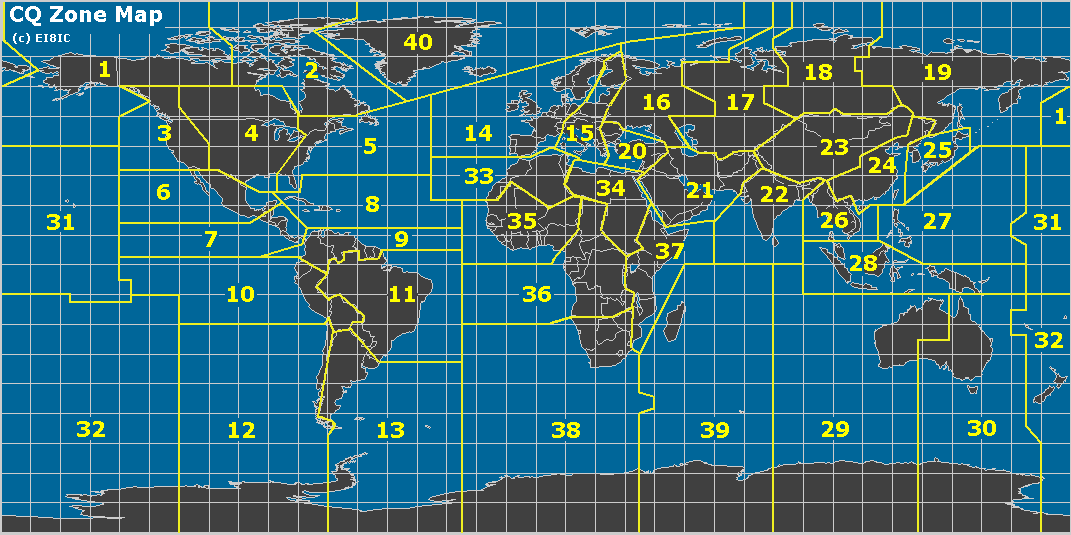
Don’t get hung up on not being able to work someone. If you’re trying to work a loud station, and he can’t hear you, don’t be afraid to turn the dial and move on. Maybe props aren’t the best between you and him at that moment. Go work someone else and come back to him in a bit if you can. With enough experience, in no time you’ll be able to tell who you have a reasonable shot at working and who you don’t.
The most important thing is to have fun! Don’t get discouraged or frustrated. If you end up working 100 DX entities, that’s great! If you only end up working 5 – so what? The bottom line is to enjoy yourself.
72 de Larry W2LJ
QRP – When you care to send the very least!
I Couldn’t Stand it Anymore
Last weekend I missed the opportunity to work XZ1J during a 10m LP opening into Texas, not only on 10m, but also on 12m. I was just not paying attention and by the time I realized I needed XZ on those bands, the opening was closed. So all week I've watched the DX cluster from my office as these LP openings have become daily happenings. Very frustrating, as there have been no evening SP openings. To make matters worse, I will be out of town this weekend and will not have a chance to work them then.
So, this morning, my oldest son Michael, AB5EB, who lives about 30 miles from me, sent me a text tell me he worked S21ZBC on 10m SSB and 17m RTTY. I checked the spots quickly to see that XZ1J was coming in as well. Well that put me over the top. If you remember the Popeye character from cartoons who used to say, "I've had all I can stands and I can't stands no more". I had a couple of hours clear on my work calendar, so back to the house I went.
The drive home is about 30 minutes and I got behind every slow car in the area. Finally I get to the house sprint to the shack to go the XZ 10m frequency. He's there and loud. Quick, find the station he's working in the pile-up, right there, make the call, de AD5A AD5A...... AD5A 5NN.....sweet. First call. Now the S21, which I also need is a few KC's up the band. He isn't as strong, working up two. I put in my call....... AD5A 5NN, sweet again. Two new ones on 10m in a matter of a minute, each on the first call. Now what about 12m? No spots, I tune the band, no XZ or S21. I text my son to post my response to his DXploits and comment that now they need to move to 12m. I tune the CW portion and hear CQ CQ CQ de S21ZBC up 2, what???? I put in my call 4 or 5 times and then, AD5A 5NN...ecstasy. I text my son who needs S21 on 12m. He had to turn around and go back home to make the QSO.
So, I drove back to work feeling satisfied and accomplished. Even though no XZ on 12m, one can't get greedy, save a little fun for later.
I do like this radio stuff.
The one that got away ……..
Amateur Radio and QRP, in particular, are like fishing. You send your signal out into the ionosphere much like an angler casts his line into the water. Sometimes you get a nibble or a hit, and sometimes you come home with an empty creel. And it seems just about every serious fisherman has a story about “the one that got away”.
Today my story should read more like “the one I never had”. Out at the Jeep during lunch, I had two quick hits on 10 Meters, D44AC on Cape Verde Island and OA4//N7CW in Peru. With those two in the log (very decent DX for 5 Watts to a Buddistick, IMHO!), I was feeling rather confident (read that – cocky), and tuned around the rest of the band. Hearing nothing else that intrigued me, I decided to switch bands to see how conditions were on 12 Meters. That’s when I heard them – 3DA0ET – the Swaziland DXpedtion! They weren’t the loudest, but they weren’t the weakest, either. They were louder than D44AC, who got me on the first call, so I thought I stood a chance (read that – expected to work them). I was seduced by the Dark Side. I ended up wasting the rest of my lunch trying to get them in the log, unsuccessfully (and thereby re-learning a very valuable lesson in humility).
But thinking about it, I guess it really wasn’t “wasted” time. It’s like that saying about the Lottery – “You have to be in it to win it”. I don’t gamble much on lotteries, but I do like to chase DX! Who knows? If I had been on at just a little different time, or if band conditions were just a little different, maybe I would have been heard in Swaziland. And it goes without saying, if you don’t try, you’ll never get them in the log. That’s what makes chasing DX so much fun. First off, you have to think of the sheer distances you’re covering. It still amazes me to this day, that a radio signal of not-much-power can travel that far – over continents, over oceans and make it to the destination – audible and intelligible!. Sometimes it takes a while for my head to wrap around that, even after being in this hobby for as long as I have. It’s so easy to take this all for granted and to not marvel at it anymore. Secondly, there’s the thrill of the hunt. You have no idea as to whether or not you will be successful. But when you do get heard and make it into the DX log – Wow, just wow!
72 de Larry W2LJ
QRP – When you care to send the very least!
A personal challenge
I went out to the car during lunchtime today. Temperatures here in New Jersey have cooled down. It was only in the upper 40s here (about 9C), so instead of standing outside and operating from the rear hatch of the Jeep, I sat inside to keep out of the breeze. Activity on 10 Meters seems to have gotten sparse. I still hear signals, mind you, but they are not as loud and not as “wall to wall” as they were just a few weeks ago. I don’t know if it’s that the band has changed a bit, or perhaps the novelty of 10 Meters coming back to life has worn off. In any event, I found myself on 17 Meters today, tuning around the band to hear what I could hear.
I worked EI13CLAN, whom I worked last month on 10 Meters. He was very strong, a very legitimate 599.
The tuning around some more, I heard XF1P calling “CQ DX UP”. OK …….. Mexico. But the pileup was huge …… HUGE! I wasn’t exactly sure why. Mexico is not exactly what you’d consider to be the rarest of rare DX. I reasoned that with a pileup that big, something that I was unaware of must be “up”. Additionally, I took it as a personal challenge. Could a QRP station running 5 Watts to a Buddistick possibly bust that pileup? XF1P was 599, but just barely. There was QSB to boot. I was reasonably sure that my signal would be audible on his end, but with that pileup, would I get lost in the sauce?

I sat there for about 20 minutes, listening and sending out my call. The KX3, with it’s Dual Watch feature, almost makes it unfair. I was able to follow XF1P along the band as he would move slightly after answering each station, XF1P in my right earbud and the station he was working in my left earbud. It just became a matter of sensing his pattern and setting the transmit VFO just a tiny bit higher after each call. Also, I had to time the sending of my call – not transmitting immediately, but waiting for the pileup to fade “just” enough where my call would be heard among the cacophony of all the true 599s that he must have undoubtedly been hearing. Finally, I heard him send back “W2L?”. Wouldn’t you know it? True to form, all kinds of stations without a “W”,” 2″ or an “L” anywhere in their calls began blindly transmitting. Not deterred, I stayed with it and threw “W2LJ” out there just a couple of more times and was rewarded with a confirmation.

Coming back from lunch, a quick peek on the computer before resuming work informed me that XF1P is an IOTA DXpedition to Partida Island – NA-124 located in the Gulf of California off the coast of Baja, Mexico. It is an uninhabited island, so I guess that makes it rare as IOTA goes. The pileup of IOTA devotees was intense, but I accepted the challenge with 5 Watts, took advantage of XF1P’s exceptional ears, and got through! That’s always a good feeling. And it also goes to show, that if I can do this, then YOU can do it too. It just takes some persistence and a lot of listening.
72 de Larry W2LJ
QRP – When you care to send the very least!
MGM 1939 film: Radio Hams / More than a Hobby
“Radio Hams” do more than play with their machines. They are also invaluable in relaying vital information during times of tragedy and disaster.
Here is a mildly entertaining look at radio hams, those amateurs sending and receiving coded messages during the late thirties when films first dealt with the subject of “radio hams.” In this case, the ham operators manage to be helpful during situations of stress, using their abilities with code to help someone in distress and to seek aid for pilots flying a missing plane.
The humorous ending has the family gathered around the radio listening to someone speaking Chinese while the narrator tells us how impressed the family was to be hearing someone across the world on their radio set.
http://www.youtube.com/watch?v=bZi7LiPNMt8
This little vintage film, a rather more serious film than many of Pete Smith’s other presentations, takes a look at how ham radios can become priceless aids during emergencies. The two stories shown, one dealing with sickness, the other with a missing plane, are bookended by a humorous look at a typical three-generation family’s fascination with their ham radio.
Of course, amateur radio, or “ham radio”, is alive and doing very well, in our modern times. Using satellites, moon-bounce communications, repeater networks, as well as shortwave, mediumwave, and longwave telecommunications technology, amateur radio continues to provide emergency services in times of need, from hurricanes, tornadoes, earthquakes, and even during such times as the infamous 9/11 atrocity. But, amateur radio also breeds invention and experimentation, always at the cutting edge of science. It is a hobby worth investigating, having room for a wide-range of interests. Preppers, science lovers, experimenters, and those with a passion to meet people from all over the world by way of radio waves, all together make up the radio hobby of amateur radio.
Clayton Moore, later famous as the Lone Ranger, appears uncredited as a ship radio operator.
Directed by Felix E. Feist
Writing Credits Buddy Adler (screenplay) (as E. Maurice Adler)
Cast (in alphabetical order)
Barbara Bedford – Mrs. Crane (uncredited)
Eleanor Counts – Miss Mulligan, Jimmy’s Sister (uncredited)
Jack Daley – Pa Mulligan (uncredited)
Robert Homans – Lighthouse Keeper (uncredited)
Clayton Moore – Ship Radio Operator (uncredited)
Alonzo Price – Clyde DeVinna (uncredited)
Jason Robards Sr. – Pilot in Distress (uncredited)
Pete Smith – Narrator (voice) (uncredited)
Harry Strang – Man in Montage (uncredited)
Phillip Terry – Co-Pilot (uncredited)
Dorothy Vaughan – Ma Mulligan (uncredited)
Produced by Pete Smith – producer (uncredited)
Music by David Snell (uncredited)
Cinematography by Robert Pittack
Film Editing by Philip W. Anderson (as Philip Anderson)
Music Department Jack Virgil – orchestrator (uncredited)
Other crew Douglas Smith – technical advisor
According to https://archive.org/details/wwIIarchive this film is in the Public Domain.
Creative Commons copyright.
2013/2014 QRP Fox Hunt Season
The season started tonight on 80 Meters. I worked Tom KV2X in NY rather easily. Then I located Jay KT5E in CO, and called him pretty much non-stop for the next hour. Sadly, it was not to be. Conditions didn’t favor me, and out of the three regular NJ Hounds, only Al W2EEW, got a two-fer. Both Charles W2SH and I nabbed only one pelt each.
Today during lunch, I was disappointed to hear that activity on 10 Meters seems to be waning. I didn’t hear many CQers, so I shinnied up to the QRP Watering Hole at 28.060 and called CQ for a bit myself. I was answered by Gerry EI5HJ. It was a nice QSO, but copy was a bit tough, with lots of QSB. 10 Meters may still be open, but the band seems to be in a bit rougher shape than it was just a mere week ago.
After my QSO with Gerry, I slid on down to 17 Meters, where I worked Cedric, CT3FT on Madeira Island. Band conditions seemed a lot better there. There was also more activity there than there was all last week.
72 de Larry W2LJ
QRP – When you care to send the very least!













