Archive for the ‘dx’ Category
 March’s QRP EME Window
 March 22nd, 2016 |
  Author:
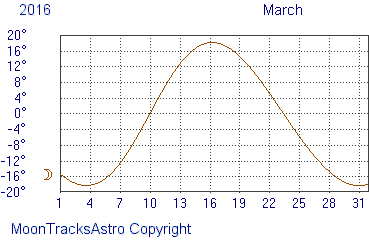 |
| Lunar declination track for March courtesy: http://www.moontracks.com/moon-declinations.html |
My minimal system (single 9el Yagi and 140w) makes it very easy to see the day to day changes in EME conditions due to various causes such as local geomagnetic conditions, Faraday rotation and libration fading ... or combinations of each! One of the days was particularly good, with numerous signals heard throughout the session while the next day was just the opposite, with only a few very weak signals and no contacts. On that particular day, I was being heard well by several European stations but was unable to hear any of them ... a true 'one-way' path and not uncommon on EME.
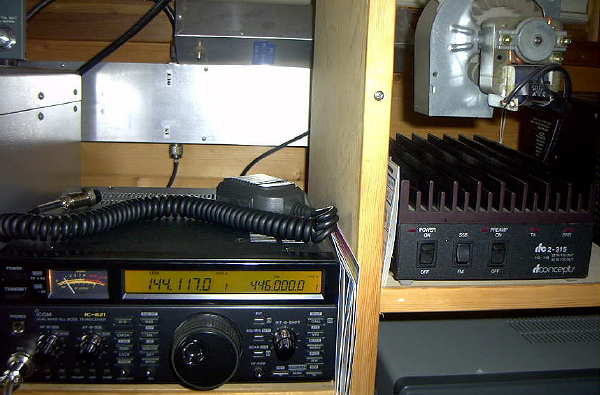 |
| My small EME station. Note old microwave oven blower on the 'brick' amplifier. |
Several smaller 4-Yagi stations were worked during the week, re-enforcing the benefits of having a moonrise over the ocean. As mentioned previously, the extra 6db of horizon gain allows my single 9el Yagi to perform more like a stack of four 9el Yagis. One of the fellows that I worked, DK5EW in Germany, asked if there was anything 'special' about my location that would make my very small station sound so strong at his end ... the ocean is clearly doing its job!
Altogether, 12 new stations were worked during March's window, bringing my total to 70 "initials". From the looks of the amount of activity, there are still many stations yet to work, that should be within range of my system.
Stations worked this week were:
I2FAK, UA3PTW, RZ3BA/1, SK5AA, PA2CHR, ES3RF, YO3JR, PA5Y, DK5EW, SM7GVF, EA4CYQ and W5ZN.
Three of these stations were using relatively compact antenna systems, consisting of 4x8el or 4x9el arrays, while the rest were larger. I have yet to tally up my DXCC or states total on 2m, but I know that W5ZN, in Arkansas, was a new state.
Up until this past week, the highest moon elevation that I have completed a QSO was with the moon at 18 degrees above the horizon. This week it was extended, at what is probably the limit of my fixed antenna, to 19.6 degrees when working ES3RF. At the other end of the scale, IK2FAK was worked with the moon at only .87 degrees high!
This month also provided my first glimpse of a 2m DX 'pileup', when J8/WW2DX in the Grenadine Islands showed up, calling CQ via the moon. My screen shot below shows at least 12 different stations calling him during his one-minute listening period ... some not yet 'warmed-up' as seen by their drifting oscillators.With several of the signals audible, it was an amazing thing to observe.
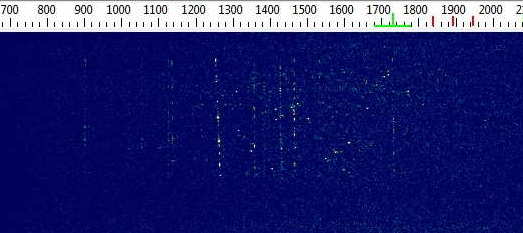 |
| 2m pile up on J8/WW2DX |
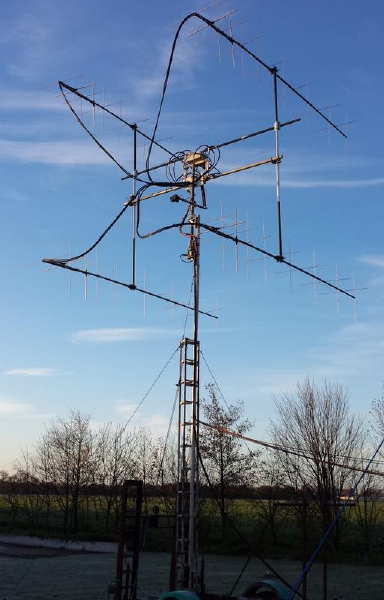 |
| The 4 x 8 el cross-polarized array of PA5Y |
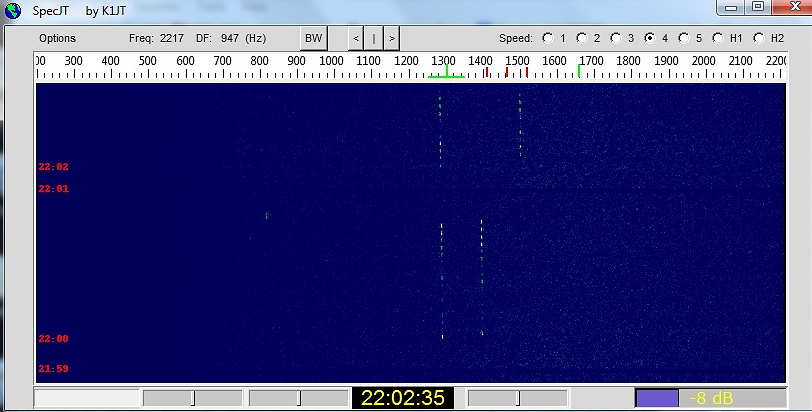 |
| YO8JR sending his 'RR' followed by '73' |
V29RW: Slacker DXpedition to Antigua
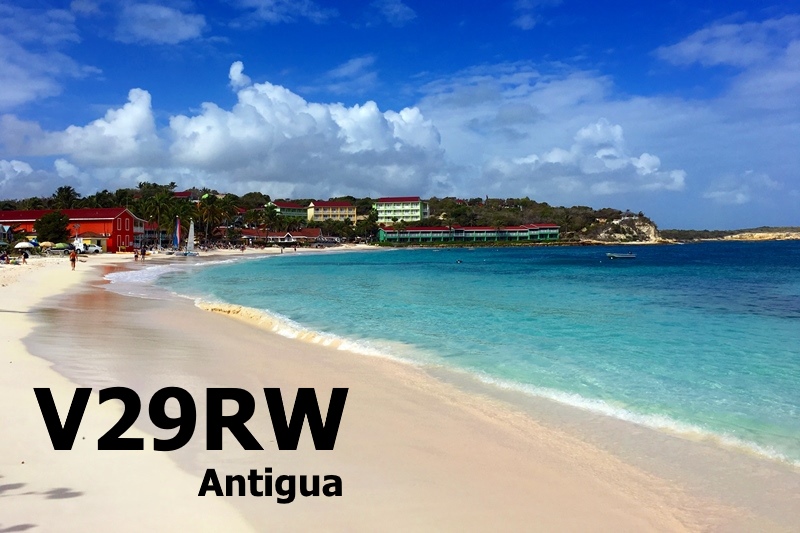
Recently, I had another opportunity to take ham radio along on vacation to a Caribbean island, this time to Antigua. This was not a super-gonzo turbo-charged DXpedition. I just worked in some radio action in between snorkeling and beach walking. This is referred to as a “holiday style” DXpedition, or maybe it’s just the slacker approach.
Radio Equipment
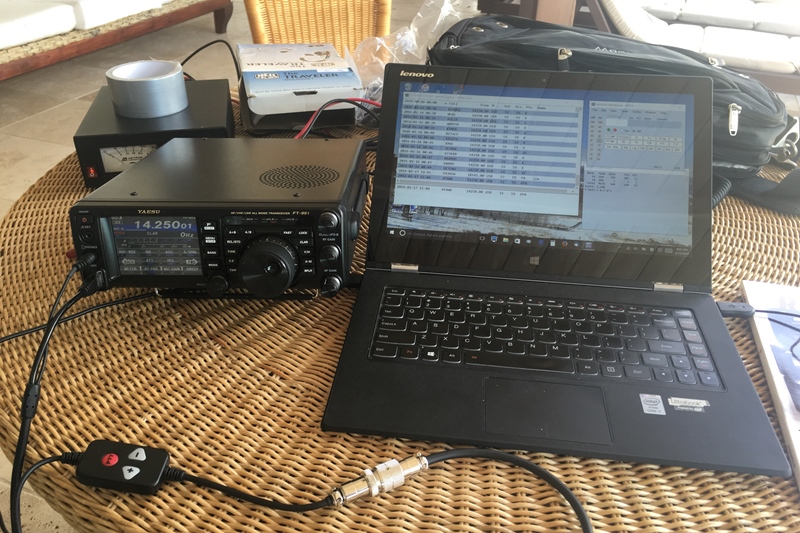
The radio gear needed to fit easily into my luggage. After all, we’ve got snorkel gear to take along. I wanted to put out a healthy signal from the island, so I rejected the idea of running QRP, opting instead for a 100W transmitter. Ultimately, I chose to take a Yaesu FT-991 which is full-power and full-featured but still relatively compact. It easily fit into my carry-on bag along with some other items. Having a built-in antenna tuner was a real plus and it was also good to have the 2m and 70 cm bands.
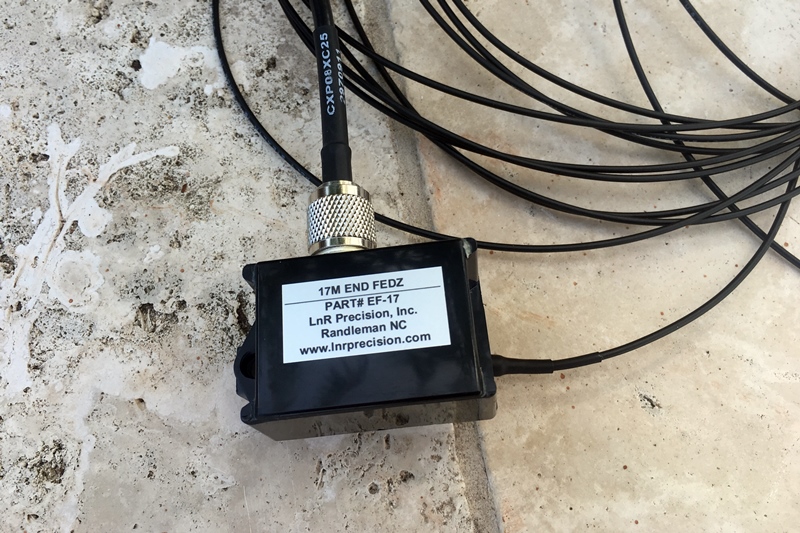
Choosing an antenna was a critical item. My first thought was to take my Buddistick antenna which covers the HF bands I was interested in working: 20m, 17m, 15m and 10m. I used that antenna from the Virgin Islands and it was really handy for taking to the beach. This time I wanted something bigger under the theory that size does matter. On the other hand, I wasn’t going to take full size yagis for each of the bands. I finally settled in on using End-Fed Half Wave (EFHW) antennas for the 4 bands (from LNR Precision). This gave me a simple half-wave antenna on each band with no coils, no traps, nothing funny going on. These antennas radiate well and have decent bandwidth…any SWR degradation can be tweaked up quickly using the FT-991 antenna tuner.
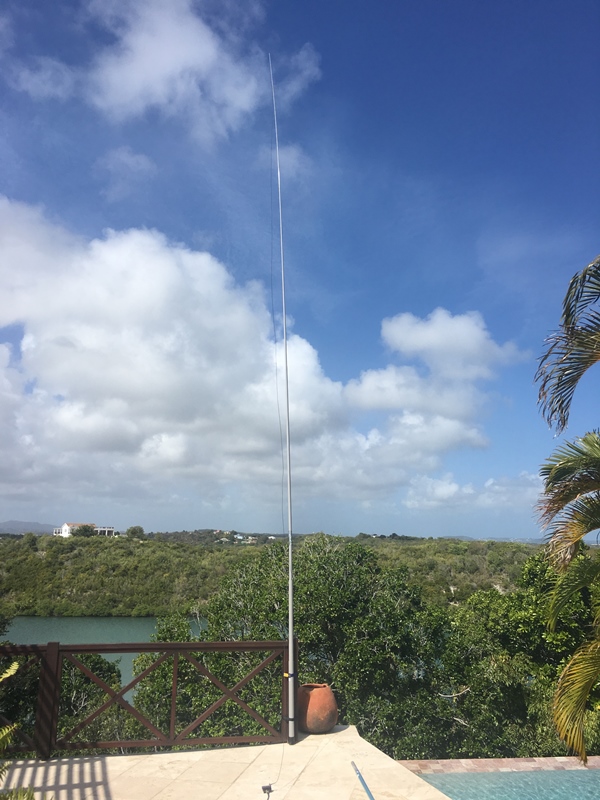
Steve WGØAT suggested I use the SOTABEAMS 30-foot mast to support the EFHW antennas. It is an incredible mast that collapses to 26.5 inches, small enough to fit into my bag. This antenna set up is common with the SOTA activators: EFHW supported by some kind of lightweight pole. I also tossed in a 19-inch magmount antenna for 2m and 70cm. (I did find a good repeater on on 147.0 MHz but did not spend much time on it.)
Rounding out the kit was an Astron switching power supply, a 25-foot length of RG-8X coaxial cable, a Heil Traveler headset and a few patch cords. I found it tempting to keep throwing more stuff in the bag so I adopted the backpacker mentality of taking just what I needed and not much more. For computer logging, I chose N1MM Plus software, set to log type to “DX”.
I have to confess that I did manage to break the 30-foot mast early in the trip. The house was on a hill and we always had a strong breeze coming through. One day it flexed the mast enough to break it. This was quickly repaired with duct tape. After that, I did not use the 2 top sections of the mast which reduced the amount of sway in the wind (and stress on the mast).
On The Air
My operating time was a bit sporadic and my operating strategy was simple: work the highest band (of 20m, 17m, 15m and 10m) that had some decent propagation to somewhere. Antigua is not extremely rare but it seemed to attract attention. Typically, I called CQ, worked a few stations and then a big pileup would develop. I made lots of QSOs with stations in North America, South America and Europe. I also made a few contacts into Africa but none with Asia. Signal reports were generally good (S9 +), so the antennas were doing the job.
All in all, I was pleased with the contacts I made, given the slacker effort. I especially enjoyed working 17m, a band I have not spent that much time on. The propagation is similar to 20m but noticeably less jammed with signals.
  Band  QSOs DXCC
    14   309   36
    18   162   13
    21    21   10
    28    91    6
 Total   583   65
QSLs for V29RW should be sent to my home callsign: KØNR (direct or via the bureau). Logbook of the World contacts have already been confirmed. Instant gratification, baby!
73, Bob KØNR, V29RW
Licensing info: It was relatively easy to get a ham radio license in Antigua, based on my US license (fees were $30 US). See this web page.
The post V29RW: Slacker DXpedition to Antigua appeared first on The KØNR Radio Site.
Hunting For NDBs In CLE 204
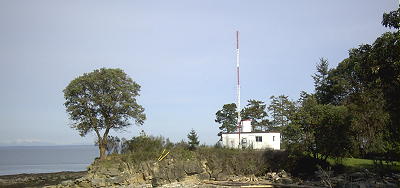 |
| 'AP - 378' - Mayne Island, BC |
This coming weekend will see another CLE challenge, this time in the 15 kHz slice from 370.0 - 384.9 kHz.
'CLE's are 'Co-ordinated Listening Events, and NDB DXers around the world focus their listening time on one small slice of the NDB spectrum.
This is a somewhat dreaded range for me since my local blowtorch NDB, 'AP' (378 kHz), sits right in the middle of the range. 'AP' is located at the entrance to Active Pass, the main ferry route to Vancouver Island, and the antenna is about 3/4 of a mile from my location. Needless to say, the beacon is about 40db over S9! With careful loop nulling, I can reduce this by about 25db but it's still an enormous signal to deal with.
Hopefully you can put 'AP' in your own log this weekend but its 25-watt signal will be much weaker for you. It's been logged as far east as Illinois and with your receiver in the CW mode, can be found on 378.399 kHz.
From CLE coordinator Brian Keyte (G3SIA), comes the following reminder:
Hi all,
Please join us in our 204th Co-ordinated Listening Event which starts
this Friday. All are very welcome.
CLEs are not contests - if you enjoy taking part you will be a winner!
51 of us from 31 radio countries joined in CLE188 back in Nov. 2014
when we listened on these same frequencies.
Days: Friday 26th - Monday 29th February
Times: Start and end at midday, your LOCAL TIME
Range: 370 - 384.9 kHz
Just log all the NDBs that you can identify with their nominal (listed)
frequencies in the range (it includes 370 kHz, but not 385 kHz)
plus any UNIDs that you come across there.
Please send your CLE log to the List in a plain text email if possible
(not in an attachment) with 'CLE204' at the start of its title.
Show on each log line:
# The date (e.g. 2016-02-26, etc., or just 26) and UTC.
(the date changes at 00:00 UTC)
# kHz (the nominal published frequency, if known)
# The Call Ident.
Show those main items FIRST - other optional details such as Location
and Distance go LATER in the same line.
If you send interim logs, please also send a 'Final' (complete) log.
As always, tell us your own location and brief details of the equipment
that you were using during the weekend.
I'll send the usual 'Any More Logs?' email at about 18:00 UTC on
Tuesday - you can check from it that your log has been found OK.
All logs must arrive on the list by 09:00 UTC on Wednesday 2nd
March at the very latest.
I hope the combined results will be completed on that day.
To help your listening, seeklists are available via the CLE page
http://www.ndblist.info/cle.htm
Good listening - enjoy the CLE
Brian
----------------------------------------------------------
From: Brian Keyte G3SIA ndbcle'at'gmail.com
Location: Surrey, SE England (CLE co-ordinator)
----------------------------------------------------------
(If you wish you could use any one remote receiver for your loggings,
stating the location and owner - with their permission if required.
A remote listener may NOT also use another receiver, local or remote,
to make further loggings for the same CLE).
These listening events serve several purposes. They:
- determine, worldwide, which beacons are actually in service and on-the-air so the online database can be kept up-to-date
- determine, worldwide, which beacons are out-of-service or have gone silent since the last CLE covering this range
- will indicate the state of propagation conditions at the various participant locations
- will give you an indication of how well your LF/MF receiving system is working
- give participants a fun yet challenging activity to keep their listening skills honed
Final details can be found at the NDB List website, and worldwide results, for every participant, will be posted there a few days after the event. If you are a member of the ndblist Group, results will also be e-mailed and posted there.
The very active Yahoo ndblist Group is a great place to learn more about the 'Art of NDB DXing' or to meet other listeners in your region. There is a lot of good information available there and new members are always very welcome.
If you are contemplating getting started on 630m, listening for NDBs is an excellent way to test out your receive capabilities as there are several NDBs located near this part of the spectrum.
You need not be an ndblist member to participate in the CLEs and all reports, no matter how small, are of much value to the organizers. 'First-time' logs are always VERY welcome!
Reports may be sent to the ndblist or e-mailed to either myself or CLE co- ordinator, Brian Keyte (G3SIA), whose address appears above.
Please ... give the CLE a try ... then let us know what NDB's can be heard from your location! Your report can then be added to the worldwide database to help keep it up-to-date.
CQ 160m CW Weekend
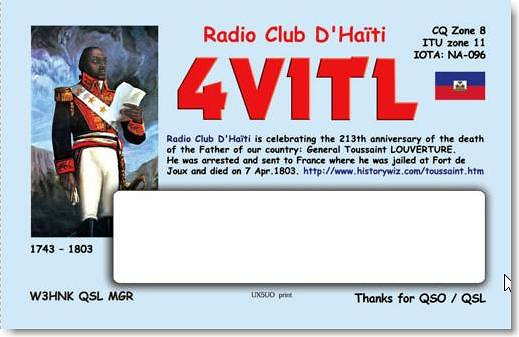
This past weekend's CQ 160m CW Contest saw the normally quiet band bursting to life with signals stacked up, one atop the other, from 1800 -1870 kHz.
At times it was very difficult to find a clear frequency to send 'CQ' and much of the contest was spent in the 'search and pounce' (S&P) mode. When a clear frequency was found I was able to have several short runs but running for any length of time while in the low power category is not realistic. I think my best hourly rate peaked at '60' for a short time as propagation would improve momentarily ... often, ten or more CQ's would go unanswered and then the next one would have two or three responses, continuing on for several minutes until the propagation would shift. These sudden 'holes' in the D-layer absorption seem to occur when conditions are marginal and it's as if the propagation switch is suddenly thrown from 'poor' to 'really good' for a few short minutes.
Overall, conditions from western B.C. were poor on Friday night and much improved on Saturday night. Although several DX stations were heard and called on Friday night, none were worked. These same stations came right back when called, on Saturday evening.
My 160m antenna is very simple, consisting of a 'half-sloper' and about fifty in-ground radials. Since the tower and antenna are mounted right at the ocean's edge, this year I threw two extra radials into the ocean ... whether or not these made any difference is difficult to say but they certainly wouldn't make things worse.

Because of the proximity to the ocean and the half-sloper producing vertical polarization, my antenna always seems to favor stations at the ends of the single-hop F2 distance ... those along the east coast and into the Caribbean as opposed to mid-continent signals. I often find myself sending several repeats to stations in the central states while those on the far coast will reply on the first call ... even stations that I can barely copy, will often come right back, which seems puzzling.
Overall, about 10 hours were spent in the contest ... ending up with 223 contacts in 51 sections and 9 DX entities. Some of the DX stations worked were PJ2, HK1, ZF2, C6, KP2 and 4V1. Checking my 160m DXCC list after the contest, I was surprised to see that 4V1TL in Haiti was a new country for me, making the contest time well worth it. Claimed scores for this, and any contest, can be viewed on the 3830 Scores website.
As the solar cycle continues to decline, 160m conditions should only get better and better, with the next few years hopefully producing a few Europeans in the 160m log once again.
VP8STI Excitement
 |
| S.Thule Island - courtesy: k5tr |
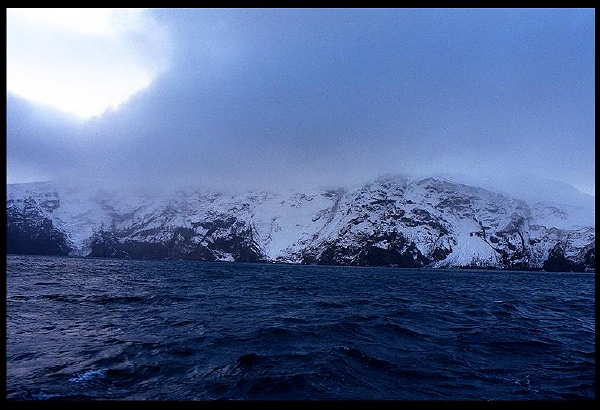
Operations from the South Sandwich Islands (Thule) has caused a lot of excitement on the bands over the past ten days ... but for myself, it was more of a last-minute frenzy, which I'll elaborate on later.
The expedition, composed of a crew of 14 operators from the 'Intrepid DX Group', left Port Stanley in the Falkland Islands aboard the MV Braveheart, on a 38-day roundtrip to South Sandwich and then to South Georgia ... two of the rarest DX entities on the planet, and by any standard, not the easiest places to reach!
South Sandwich was on-the-air from January 18th to the 25th, when a sudden turn of events put an end to the operation from the island. Not long after they suddenly disappeared from the air, this bulletin appeared on the DX newswebsite:
Today at 21:20 UTC, Nigel Jolly, Braveheart owner, declared an emergency and ordered to VP8STI team to cease all operations and return to the ship.
A large ice flow that had broken away due last nights storm starts to block the entrance to the Bay where they were camped. There was strong potential for the ice flow to prevent Braveheart to get them.
Team is now safely aboard the Braveheart and they are moving away from Southern Thule Is. All the equipment and personal gear is still on the island. They hope to return to camp site during next good weather window.
Once they retrieve their equipment, they could make a determination as to whether they can proceed to South Georgia to do VP8SGI as planned.
The latest word sounds very hopeful:
Finally yesterday, team was able to collect all gear from Thule Is.
All team members are OK and they are on the way to South Georgia where they will arrive after three days sailing.
They will try to be on the air during eight days as VP8SGI.
Personally, I want to thanks to all who send support messages to us, expressing their concerns about VP8STI team situation.
Delorme tracker is working, you can see Braveheart progress at: http://www.intrepid-dx.com/vp8/location.php
 |
| RV Braveheart |
I soon realized that operations on South Sandwich would be coming to a screeching halt at any moment and scrambled to see where they were presently operating. Unfortunately they seemed to spend most of the day (25th) on the WARC bands, for which I have no antennas ... I really need to hang a 30m dipole up in the trees one of these days for situations just like this.
As darkness approached VE7 land, I began seeing a few spots for them on 20m phone, not my favorite mode, nor the most efficient for working pileups.
Zeroing-in on their frequency found them with a nice 5x7 signal on 14.180kHz and listening from 14.235 - 14.245kHz. The operator was working North America by call districts and when I tuned-in, was working "Ø" 's. He would work ten stations and then change. He started on down the list, calling for "9" 's and then "8" 's but when he had finished with them, he called for "1" 's ... hmm. Perhaps he had started with "7" 's before I arrived and was working his way through the list once again.
It seemed to take forever when he had finally finished with the "6" 's and his signal was now considerably weaker ... "7" 's should be next. But no ... it was even better!
Luckily I had been following his tuning technique as he worked through the pileup and was able to track his listening frequency as he worked his way from 14.235 to 14.245 and back again. I had my transmit frequency already set on the frequency of the last "6" that he had worked ... when he called for "any VE's?" ... as luck would have it, he came back on my first call, not only making my day but making my week!
After a bit of a scare, I was very fortunate to work them on what turned out to be their last full day of operation, as they left the air, and South Sandwich, after only a few more hours of operation.
From now on I'll be checking my list much more carefully.
I Need You in My Log! SKCC K3Y/0 Special Event (January 2016)
I need your help!
Come meet me on the shortwave (HF) ham bands for the Morse code (CW mode) special event, the Straight Key Century Club (SKCC) celebration, with special callsign, K3Y. During the shifts (time slots) listed below, I am the control operator as K3Y/0.
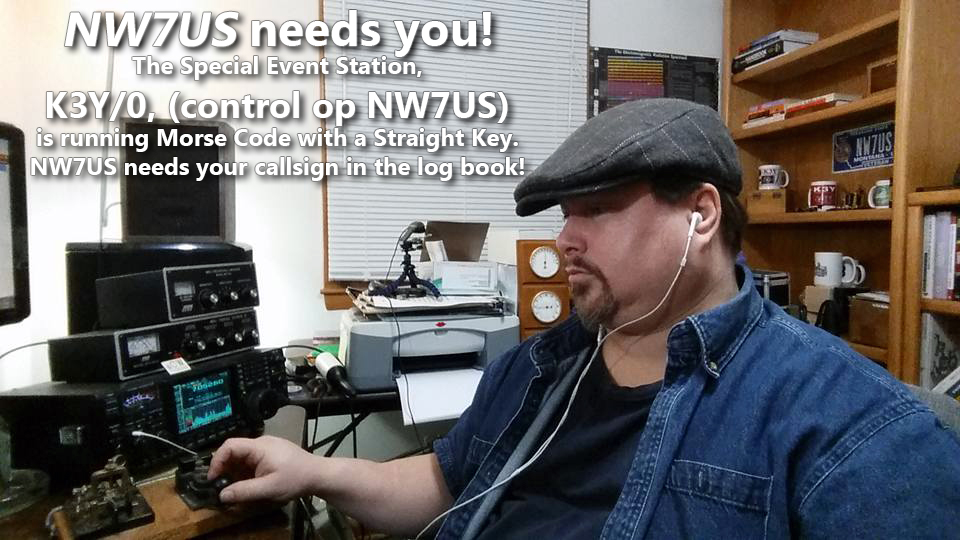 I need you to make a contact with me.
This special event takes place every year during January. We celebrate the legacy of Morse code, and promote Morse code and manual creation of the code by any non-electronic (digital) device and method. Which means that we love mechanical bugs, straight keys, two ends of a wire, or any other manual device, if Morse code is generated. The Straight Key Century Club is a free membership group. The link to their website is below.
I need you to make a contact with me, during my scheduled times, listed below.
NOTE: YOU DO NOT NEED TO BE A MEMBER OF THE (free) SKCC GROUP. To get into my logbook, you meet me on my frequency, and use Morse code to communicate with me. It is painless. If you must, you can use computer-generated Morse code. Or, you can tap it out on any Morse code signalling device, like a bug, a set of paddles, or a straight key; whatever you choose to make Morse code emanate from your HF transmitter.
HOWEVER: For those of you who want to get fully immersed in the spirit of this event, you are invited to use a straight key. And, as a bonus, you may and can join the SKCC group for FREE. Then, you would have your own SKCC number. That’d be cool; we SKCC members use that number in our exchange during our QSO information exchange. But, you don’t need that. Since it is free, why not?
What is needed is simply you, getting on the shortwave band, finding me, hearing me, and responding to me with Morse code. In other words, we need to have a QSO using Morse code. I am not a fast operator, so no problem if you are not very fast. I’ll meet your speed.
In any case, here are some of the times I will be on the air as K3Y/0… please dust off your straight key, bug, paddles, whatever, and make a QSO with me. Thanks!
My current schedule:
UTC Start/End (remember, these are NOT your local times, but are the UTC (GMT) times!)
(revised times, as of edit date)
 00:00 - 02:59 19-Jan-16
 00:00 - 02:59 20-Jan-16
 00:00 - 02:59 21-Jan-16
 00:00 - 02:59 22-Jan-16
 00:00 - 05:59 23-Jan-16
 14:00 - 18:59 23-Jan-16
 20:00 - 21:59 23-Jan-16
 00:00 - 02:59 24-Jan-16
 14:00 - 18:59 24-Jan-16
 21:00 - 21:59 24-Jan-16
 00:00 - 02:59 25-Jan-16
 00:00 - 02:59 26-Jan-16
 00:00 - 02:59 27-Jan-16
 00:00 - 02:59 28-Jan-16
 00:00 - 02:59 29-Jan-16
 00:00 - 05:59 30-Jan-16
 13:00 - 18:59 30-Jan-16
 20:00 - 21:59 30-Jan-16
 00:00 - 03:59 31-Jan-16
 13:00 - 23:59 31-Jan-16
Now, what frequency will I be on?
To find out what frequency I am on:
Visit http://g.nw7us.us/sched4SKCC and look on the right side for my callsign, NW7US. I usually post my frequency of operation right after my call sign.
Typically, evening operation is 30m, then 40m, and then possibly 80m.
If you are trying to alert me to your presence, you may message me on my personal Facebook profile, under my “Tomas David Hood” profile messages, but I may not see that right away.
Here is the detail covering the K3Y operation and the SKCC group: http://skccgroup.com/k3y
73 de NW7US
dit dit
This was last year:
https://www.youtube.com/watch?v=UfRvITFpTb4
..
..
LHS Episode #159: Digital Mode Interfaces
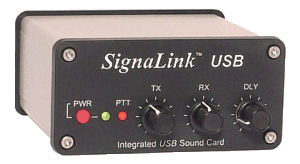 Hello, dear listeners! Thank you for tuning into another episode of Linux in the Ham Shack. In this week's episode, your hosts discuss a variety of topics from 600-meter operation to Linux in cars to Star Wars. Our featured segment tonight is a look at PC-to-radio interfaces for digital mode communication. Thanks for tuning into, and hope to see you next time.
73 de The LHS Team













