Archive for the ‘antennas’ Category
 Of Pounding Ground Rods and Labeling a Field Box
 October 7th, 2011 |
  Author:
 My arm is tired! I pounded in a ground rod tonight, a stout 8-footer from Fleet Farm. It wouldn’t have been so bad if it had gone in on the first try, but it took me three tries before I found a spot that didn’t have some obstruction about four feet under ground! (Remember I live in Granite Falls. There’s lots of rock around here.) I’m not sure which was harder — swinging the sledge hammer until the rod got stuck, or trying to pull the crazy thing out of the ground when it did. Soaking the ground with water helped to get it out in one instance.
It’s tempting to soak the ground with water before pounding your ground rod in, to make it sink in easier, but I’ve read that you shouldn’t do that as you wind up with a poor connection after the soil dries. As with many other things, the easy way isn’t always the best way.
Anyhow, I finally got it in far enough. There’s about ten inches sticking up out of the ground still, but all I’m doing by swinging at it now is flattening out the top. Once my wife hides it with a hosta plant it will look just fine! I tried pounding in a second one, but when it got stuck and I had to work it out (by clamping vicegrips on it and prying it out with a crowbar, a few inches at a time), I called it a day.
Much easier and more satisfying was labeling the toolbox I’ve converted into a field-kit: I’m asking an awful lot of this decal, sticking it on a pebbled surface. But so far it’s sticking just fine. Randy George, N3ZK, does a great job on these, ships them fast, and the price is right! For only $4.00 (shipping included) you get three of these labels.
In the field box right now is my Heathkit HW-8 and all the accessories necessary to zip out to my picnic table and get on the air with my low-hanging, temporary OCF dipole. Pretty soon it will be too cold to do that comfortably! That’s why I’m pounding ground rods, trying to get my long-awaited New Carolina Windom up and going before the ice and snow comes.


Yet another fake Diamond antenna
I ordered a Nagoya NA-771 antenna on eBay. I was impressed with the shorter NA-701 and wanted something with a bit more gain that was not poke-you-in-the-eye long. The NA-771 had mostly good reviews on eHam.
I ordered from an eBay seller that shipped from the UK. The price was £4.99. When it arrived, I found the packaging and the antenna itself claimed to be a Diamond RH-771 not a Nagoya NA-771.

But this is clearly another fake Diamond. The lettering is white whereas the real Diamond product is lettered in blue. The lettering also contains nonsense. It claims “144/430 MHz & VDE BAND HECEMNG COVERAGE JAPAN.” Eh??? Perhaps it was supposed to say wide band general coverage? And the antenna is only 36cm long whereas the real RH-771 (and the NA-771) are supposed to be 39-40cm long.
None of this would matter if the antenna was any use, but in fact its resonant frequency is just below 120MHz. At 145MHz the SWR is more than 4 to 1 and it radiates a poorer signal than the shorter Nagoya NA-701 antenna.
Anyone want an air band antenna? Yours for a fiver. And can anyone recommend a seller that has the genuine Nagoya NA-771?

Duh-tective sends his confession and apologies!
Made one of those last minute decisions to go out and operate in the last minute announced QRP-ARCI Welcome to QRP Event. Packed my trusty Sierra and End Fed Half Wave with Stuner (ala Stu KI6J) and went down to the lake park to take over the shelter. Hurricane Irene’s leftover wind gusts of up to 30 mph made the launching of antenna supports a bit more challenging than normal, but I used a bit heavier sinker than normal and only need one do-over shot to get my two lines in the air.

K4UPG setup for QRP ARCI Welcome to QRP Event 2011
Ran my EFHW in a L configuration with the vertical side up to about 33 feet and the horizontal side going to a nearby tree that was well placed for hanging my antenna. I started on 40 m and shortly after light off worked QRP contest regular W4BAI and felt good about the day. But either the band or the connection quickly began to let me down with signals diminishing quickly into the noise floor. Reluctantly shortened the antenna to switch to 20m and for some reason signals there were even lower in strength… and the antenna was not loading. Hmmmm! Could not get the LED to even dim–what could cause that? Changed my coax from rig to tuner, double checked the banana plugs and all seemed well there, but no match and the signals I heard were WAY down in the mud. I tried to check freq with a QRL? on several spots and called CQ until I was tired of pounding brass with no response heard. No fun…
Then the DUH-tective showed up and solved the problem.
Seems I had not switched the band module in the Sierra and it was still on 40m but the antenna was a 20m EFHW. DUH… my sincere apologies to anyone that got qrm’ed by my QRL’s and CQ’s into a mis-matched antenna. This is one time that I was glad to be running QRP at only 2.4 watts out. A quick band switch and I worked another contest regular K0ZK and then in the next QSO worked NE5DL for both QRP ARCI and SKCC number exchanges in two different QSO’s. Had a bit of distraction in the middle of our first QSO as the rain started and was pounding into my back as the 30 mph winds sent the rain horizontally! A bit more with Dave and I called it a day before the rig got wet. Good thing the DUH-tective showed up.

My sole visitor was a Black Racer about 4 ft away from me!
Hey, I was outdoors, saw a nice looking 3+ft long Black Racer snake about 4 feet from my operating position and made a couple QSO’s despite the goof ups. Who could ask for more?
VK on a whip antenna
The amazing power of the WSPR mode to enable weak signals to be received over long distances was demonstrated conclusively when my 2 watt signals, transmitted into a 1.3m long telescopic whip antenna from inside the G4ILO shack,were received in Australia and the USA, not once but several times with SNR reports of up to -19dB.
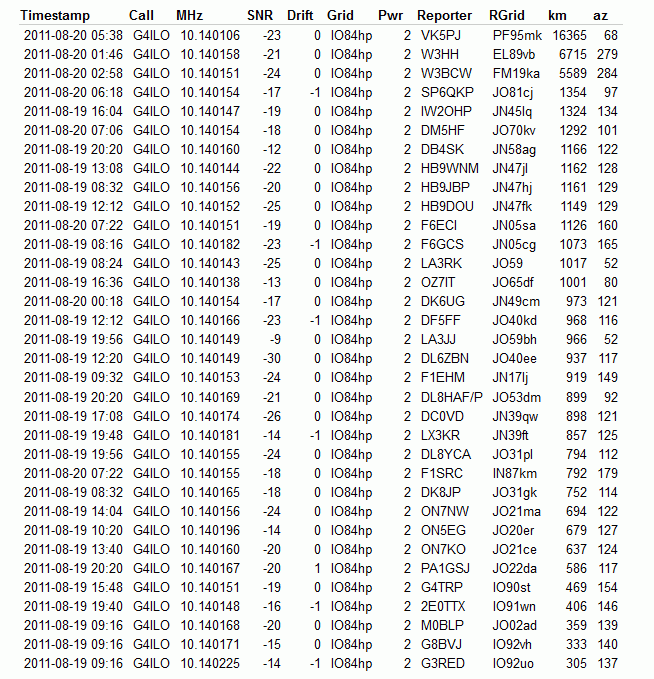
These spots were not achieved using a hand held radio as they occurred early in the morning when I was asleep. But they were made using a home made portable 30m whip antenna that I designed to be used with the VCXO-AXE portable WSPR transmitter I recently built. Here is a picture of the antenna taken during the tests.
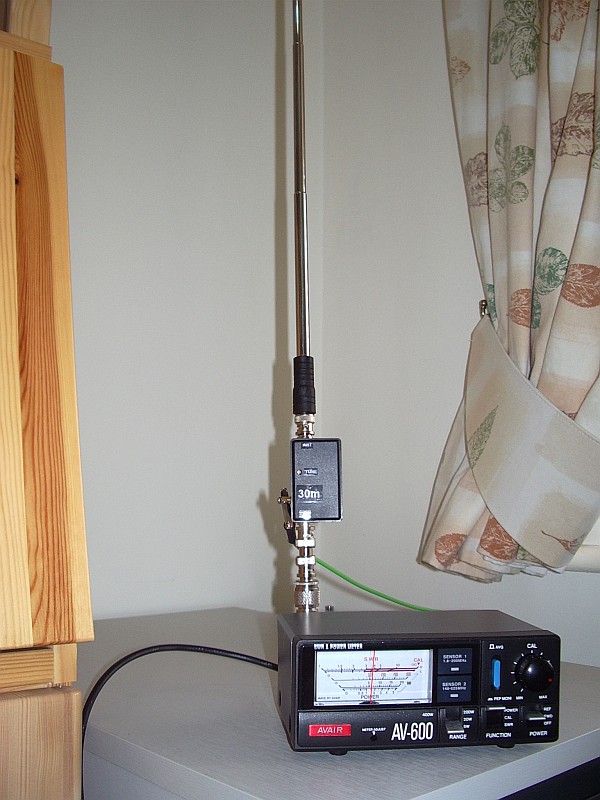
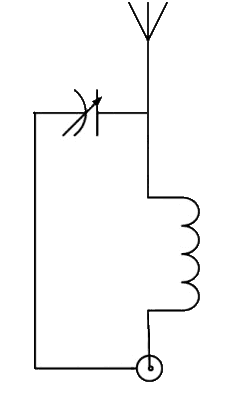
The antenna consists of an L-match mounted in a small plastic project box, with BNC sockets for the transmitter and the whip antenna.
The constructional details can be gleaned from this internal view here. Click the image to see a much larger version.
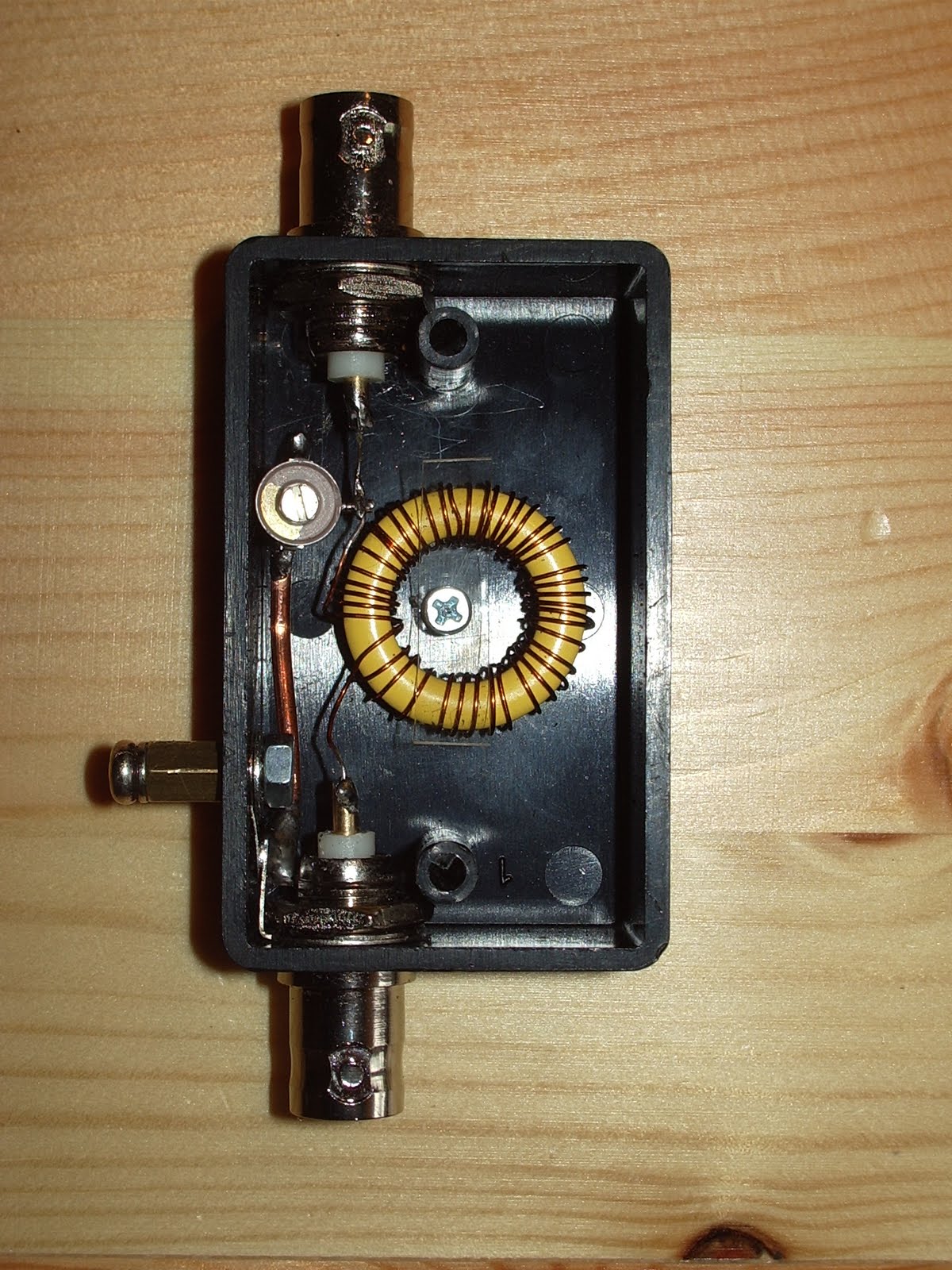
The loading coil consists of about 46 turns of 28SWG wire on a T80-6 toroid. The matching capacitor is a 4 – 40pF trimmer. The number of turns was determined empirically (i.e. using trial and error) so don’t ask me for details of how to make one for other bands. There may be formulas for calculating things like that but I don’t know them.
It would have been difficult to make this antenna without an antenna analyzer like my RigExpert AA-200 which displays the SWR across a range of frequencies graphically. With my first attempt at the inductor it was possible to obtain an SWR null at 10.140MHz but it was rather a broad dip and the minimum was around 3:1. However at lower frequencies I saw that I was able to obtain a much deeper, sharper null. This made it clear that what I needed to do was remove some turns until the deep, sharp null was at the frequency I wanted. A deep null indicates higher Q and therefore better efficiency.
You can see the SWR curve of the final version below.

Note, however, that this was taken inside the shack in the test position where reflections spoiled the SWR and broadened the dip. When measured out of doors the SWR curve dipped deeper and was narrower as long as I stood clear of the antenna. (It was interesting to note how the SWR was affected even if I was a metre away from the telescopic whip. This suggests efficiency would be adversely affected when used in true hand held fashion.)
A good ground or quarter wave counterpoise wire is needed with this antenna. The resonant frequency is affected by the ground system used as well as the length of the whip and the position of the trimmer. If you don’t want to take an antenna analyzer to the field to check and tune the antenna before operation you should use the same counterpoise. So it would be advisable to pair the counterpoise with the antenna.
Further tests would be useful to determine the extent to which a good match is reproducible in different locations using the same whip length and counterpoise without retuning.
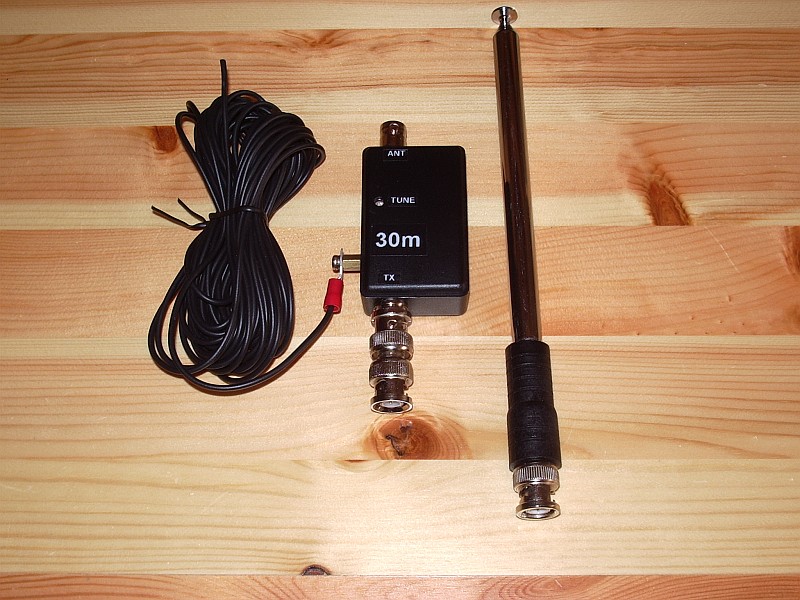
In case retuning is needed I added an access hole for the tuning trimmer. The resonant frequency can also be changed (increased) by shortening the telescopic whip a section or two.
This has been an interesting project. As a result of it I now have a completely portable, pocketable, battery powered system capable of sending a radio signal half way round the world, and I have developed a useful monoband 30m antenna.

Whispering with wonder
A few days ago I dug out of the cupboard the Wonder Loop portable magnetic loop that I made a while ago. I had lost the pieces of uPVC electrical conduit that made a Heath Robinson support for the coaxial cable loop element. But I had always felt the saggy coaxial loop was a bit of an eyesore anyway. So I decided to make a new loop using microbore copper tubing. It turns out that you can buy this stuff on eBay – any diameter and length that you want shipped to your door next day by first class post. Three metres of 1cm dia tube cost just over £12.

The new loop looks a lot better and certainly hasn’t harmed the performance of the antenna which continues to amaze me. I tested it using WSPR at a 1W power level on all bands (40m – 15m) that my Wonder Loop covers. The best result was obtained yesterday afternoon on 20m, between 16:30 and 19:38z, when I received 15 reports from VK2XN of from -9 to -25dB SNR, at a distance of 16579km. This, I repeat, was using just 1 watt from the FT-817 with the Wonder Loop sat on my shack “workbench” almost exactly as in the picture. (The FT-817 was moved to the radio/computer desk during transmission.)
I also spotted 9 reports of VK2XN during the same period, which surprised me due to the extremely high noise level I have here on 20m. The SNRs weren’t so good, though, and he was running 10 watts. Still, that almost qualifies as a two-way contact.
I haven’t tried other modes yet, mainly because the shack is so small and these days I’m a bit wary about sitting inches from an antenna even if it is radiating no more than a watt or two. But the original Wonder Loop was very successful using PSK31 and I hope to try this one with JT65A shortly.
The one disadvantage of the new copper loop is that it isn’t exactly portable, which had been one of my original objectives when building the antenna. If you could get hold of some metal strip it might be possible to make the loop from six pieces that you can join together using bolts and wingnuts to form a hexagon. Possibly you could even do this using tubing, flattening the ends of each 60 degree segment and then drilling them so the loop could be bolted together. But as I’m not planning on taking the antenna anywhere at the moment I’ll keep the one-piece loop which I can stick behind the shack door for storage.
This is a really great antenna that should enable anybody to operate HF from anywhere.

I am thinking Flight of the Bumblebees in STYLE this year !

K4UPG demonstrates how to get to FOBB in STYLE!
While everyone is thinking about antennas, staying cool and planning for the upcoming FOBB, I been checkin out a new ride! What do you think? Buzz- Buzz! Does this shout FOBB or what?
Now I can settle down and get ready for FOBB action with my untested top secret antenna. It will be all out for me again this year! Lookin’ for my friends out there on the ether and praying we don’t get lightning again like we did in 2009.
The last few years 20 meters has been the go to band, but it sure has not sounded very good here in Central Florida during the contest hours, so it will require being ready to shift bands to take advantage of the conditions.
BumbleBee #010 is gonna be listening for you all and lookin’ for the promised post of last year’s results too. CUL and 72– K4UPG
Amateur Radio Antenna Review Form
Amateur Radio Antenna Review Form Version 1.0
Name of Antenna________________________
Reviewer Callsign_________

Type of Antenna: (check all that apply)
( ) Commercial dipole that seems to work better than any dipole I've ever built
( ) Off center fed dipole that works better than a regular dipole
( ) Vertical that doesn't need any radials
( ) 6 foot whip that works great on 6m - 160m
( ) Old design from Handbook someone is selling as a new idea
( ) A dipole or dipole variant I'm selling to unsuspecting people
( ) I don't know
( ) Other _________ (specify)

Owned Antenna For:
( ) 0 - 6 Months
( ) 6 - 12 Months
( ) More than 30 years
( ) Never owned one but I think it's great

Why Antenna is Great: (check all that apply)
( ) Got a 59 / 599 report from several stations
( ) Is stronger in comparison tests against my old crappy antenna
( ) Worked a guy in ____________ (print country)
( ) Neighbor / XYL can't see it
( ) Antenna annoys Neighbor / XYL
( ) Manual good translation from Chinese large help in assemblage
( ) Antenna gain specification is in dBd and not evil dBi
( ) Heard on 80m roundtable it was good
( ) Can be fed with: (check all that apply)
              ( ) Any length of coax
              ( ) RG-58 or RG-8
              ( ) Specific length of "special" coax (included in box)
( ) Low SWR (1 to 1) across entire:
              ( ) Band
              ( ) RF Spectrum
              Antenna Tuner Required To Get Low SWR: Yes / No (Circle all that apply)
( ) Antenna has a cool name
( ) Antenna as good as multiple stacked four element yagis when condx are good
( ) Repels lightning
( ) Antenna includes mystery black box

Overall rating: ( ) Fine Business   ( ) Magic   ( ) Dead Full Quieting  ( ) 5 out of 5















