Archive for the ‘antennas’ Category
 Stealthy Roof Mast
 May 23rd, 2015 |
  Author:
  |
| courtesy: https://openclipart.org/ |
This time it's his stealthy mast to support some small VHF utility antennas. If you're interested in a simple stealthy mast for the roof-top, you may find some worthwhile hints here. His system would make a very nice stealthy support for a PAØRDT mini-whip which would put your antenna well above the house and its associated noise fields ... have a look.
2 Meter Portable Ground Plane Gizmo Antenna
Portable, Ground Plane for 2 Meters made with BNC antennas
that you can ‘take down’
Its a compact ground plane antenna for portable use!

2 Meter Ground Plane Portable Gizmo Antenna in Operation 2
This antenna is built on a 2 inch washer. Holes were drilled in the washer to accommodate 4 radials. The center hole for the BNC to BNC connector was already there, but had to be reamed out. This (male to male) connector is where the coax from the radio is attached on the bottom of the washer. It also serves to hold (the center radiator element)!
(Note: The radiator, in the center, needs to attach to a BNC MALE connector, the cable from the radio also needs a BNC MALE connector. I used a male to male adapter for this purpose. It didn’t fit tightly so I used an old bike inner tube to cut a small spacer for taking up the slack. I’d have used a metal washer for ‘fitting’ the adapter, but I had already make 3 trips to the hardware store, so I used what I had)
Gizmo Portable Antenna
without the cover

Center Post of BNC Connector for the Radials are Shorted to the Shell Side
I used BNC female connectors from, Digikey, a good source for components! The center post of this connector is shorted to the ‘shell side’ to provide a ground plane with all the radials!
The 24 inch antennas from China were purchased on Ebay! CHEAP! The 2 inch washer is from the local hardware store. Everything fits on this washer, a 2 inch space, but the center coax is tedious to attach with all the radials in place, especially if you have big fingers.
The Cap is from a spice bottle!
I live alone so it was not a problem! LOL

Spice Bottle Cover
I love to use things for which they were never intended! This spice bottle cap is a good example of this. At this point, I’m not sure if I’ll seal it to the top BNC antenna radiator element or not? If I seal it (with hot glue, maybe) , the cap becomes permanently attached to the radiator element, and would be difficult if not impossible to remove. The whole idea here is to use this antenna as an impromptu portable antenna!

2 Meter Ground Plane Portable Gizmo Antenna Hanging from a Taped Tie Wrap
A tie wrap is used to ‘hang’ the antenna. Its hanging from a hook on my porch at the condo. I put 50 watts into it to get a repeater 10 miles away. SWR was 1:1 This is a portable antenna! Its not meant to be a permanent one. If you have ever needed a 2 meter antenna that you can pull up into a tree with a string or rope, this is it! Hauling it up 40 or 50 feet on a rope will get you better results than at ground level.
There is a joke that says, have you ever seen a golfer with only 1 club? Ham radio antennas are in the same category as golf clubs. You just can’t have too many!
All the elements can be removed for easy storage and transport, (radials as well as the vertical element)! I’m sure some clever ham will come up with a suitable case for this entire assembly. If I had one of those nifty clear plastic shipping tubes, I’d store in that! I’ll be on the lookout for one!
HF Mobile, A Different Kind of Radio Shack
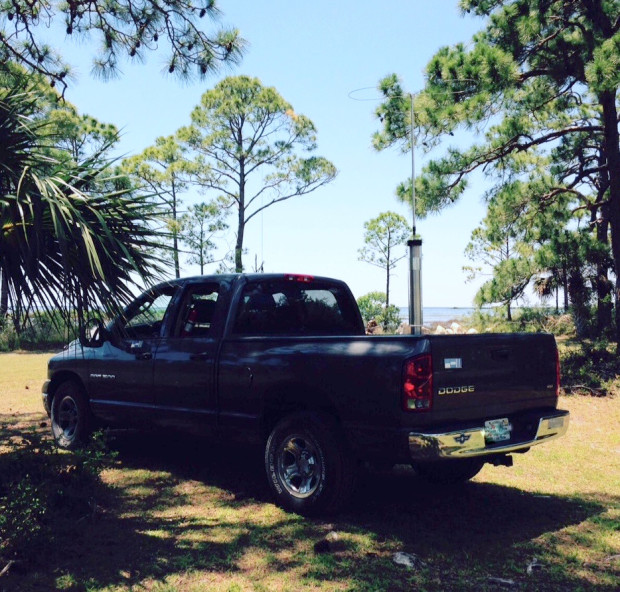
The Scorpion Antenna is mounted in a good spot in the rear of my pickup truck bed. Seen here at Hagen’s Cove in Perry Florida on the Gulf of Mexico in the ‘big bend area’!
Going Mobile, Rag Chews, Nets, CW, its all available and very doable when you are on the road!
Mobile HF radio adds yet another dimension to Ham Radio. This is my second go, at HF Mobile operation.
Years ago, when ‘real life’ happened to me, I had no home QTH to operate from so I bought a new (at that time) Icom 706 M II G radio. It was a great choice. A DC to daylight rig, and its still working 15 years later. This next episode of HF mobile is greatly improved over my previous one. A good antenna at the time, was made by High Sierra. It was a screwdriver type. (the original mobile antenna’s were nick named ‘screwdriver’ because they used an electric screwdriver for moving the coil)
High Sierra no longer makes mobile antennas, but the good news is there is a good company making them in Arizona, Scorpion antennas!
The Scorpion antenna is a heavyweight, at 18 pounds and it needs a very robust base to hold it. Breedlove Mounts
Its the Rolls Royce of Mobile screwdriver type antennas, and not just because I bought one, it is indeed, a very rugged and carefully crafted antenna.
I’m primarily a CW op so I incorporated a touch sensitive paddle to do CW on the move or sitting still in a local park like this one at Hagen’s Cove, on the Gulf of Mexico in the ‘big bend area of Florida!’

The cap hat ‘whip’ is a 3 foot rod of solid aluminum. It shortens the overall whip. This is nice for parking my truck in the breezeway without hitting the roof.
A motorized coil is moved up or down electrically! Listening for the greatest noise, depending on the band of choice, puts me in the ball park for checking the SWR. A 1:1 ratio is easily obtainable if care is taken during installation. Bonding straps are a must. All the parts of the truck body, door, tailgate, hood, fenders and truck bed, must be bonded together to from a good RF ground. Not a DC ground, mind you, but an RF ground plane. (The ‘other half’ of the antenna’)

All the body parts of the truck must be bonded together with straps. RF flows on the surface not the cross section of a conductor, so the wider the better. Copper flashing best carries RF current but a compromise is make for braid due to continuous flexing while opening and closing doors, and tail gates.
Bonding is one of the things that separates a good installation from a poor one. I had fun with the first truck and radio set up back in 2001 but I learned a lot about mobile HF radio since then and did things differently this time.
Location, location, location! It sells real estate and its very important for HF Mobile Antennas!
What makes a good location on a vehicle?
I’ve seen many examples of HF radio antenna installations that work, but some work much better than others. Besides bonding, another good trick for a good installation is to use a very good location; the main mass of metal must be Directly under, not near, the base of the antenna. Will a bumper mounted antenna work? Yes, but one with a mass of metal directly beneath the antenna will work better.
Its simply a case of, more bang for the buck!

Positioning the bottom of the movable coil above the truck side wall is best.
The Scorpion antenna movable coil still has the protective bubble wrap on it in this picture.
Clearance is important!
The bottom of the coil must have clearance from metal objects like the side wall of the truck.
Detailed installation instructions come with the scorpion antenna. This is very important. A good installation will insure good operation. Skimping on installation will only hurt you in the long run.
I installed an auxiliary battery in the back set compartment of the truck. Its a sealed lead acid 75 Ah battery made by Optima. I bought it trough Apex Battery.
Optima Blue Top from Apex Battery co.

Optima Blue Top 75 Ah Auxilliary Battery
I can use either the auxiliary battery or the truck battery or both at the same time, thanks to a marine dual battery manual switch.
See its picture below.
I used #4 wire to connect the truck battery in parallel with the auxiliary battery in the back seat area. This large gauge wire greatly reduces voltage drop between the batteries. For extended stays in one place, I can operate on the auxiliary battery, without running the engine. This insures that the separated truck battery will start the truck when I’m done operating.
I have not yet mounted this switch on a back board, but that is coming. I need both hands to operate the switch now and I want to be able to do it with only one hand!

Dual Battery Switch in the -Both-Battery- Position
The business half of the IC 7100 is mounted to the floor of the truck on the hump. The battery box can be seen with a power pole connection box on top.
The control box for the IC 7100 rides up front on the center console as does the touch sensitive paddle. The microphone hands on the cup holder.
I have a Warren Gregoire headset for SSB. It features a noise cancelling microphone. Warren Gregoire Headset (no relation to me)
(Special note here; its illegal to have both ears covered with a headset in Florida while you drive.)
Its a stupid law because you can legally drive in Florida even if you are stone deaf! So that kills the reasoning for ‘listening to sirens’ on emergency vehicles!
Okay, that rant is done! Back to the Mobile installation.

Battery Box, with Power Pole Box,-top, IC 7100-bottom

AA1IK, Using Warren Gregoire Headset 2
Join me on a new Yahoo Group for HF Mobile ops.
New HF Mobile Yahoo Group
Here I am using the Warren Gregoire headset. This headset has a noise cancelling mic so its a good fit for mobile HF radio. SSB is a new thing for me. I’ve been a CW op, for most of my ham life. I’m having a great time meeting new folks all around Florida on 40 Meter SSB. Ham radio has lots to offer and I’m glad I have not yet exhausted all the possibilities. I have not forsaken CW, but SSB is a fun mode, as I’m sure many of you already know.
The IC 7100 is a two part radio. You saw the ‘business end’ in a previous photo. This photo shows the control head and the touch sensitive paddles Touch Sensitive Paddles They are held in place with a bungee cord. The black plate that you see here is a small plastic clipboard with the clip removed. It is glued in place to the light brown plate, and that is also a clipboard with the clip removed. Both clipboards are held in place with bungee cords. This allows me to remove the control head and the paddles for security reasons.

IC 7100 and Touch Paddles

Remote Switch-top, SWR/RF PWR Meter-left, Speaker-right
The remote switch for moving the antenna up and down to tune in each band is show in the little cubby hole. The SWR/PWR meter is stuffed into a hole where the ‘never has been used-ashtray’ was. The speaker is mounted just above the cup holder.

Remote Switch Moves Antenna Up and Down to Tune Each Band
This photo shows the remote switch. It is hand held, and easily put away after the antenna is tuned.
So! That is pretty much the end of a walk through in my new mobile ham radio shack. So far, I’ve listened to CW on the road but have not called CQ or talked to anyone while driving. I became interested in CW Mobile early in my ham radio career.
The first requirement for operating CW Mobile, according to an article that I read on the subject, said to ‘become a dynamite CW operator! Its been almost 25 years since then and I’m still working on that first requirement.
I’ll keep trying!
De AA1IK
Ernest Gregoire
Happy Morse Code Day!
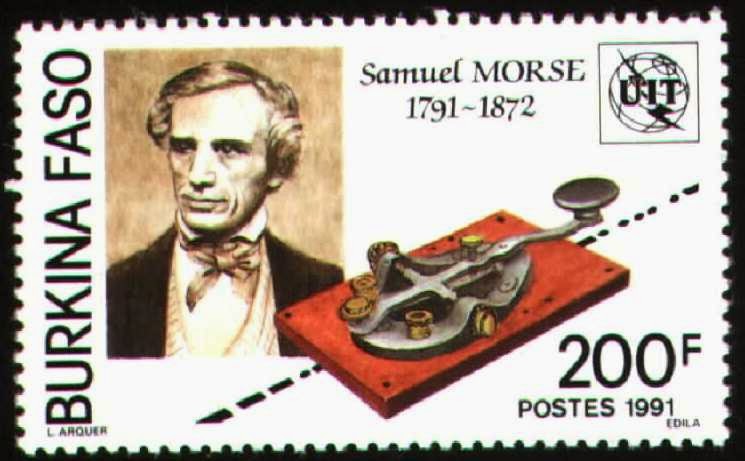
Does this make Samuel the original "Old Man"? Sorry Mr. Maxim*, I think Mr. Morse has seniority on you for that title, as Mr. Morse would be celebrating his 224th birthday today, were he of the kin of Methuselah.
Now that QRPTTF is over, except for e-mailing in my log summary, I thought I'd post where my signal was being heard on Saturday, according to the Reverse Beacon Network.
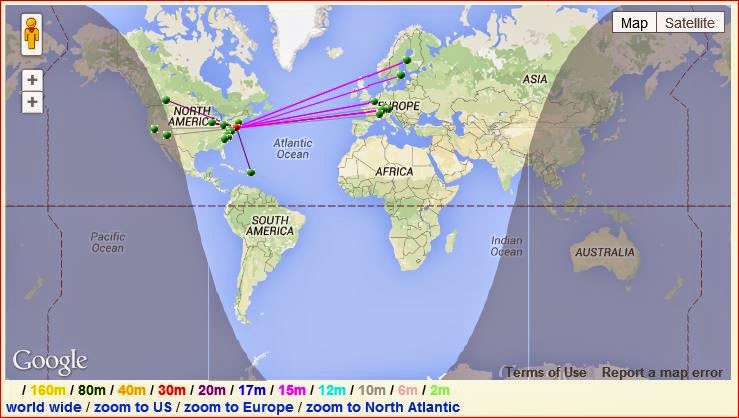
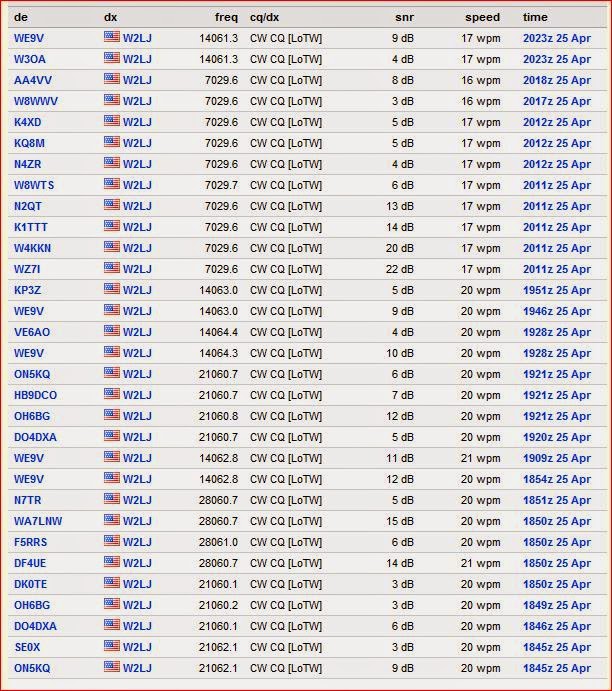
Bob W3BBO and I were discussing QRPTTF yesterday amongst ourselves, and it occurred to both of us that the western half of the nation seems to have reported larger QSO totals than the eastern half of the nation. This based on e-mails sent to QRP-L that we had read. Not sure what that means, but so far I haven't seen many e-mails from anyone east of the Mississippi with log summaries of around 40 QSOs or so. It will be interesting to see how it breaks down geographically once the results are in.
The EARCHI does get heard, and being on the top of a high hill (we call those mountains, here in NJ) sure makes a difference. And this makes for the other important lesson I've learned from events such as these. As nice as it would be to come in 1st place in a contest such as QRPTTF, the real prize won is enjoying a day outdoors, playing radio in the fresh air and sunshine, being able to forget about everyday worries, cares and concerns, even if it's just for a couple hours.
72 de Larry W2LJ
QRP - When you care to send the very least!
* - For those of you who are new to the Ham radio game, Hiram Percy Maxim who founded the ARRL, often wrote editorials under the pseudonym "The Old Man". Since HPM lived from 1869 - 1936. I guess that makes Mr. Morse the rightful holder of "The Old Man" title.
QRPTTF – 2015
As Mr. Lennon wrote, "Life is what happens when you're busy making other plans."
I had planned to get to Washington Rock State Park around Noon. The park, which is on the first ridge of the Watchung (Wach Unc in Lene Lanape) moutnains, meets the QRPTTF theme requirement for being a place somehow related to Native Americans. What actually happened was that my daughter was invited to a sleepover/birthday party, and I had to have her at her friend's house at 2:00 PM. So much for the early start.
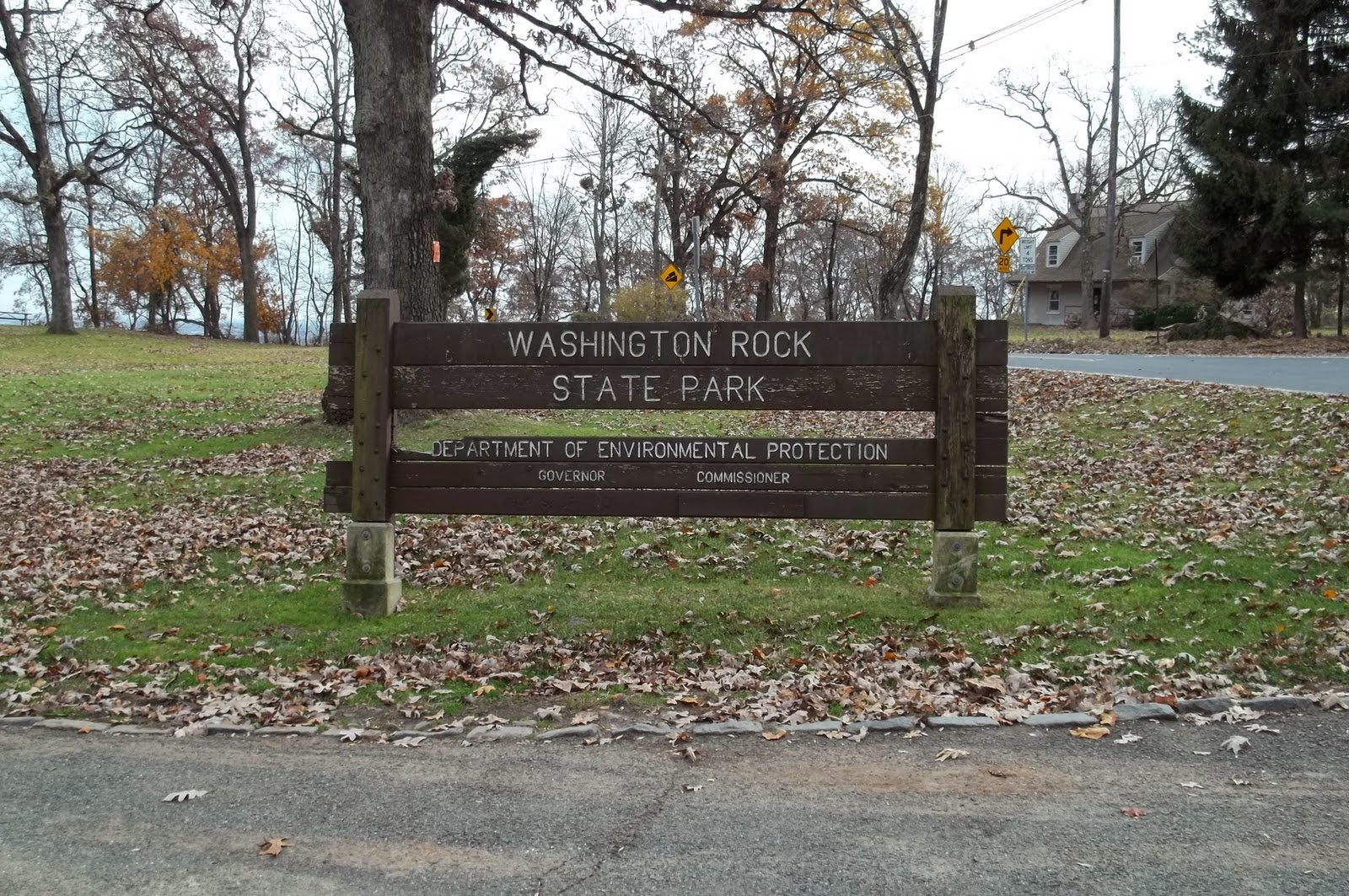
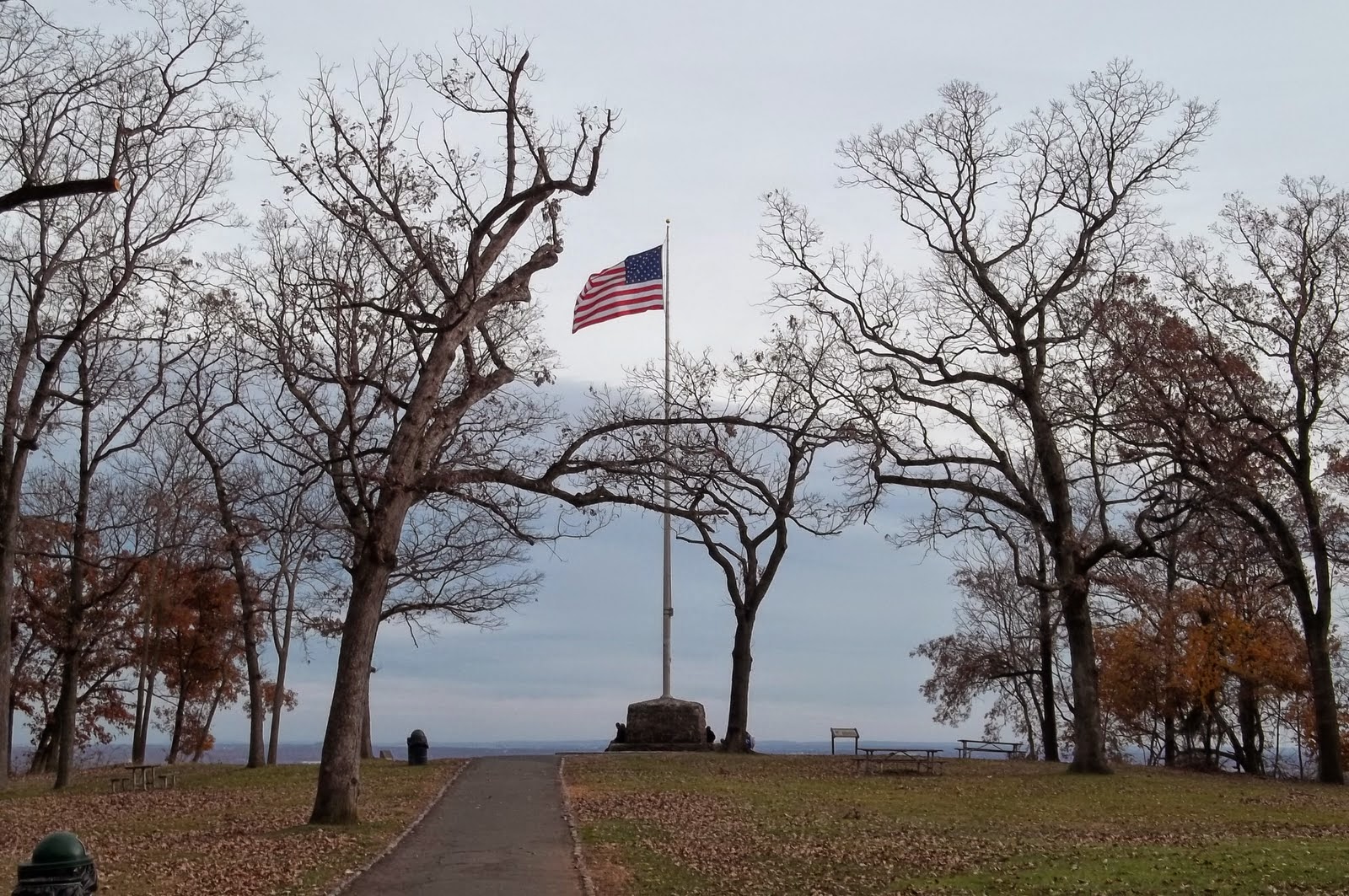
Set up did go like the knife through hot butter, after I made it to the park. The new Joplin ARC antenna launcher got my antenna hoist line up over a 40 foot high tree branch on the first shot. The EARCHI was up, literally in minutes.
I got on the air at about 1830 UTC and I spent about 15 minutes calling CQ QRP on 15 Meters with no takers. I had a feeling that 15 Meters was going to be good today. It wasn't, at least for me. So I meandered over to 20 Meters and was answered by Craig N8KMY at 1855 for my first QRPTTF QSO.
It didn't start out as a QRPTTF QSO. He called me because in his words, he couldn't believe that I was QRP. He is located in northern MI and told me that I was one of the loudest signals on the band for him. He repeatedly asked me to confirm that I was only running 5 Watts.
He was as loud to me as I was to him, so that's where the fun began. First he lowered his power from 40 Watts to 20 Watts, when I told him there was no difference in his signal, he continued to lower his power down to 10 Watts, and then, eventually 5 Watts. He was astounded when I told him (quite honestly) that there was no difference between his signal at 40 Watts or 5 Watts. A new QRP convert? I certainly hope so! Craig seemed enthusiastic enough.
Getting him down to 5 Watts qualified as a QRPTTF contact. We had a nice ragchew for about 25 minutes. A bit longer than I had intended, but it's never a bad thing to promote QRP, and bring a new soul into the fold, right? So it was worth it.
Besides, as it turned out, the bands weren't exactly rip-roaring with QRPTTF activity. I ended up making only 8 QSOs. Six on 20 Meters and two on 40 Meters.


I worked, in addition to N8KMY, NK9G, WQ8RP, K7RE, K4UPG (Kelly, my fellow QRP Polar Bear - Grrrrrrrr), WB3T, KS8M and AA5TB.
What made the day, was when my fellow SPARC members, Marv K2VHW (my official QRPTTF 2015 photographer) and Drew W2OU came for a visit. They kept me company in between QSOs and also stayed with me until I packed up for the return trip home. Around 5:00 PM, it started getting chilly again and QRPTTF signals were becoming about as scarce as hen's teeth. So only though I put in only 2 & 1/2 hours behind the key, I decided to call it an event and head home.
The important thing was that I had fun and enjoyed my time playing radio today. It feels like I don't get to do this anywhere near enough.
72 de Larry W2LJ
QRP - When you care to send the very least!
They named a candy after me!

VE7SKA’s New Skywire
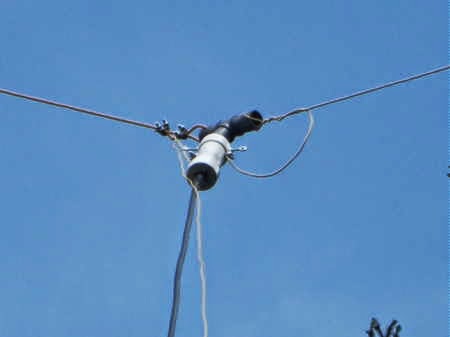
Mike, VE7SKA, AM/FM DXer from Saltspring Island, a nearby island here in the oceans of south-west BC, has sent me a description of his latest doings. Mike took advantage of the recent warm sunny weather to do some antenna work.
Mike calls his new antenna the SDSS (Super Drooper Sleuther Sloper)! It is 110' long, made of #18 wire and hangs from near the top of his 48' tower, drooping to a low sturdy Fir branch, about 10' high.
Using a section of Belden 9913 that was already on the tower (it used to feed his 6m array), Mike feeds the 'drooper' via a 9:1 balun / matching transformer... with the antenna feeding one leg of the transformer and the other side going to a section of #18 wire dropping straight down and terminated in a small ground system at the base of the tower.
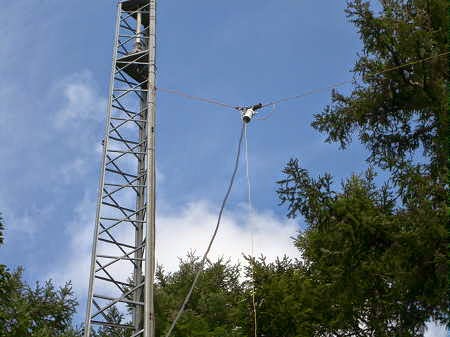
The antenna runs ESE at 112 degrees by WNW at 292 degrees ... the bread and butter direction from SW Canada. For phasing and comparison, Mike uses a much lower wire, 30' long x 7' above ground level, running SE at 140 degrees by 320 degrees NW.
Mike reports: "An immediate test done after launch at 3pm logged a new 10 watt TIS on 1630kHz from just north of Marysville, WA on I-5 freeway. Little daytimer KBRD 680 Lacey, WA with 250 watts wasn't even audible on the Quantum QX Pro v3 amplified loop ... recent MW condx have been favorable ... a sunset tentative of 1460 KLTC N.Dakota (5kW); logging rarity 930 KTKN AK (1kW) on a very busy frequency ... new logging 1580 KKTS WY at 220 watts, phasing out pests KGAL and KMIK."
Mike goes on to say that phasing the new antenna against its smaller and lower little cousin allowed him to log several of the stations noted above, although the lower antenna picks up more noise.
This is really the key to any antenna system and one of the reasons we were always taught to get antennas as high as possible ... to get away from those nasty noise sources in or near the house.
With several antennas to play with now, Mike is looking forward to some interesting work on both the BCB, the beacon band and the lower SW bands but plans to get the antenna up much higher in some of his tall Firs before too long. As well, a high Low Noise Vertical is also on the 'to build' list.
So far the SDSS is proving the old myth wrong ... that antennas put up in anything less than the foulest of weather just don't work.













