Author Archive
 Hunting For NDB’s In CLE 206
 April 20th, 2016 |
  Author: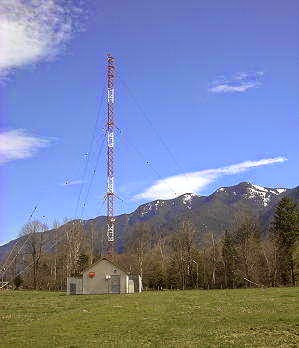
This coming weekend will see another CLE challenge, this time in the LF band from 190 - 239.9 kHz.
'CLE's' are 'Co-ordinated Listening Events', and NDB DXers around the world focus their listening time on one small slice of the NDB spectrum.
One nice catch to try for is 'LU' on 214 kHz shown on the left. The 'LU' NDB is in a breathtaking location, high on a mountain meadow at the foot of the North Cascade mountain range. In spite of the towering mountain peaks to the east and to the south, 'LU' is well heard, being reported as far east as Massachusetts and as far west as Hawaii.
The antenna is a 100' top-loaded vertical with, presumably, an extensive ground system as this is a very large site. The transmitter is a 500 watt Nautel. 'LU' is about 20 miles north-east of the Abbotsford Int'l Airport, Vancouver's alternate.
From CLE coordinator Brian Keyte (G3SIA), comes the following reminder:
Our 206th Co-ordinated Listening Event is next weekend.
Do join in if you can. First-time CLE logs will also be very welcome.
Days: Fri. 22 - Mon. 25 April, Midday-Midday, your local time
Frequencies: NDBs from 190 - 239.9 kHz
PLUS: Normal NDBs on 'half-way' frequencies nnn.5 kHz
(from 190.5 - 999.5 kHz)
Both halves are for everyone to try.
Away from Europe many of the frequencies below 240 kHz are busy with
NDBs. In Europe there are very few there, but some DX ones might be heard from North America and maybe from a few other places.
The normal NDBs (not DGPS) which have carriers on the 'half-way'
frequencies (e.g. 284.5 DY, 333.5 VOG, 370.5 LB, 390.5 ITR, 433.5 HEN)
are scattered across Europe but there are very few of them elsewhere.
'Hot spots' are ENG and ITA.
These half-frequencies give comfortable QRM-free listening and probably
some good catches as a result.
America has only one or two (e.g. 381.5 SJX) but East and West coasters
might hear some DX ones.
We last used these 'rules' for CLE190 in January 2015.
Please send your CLE log to the List in a plain text email if possible
(not in an attachment) with 'CLE206' at the start of its title.
Show on each log line:
# The date (e.g. 2016-04-22, etc., or just 22) and UTC.
(the date changes at 00:00 UTC)
# kHz (the nominal published frequency, if known)
# The Call Ident.
Show those main items FIRST - other optional details such as Location
and Distance go LATER in the same line.
If you send interim logs, please also send a 'Final' (complete) log.
As always, tell us your own location and brief details of the equipment
that you were using during the weekend.
Good listening - enjoy the CLE
----------------------------------------------------------
From: Brian Keyte G3SIA ndbcle'at'gmail.com
Location: Surrey, SE England (CLE co-ordinator)
----------------------------------------------------------
(If you wish you could use any one remote receiver for your loggings,
stating the location and owner - with their permission if required.
A remote listener may NOT also use another receiver, local or remote,
to make further loggings for the same CLE).
73
Brian
These listening events serve several purposes. They:
- determine, worldwide, which beacons are actually in service and on-the-air so the online database can be kept up-to-date
- determine, worldwide, which beacons are out-of-service or have gone silent since the last CLE covering this range
- will indicate the state of propagation conditions at the various participant locations
- will give you an indication of how well your LF/MF receiving system is working
- give participants a fun yet challenging activity to keep their listening skills honed
Final details can be found at the NDB List website, and worldwide results, for every participant, will be posted there a few days after the event. If you are a member of the ndblist Group, results will also be e-mailed and posted there.
The very active Yahoo ndblist Group is a great place to learn more about the 'Art of NDB DXing' or to meet other listeners in your region. There is a lot of good information available there and new members are always very welcome.
If you are contemplating getting started on 630m, listening for NDBs is an excellent way to test out your receive capabilities as there are several NDBs located near this part of the spectrum.
You need not be an ndblist member to participate in the CLEs and all reports, no matter how small, are of much value to the organizers. 'First-time' logs are always VERY welcome!
Reports may be sent to the ndblist or e-mailed to either myself or CLE co- ordinator, Brian Keyte (G3SIA), whose address appears above.
Please ... give the CLE a try ... then let us know what NDB's can be heard from your location! Your report can then be added to the worldwide database to help keep it up-to-date.
Hearing The Hum?
 An interesting item in Global News today caught my attention. In 2012, Glenn MacPherson, a teacher living in Gibsons, BC (a coastal community about 50 miles north of me and line-of-sight) began to hear a low level 'hum'. At first he thought it might be coming from local float plane activity but soon ruled that out. After Googling for any information about possible causes, he quickly learned that he was not the only one hearing ' the Hum' ... so he set up a website where people could report what they were hearing and found that it was a worldwide phenomenon.
 Possible theories for what has been described as 'hum' and 'rumbling' range from VLF transmissions to submarines to “ 'nothing more than the grand accumulation of human activity' that could include noise from highways, marine traffic, mining, windmill farms, hydroelectric dams and other forms of industry."
MacPherson speculates that some people may indeed be sensitive to VLF frequencies.
“When I say VLF, I’m not referring to sound,” MacPherson said. “That leads to another striking and startling conclusion, the fact that the Hum may not be a sound in the traditional sense. It may be the body’s reaction to a particular band of radio frequencies. That’s not an outrageous idea. The concept that the body can interpret certain electromagnetic frequencies as sound is reasonably well-established in research literature.”

MacPherson has now built a large Faraday cage to follow up with his VLF theory.
So far, over 9000 reports of the mysterious Hum have been filed on MacPherson's website's database and plans to translate the site into Chinese will likely see that number soon rising.
Here on Mayne Island, it is very quiet and stepping outside on a winter night when there is no wind or no waves hitting the beach there is truly not a single thing to be heard, including the Hum. I do however, on warm summer evenings, often hear the rumblings coming from the Roberts Bank coal loading facility and container port, on the other side of Georgia Strait about 12 miles away.
 |
| Roberts Bank courtesy: http://www.vancouversun.com |
Perhaps you can hear the Hum as well and might like to report it or discuss possible sources with others.
VK4YB Lights Up West Coast On 630m
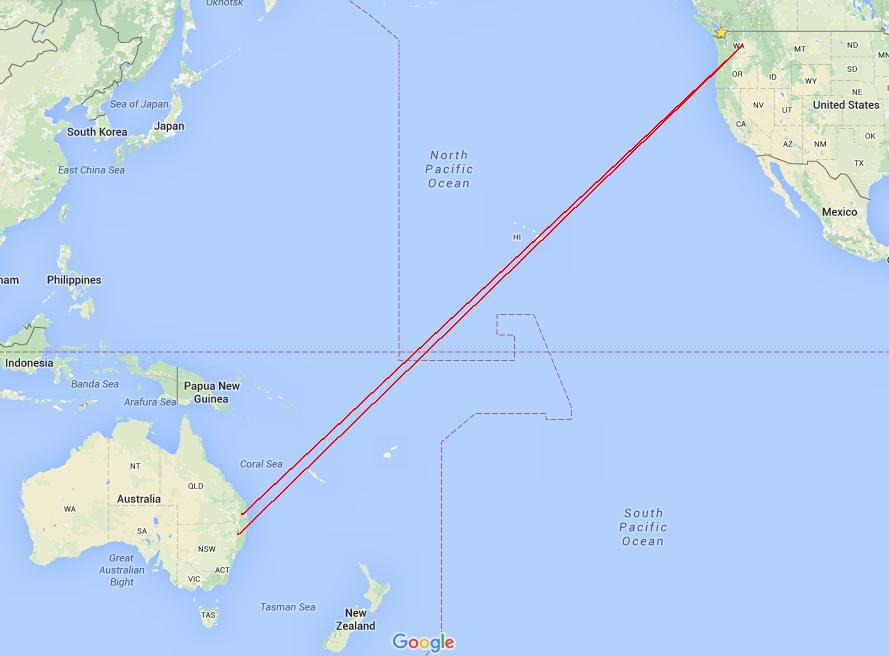
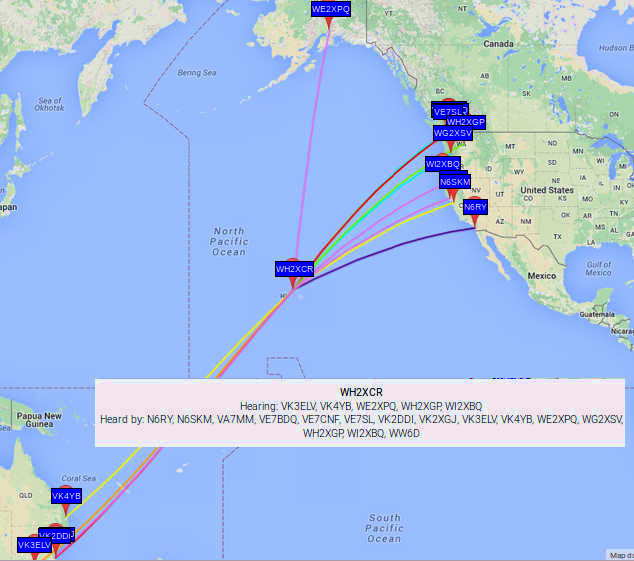 The past few weeks have seen many of the VK 630m WSPR stations making it into North America's west coast and points east. VK2DDI, VK2XGJ, VK3ELV and VK4YB have been the signals most often seen. Particularly dominant is the signal from Roger, VK4YB, the northern-most station, located in Moorina, Queensland, near the Pacific Ocean.
Roger's signal has been decoded locally by myself as well as VE7BDQ and VA7MM, creating excitement over the more normal nightly spots from the central states.
2016-04-13 11:10 VK4YB 0.475646 -28 QG62ku 5 VA7MM CN89og
2016-04-13 11:20 VK4YB 0.475647 -29 QG62ku 5 VA7MM CN89og
2016-04-13 11:28 VK4YB 0.475647 -28 QG62ku 5 VA7MM CN89og
2016-04-13 11:28 VK4YB 0.475644 -23 QG62ku 5 VE7BDQ CN89la
2016-04-13 11:36 VK4YB 0.475644 -26 QG62ku 5 VE7BDQ CN89la
2016-04-13 11:52 VK4YB 0.475643 -25 QG62ku 5 VE7BDQCN89la
2016-04-13 11:56 VK4YB 0.475643 -28 QG62ku 5 VE7BDQ CN89la
2016-04-07 08:54 VK4YB 0.475643 -25 QG62ku 5 VE7SL CN88iu
2016-04-07 09:36 VK4YB 0.475644 -29 QG62ku 5 VE7SL CN88iu
2016-04-07 10:08 VK4YB 0.475644 -29 QG62ku 5 VE7SL CN88iu
2016-04-07 10:18 VK4YB 0.475644 -29 QG62ku 5 VE7SL CN88iu
2016-04-07 11:04 VK4YB 0.475644 -29 QG62ku 5 VE7SL CN88iu
2016-04-13 11:06 VK4YB 0.475644 -24 QG62ku 5 VE7SL CN88iu
2016-04-13 11:10 VK4YB 0.475644 -23 QG62ku 5 VE7SL CN88iu
2016-04-13 11:20 VK4YB 0.475644 -23 QG62ku 5 VE7SL CN88iu
2016-04-13 11:28 VK4YB 0.475644 -28 QG62ku 5 VE7SL CN88iu
2016-04-13 11:32 VK4YB 0.475644 -25 QG62ku 5 VE7SL CN88iu
2016-04-13 11:52 VK4YB 0.475643 -18 QG62ku 5 VE7SL CN88iu
2016-04-13 11:56 VK4YB 0.475643 -22 QG62ku 5 VE7SL CN88iu
2016-04-13 12:16 VK4YB 0.475643 -27 QG62ku 5 VE7SL CN88iu
2016-04-13 12:28 VK4YB 0.475643 -26 QG62ku 5 VE7SL CN88iu
2016-04-13 12:32 VK4YB 0.475643 -25 QG62ku 5 VE7SL CN88iu
2016-04-13 12:54 VK4YB 0.475644 -24 QG62ku 5 VE7SL CN88iu
2016-04-13 12:58 VK4YB 0.475643 -24 QG62ku 5 VE7SL CN88iu
2016-04-13 13:10 VK4YB 0.475643 -25 QG62ku 5 VE7SL CN88iu
2016-04-13 13:24 VK4YB 0.475643 -27 QG62ku 5 VE7SL CN88iu
2016-04-13 13:28 VK4YB 0.475643 -27 QG62ku 5 VE7SL CN88iu
Roger has sent the following information to me regarding his well-planned system:
My antenna is serendipitous.
I am a complete novice on 630m. I only came on the band about 2 months ago at the request of a local friend, Peter, VK4QC. That is not quite true, because I was on the band once before, about a year ago and made one contact and then managed to burn out the front end of my Drake TR7, which I had roughly converted to 630m operation.
My QTH is atop of a stony ridge on 10 acres. The previous owner said there was some soil somewhere, but I haven't found it yet! Ground conductivity is very poor, I think. If you drive in two stakes about six inches apart, an ohmmeter says infinity. That's if you can drive in a stake. Because after the first quarter inch you hit shale rock. Interestingly the shale layers are at about 60 degrees to the horizontal. There are some quartz inclusions. Yes, I have tried crushing the quartz and panning it - no gold!
Getting back to my story, I needed to put up a 630m antenna in a hurry. The idea of winding a big loading coil with the rotatable inner coil was a bit daunting. And putting down ground radials or an earth mat was out of the question. So, using only some wire, string and a bow and arrow, this is what I came up with:
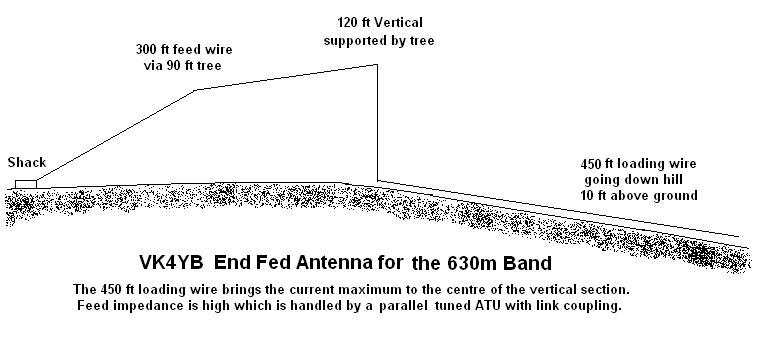
What is missing from that drawing is that the wire is running North-East to South-West, all in a straight line, with the shack at the North-East end. It is line-of-sight from the top of the vertical section to the Pacific ocean. I didn't put the direction on the original drawing because I didn't think it was important. I thought it was essentially a top-fed vertical and would therefore be omni-directional. Nothing could be further from the truth. Experience has shown that it is very directional. I have never had a single report from Japan, and yet my signal has peaked at -3 in Hawaii (about the same distance). Also VK3ELV, using a quarter wave near vertical, gets almost nightly reports from both Japan and Hawaii and at similar strengths. That would seem to indicate a front to side ratio of more than 20dB for my antenna, which is surely impossible?
I estimate the feed point impedance is about 3000 ohms. The ATU has 48 turns on the secondary, tuned by fixed capacitors of 960 pF in parallel with a 500 pF variable which is about two thirds meshed. The primary is 5 turns fed by the transverter having a 50 ohm nominal output. The impedance at the top of the secondary should be near 5000 ohms, but the antenna feed wire is tapped about two thirds of the way up the secondary coil, which gives 1.03 : 1 SWR. The earthy end of the coil is connected to the mains earth and the metal work of the shed. I haven't tried terminating the far end. I did think about connecting it to the fence wire that runs round the property but I thought that might be a bit dangerous. There would be high voltage points in places. The transverter output is nominally 50 watts, but it is giving about 90 watts in reality.
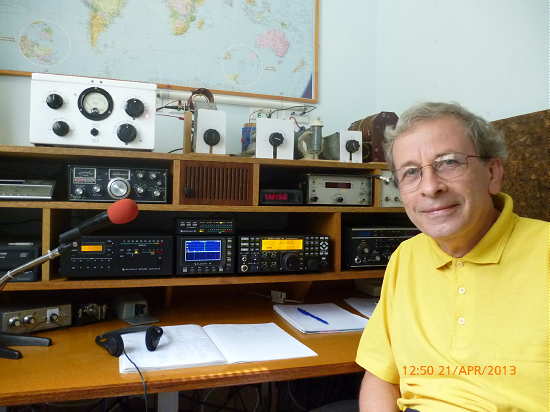 |
| Roger - VK4YB |
Like many on 630m, Roger is using an Elecraft K3 into a transverter to generate his 630m 90 watt signal. It is interesting to see the strength of Roger's signal here throughout the night but particularly during the 1152-1156Z time slot. His signal peaked at -18db, right at the level of audibility ... CW levels, but quickly dropped. Throughout the night however, his signal was easily within range of the capabilities of the two-way JT-9 WSPR QSO mode ... had either of us been seriously involved in a two-way JT-9 QSO attempt during that night, it would have been quick work I think.
John, VE7BDQ, has already managed to push his WSPR signal to VK on more than one occasion ... this from a typical, suburban backyard inverted-L. The possibilities are exciting, but will mean some middle-of-the-night vigilance!
As activity on 630m increases in both VK and VE, we are beginning to see more and more DX possibilities arising, particularly during the Spring and Fall equinox periods when this path seems to peak. As activity in Japan picks up, it is only a matter of time before some of them begin showing up in numbers here on the west coast, as the path to JA has always been reliable and somewhat less demanding than the path to down under. I suspect also, that as the present solar cycle draws down (and supposedly goes 'quiet'), 630m Trans-Pacific signals will grow even stronger,and on most other paths as well.
In view of the JT9 QSO possibilities, I think it is clear that I now need to seriously think about building a transverter, allowing me to at least be in 'ready-mode' for the coming 630m challenges ... hopefully for the next equinox.
Seven To Go

Confirmed DXCC entity #332 arrived in the mail last week. With a total of 339 active DXCC entities, this leaves just seven to go.
Although I had worked Tunisia a couple of years ago on 15m, I was never able to get the contact confirmed. In spite of sending an SAE and green stamps for postage, 3V8HQ's several promises of his card 'soon to be mailed', proved to be hollow.
The contact with 3V8HQ was my first and only one with Tunisia, since being licenced in 1963. The low level of ham radio activity from 3V8 combined with the challenges of VE7 to Meditteranean Africa propagation, made it a difficult one to work.
 |
| courtesy: https://www.google.ca/maps |
My present confirmed list sitting at 332, combined with my 10 confirmed 'deleted' entities, brings the overall confirmed total to 342. The seven remaining entities will be very difficult, if not impossible, unless I live to be 150. They are:
FT/G, TO - Glorioso
HK0 - Malpelo Island
KP5 - Desecheo Island
P5 - N. Korea
SV/A - Mt. Athos
Z8 - S. Sudan
ZL9 - Auckland / Campbell Islands
A couple of these have been active in past recent years ... for some, I was asleep at the switch and for others, I was away travelling at the time. With solar conditions heading downhill quickly, and possibly staying there for many many years, the prospects of working these last seven is looking pretty bleak.
On the other hand, my favorite winter band (160m) should continue to improve. Last week also brought a new DXCC QSL for me on that band, A35T in Tonga, bringing my confirmed total on that band to 157.
Getting new entities from here on out will be increasingly challenging ... I guess I need to remember, that if it was easy, it just wouldn't be any fun!

TIS DX
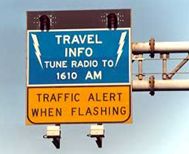 Have you ever wondered where those odd stations found at the ends of the AM broadcast band might be located and what they're all about? These are 'Traveller Information Stations' or 'TIS's and, 'Highway Advisory Radio' (HAR) stations. Because of their low power (100mw - 10W), they make challenging DX targets if you can catch the ID on their continually- repeated audio loop.
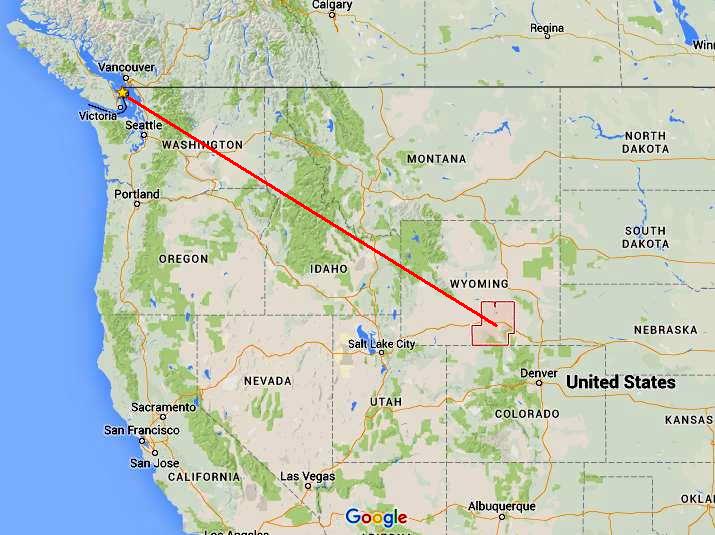
These stations are located throughout Canada and the USA at places such as highway intersections, border crossings, ferry terminals, airports and parks ... just about any place that needs to advise travellers (vehicles) with up-to-date directions or information. From here on Mayne Island, the farthest TIS I have been able to identify was WPTC509, located in Carbon County, Wyoming.
 |
| courtesy: https://www.google.ca/maps |
IRCA TIS/HAR LIST (Winter 2016)
The IRCA TIS/HAR LIST lists all US and Canadian TIS/HAR stations, by frequency, including call letters, state (province,) city, county, licensee, address, coordinates, expiration date and dates of DXM/DXN reports/sources. It has been updated with FCC data, DXM, DXN and DXer reports, and on-line listings through March 1 2016.
The 2016 IRCA TIS/HAR LIST is posted on the IRCA website for all to download. The link is: http://www.ircaonline.org/TIS_2016.pdf.
For those preferring a hard copy, one can be ordered from the IRCA.
As well, this page on regulations, permitted content and TIS history has some interesting info.
IRCA is one of the oldest clubs dedicated to DXing the broadcast bands and members receive a monthly journal of members loggings as well as other relevant articles. A trip to the IRCA website might get you hooked on this part of the radio hobby as it's probably the way that most amateurs discovered the 'magic of radio', on late winter nights! Just in case you need it, the mwlist will help you identify any stations heard in the AM broadcast band, worldwide.
Top Hats
 When it comes to discussion of 630m, the topic of antennas seems to top the list. One of the easiest ways to enjoy what 630m has to offer is to try and utilize a low band antenna that may already be in place. An 'inverted-L' for 80 or 160 can be readily bottom-loaded and with a few radials, can provide a good starting point ... but with a little additional work, its efficiency can be easily improved by expanding the top horizontal (top hat) section.
Jim, W5EST, has posted an interesting description of the pros and cons of the 'top hat' in a recent KB5NJD daily 630m report. Those thinking about getting on the band or those considering ways of improving their present antenna might find the information helpful.
Top Hat Advantages:
Higher EIRP comes from a more nearly uniform current distribution all the way up a TX vertical. https://en.wikipedia.org/wiki/T-antenna . But remember that adding top hat doesn’t help you if your license is subject to a legal limit EIRP that’s reached by your station already.
A vertical without a top hat has no current at its tip, meaning the upper part of a hatless vertical is inefficiently used. Average RF current for a hatless short vertical is only half what an RF ammeter shows at the antenna base. Top hat lets a shorter vertical antenna yield same total radiated power TRP by increasing its degree-amperes, as discussed March 31, this blog.
2 amperes of 630m RF base current in a 10° tall hatless short vertical can give 10 degree-amps (2 x ½ x 10°) and yield 15 degree-amps with an ample top hat. A top hat can increase average RF current by about a quarter to half, which could as much as double the TRP.
Top hat increases antenna system capacitance. You get more flexible QSY by decreasing the system Q. SWR increases rapidly as your frequency departs from antenna system resonance, see graph Feb. 10, this blog. With lower system Q the SWR doesn’t increase so rapidly. Then you can QSY temporarily a little way without retuning or by just retuning a little in the shack instead of outdoors at the ATU.
Decreased Q somewhat lowers antenna voltage KV from antenna base to top hat. On 630m Q = (2π 475)L/R by definition and Vantenna = 1.4 Q P / I < Vbreakdown. See Jan. 16, this blog.
Top hat wires can be symmetrically or asymmetrically positioned to give approximately similar capacitance whichever way. I’ve not modeled the effect of a top hat on the azimuth and elevation antenna patterns of an electrically short vertical. I don’t think the effect is very significant. But if you know a link or some better information about this, let us know.
If your radials have extended way beyond the extent of a small top hat high above, then providing longer top hat conductors above the radials can more efficiently utilize the radials. If the radials mostly go in one or two directions, then for highest antenna system capacitance the hat wires should extend in those directions to couple best with the radials. Your experience may suggest this last is not too important, especially if you have a perimeter conductor and/or several ground rods and your soil has favorable conductance.
Another top hat advantage is that top hat conductors are compatible with structural support and stabilization for the very top of an MF/LF vertical antenna. You get added degree-amperes–and steadying at the top to boot.
If the top hat slants upward, its system capacitance contribution is somewhat decreased compared to a top hat of same length horizontally, but the vertical slant contributes radiated power. Depending on the arrangement of antenna and trees on some properties, using a shorter vertical with an upwardly slanting asymmetrical top hat may make the antenna system both easier to guy and less obvious to neighbors.
Putting in a top hat or improving a top hat increases the degree-amperes of a short vertical mainly by distributing the same RF amperes more uniformly. Adding more radials and longer radials decreases the antenna system resistance and increases the degree-amperes of a short vertical mainly by increasing the RF amperes of antenna current itself.
Top Hat Disadvantages:
A top hat obviously requires outdoor work to construct or revise it. You may be able to simply increase your transmitter power TPO more conveniently than to do the outdoor work.
A top hat needs to extend more or less horizontally from the top of the vertical, although the angle is not too critical within +/-45°. Distant supports for the top hat at that top level may be unavailable or expensive and inconvenient to provide. If the top hat were attached to the vertical below the top of the vertical, the otherwise radiation-beneficial top segment of the vertical becomes mostly unused.
If the top hat slants quite steeply downward, its effect on system capacitance may be a wash– more capacitance by closer approach to the ground and less capacitance because same length top hat conductor extends less outward over the ground below. That defeats a reason for putting up a top hat in the first place.
Moreover, if the top hat slants steeply downward, then vertically downward RF current in the top hat cancels part of the radiation from the vertical antenna and at least partially defeats the improvement in vertical antenna current uniformity that the top hat is intended to confer.
A long top hat may not fit on the available real estate. Even if it fits, it may add to visibility as far as difficult neighbors are concerned.
Adding a top hat means you need to retune the ATU after the addition. But so does improving the radials or just about anything else you do.
Top hat conductors add more weight on a vertical than lighter-weight guying does. The weight of the top hat likely adds to the support demanded of the antenna base. If you put downward-slanting top hat conductors under tension at their far ends to keep them from drooping in the middle, then a lot of that tension will be imposed on the vertical too. That can produce a buckling force on the vertical which may call for additional guying halfway up the vertical.
Top hat conductors convey a declining but substantial RF current along their length. That involves I2R losses in the skin effect resistance of the top hat conductors. However, if your earth resistance is high or your radial/grounding system is not very elaborate, some loss in the top hat probably does not decrease the RF amperes of antenna base current very much at a given TPO compared to the improvement in radiation TRP that the top hat gives you.
If skin effect resistance losses in the top hat are significant compared other losses in the system, reducing top hat losses generally means more conductors or heavier conductors in the top hat. That translates to more weight for the whole system to support.
A top hat translates KV of antenna top voltage to its ends. If the top hat extends all the way to leaf cover of trees or shrubs, unexpected sparks might jump to them in quiet weather, or in windy weather, or sometime when such trees or shrubs grow nearer to the top hat end(s).
Generally top hat advantages outweigh their disadvantages so long as you plan intelligently. Please tell us your experiences with top hat advantages and disadvantages!”
 |
| A G3XDV LF top hat |
Jim often adds an interesting op-ed piece to the KB5NJD daily report and sifting back through the past few weeks will provide some great 630m 'food for thought' bed time reading!
630m To Down Under
 |
| Today's Sun courtesy: http://sdo.gsfc.nasa.gov/ |
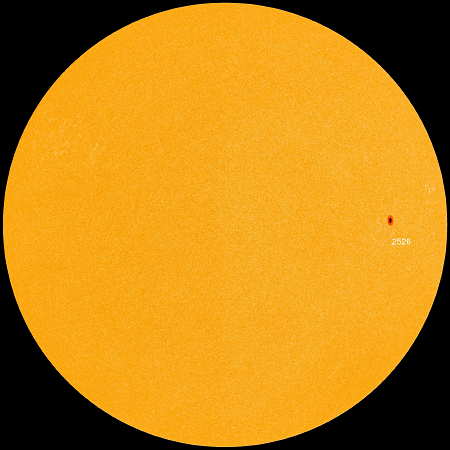
With the sun remaining reasonably quiet over the past several days, a sudden spike in the geomagnetic field on Saturday afternoon saw a number of trans-Pacific spots showing up on 630m WSPR mode.
 |
| courtesy: http://wdc.kugi.kyoto-u.ac.jp/ |
 | |
| courtesy: https://www.google.ca/maps |
 |
| VK3ELV 630m |
 |
| courtesy: https://www.google.ca/maps |
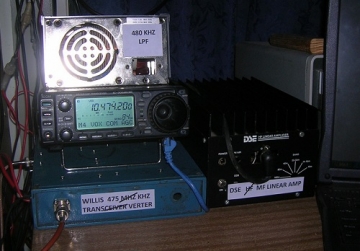
Although VK3ELV's signal was right at the edge of WSPR decoding levels (-29db), it would only take a few more db to allow a two-way JT9 digital mode QSO to take place ... maybe something that will be possible in the coming years of solar minimum and much better LF/MF propagation. To be readable on CW would need an equivalent true power output increase of at least 16 times, requiring VK3ELV to run around 2,000 watts output!
Over the years I have seen ZL6QH a number of times on 2200m (QRSS CW mode) but this is my first reception of VK and, hopefully, not my last.
To keep up to date with overnight activities on 630m, visit the excellent site of KB5NJD. John posts a detailed daily summary of events. In addition, you will find some excellent resources to help you get involved in this part of the spectrum ... and remember, you don't need a big backyard or a big antenna to have fun on 630m.













