Author Archive
 Top Hats
 April 6th, 2016 |
 Author:
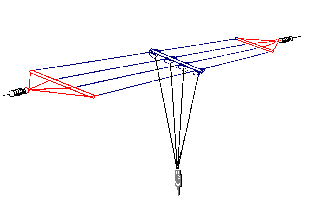
 When it comes to discussion of 630m, the topic of antennas seems to top the list. One of the easiest ways to enjoy what 630m has to offer is to try and utilize a low band antenna that may already be in place. An 'inverted-L' for 80 or 160 can be readily bottom-loaded and with a few radials, can provide a good starting point ... but with a little additional work, its efficiency can be easily improved by expanding the top horizontal (top hat) section.
Jim, W5EST, has posted an interesting description of the pros and cons of the 'top hat' in a recent KB5NJD daily 630m report. Those thinking about getting on the band or those considering ways of improving their present antenna might find the information helpful.
Top Hat Advantages:
Higher EIRP comes from a more nearly uniform current distribution all the way up a TX vertical. https://en.wikipedia.org/wiki/T-antenna . But remember that adding top hat doesn’t help you if your license is subject to a legal limit EIRP that’s reached by your station already.
A vertical without a top hat has no current at its tip, meaning the upper part of a hatless vertical is inefficiently used. Average RF current for a hatless short vertical is only half what an RF ammeter shows at the antenna base. Top hat lets a shorter vertical antenna yield same total radiated power TRP by increasing its degree-amperes, as discussed March 31, this blog.
2 amperes of 630m RF base current in a 10° tall hatless short vertical can give 10 degree-amps (2 x ½ x 10°) and yield 15 degree-amps with an ample top hat. A top hat can increase average RF current by about a quarter to half, which could as much as double the TRP.
Top hat increases antenna system capacitance. You get more flexible QSY by decreasing the system Q. SWR increases rapidly as your frequency departs from antenna system resonance, see graph Feb. 10, this blog. With lower system Q the SWR doesn’t increase so rapidly. Then you can QSY temporarily a little way without retuning or by just retuning a little in the shack instead of outdoors at the ATU.
Decreased Q somewhat lowers antenna voltage KV from antenna base to top hat. On 630m Q = (2π 475)L/R by definition and Vantenna = 1.4 Q P / I < Vbreakdown. See Jan. 16, this blog.
Top hat wires can be symmetrically or asymmetrically positioned to give approximately similar capacitance whichever way. I’ve not modeled the effect of a top hat on the azimuth and elevation antenna patterns of an electrically short vertical. I don’t think the effect is very significant. But if you know a link or some better information about this, let us know.
If your radials have extended way beyond the extent of a small top hat high above, then providing longer top hat conductors above the radials can more efficiently utilize the radials. If the radials mostly go in one or two directions, then for highest antenna system capacitance the hat wires should extend in those directions to couple best with the radials. Your experience may suggest this last is not too important, especially if you have a perimeter conductor and/or several ground rods and your soil has favorable conductance.
Another top hat advantage is that top hat conductors are compatible with structural support and stabilization for the very top of an MF/LF vertical antenna. You get added degree-amperes–and steadying at the top to boot.
If the top hat slants upward, its system capacitance contribution is somewhat decreased compared to a top hat of same length horizontally, but the vertical slant contributes radiated power. Depending on the arrangement of antenna and trees on some properties, using a shorter vertical with an upwardly slanting asymmetrical top hat may make the antenna system both easier to guy and less obvious to neighbors.
Putting in a top hat or improving a top hat increases the degree-amperes of a short vertical mainly by distributing the same RF amperes more uniformly. Adding more radials and longer radials decreases the antenna system resistance and increases the degree-amperes of a short vertical mainly by increasing the RF amperes of antenna current itself.
Top Hat Disadvantages:
A top hat obviously requires outdoor work to construct or revise it. You may be able to simply increase your transmitter power TPO more conveniently than to do the outdoor work.
A top hat needs to extend more or less horizontally from the top of the vertical, although the angle is not too critical within +/-45°. Distant supports for the top hat at that top level may be unavailable or expensive and inconvenient to provide. If the top hat were attached to the vertical below the top of the vertical, the otherwise radiation-beneficial top segment of the vertical becomes mostly unused.
If the top hat slants quite steeply downward, its effect on system capacitance may be a wash– more capacitance by closer approach to the ground and less capacitance because same length top hat conductor extends less outward over the ground below. That defeats a reason for putting up a top hat in the first place.
Moreover, if the top hat slants steeply downward, then vertically downward RF current in the top hat cancels part of the radiation from the vertical antenna and at least partially defeats the improvement in vertical antenna current uniformity that the top hat is intended to confer.
A long top hat may not fit on the available real estate. Even if it fits, it may add to visibility as far as difficult neighbors are concerned.
Adding a top hat means you need to retune the ATU after the addition. But so does improving the radials or just about anything else you do.
Top hat conductors add more weight on a vertical than lighter-weight guying does. The weight of the top hat likely adds to the support demanded of the antenna base. If you put downward-slanting top hat conductors under tension at their far ends to keep them from drooping in the middle, then a lot of that tension will be imposed on the vertical too. That can produce a buckling force on the vertical which may call for additional guying halfway up the vertical.
Top hat conductors convey a declining but substantial RF current along their length. That involves I2R losses in the skin effect resistance of the top hat conductors. However, if your earth resistance is high or your radial/grounding system is not very elaborate, some loss in the top hat probably does not decrease the RF amperes of antenna base current very much at a given TPO compared to the improvement in radiation TRP that the top hat gives you.
If skin effect resistance losses in the top hat are significant compared other losses in the system, reducing top hat losses generally means more conductors or heavier conductors in the top hat. That translates to more weight for the whole system to support.
A top hat translates KV of antenna top voltage to its ends. If the top hat extends all the way to leaf cover of trees or shrubs, unexpected sparks might jump to them in quiet weather, or in windy weather, or sometime when such trees or shrubs grow nearer to the top hat end(s).
Generally top hat advantages outweigh their disadvantages so long as you plan intelligently. Please tell us your experiences with top hat advantages and disadvantages!”
 |
| A G3XDV LF top hat |
Jim often adds an interesting op-ed piece to the KB5NJD daily report and sifting back through the past few weeks will provide some great 630m 'food for thought' bed time reading!
630m To Down Under
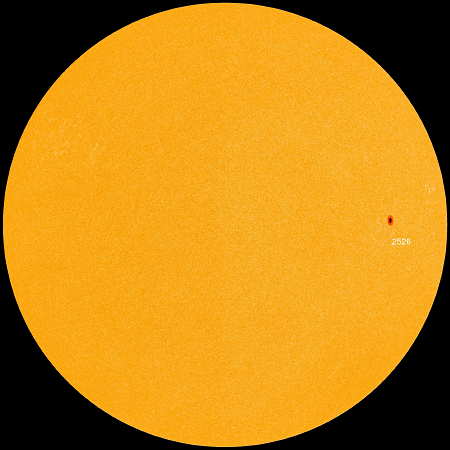 |
| Today's Sun courtesy: http://sdo.gsfc.nasa.gov/ |
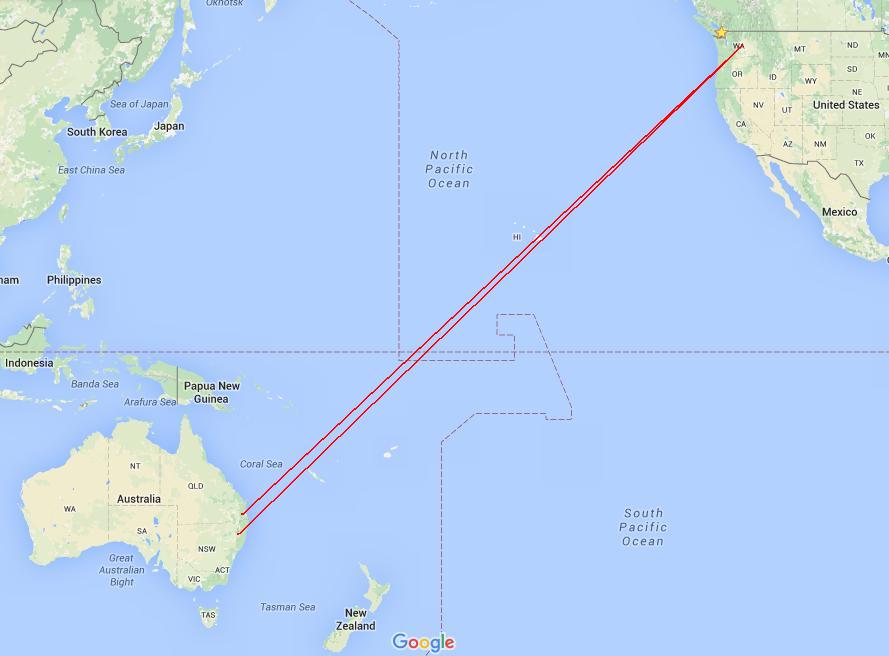
With the sun remaining reasonably quiet over the past several days, a sudden spike in the geomagnetic field on Saturday afternoon saw a number of trans-Pacific spots showing up on 630m WSPR mode.
 |
| courtesy: http://wdc.kugi.kyoto-u.ac.jp/ |
 | |
| courtesy: https://www.google.ca/maps |
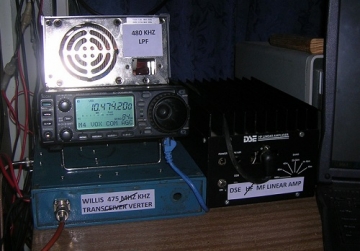 |
| VK3ELV 630m |
 |
| courtesy: https://www.google.ca/maps |
Although VK3ELV's signal was right at the edge of WSPR decoding levels (-29db), it would only take a few more db to allow a two-way JT9 digital mode QSO to take place ... maybe something that will be possible in the coming years of solar minimum and much better LF/MF propagation. To be readable on CW would need an equivalent true power output increase of at least 16 times, requiring VK3ELV to run around 2,000 watts output!
Over the years I have seen ZL6QH a number of times on 2200m (QRSS CW mode) but this is my first reception of VK and, hopefully, not my last.
To keep up to date with overnight activities on 630m, visit the excellent site of KB5NJD. John posts a detailed daily summary of events. In addition, you will find some excellent resources to help you get involved in this part of the spectrum ... and remember, you don't need a big backyard or a big antenna to have fun on 630m.
The Joys Of HF
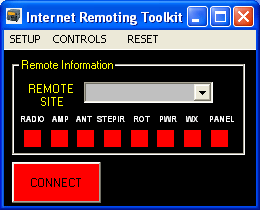 It seems that contesting clubs in Manitoba and New England want to show non-hams, new hams and all hams, the 'joys of HF radio'. In a beta test of their idea, called 'Discover the HF Experience', participants in Manitoba will have the opportunity to get on HF by operating K1K, in Massachusetts, remotely, from the Garden City Canada Inn located in Winnipeg, Manitoba, on Saturday, April 2nd.
Future events will take place in Massachusetts from the Yankee Clipper Contest Club's venue on April 10th and a much larger operation, featuring four operating positions at Dayton in May, at the ARRL's Expo site. Full details of all operations can be found here.
The idea was the brainchild of Gerry Hull, W1VE who, along with Cary Rubenfeld, VE4EA, has brought his idea to life.
“Our amateur population is at an all-time high, but most new hams are getting a Technician ticket, getting on VHF and UHF, and hanging out with like-minded friends,” Hull said. The limitations on what Technician licensees can do often leads to boredom, Hull said, “and they drop out of the hobby. They never get the exposure to HF ham radio, and as any veteran radio amateur can tell you, that’s a lifelong exploration.”
Now I fully concur that far too many of our newest amateurs land on VHF or UHF and never move, almost totally unaware of what HF radio is all about. Being exposed to HF radio is a great idea, yet ... and maybe I'm just old-fashioned, but I'm not sure that this 'first experience' is best done via remote operation. From my own initial exposure to ham radio, seeing the magic happen in a basement or attic radio shack, complete with glowing dials and a wall full of QSL's from all over the world, was enough to hook me for life. I'm pretty sure that same feeling can't be conveyed by sitting in front of a laptop and pushing a few keys.
I am not a fan of 'remotes' but from what I have seen, this may be one of the better examples and if it grabs and convinces even a few to explore HF on their own, that would be a good thing ... then all we'd have to do is get them on CW !
Local Lightwave Activity / A New 630m Resource Site
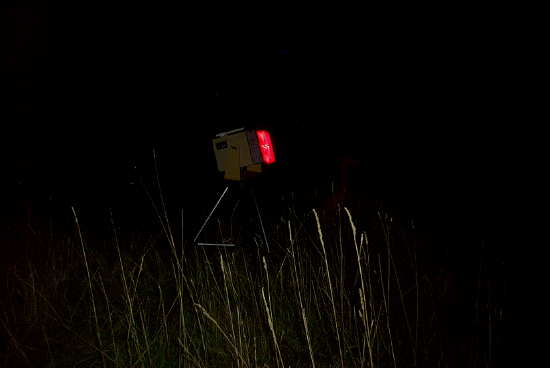 |
Toby, VE7CNF, has sent me some mail indicating that his new lightwave system is ready for a two-way test!
His system is very similar to the ones built and deployed by myself and Markus, VE7CA, in late 2013. The culmination of that activity is described here, in 'On Making Nanowaves - Part 6'. Our lightwave QSO and homebrew gear were later described in a 'how to' article in the 'The Canadian Amateur' as well as in the newest edition of 'The Radio Amateur's Handbook' (2016).
Toby describes his most recent pre-QSO backyard testing:
The lightwave gear appears to be working well. Focus looks good and the
finder scopes are doing their job. There's a reflective sign high up on a
hydro tower 170 meters away that's handy for testing. It lights up bright
when the transmitter's on it.
Back scatter off the clouds above my house worked too. I heard my CW beacon, audible 339, off a patch on the clouds about 1 degree wide. I don't really know if it was clear air scatter from closer by, or scatter off the clouds, but the spot was small. That's with the tx on the front deck, and rx in the back.
I used Spectran to check the noise from city lights in my area. At QRSS10
speed there are spectral lines at 540, 600, and 660 Hz. They aren't too
strong, but those are some frequencies we should avoid.
 |
| VE7CNF's lightwave system - TX (L) & RX (R) |
Hopefully the weather will co-operate enough to allow us to make a two-way QSO later this week. Plans call for Toby to set up near the same location in West Vancouver used by VE7CA as it offers a clear LOS path to Mayne Island, 54km to the southwest.
 |
| 54km Georgia Strait crossing (courtesy: https://www.google.ca/maps) |
*****************************************************
Rik, ON7YD, has set up a new website devoted to information specific to 630m. His 472kHz.org site looks as if it will be a valuable resource for those looking to get information and a start on our new band. At present, there is some really great information regarding transmitters, antenna systems and calculating E(I)RP levels. Have a look!
ARRL Working For LF / MF Future
As the rollout of new LF and MF ham bands grows closer for U.S. amateurs, earlier this month, the ARRL requested the FCC to carefully consider the procedural requirements governing the advance notification of local electric authorities of their intended 630m / 2200m operation. The FCC had suggested that under certain circumstances (mainly the distance to the nearest PLC signal-carrying power lines), amateurs would be required to notify and co-operate with power authorities ... but it was all very vague and seemed to place the conditions under which operating authority would be granted into the hands of the power companies.
In what appears to be a preemptive move to head-off the (possibly) overly onerous and impossible roadblocks suggested by power company representatives, the ARRL filing states:
“ARRL does not object to such a notification requirement, provided that it is appropriately circumscribed, not overbroad in its applicability, and not overly burdensome for radio amateurs to comply with,” the League’s statement asserted.
In addition, the power authority Utility Telecom Council (UTC) has been notably silent on the issue ... slowing the process even further.
"The ARRL noted that comments filed by the Utilities Telecom Council (UTC) called for a system of “quasi-coordination” by radio amateurs before commencing operation on 2200 meters (135.7-137.8 kHz). In its remarks to the FCC, the ARRL pointed out, however, that the UTC has not volunteered any information with respect to how a notification process might work nor offered any PLC database information to the ARRL or to the amateur community so prospective users of the band could determine if their operation might be problematic."
The League took the opportunity to remind the FCC, once again, that the low ERP levels generated by amateurs operating on the new bands would have a low probability of creating any interference and further pointed out that PLC systems operating between 9 and 490 kHz are not subject to protection from licensed services.
The ARRL also indicated that any sort of blanket notification requirement prior to transmitting on 2200 or 630 meters “would be clear regulatory overkill,” and that utility companies should clearly be required to demonstrate how amateur operations would cause harmful interference to their PLC (unlicenced) operations.
It's good to see the ARRL still being proactive with regards to procuring these new frequency allotments on behalf of U.S. amateurs ... hopefully making implementation sooner rather than later. The entire ex parte filing can be read here as well as the ARRL's own news posting of the procedure here.
In the meantime, I'll make yet another call-to-arms to fellow Canadian amateurs, who already have these two new bands but aren't using them ... new activity from the western provinces would be especially welcome as there are a now a number of well-equipped stations in VE7 who would like to work you.
March’s QRP EME Window
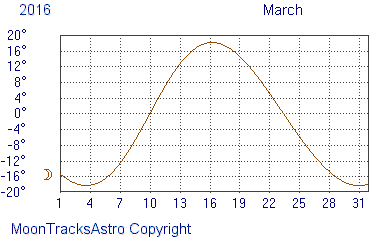 |
| Lunar declination track for March courtesy: http://www.moontracks.com/moon-declinations.html |
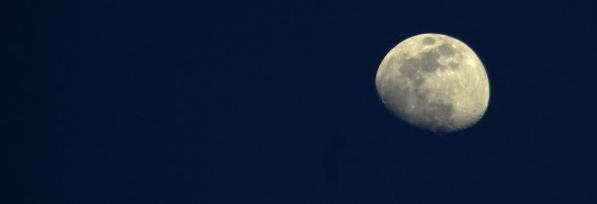
My minimal system (single 9el Yagi and 140w) makes it very easy to see the day to day changes in EME conditions due to various causes such as local geomagnetic conditions, Faraday rotation and libration fading ... or combinations of each! One of the days was particularly good, with numerous signals heard throughout the session while the next day was just the opposite, with only a few very weak signals and no contacts. On that particular day, I was being heard well by several European stations but was unable to hear any of them ... a true 'one-way' path and not uncommon on EME.
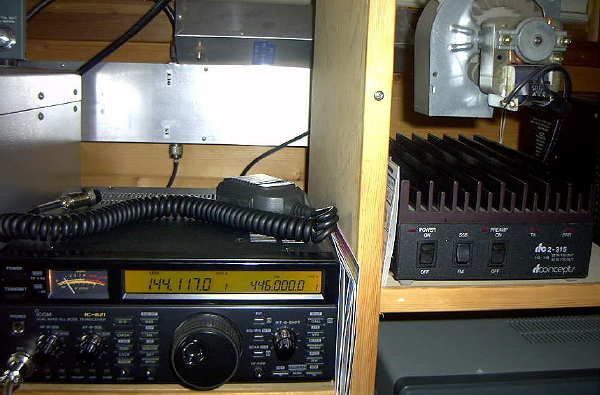 |
| My small EME station. Note old microwave oven blower on the 'brick' amplifier. |
Several smaller 4-Yagi stations were worked during the week, re-enforcing the benefits of having a moonrise over the ocean. As mentioned previously, the extra 6db of horizon gain allows my single 9el Yagi to perform more like a stack of four 9el Yagis. One of the fellows that I worked, DK5EW in Germany, asked if there was anything 'special' about my location that would make my very small station sound so strong at his end ... the ocean is clearly doing its job!
Altogether, 12 new stations were worked during March's window, bringing my total to 70 "initials". From the looks of the amount of activity, there are still many stations yet to work, that should be within range of my system.
Stations worked this week were:
I2FAK, UA3PTW, RZ3BA/1, SK5AA, PA2CHR, ES3RF, YO3JR, PA5Y, DK5EW, SM7GVF, EA4CYQ and W5ZN.
Three of these stations were using relatively compact antenna systems, consisting of 4x8el or 4x9el arrays, while the rest were larger. I have yet to tally up my DXCC or states total on 2m, but I know that W5ZN, in Arkansas, was a new state.
Up until this past week, the highest moon elevation that I have completed a QSO was with the moon at 18 degrees above the horizon. This week it was extended, at what is probably the limit of my fixed antenna, to 19.6 degrees when working ES3RF. At the other end of the scale, IK2FAK was worked with the moon at only .87 degrees high!
This month also provided my first glimpse of a 2m DX 'pileup', when J8/WW2DX in the Grenadine Islands showed up, calling CQ via the moon. My screen shot below shows at least 12 different stations calling him during his one-minute listening period ... some not yet 'warmed-up' as seen by their drifting oscillators.With several of the signals audible, it was an amazing thing to observe.
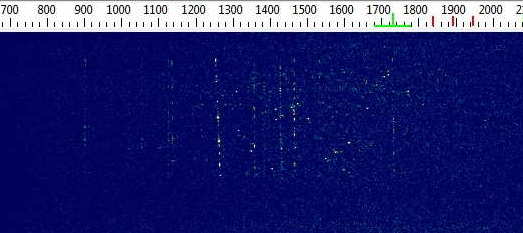 |
| 2m pile up on J8/WW2DX |
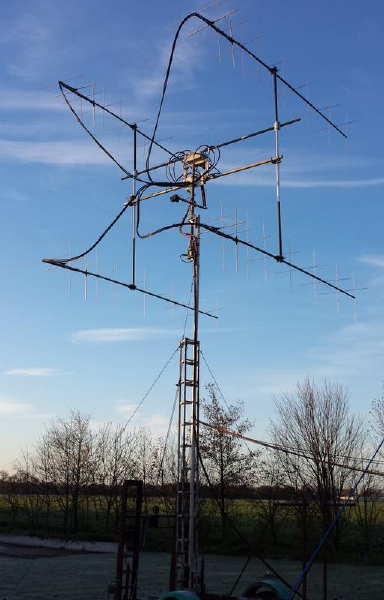 |
| The 4 x 8 el cross-polarized array of PA5Y |
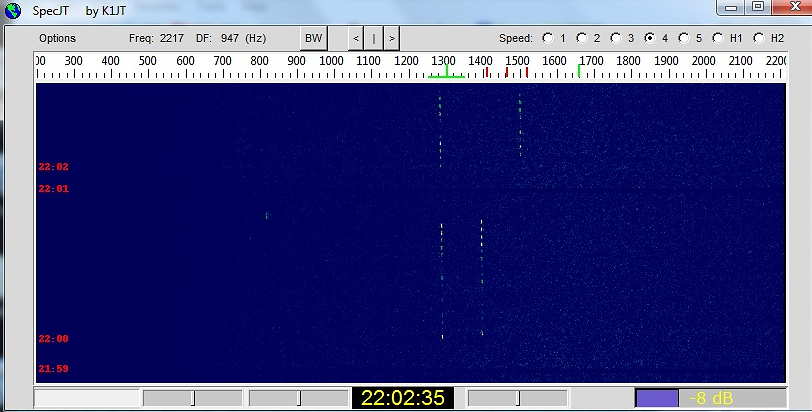 |
| YO8JR sending his 'RR' followed by '73' |
Saturday Morning On Radio Row
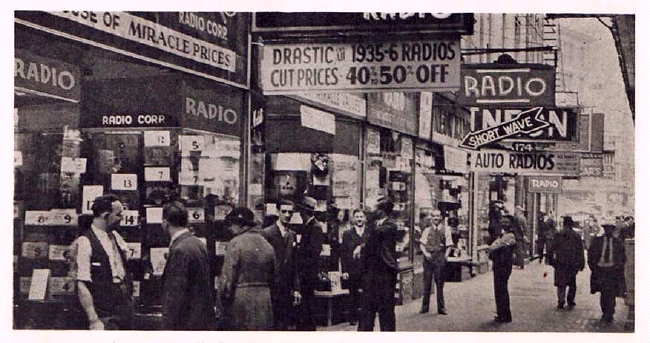 |
| New York City |
As a young shortwave-crazed kid in the 50's, there was nothing that I looked forward to more than the weekend and being able to stay up as late as I wanted, tuning the bands on my big old GE cathedral ... high up in my third-floor attic bedroom shack. But number two on the list was my weekly Saturday morning trip, by bus, to Vancouver's north Granville Street and then on to the library. There I could read the latest radio magazines as well as look at their huge archived collection of earlier issues.
In the 50's, there was a three block strip of radio shops on the north end of Granville street, just after the bridge into downtown Vancouver.
 |
| Granville Street |
During this same time span, once or twice per year, the family would pile into Dad's old Chevrolet and we would make a road-trip to Seattle. Unlike the present, our Canadian dollar was worth more than the American dollar back then, so there were always some great shopping bargains to be found. I recall there being a number of old radio shops as well as several surplus stores just south of Pike Street, on 1st Avenue as well as a few more, one or two blocks down the hill toward the docks. Maybe these were the last vestiges of Seattle's version of 'Radio Row'.
Of course nothing compares with the original 'Radio Row', located in the lower Manhattan district of New York City. It was born along with radio itself and by the early 30's the Cortlandt Street neighbourhood was blanketed with shops selling radios to consumers and components to builders. A Saturday morning trip to the Cortlandt Street paradise was a ritual for hundreds of radio fanatics for more than four decades, as seen in this timely old film taken one typical (Saturday?) morning on New York's 'Radio Row' ... what an amazing time it must have been!
From "The Death of New York's Radio Row", by Syd Steinhardt :
"Radio Row's popularity peaked in the 1950s. Its proximity to the New Jersey ferry docks and the financial district, combined with the advent of new consumer electronics goods and postwar demand, attracted floods of shoppers to the area every day except Sunday. To service their customers, stores opened at 7:00 a.m. on weekdays and closed late on Saturdays.
Radio Row was not a neat and pretty sight. Block upon block over 300 street level stores, with over three times as many enterprises in the floors above them were jammed into 20 to 25-foot storefronts, up and down streets such as Albany, Carlisle, Greenwich and Liberty. Their shelves and floor spaces were packed with vacuum tubes, condensers, transistors and other high-tech bric-a-brac for ham radio enthusiasts and do-it-yourselfers. It was, as the New York Times called it in 1950, "a paradise for electronic tinkerers." "
By the mid sixties, only a few radio shops remained and after some very bitter court battles, the remaining merchants were 'bought out' and the Cortlandt Street area was cleared so that construction could begin on the World Trade Center's twin towers. Today, the area is now home to One World Trade Center, the tallest building in the U.S.A. and to the 9/11 Memorial ... now all sacred ground.
 |
| courtesy: New York Port Authority |
I was in New York City, three years after 9/11 and recall looking with much sadness into the multi-block deep hole in the ground ... how much happier it must have been there, back on those wonderful Saturday mornings, on 'Radio Row'.