Author Archive
 A swap around of the mobile rigs, 28MHz mobile and a lot of JT65A…
 October 7th, 2012 |
  Author:
 I’ve been working on a review of the Wouxun KG-UV920 for Practical Wireless over the last week or two. All done now and you’ll hopefully see the review in around a month. With the Wouxun out of the car I’ve decided to have the FT-7900 in the car for a while rather than the FT-8900. The 8900 is now in the shack and working out quite well.
For example I can scan a bunch of repeater channels and monitor 145.500. A couple of contacts have resulted already. Interestingly, although the 8900 is on a triband collinear for 50/144/432MHz, on a couple of days when 29MHz has been open, I’ve heard stations quite well. I may turn the power down and see what can be worked!
In the car, I’ve replaced another magmount and am back on 28MHz mobile which is good. Heard an A4 on 29.600MHz FM yesterday. Keen to try and work some 29MHz AM as well!
I’ve been quite active on 28MHz JT65A over the last few days too with some nice QSOs into South America in the evening. I was excited to work A61BK this afternoon – and even more excited when Khalid posted a picture of the QSO on Twitter!
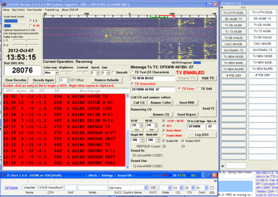

FT8900 in the shack: 50MHz FM added to the monitoring mix
With the Wouxun dual band mobile rig here to be reviewed for Practical Wireless, I thought I would pop it in the car for a week or so. I did that yesterday and took the FT8900 out of the car. Since all the connections are the same as the FT7900 I use in the shack for 144/432MHz FM, I thought I would use it in the shack.
It seems to be working well, and nice to have 50MHz on it too, though no 50MHz FM QSOs yet. I’ve a couple of memories set up for 29MHz and though it’s only on the 50:144/432 MHz collinear, good signals have been coming through on 29MHz FM.
More of course on the Wouxun in Practical Wireless!

70MHz TEP from SV2DCD to ZS6BTE
It’s the right time of the year to be looking south on 50MHz and 70MHz for TransEquatorial propagation.
Great to see a report from Leo SV2DCD on his blog about a QSO this week with ZS6BTE.

Activity update; UHF tropo, 28MHz DX, some late summer Es, new valves and antenna!
The last week or two seem to have had their share of interesting propagation, but little time to blog about it.
The morning of Sunday, 16th September was an interesting one on 432MHz. Thanks to Steve M0BPQ on Twitter, I gathered that there was some good tropo into the south of France and Spain. I went up to the shack not really expecting to hear much, but there was a French contest on and I was surprised to hear signals. The first couple of stations that I worked were in the north of France but with excellent signals. I came across F6EZS/P who was very loud and I assumed he was in Normandy. I was a bit surprised when it turned out that he was in IN93 square in the Pyrenees – we had an easy QSO. I was also pleased to work into JN03 square with F2JR/P (from memory) – another nice QSO at just under 1000 km. I wasn’t able to stick around too long as I had a busy day planned, but thoroughly enjoyed the QSOs.
Over the last week or so, 28MHz has shown some great improvements in propagation. Like last year, I have been playing on JT65A and although have not made so many QSOs, have been interested to see what has been coming through and where I have been heard, even when I’ve been working other stations close by – the PSK Reporter website is very useful in that regard.
I was pleased to find 50MHz open last Saturday afternoon – to Poland and Germany mostly – I even found some new squares! Signals improved and improved and I decided to try 70MHz. OK1VBN was a great signal who I was able to work – and nice to work YO2LAM for a new square. 9A2SB was around too. Quite late in the season for 70MHz Es. Although I didn’t work it, there was apparently some Es+TEP to southern African on 50MHz, with ZS6WN being worked from the UK. On Sunday, 50MHz was open again but with weaker signals and nothing on 70MHz that I could detect.
The Virtual Radar experiment is proving quite interesting on 1090MHz with planes showing up over distances of 50-60 miles on a regular basis. I am looking forward to seeing what happens in tropo conditions.
A pair of replacement 4CX350As have been found – following the demise of the valve in the ‘melted aerial’ incident – so will be able to get the 144MHz amp going again.
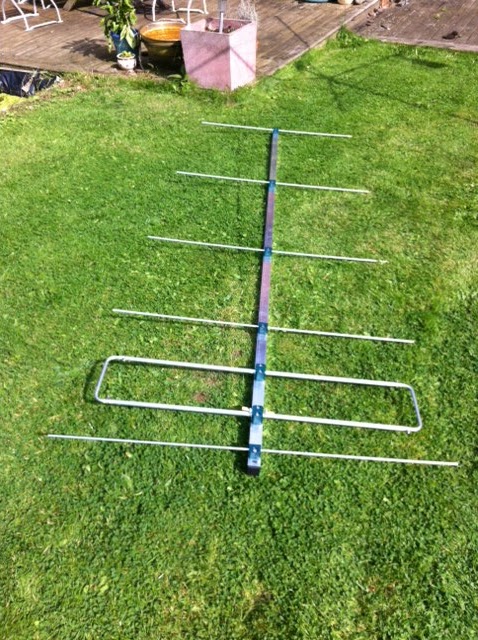
The new Innovantennas 6el yagi is constructed and awaiting some testing – I was hoping to do that last weekend, but a bad cold got in the way. As it may be a little time before I can get the 6el up on the mast, I may even hook it up on a stepladder in the back garden and point it at the moon and see what happens.
All good fun and plenty going on!

A cheaper approach to Virtual Radar using the microADSB dongle
For quite sometime, I have been intrigued by the whole ADS-B Virtual Radar thing. As you know, if you’ve read this blog for a while, I love maps and plotting objects on them. I love planes too and whenever I look up and see a plane I always wonder where it has come from and where it is going to. Not to mention the propagation angle. ADS-B (Virtual Radar) operates at 1090MHz, so how interesting to have a set of beacon sources operating at around 1GHz and to be able to monitor propagation to and from them.
How to achieve it? Until recently, the only way to do it appeared to see some very interesting, if expensive units such as the SBS-3 Virtual Radar devices. These look great, well put together but seemed a lot of money for something that would probably not be a core part of the station here.
Dave G4FRE had told me of his experiments of using Ubuntu and the RTLSDR dongle to monitor ADS-B which looked effective and interesting. I did not really want to get into the whole Linux thing. I’ve nothing against Linux, but I spend my days looking into the technicalities of computer systems and though it is something that fascinates me it is not something I want to reproduce at home! I might give it a go in the future though. Dave has had some good results with his Ubuntu box and RTLSDR which does sound worth experimenting with.
However, talking to Mark VK3PI on Twitter he mentioned that he had got a lower cost ADS-B receiver which was showing good results.Mark had obtained a USB dongle from Miro LZ2RR called the microADSB The cost was modest compared to other solutions, so I placed an order.
The microADSB arrived on Thursday and I wasted no time getting it going. The package consists of the dongle itself, a CDROM of software, a USB cable from the dongle to the PC and a small magmount antenna terminated with an SMA that connects to the dongle.
Software installation was straightforward. On plugging the dongle in, I was prompted for the drivers which installed happily off the CD. The software that comes with the dongle is adsbScope. All I had to do to get it working was to select the virtual COM port that the dongle had attached to and then connect ADSB Scope to the dongle.
I was doing this at around 10pm at night with a few less planes flying, but I moved the antenna close to the window of the lounge on the ground floor and was soon seeing points plotted from the planes at surprising distances from home. Having got it all setup, I transported the laptop and the dongle upstairs to the shack, which has an easterly facing window and set it up. Range seems to be regularly 50-60 miles with occasional greater distances.
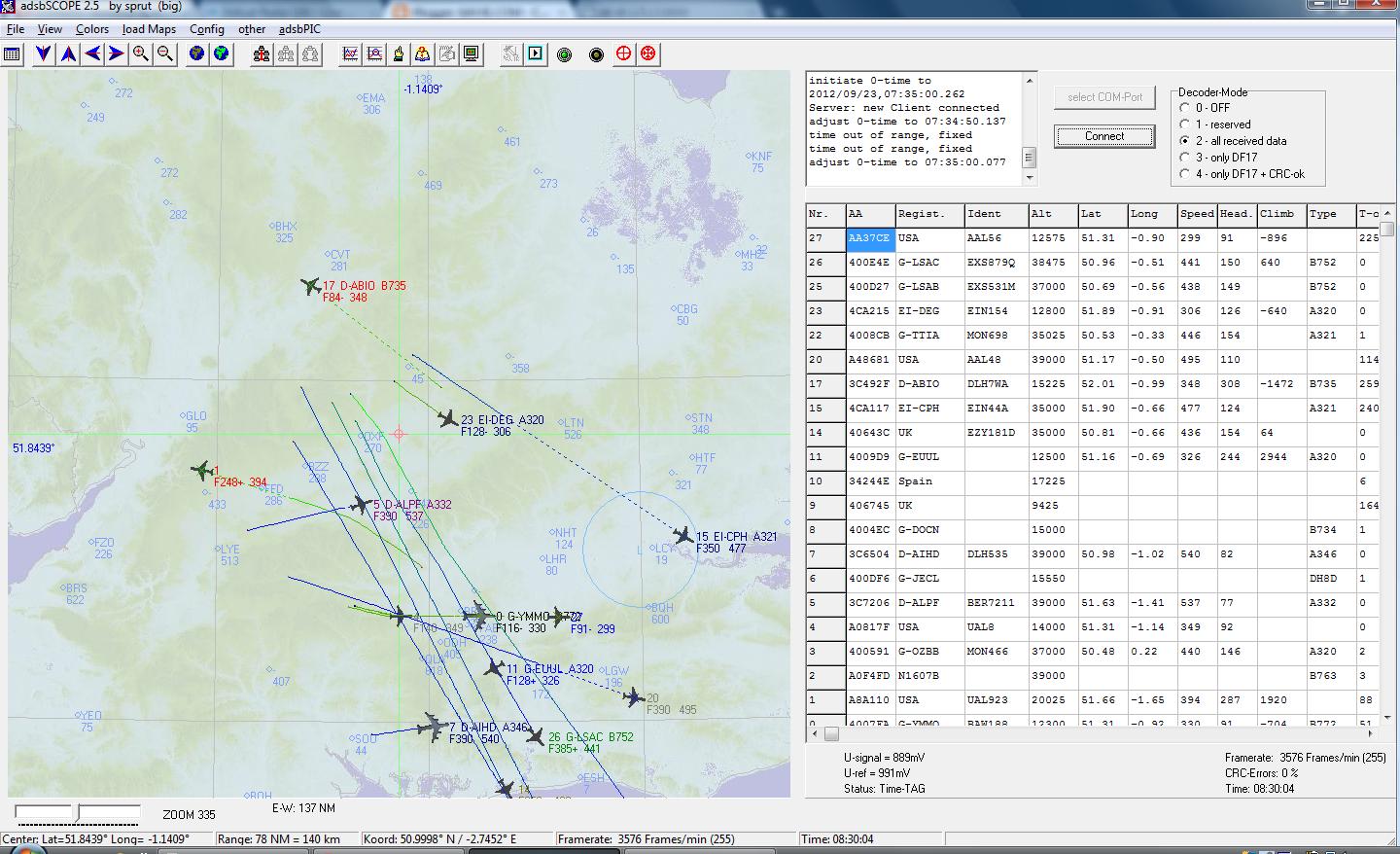
adsbScope allowed me to plot planes easily and it shows, where possible, the country of registration and the flight number, However, this didn’t entirely satisfy my curiosity about where the planes were flying to and from.
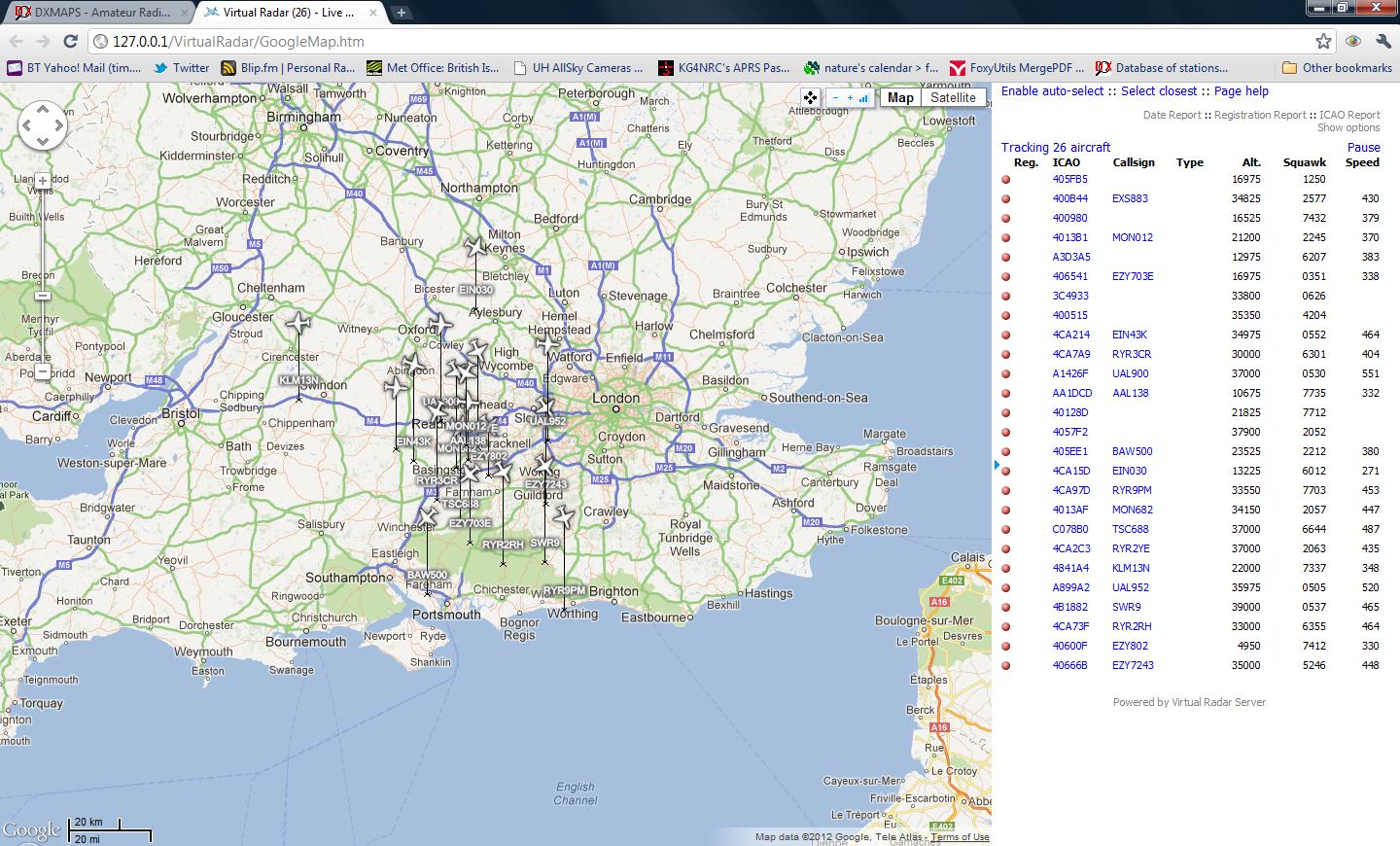
I had noticed an application called Virtual Radar server which runs as a webserver on your PC and picks up the data from adsbscope and augments it with information from a routes database and plots the planes on a nice Google map. I had to start adsbScope’s server functionality which Virtual Radar Server was able to read. Virtual Radar Server expects an SBS type installation, so I had to install a plugin called Database Writer which reproduced the basestation.sqb file/database which the SBS software seems to work on. I enabled the plugin and then allowed it to create the database file and granted it permissions to update it.
That did the trick! I was then able to browse to the URL which the Virtual Radar server provided on the local machine to see the planes plotted, along with the route information. I’m finding that so far, if I just want to get a sense of what propagation is like, I stick with adsbScope as that tells me all I need to know, but if I want a bit more information abut the flights, then I start up Virtual Radar Server.

Happy 80th birthday, Practical Wireless magazine
Today, September 13th, Practical Wireless is 80 years old! In 1932, the very first Practical Wireless was published and was at that time a weekly.
Amateur radio magazines available on the High Street have come and gone over the years; ‘Short Wave Magazine’ of course. Who remembers the UK’s ‘Ham Radio Today’ and ‘Amateur Radio’ in the 1980s? For one reason or another all these have come to an end leaving ‘Practical Wireless’ as the only remaining solely Amateur Radio magazine that can be purchased at your newsagent.
My grandfather loved Practical Wireless and as a boy, we worked on crystal sets and transistor radios together. It gives me a thrill that now I am able to contribute in a small way to the magazine and I hope, enthuse people to enjoy our hobby.
Look out for GB80PW being operated today from the home of PW’s Editor, Rob Mannion, G3XFD. I gather there are plans to be on 7MHz SSB (or, in PW style s.s.b.) during the morning and early afternoon, after which time the station will move to 14MHz SSB – with hopefully some 3.5MHz PSK31 in the early evening.
If, like me, you’ll be at work today, look out for GB80PW on Saturday 15th September – the plan is to be on 7MHz SSB between around 0930 and 1500 local time (0830-1400z).
Happy birthday, Practical Wireless!

DX Magazine’s ‘Most Wanted’ survey
If you’ve read this blog for a while, you’ll know that I have mixed feelings these days about HF DXpeditions and some of the behaviour that they engender on the bands. Nevertheless, there is a great deal of pleasure derived by many in chasing the DXCC entities.
Carl, N4AA, Editor of ‘DX Magazine’ has been organising the ‘Most Wanted Survey’ of countries over many years and over the last 10 years or so, it has been my pleasure to assist in a small way with the IT to analyse the results. If you are interested in helping Carl with the survey, you might like to read the following press release
“Effective immediately the 2012 Most Wanted Survey form is available on the DX Publishing web site.
“Please go to: www.dxpub.net and under the heading MOST WANTED SURVEY you will find a link to the form. Click on ‘2012 SURVEY’.
“Several prefixes are in BOLD type. These are ones which may cause confusion due to their similarity, i.e. 3D2, VK9, VK0, etc. Please use care when marking these to be sure the correct one is counted.”
“There are a few shown in RED. These indicate either an addition to the list from last year or a change in the prefix (ZK2 is now E6). “There is a ‘block’ at the bottom of the form for you to send along any comments, or to include any country that you need which is not on the list.”
“Please pass the word to your friends and to any DX clubs in your area that the survey will be available until October 15th. Thanks for your participation. 73, Carl, N4AA”
Arguably, with the much greater use of systems such as LOTW, ClubLog and so on, there will be reduced need for surveys like this – as analysis of the database behind LOTW and ClubLog reveals in an instant the ‘needed’ countries. Nevertheless, the ‘Most Wanted’ survey still provides a valuable indication towards the wishes and needs of the HF DX community.














