Author Archive
 Thank you Ian, MW0IAN
 December 3rd, 2012 |
  Author:
 If you’re anything like me, then on a cold, wet, grey morning in December then you need something to help you smile. Well, Ian, MW0IAN made me smile this morning.
Ian had read my blog about the KH-6 50MHz handheld and in particular, my lack of a decent antenna for it. Very luckily for me, he got in touch to say that he had a spare antenna and would I like it. I would, I would, I would, please! So, Ian has kindly agreed to post it. I’m really looking forward to trying the antenna out and see if we can eke some better performance out of the KH-6.
In the meantime, and most importantly, Ian has a really interesting blog where he details some of his QRP and SWL projects. Take a look!
Thanks for your kindness, Ian!
More on the Palstar KH-6 50MHz handheld
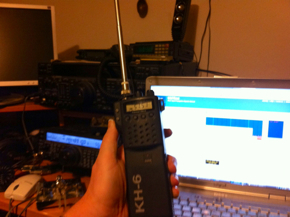
Perhaps you remember a few months ago, I picked up the KH-6 50MHz handheld from eBay. To be truthful I hadn’t done a lot with it.
I was a bit disheartened when I took it up White Horse Hill and failed to hear either the GB3RAL beacon at Harwell or the GB3ZY repeater at Dundry, both of which I thought should have been audible. So, I had a feeling the rig was perhaps a bit deaf.
A few days ago I was moved to investigate a bit more and the results were interesting. I examined the ‘rubber duck’ which had come with the rig. It turned out to be an AOR scanner antenna – probably not very efficient at all on 50MHz. Connecting the rig up to the 50MHz antenna on the roof, the GB3RAL beacon was end stop!
On my desk was another scanner antenna from my Dad’s old scanner which was a telescopic rod antenna. Although still rather less than a quarter wave on 50MHz it stood a better chance. Promising too was the fact that I could weakly hear the GB3RAL beacon keying.
So, I think the receiver’s just fine. I’ll take the rig up the hill next time and see what I can hear. Incidentally, the battery pack has great life – it’s held its’ charge over an extended period. Impressive!
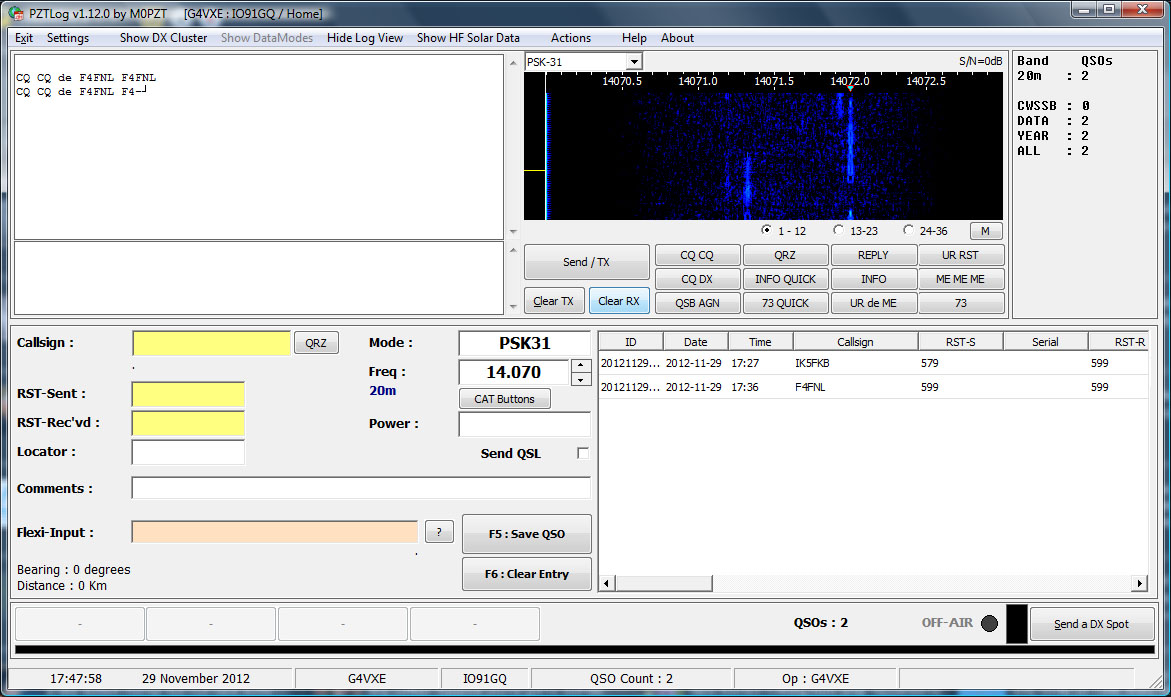
Trying out PZTLog
The Oxford Museum of the History of Science
A couple of weekends ago, I had the opportunity to take a look around the Museum of the History of Science in Oxford. There were lots of interesting exhibits but here are a few that caught my eye.
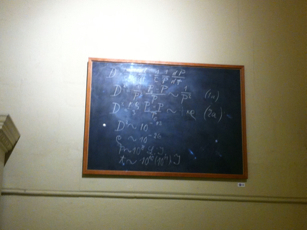
First, a blackboard. A smart scientist called Albert Einstein visited Oxford. During his lecture – he used this blackboard. I was really thrilled to see Einstein’s writing.
The formula? I’m not an expert, but I believe it shows the age of the Universe. The result of which holds up pretty well.
Here’s a beautiful Marconiphone receiver.
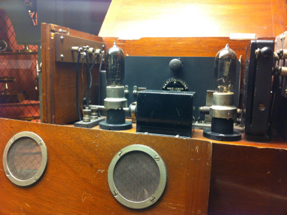
And a Marconi transmitter!
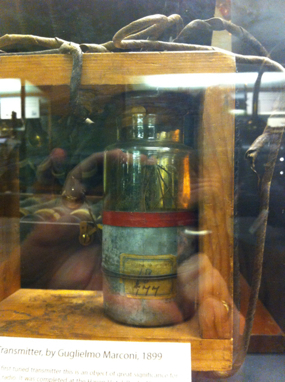
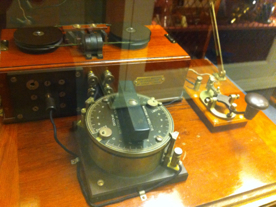
Look at this gorgeous morse key! A ‘grasshopper’ design. Never seen anything like it.
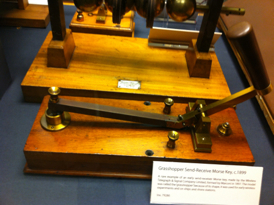
An excellent visit! Highly recommended if you’re in the Oxford area.
Today’s 28MHz WSPR

A good day on 28MHz WSPR, particularly as I didn’t get started until I’d finished playing with the DSTAR kit this morning
New version of WinDV v1.5.5
Earlier in the week I noticed that there was a new version of the WinDV software that I use in conjunction with the DVAP, version 1.5.5. I downloaded it then but it wasn’t until this morning when I was doing some household chores and garden work that I had a chance to try it out. I hooked the DVAP up to REF001C and had a nice QSO with Brian, ZL1HN. During the QSO with Brian he mentioned getting a Raspberry Pi working with a DVAP which sounded an interesting project. Oh dear, I can see me getting a Pi at this rate…. I had another interesting chat with Clive 2W0CLJ who was doing good stuff with one of the DVRPTR boards and an FT7800.
Get the new version of WinDV at the dutch*star site
A good day’s VHF
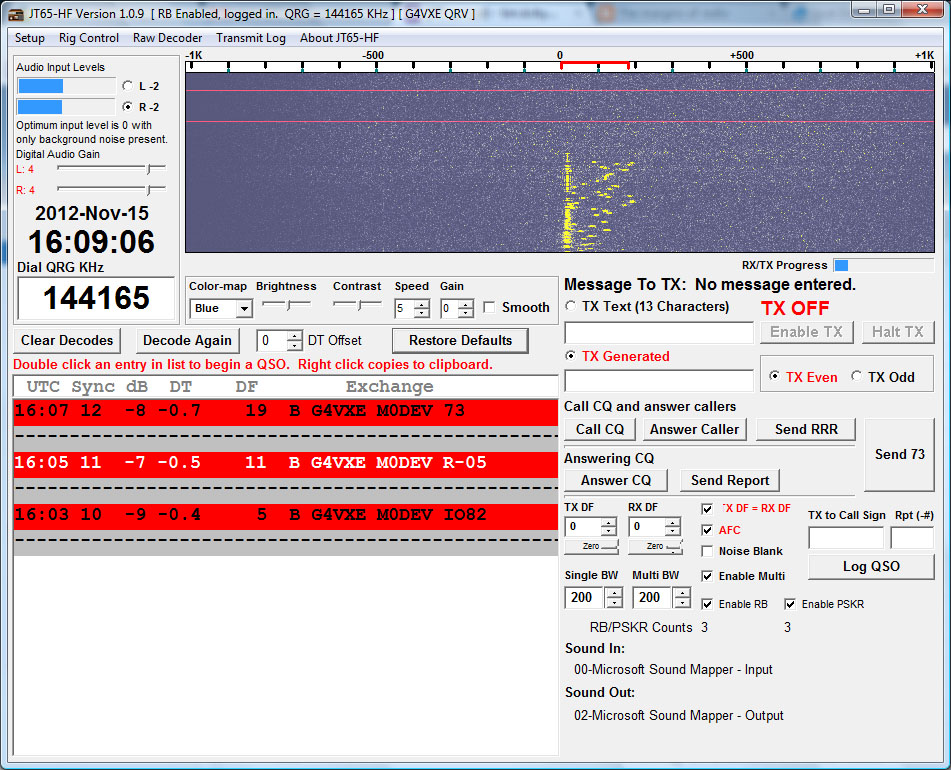
It was nice to hear from Mark M0DEV following our exchange of WSPR signals on 144MHz. It turned out that I was the most distant WSPR signal that he’d heard on 144MHz at that point. We decided it would be fun to try a QSO and decided that since we both used JT65-HF regularly, we’d use that rather than the more usual variant for VHF/UHF JT65B.
Running 10W at each end, both into collinears, it was an easy QSO over a path of around 140km. Not massive DX of course, but very satisfying. Following a successful exchange of signals we then turned down our power as low as it would go – around 1W in my case and were still easy able to exchange signals. Mark calculated that given the conditions at the time, around 150mW would have probably done the trick. Sadly I can’t run that little power – at least not readily!