Author Archive
 Operating G100RSGB, freefalling lions, a few VHF NFD contacts and a satellite SWL!
 July 7th, 2013 |
  Author:
 It’s the RSGB’s Centenary Year and the callsign G100RSGB has been doing the rounds of the clubs in the UK, a bit like an Olympic torch of the air! Well, this weekend was the turn of the Harwell Amateur Radio Society and they very kindly invited me to come and join in with some operating.
I popped down first thing on Saturday morning. I decided to try some 14MHz CW operation which was modestly busy. G100RSGB is a real pig of a callsign to send on a keyer you don’t know. So, after being very gently chided for sending G1??RSDD I decided that perhaps it would be prudent to find another mode!
We got the 50MHz station setup and although there was no Es around, it was fun working some tropo contacts on the band, including a number of stations setting up for VHF NFD. I was particularly impressed to work DJ6XV and another of the team worked a GM/P. On 144Mhz, Ann found some propagation to the south, working an EA1 portable as well as some French stations down in IN93.
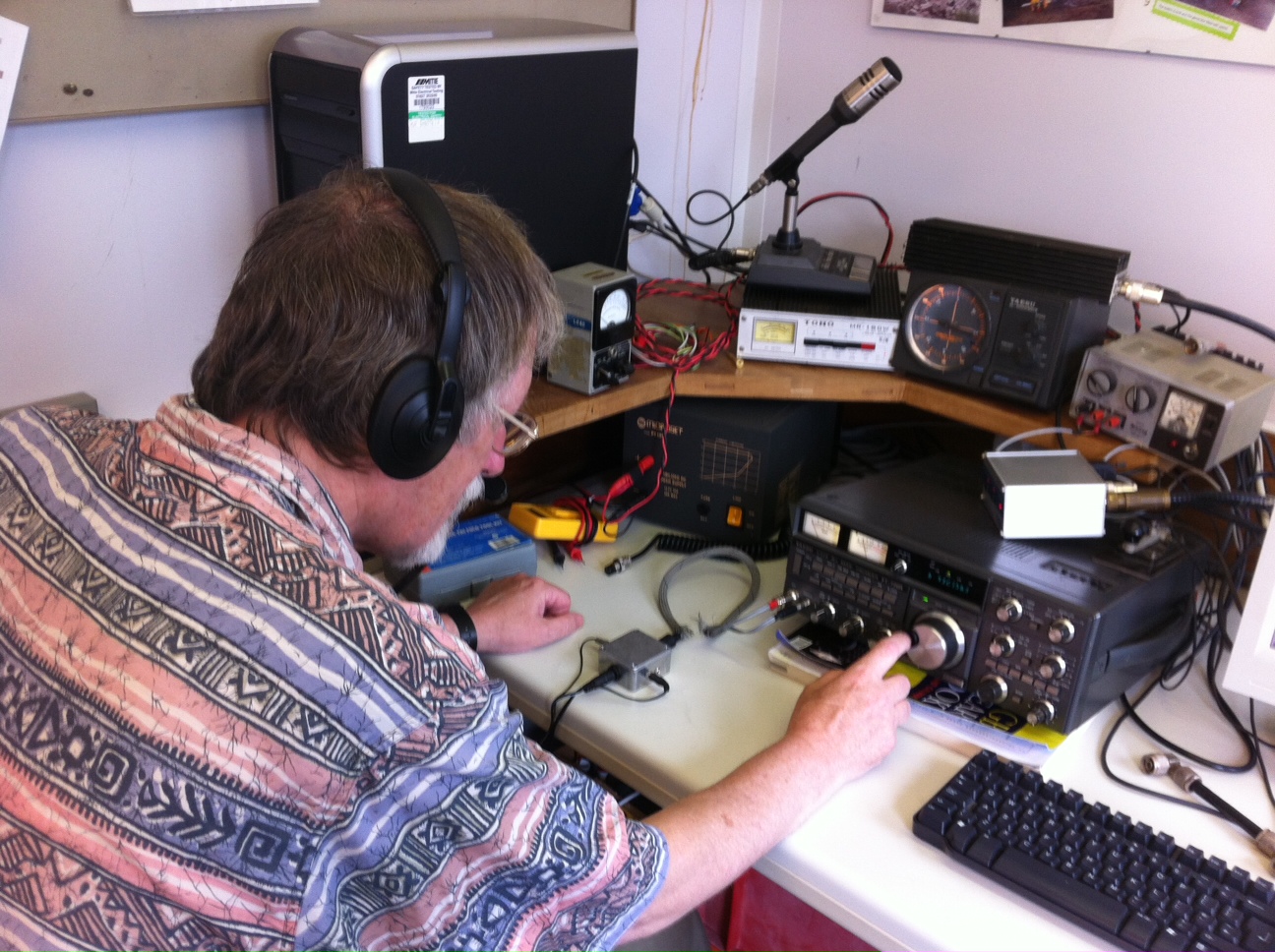
Mike G8CUL gets the G100RSGB station at Harwell ready for some DX!
It was great fun to join in with the celebration and many thanks to the Harwell club for the very kind invitation.
In the afternoon, I made a few 50MHz VHF NFD QSOs, I was particularly pleased to work EI9E/P and GW2OP/P – not bad tropo with my vertical antenna – so definite ‘Golden Ears’ awards for the operators there for pulling me out of the noise.
By chance, later in the afternoon, I noticed that Dave M6RPI had launched another pair of balloons, one of them, once again, carrying Kingsley, the Reading FC mascot. It was fun to track the ascent of the balloon, and noticing the temperature figures reported, showed very clearly that a temperature inversion was going on. One moment the temperature was around -17C and then another 10000m higher and the temperature was just above zero.
It was fascinating to listen to the balloon transmission and for the first time, I was monitoring when the balloon burst. It was quite apparent as the steady signal suddenly started Doppler shifting as the payload fell at around 1km every 15 seconds. Poor Kingsley the lion! But have a look at Dave’s video of the balloon burst and see some stunning video footage
Video courtesy of Dave Akerman M6RPI
Then today, I was busy writing the PW column which was enjoyable. In odd breaks I made a few QSOs on 70MHz and again was particularly pleased to work GW2OP/P and EI9E/P. I did faintly hear a GM at one stage, but nowhere near workable. Very pleasing on the vertical.
After I’d finished the column and a few household chores, I noticed an FO-29 pass was due. I decided to have a listen and put the Elk antenna together quickly. There seemed to be some FM interference, but it was nice to hear Bob G0FGX coming through nicely. It turns out Bob is close to where my Mum and Dad used to live in Cornwall.
Finally, as I had the Elk hooked up to the FT817, I decided to see what I could hear and work with the Elk, handheld in the back garden on 144MHz in NFD. I was delighted to work GW2OP/P (again) and even more surprised to work MM0CPS/P in IO84. More Golden Ears awards, fellas!
A nice varied weekend’s radio!
Beware a lion on a parachute: My first attempt at tracking High Altitude Balloons on 434MHz
A few weeks ago, I enjoyed tracking two high altitude balloons launched from near Cambridge, across the channel across Belgium, Germany and then finally into Austria. On that occasion, I didn’t have the time to set up the software to attempt to receive the data from the balloons and upload them.
Earlier in the week, I noticed Dave Akerman M6RPI mention that there would be two balloon launches this Saturday. Both quite interesting – one was a fund raising venture for Purley Infants’ School and the second one was even more fun – an attempt to release Kingsley, the Reading FC mascot from a balloon at exactly 18.71 miles above the earth and have him drift down to earth on a parachute.
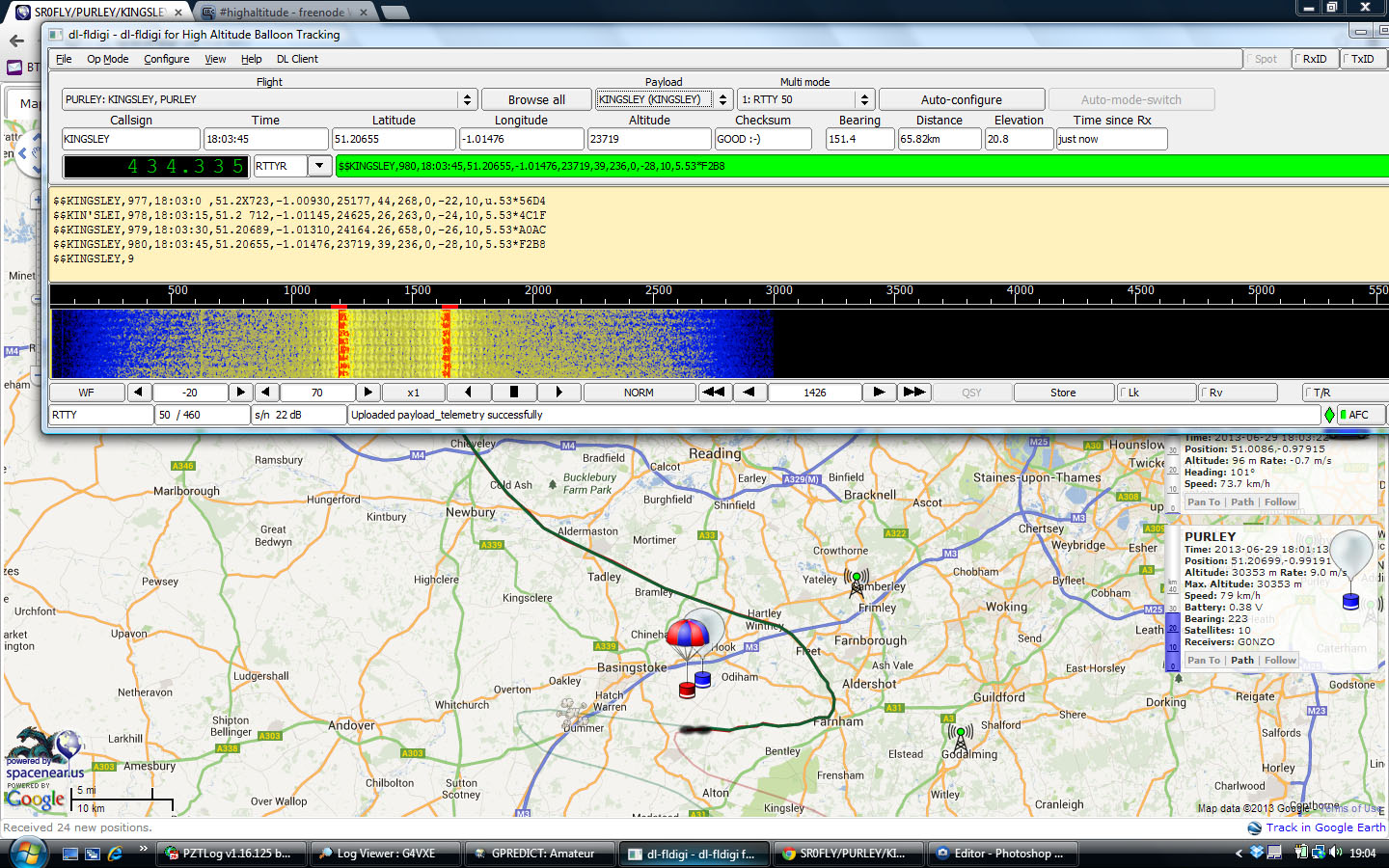
As ever, I didn’t really plan it, but at least I was downloading the DL-FLDIGI software as the balloons were being launched! Data about launches together with a plot about where the balloons currently launched are, is shown on the SpaceNear website
As the balloons were being launched from about 20 miles from me, I was reasonably confident I would hear them. I turned the 432MHz yagi (10 ele) towards the launch site. I picked the Purley balloon and tuned the FT847 to the appropriate frequency on 434MHz SSB. The balloons transmit a RTTY signal. Very soon, I could hear a weak signal.
I fired up DL-FLDIGI and filled in the station configuration details. After a bit of fiddling, I settled on setting the mode to RTTYR (the FT847 was on USB) and I was able to decode some data. Although I was receiving data and could see that it was being uploaded to the Spacenear site, I was getting a lot of bad checksums. Initially, I thought this was something I was doing wrong. However, I think it was because the Purley balloon must have been running quite low power. I will ask Dave about this.
However, when I tuned to the KINGSLEY balloon, signals were very much stronger and I was able to track it well as it rose to the target height, burst and then gently descended to a landing spot not too far from Basingstoke. It was fun tracking it very close to the horizon. Actually during part of the descent, the balloon’s transmit frequency was drifting fast – almost too fast for DL-FLDIGI’s AFC! However, I was able to persuade it to play after a bit more fiddling and a restart of the software!
Now, has anyone in Basingstoke seen a toy lion on a parachute? (actually, the good news is that Dave, M6RPI has recovered both payloads successfully, so Kingsley hasn’t had to sleep out rough..)
Two days, three QSOs on 50MHz FM!
It’s been a while since I had many QSOs on 50MHz FM. Two or three years ago, I used to work Roger G4HZA most mornings via GB3FX, but Roger moved away.
Since then, I’ve occasionally called CQ on 51.510 FM, particularly in the Es season. As you may have read, I was rewarded with a nice contact with EA2DVT last week. Yesterday, I called CQ and was pleased to be called by Andy G6REG/M using his new second-hand AKD mobile rig. We made an easy contact over a distance of around 15 miles.
This evening a CQ had both Andy and David, M0MLN respond! David was quite close by, testing an antenna but was able to work both myself and Andy. Andy and I enjoyed a mobile to mobile QSO for some minutes. Despite some varied terrain we noticed much less mobile flutter than we would have expected on higher VHF bands, even 70MHz.
It would be fun to hear more mobiles or fixed stations on 51.510, whether on ground wave or by Es!
Down on 50.500, yesterday evening I heard Spanish. No callsigns, so whether it was a repeater or just a local contact, I couldn’t quite tell.
Updated RTL1090 – more planes on your SDR based virtual radar
A few days ago, I noticed some mention about a new version of the RTL1090 program. This is Windows software which you can run on your PC in conjunction with the RTL-SDR dongles and plot ADS-B transmissions from aircraft. For a bit more detail, please see my earlier blog post
Yesterday evening I downloaded the program and installed it, which was straightforward. My first impression was that I was seeing more aircraft than I had before. With the small antenna provided with the dongle on the desk in front of me, I was seeing aircraft further out than I had done before with the RTL1090 software. Testing again this morning, the same seems true.
As well as seemingly being a bit more sensitive, the new version of the RTL1090 software provides a bit more information in the List view abut messages which have been decoded, which might be useful or interesting (or encouraging) if you have not yet got the link to a plotting program working yet.


Download the new version of RTL1090 here
The other thing that looks quite interesting is that the team have produced a program to interface with RTL1090 and plot aircraft on a map. It’s called Globe-S and can be found here – I haven’t yet installed it, but it looks a nice interface.
50MHz repeaters in Italy: 50.500 and 50.800
A couple of times in the last week, I’ve heard two Italian repeaters on 50MHz from the mobile. Most regularly I have heard one on 50.500 but I have also heard one on 50.800.
Of course, I wondered where they were. IK2ANE has a good repeater list but I can’t see either frequency mentioned.
It’s possible that the repeaters are not Italian and were just being used by Italian stations! It’s also possible they weren’t amateur stations – no call signs were heard!
Self-publishing, amateur radio and what it means for RSGB, ARRL etc
Over on Twitter, this week, my pal Rachael Lucas, who has recently self-published an amazing successful first novel, drew my attention to some ‘interesting comments’ from the established publishing industry about self-publishing. Let’s just say, the comments weren’t encouraging. They reminded me of music company executives who hadn’t worked out how downloads would revolutionise their industry.
I’d casually wondered about self-publishing before, but I decided to look into what you needed to do to publish your own book. It turns out remarkably simple to get your eBook content onto Amazon. Clearly, you need to write something compelling and to be able to market it. Social Media is your friend, after all.
What does this mean for amateur radio publications? Well, if you’ve an idea and you want to put an eBook together, it’s simple! What does it mean for established publishers such as RSGB and ARRL? Time will tell, but I’d guess they will get squeezed as we see a shift towards self-publishing. That should mean that the breadth of titles available increases – up until now, ARRL/RSGB would presumably only commission titles that were reasonably mainstream. With subject matter experts able to self-publish, it would be good to feel that a wider and more esoteric range is available ( though sales may not be that high!).
For ARRL/RSGB who have traditionally made some money out of publishing, this represents an opportunity (or a threat, depending on your standpoint).
And yes, I have some ideas – I just have to find time to apply brain to keyboard.
Listening for the SO-50 satellite with the UV-5R and the Nagoya NA-771 antenna
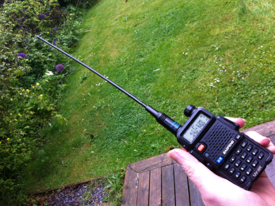
Inspired by David, KK4MND’s video the other day, I thought it would be fun to see if I could at least listen to the SO-50 satellite with the UV-5R. I realised that I would most likely need a better antenna than the stock antenna which comes with the UV-5R.
Via eBay, I ordered a Nagoya NA-771 dual bander which seems to have quite a good reputation. Having read about ‘counterfeit’ antennas, I wondered what I would get, but at around £8 including shipping from Hong Kong, it would not be the end of the world if it was useless.
The antenna arrived yesterday. Some quick comparisons, inside, on local repeaters were encouraging and signals were better on several UHF repeaters that I listened to with both antennas.
This morning, SO-50 obliged with a nice overhead pass as I was out in the garden, digging out a new vegetable bed. To my delight, signals were quite audible. Rob, M0TFO had a particularly good signal and I also heard an EA7. I’m pretty sure that on a quieter pass, I should be able to make a QSO with the UV-5R.
Of course the Elk antenna is much better – but the simplicity of the UV-5R and the NA-771 is appealing.













