Author Archive
 Projects on my mind…
 September 10th, 2013 |
  Author:
 Rather quiet on the blog for the last couple of weeks. All’s well and there’s no lack of enthusiasm. Life has been busy, ‘good busy’. Non radio related, but we have acquired a new kitten, who we think is around 8 weeks old. She was stray in our village and despite, numerous enquiries, we could not track down her owner. We think she was born on a farm close by in a barn. Anyway, she is wonderful and we are delighted to have her with us. We are hopeful that the introductions with our other two cats, Max and Pippi, will go well – an initial brief introduction on Sunday went without incident!
I was thinking this morning about some of the different radio projects which are on my mind to have a go at over the next few weeks/months:
– 10GHz receiver using LNB and RTLSDR. I have most of the bits to do this and just need to piece it together and try it out. I’m particularly interested to see if I can receive the beacon on Cleeve Common, GB3CCX regularly. I’m also keen to see if it will exhibit rainscatter characteristics. Initially I will try using the LNB and see if I can hear anything. If that’s insufficient, I guess the next trick is to try and source an old Sky dish and use that. Should be fun.
– At the opposite end of the spectrum, I wonder if I can get some RF out on 472khz. I had an interesting reply to my post about the IC706 and 472khz from Daniele IN3FCI, who is using an IC706 at around 5W output. He’s built some matching to get his long wire working. I must find out more and see if I can get on and make a QSO! I’ll have to see if I can hook the IC706 up to the WSPR gear if so and see what is possible.
– I also have in mind to get hold of one of the cheap and attractive Intek CB rigs and modify it for 29MHz AM and FM. I already have the band and modes in the car, but it would be fun to get it going and try it out for myself.
– Getting active on FO-29 with the FT790 and FT817. As I posted the other day, I think the acquisition of a duplexer for 144 and 432MHz will be useful for satellite activity. I can use it for FO-29 and potentially also with the FT-847. I was musing the other day about doing some satellite activity from the car (static mobile!) using the FT-847 and the Elk antenna. I’d need the duplexer for that too.
Plenty of projects in mind then! No doubt I’ll get around to a few in due course! Operating wise, it’s been mostly 14 and 21MHz JT65A and JT9 over the last few days – mostly remotely controlled from the iPad on the sofa! Perhaps we can have Bailey the kitten making contacts…
Listening to 10GHz beacons with nothing more than a browser
I was excited to hear, the other day, via John G4BAO that there is now a online SDR for 10GHz. Located on Mow Cop, in the UK on the Staffordshire/Cheshire border, it enables you to tune across the 10GHz beacon band.
If, like me, you are intrigued by microwave propagation, but for whatever reason, don’t have gear of your own, this provides the opportunity to listen to the band from a good location in different conditions and see what you can hear.
I am particularly looking forward to seeing what possibilities are afforded by rainscatter. So far, when I have been listening, I have heard the ‘local’ GB3XGH beacon at good strength and fading up and down. I also saw traces of GB3KBQ on the Mendips. Judging by the short duration, I wondered about aircraft scatter.
Anyway – have a look for yourself! The 10GHz SDR receiver is online here (make sure you have Java and Javascript enabled).
Thanks to G7CKX, G4HJW and G6GXK for a very interesting facility!
Testing out WSJT-X v1.2 – preparing for autumn..
I tend to joke, although it’s not really so much of a joke that my basic operating pattern is to operate VHF/UHF over the summer months and then HF datamodes, specifically JT65A and JT9 over the winter months. There is more flexibility in this really, but when VHF isn’t doing much, it’s HF JT65 and JT9 that I find interesting.
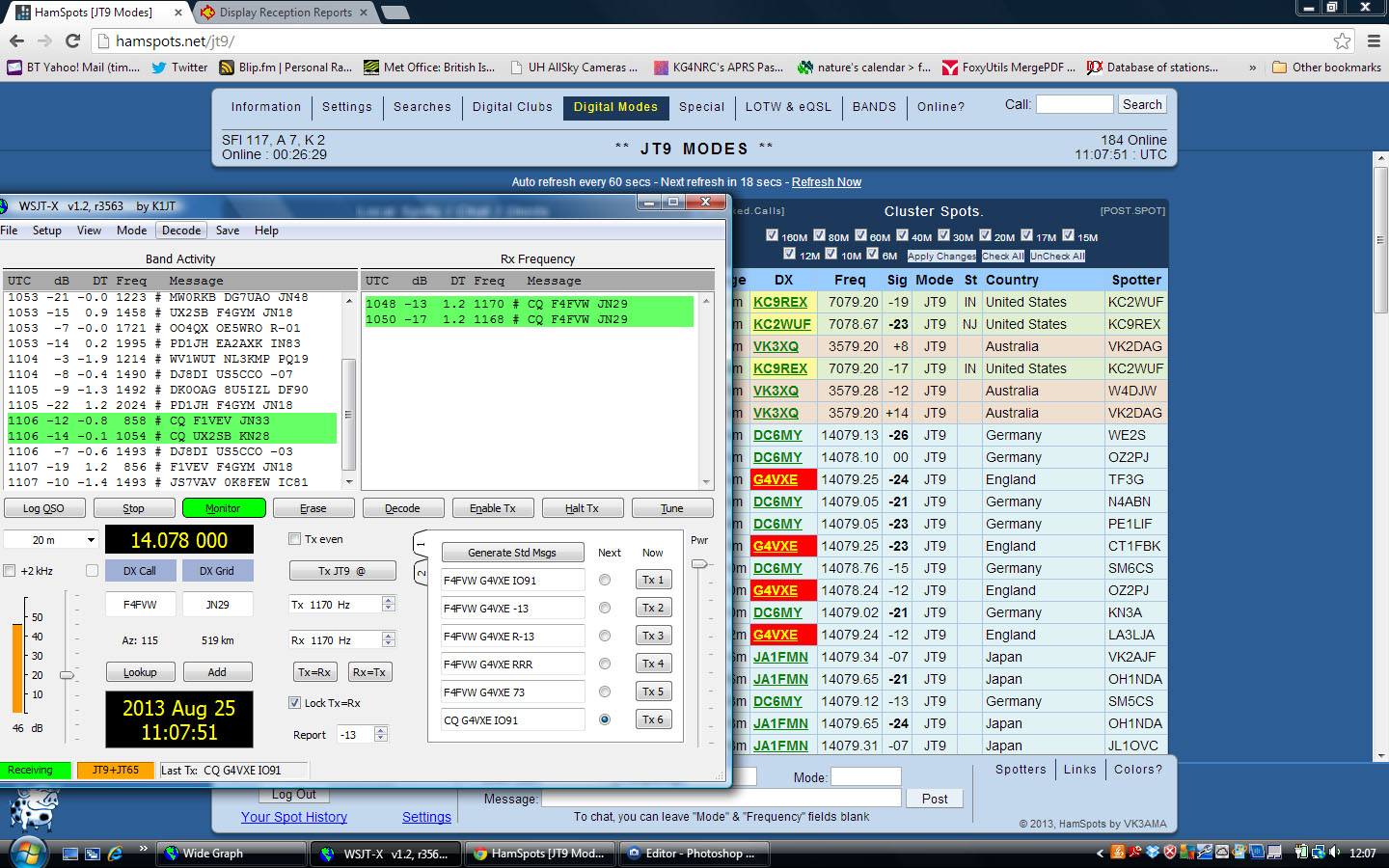
This morning dawned so autumnal and there was nothing to be heard on 50MHz that I decided some JT65 was probably in order. I fired up WSJTX v1.1 which I installed a few weeks ago and had a couple of nice 14MHz QSOs with CT3DL and EA7CHS to prove it all still worked.
After breakfast, I noticed that there was a beta release of WSJTX v1.2 so I downloaded it. I installed it and initially my heart sank – as there didn’t seem to be an option to select the Direct X sound drivers on transmit. You may remember if you have been reading the blog for a while that I found I needed to select these in order to transmit intelligible JT9.
I decided to go ahead anyway and if I needed to, I could rollback a version. Fortunately, this was not necessary. I had a quick listen on the monitor receiver as I transmitted both JT65A and JT9 and the signal sounded good. So, whatever there was before that was causing this problem, Joe K1JT seems to have sorted it out! I was also pleased to see that both my JT65A and JT9 transmissions were picked up by other people – so it must be decoding ok. I was particularly pleased to have my JT9 transmission picked up by TF3G in Iceland.
Initial impressions of v1.2 are good. I can see some JT65A decodes which look a bit suspect to me, but we’ll see how those go! On the positive side, I like the new power slider on the right hand side of the screen, which allows you to tweak the power down. I think this will be particularly valuable on JT9, which is exceptionally good for low power QSOs.
My watt of forlorn hope part two. Or my FT790 and its’ part in a satellite setup!
I’ve not done much with FO-29 so far. With the FT817 being half duplex, I’m a little wary of transmitting much, as it would be easy to interfere inadvertently, with another QSO. Having said that, some simple QSOs are readily possible.
The other day, I had an idea. With the lovely old FT790 that I bought for not a lot off eBay last year, could I use that in conjunction with the FT817 and a duplexer and make a full duplex portable station?
The key would be how good the FT790 receiver would be. This morning, FO-29 was passing over to the west, so I hooked up the 790 to the Elk and had a listen. It seemed to work fine. I heard many stations on the pass: G4DOL, GW1FKY, EA3LW, EA8HB and several others whose calls I’ve forgotten. In fact, I got the impression that I was hearing the satellite better than some others.
I think I will try a duplexer and see if I can make this work. De-sense may be a problem perhaps, and physically managing both the FT817 and FT790 may be a challenge.
It’s got to be worth a go! Also, it will be nice to use FT790 in ‘anger’, rather than just sitting on the bench looking nice.
Programming the UV-5R to operate with the SO-50 satellite
Julian, G4ILO just asked me a question about how I’d programmed the UV-5R to work through SO-50.
I’ve set up 6 different memories, just as you would for a repeater, except that in this case, the input and output frequencies are on different bands. For each memory, I have left the transmit frequency as 145.850 (it might be a bit out towards the beginning and end of the pass, but hopefully not too far off). On transmit, I have the CTCSS tone set to 67hz. I have seen documentation that SO-50 likes this, and other people saying it doesn’t really matter! I also programmed one memory which is not used for QSOs with a CTCSS tone of 74.4Hz. This can be used to ‘wake’ the satellite up if the radios have switched off. I’ve not done this myself yet.
Receive frequencies are 436.805, 436.800, 436.795, 436.790 and 436.785. I also programmed up 436.780, but have not used this one so far.
On the basis that a picture speaks a thousand words, here’s a picture from the programming software of what the setup looks like.

A poor antenna has infinite gain over no antenna – with thanks to K2TK
Yesterday, Chris KQ2RP tweeted K2TK’s line ‘A poor antenna has infinite gain over no antenna’ and it made me smile. It encapsulates so much about my whole approach to radio (and actually more than that).
Some people like everything to be perfect before they embark on a project. Every little last thing needs to be just right. That’s not me. In radio terms, I’d far rather try and lash something together to get it going and try it out than wait for something to be perfect (in my case, it would never happen!).
As a VHF enthusiast, I very often hear, I don’t have an antenna for 50MHz, or whatever. If you’re a 160m enthusiast, you probably hear the same thing! There’s usually some sort of antenna that you can bodge into service, even if it’s a grotty wire dipole twisted together. It’s rare that you can’t get it to radiate SOME sort of signal, and I’m sure I’ve made hundreds of QSOs on antennas where bits of wire were just twisted together.
I often hear people say of the data modes, such as PSK31 – ‘I don’t have a data modes interface’. To get started – just hold the microphone over the speaker of the computer as it transmits the PSK31 tones – and use the microphone on the computer to decode the tones from the radio. It works fine – even if there’s a little juggling to do. You can even use apps on your mobile phone to decode the PSK31!
Having proven that you can make something work simply, you may be enthused to get a more elegant solution going. Or you may not – sometimes, just the simple matter of having made something work is enough and you don’t need to come back to it.
Give it a go (what ever it is!) I bet it will be fun…
First SO-50 QSOs with the UV-5R
The experiments with the UV-5R and the Nagoya NA-771 were encouraging for listening, but being a bit impatient I thought I could use the Elk yagi to get a bit of gain to make some QSOs.
What was needed was an adapter from the UV-5R (SMA-F) to the Elk – I’d used a PL259 to connect to the FT817. I decided I would use a pigtail lead rather than a straight adapter, to avoid putting undue strain on the antenna connector. Various US outlets listed the leads on Amazon, but wouldn’t ship to the UK. I was pleased to find that Sinotel Ltd had stock in the UK, so I placed an order.
The adapter arrived this morning and I was able to get set up for an SO-50 pass. It was raining hard – so I opened the patio door and waved the antenna outside. Signals were good. If anything, I felt the UV-5R might have been more sensitive at 436.800MHz than the FT817 – just a guess. I was able to have a tentative QSO with Simon G6AHX, an old friend from Cheltenham days. For some reason the satellite dropped out with me, so the contact was a bit stilted, but think we got there in the end.
So the UV-5R and Elk looks like a very viable portable FM SAT setup. At over £100, though, the Elk is a lot more expensive than the UV-5R! It works well, but will probably put off the casual experimenter. Perhaps a homebrew tape measure antenna might be an option?













