Author Archive
 Ham Radio to the rescue!
 May 19th, 2015 |
  Author:
 After kind of causing the problem, in the first place.
http://kdvr.com/2015/05/17/littleton-snowshoer-rescued-after-falling-off-icy-ledge/
Thanks to Drew W2OU for pointing this one out.
But in all seriousness folks, portable ops can seem harmless, but they come with their own hazards and some can be life threatening.
Just a few basic things to keep in mind:
Don't go hiking alone if you're unfamiliar with the trail. It's too easy to get lost. I speak of this one from personal experience. Once I was out on a hike in the Adirondacks on an unfamiliar trail for the first time, and I took a turn I shouldn't have and found myself off the trail. Fortunately, I kept calm, retraced my steps and found my way back quickly and easily. However, if you panic, all bets may be off. Moral of the story - two or more sets of eyes are better than one when looking for trail markers.
Always take along extra water, food and appropriate clothing. While it may be hot and sunny when you start out, weather can and often does change in a heart beat, so keep weather conditions in mind. For good measure, always bring along your VHF/UHF handheld, it could literally save your life.
Let someone know where you're going and approximately how long you'll be gone.
This is an obvious one, but people sometimes forget. If you can hear thunder, shut the station down! A storm does not have to be right on top of you to be a lightning threat. Lightning bolts can touch down more than 10 miles away from a thunderstorm's leading edge.
Portable operating is about the most fun you can have in Amateur Radio, but you have to approach it in a common sense fashion.
72 de Larry W2LJ
QRP - When you care to send the very least!
http://kdvr.com/2015/05/17/littleton-snowshoer-rescued-after-falling-off-icy-ledge/
Thanks to Drew W2OU for pointing this one out.
But in all seriousness folks, portable ops can seem harmless, but they come with their own hazards and some can be life threatening.
Just a few basic things to keep in mind:
Don't go hiking alone if you're unfamiliar with the trail. It's too easy to get lost. I speak of this one from personal experience. Once I was out on a hike in the Adirondacks on an unfamiliar trail for the first time, and I took a turn I shouldn't have and found myself off the trail. Fortunately, I kept calm, retraced my steps and found my way back quickly and easily. However, if you panic, all bets may be off. Moral of the story - two or more sets of eyes are better than one when looking for trail markers.
Always take along extra water, food and appropriate clothing. While it may be hot and sunny when you start out, weather can and often does change in a heart beat, so keep weather conditions in mind. For good measure, always bring along your VHF/UHF handheld, it could literally save your life.
Let someone know where you're going and approximately how long you'll be gone.
This is an obvious one, but people sometimes forget. If you can hear thunder, shut the station down! A storm does not have to be right on top of you to be a lightning threat. Lightning bolts can touch down more than 10 miles away from a thunderstorm's leading edge.
Portable operating is about the most fun you can have in Amateur Radio, but you have to approach it in a common sense fashion.
72 de Larry W2LJ
QRP - When you care to send the very least!
The scoop from Elecraft at FDIM
So Elecraft came to FDIM today, to announce the new K3S.
The new product is an enhanced K3 with many new features - here's a link to a .pdf which explains them all in detail. And here's a link to a FAQ.
It appears the new K3S will be approximately $500 more than the old version, and the original K3 has been "discontinued" or "replaced" - whichever you prefer. In addition, it appears most, but not all the enhancements will be retro-fittable to make a K3 a K3S. The new bezel and the attenuator, for instance, will not.
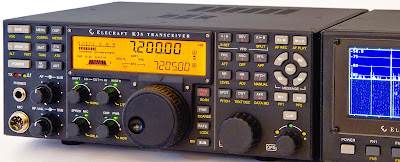
I wonder - how does the guy feel who took delivery on a brandy new K3, in the very recent past? Are they happy because they squeaked under the wire and got their K3 at the lower price? Or are they feeling a bit miffed because they ordered and received something that is no longer "the latest and the greatest"? Except for the cosmetics, it appears that you can pretty much turn your existing K3 almost into a K3S - and you do have a "system" that is continually upgradable. So if you're an Elecraft owner, you can take comfort in the fact that when you buy something, the company does its best to stand behind their product and you.
I for one, am quite happy with my KX3's. They're all the radio I need, and should Elecraft come out with a KX3S tomorrow, I would not be bothered in the least.
The morning UStream feed from FDIM was disappointing. If you attempted to watch it, you saw that only a portion of the video picture appeared and none of the audio. Basically, you missed the entire Elecraft K3S presentation. Things got straightened out during Rev. Dobb's presentation and we were able to hear that the good Reverend was inaugurated as QRP-ARCI's very first Lifetime Member.
The silver lining is that hopefully the feed will be up and running normally for the remaining sessions.
72 de Larry W2LJ
QRP - When you care to send the very least!
The new product is an enhanced K3 with many new features - here's a link to a .pdf which explains them all in detail. And here's a link to a FAQ.
It appears the new K3S will be approximately $500 more than the old version, and the original K3 has been "discontinued" or "replaced" - whichever you prefer. In addition, it appears most, but not all the enhancements will be retro-fittable to make a K3 a K3S. The new bezel and the attenuator, for instance, will not.

I wonder - how does the guy feel who took delivery on a brandy new K3, in the very recent past? Are they happy because they squeaked under the wire and got their K3 at the lower price? Or are they feeling a bit miffed because they ordered and received something that is no longer "the latest and the greatest"? Except for the cosmetics, it appears that you can pretty much turn your existing K3 almost into a K3S - and you do have a "system" that is continually upgradable. So if you're an Elecraft owner, you can take comfort in the fact that when you buy something, the company does its best to stand behind their product and you.
I for one, am quite happy with my KX3's. They're all the radio I need, and should Elecraft come out with a KX3S tomorrow, I would not be bothered in the least.
The morning UStream feed from FDIM was disappointing. If you attempted to watch it, you saw that only a portion of the video picture appeared and none of the audio. Basically, you missed the entire Elecraft K3S presentation. Things got straightened out during Rev. Dobb's presentation and we were able to hear that the good Reverend was inaugurated as QRP-ARCI's very first Lifetime Member.
The silver lining is that hopefully the feed will be up and running normally for the remaining sessions.
72 de Larry W2LJ
QRP - When you care to send the very least!
Something new from Elecraft?
Will Elecraft be introducing something new at Hamvention tomorrow? Seems like it to me. Eric and Wayne posted the following on Facebook:
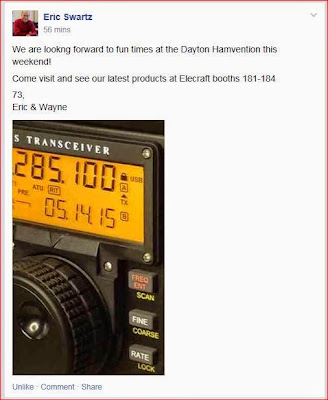
Notice the use of tomorrow's date in the display. Also - the current black chassis radios in the Elecraft line are the K3 and the KX3. Both use black screws on the bezel - not silver. AND the last character before the word "Transceiver" on both radios is a "3" ...... not an "s". Lastly, there's no current radio in the Elecraft line (that I'm aware of) that has that little "down arrow" above the VFO knob.
Seems to me that a major announcement is in the offing for tomorrow. I guess time will tell!
72 de Larry W2LJ
QRP - When you care to send the very least!
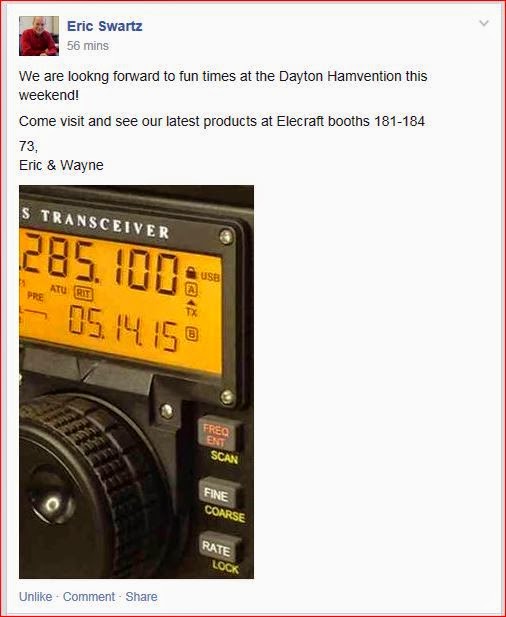
Notice the use of tomorrow's date in the display. Also - the current black chassis radios in the Elecraft line are the K3 and the KX3. Both use black screws on the bezel - not silver. AND the last character before the word "Transceiver" on both radios is a "3" ...... not an "s". Lastly, there's no current radio in the Elecraft line (that I'm aware of) that has that little "down arrow" above the VFO knob.
Seems to me that a major announcement is in the offing for tomorrow. I guess time will tell!
72 de Larry W2LJ
QRP - When you care to send the very least!
It’s time
As much as I hate to do it, I need to look for a new laptop for the shack. A few months ago, when the family computer gave up the ghost, I pressed my shack desktop into service in that role. To fill the void in the shack, I resurrected my old Acer Inspire One netbook. It's a small machine with a very small screen, with hardly any processor power. It was performing duties way beyond its pay grade. This is the kind of computer that was designed for looking at e-mails and Facebook, and that's about it. Needing something better, I tried recruiting my even older HP laptop (the one with the broken top lid hinges - thanks, kids!) into service. Alas, it's better than the Acer, but only by the breadth of a hair. It has a bigger screen, more RAM and a bigger hard drive, but it's still an old XP machine that has grown long in the tooth.
To explain what I mean ..... I went down to the shack last night to add some entries to my main logging program from the HamLog app I use when operating portable. I flipped the on switch at 9:30 PM and by the time it had booted up and the logging program had loaded it was about 9:47 PM. 17 minutes is not good. I wanted to start pulling out my hair by then. I think watching paint dry, or grass grow would have been less stressful and more entertaining.
That exercise in frustration drove me to start searching the Web. At work, IBM issued me a Lenovo T410. I still use this model every day. Yes, they are slowly being refreshed out with the newer T440 model, but mine has served me decently well at the job over the last few years. I have found a couple places where I can pick up a refurbed T410 with 4G of RAM, a 250 GB hard drive and Windows 7 Professional in the $150 neighborhood.
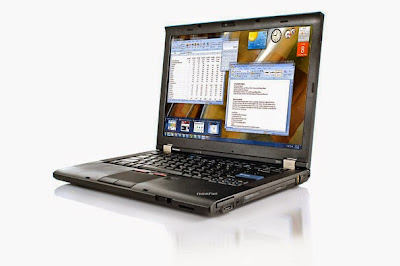
This model has everything I would need. It can hook up to the Internet wirelessly, it has 3 USB ports (need one for the KX3, one for a mouse, and one for an external keyboard), provisions for adding a second VGA monitor and the standard audio ports, so I can do the digital modes, should I ever be inclined to go down that road. Not planning to go there, but you never know. I'll have to dip into savings to acquire one, but having a computer in the shack has almost become a necessity.
Of course, I could always go native and log strictly with paper and pencil, but I don't think the ARRL would accept mailed in Xerox copies of my log for LoTW. Also, I like to keep my eye on QRPSPOTS as well as SOTAWatcher. Can't do that without some kind of computer, although I guess I could always just use my cell phone for those. And having a Telnet DX Cluster at my disposal for confirming that I correctly copied the call of that DX station who was sending at a blistering 45 WPM is a nice thing to have, too. (Was that an "H", or a "5" ? - 37 years of Hamming and my ears still wig out on those two, at times.)
This is another occasion where I'll just have to bite the bullet and take the plunge. Good thing I wasn't planning on going to Dayton.
Oh, and by the way, as long as I mentioned Dayton .... best wishes to all those heading to Ohio for FDIM and Hamvention. May the weather be good, the traffic light and travelling conditions safe - there and back!
72 de Larry W2LJ
QRP - When you care to send the very least!
To explain what I mean ..... I went down to the shack last night to add some entries to my main logging program from the HamLog app I use when operating portable. I flipped the on switch at 9:30 PM and by the time it had booted up and the logging program had loaded it was about 9:47 PM. 17 minutes is not good. I wanted to start pulling out my hair by then. I think watching paint dry, or grass grow would have been less stressful and more entertaining.
That exercise in frustration drove me to start searching the Web. At work, IBM issued me a Lenovo T410. I still use this model every day. Yes, they are slowly being refreshed out with the newer T440 model, but mine has served me decently well at the job over the last few years. I have found a couple places where I can pick up a refurbed T410 with 4G of RAM, a 250 GB hard drive and Windows 7 Professional in the $150 neighborhood.
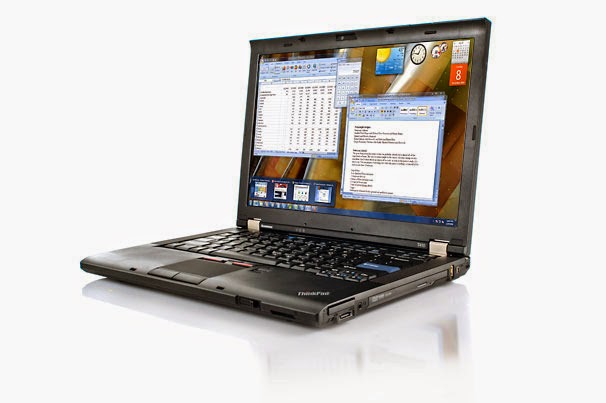
This model has everything I would need. It can hook up to the Internet wirelessly, it has 3 USB ports (need one for the KX3, one for a mouse, and one for an external keyboard), provisions for adding a second VGA monitor and the standard audio ports, so I can do the digital modes, should I ever be inclined to go down that road. Not planning to go there, but you never know. I'll have to dip into savings to acquire one, but having a computer in the shack has almost become a necessity.
Of course, I could always go native and log strictly with paper and pencil, but I don't think the ARRL would accept mailed in Xerox copies of my log for LoTW. Also, I like to keep my eye on QRPSPOTS as well as SOTAWatcher. Can't do that without some kind of computer, although I guess I could always just use my cell phone for those. And having a Telnet DX Cluster at my disposal for confirming that I correctly copied the call of that DX station who was sending at a blistering 45 WPM is a nice thing to have, too. (Was that an "H", or a "5" ? - 37 years of Hamming and my ears still wig out on those two, at times.)
This is another occasion where I'll just have to bite the bullet and take the plunge. Good thing I wasn't planning on going to Dayton.
Oh, and by the way, as long as I mentioned Dayton .... best wishes to all those heading to Ohio for FDIM and Hamvention. May the weather be good, the traffic light and travelling conditions safe - there and back!
72 de Larry W2LJ
QRP - When you care to send the very least!
Possibilities
It's sunny and the sky is a brilliant blue and there are no clouds. The high temperature for the day is expected to reach around 80F (27C). The SSN is currently at 110 and while the A index is slightly high, the K index is only "1".
I am hoping this makes for good band conditions during lunchtime today. Hopefully, I'll jump on somewhere around 1745 UTC for about an hour.
Amateur Radio is so much like fishing. The possibilities abound, and you rarely know what you're going to get. I don't get how anyone could not like this hobby. Even when I get skunked, I may be disappointed, but I never have a bad time.
To turn a phrase, "A bad day at Amateur Radio is better than a good day at ...... (you fill in the blank)".
I'll update this later to let you know how it went.
Lunchtime Post Mortem:
The weather was indeed beautiful, the band conditions were "meh". Signals were non-existent on 10 and 12 Meters, sparse on 15 Meters and most plentiful on 17 Meters (which has become a favorite band).
I worked YN5SU in Nicaragua and OT4A in Belgium, and that was it. I called CQ for a bit and had no takers. But I was getting out, according to RBN:
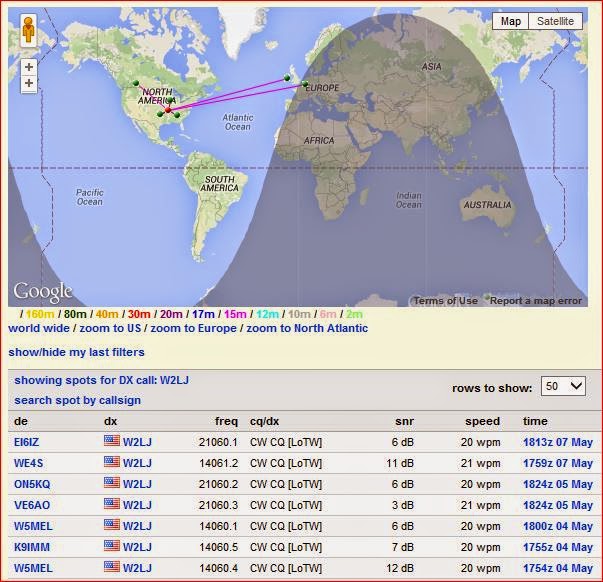
I have no idea, however, why RBN has my location as somewhere in the vicinity of Missouri.
72 de Larry W2LJ
QRP - When you care to send the very least!
I am hoping this makes for good band conditions during lunchtime today. Hopefully, I'll jump on somewhere around 1745 UTC for about an hour.
Amateur Radio is so much like fishing. The possibilities abound, and you rarely know what you're going to get. I don't get how anyone could not like this hobby. Even when I get skunked, I may be disappointed, but I never have a bad time.
To turn a phrase, "A bad day at Amateur Radio is better than a good day at ...... (you fill in the blank)".
I'll update this later to let you know how it went.
Lunchtime Post Mortem:
The weather was indeed beautiful, the band conditions were "meh". Signals were non-existent on 10 and 12 Meters, sparse on 15 Meters and most plentiful on 17 Meters (which has become a favorite band).
I worked YN5SU in Nicaragua and OT4A in Belgium, and that was it. I called CQ for a bit and had no takers. But I was getting out, according to RBN:
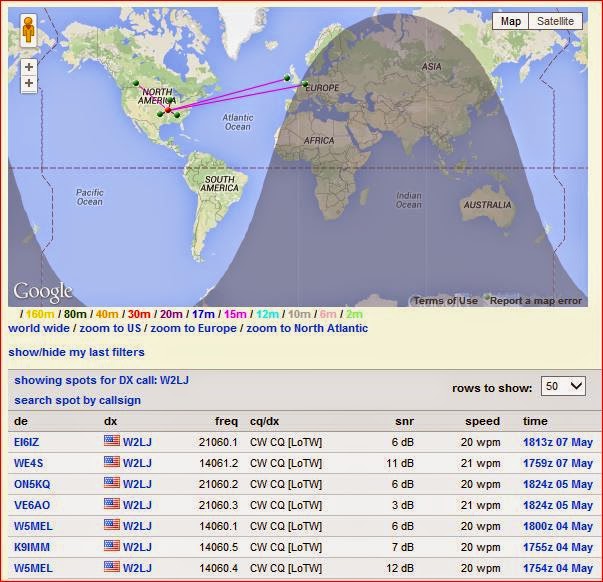
I have no idea, however, why RBN has my location as somewhere in the vicinity of Missouri.
72 de Larry W2LJ
QRP - When you care to send the very least!
Hams doing what they do best
These articles are from the ARRL Website:
4/27/2015
As the death toll climbs in the wake of the devastating magnitude 7.9 earthquake in Nepal, rescue and recovery work is continuing, and Amateur Radio volunteers have been a part of it. The earthquake — said to be the worst in Nepal in 80 years — hit an area between the capital city of Kathmandu and the city of Pokhara. An emergency net had been running around the clock on 20 meters with Jayu Bhide, VU2JAU, as net control station and other stations in India participating. Bhide is the Amateur Radio Society of India National Coordinator for Disaster Communication.
The Nepal disaster has claimed more than 3200 lives and wreaked widespread damage. Many others are missing or have been injured. Hospitals have been flooded with those who suffered serious injuries in the earthquake. Persistent aftershocks continue to terrorize those who managed to escape harm. On Mount Everest an avalanche devastated base camp, and at least 100 climbers were stranded on the mountain. Several mountaineers were reported among the dead.
Hams in India have been among the most active responders. Parts of eastern India also suffered earthquake damage. Within Nepal, members of the Nepal Amateur Radio Society are reported to be active on HF emergency nets as well as on VHF/UHF to handle local traffic.
“The situation in Nepal is getting worse, as tremors continue to strike every hour at a magnitude of 4.7,” Bhide said. The government of Nepal has asked all people to stay out of buildings, as damage is expected to increase. Due to the conditions, emergency communication with 9N1 stations came to a standstill; no communication was possible overnight as the earthquake demolished the building where emergency communication gear was installed.”
He said Satish Kharel, 9N1AA, and his daughter Tej, 9N1DX, were able to return to the air this morning. Both are in Kathmandu. 9N1AA has said he’s operating low power with the help of solar power and coordinating with the Nepal police in Kathmandu. Suresh Upreti, 9N1HA, has been assisting with emergency communication as well. Internet service has been spotty in Nepal at best. So far, there has been no cross-border movement of either radio equipment and radio amateurs.
Sanjeeb Panday, 9N1SP, has indicated that he will be on 21.360 MHz at 1645 UTC, and radio amateurs not involved in the disaster response should avoid this frequency. 9N1SP has intermittent Internet service. He has said that propagation on 20 meters, where an initial emergency net was established was poor, but he has been in contact on 15 meters with Tim McFadden, KB2RLB/T6TM, a Military Auxiliary Radio System (MARS) member in Afghanistan.
Ironically, McFadden, Kharel, Panday, and others took part in MARS exercises in 2013 and 2014 in which the emergency scenario was an earthquake in Nepal. Army MARS Program Officer Paul English, WD8DBY, said the response to this earthquake followed the procedures trained during those earlier exercises. McFadden had been scanning International Amateur Radio Union (IARU) Global Emergency Center of Activity (GECOA) frequencies for stations in Nepal. GECOA frequencies were established as places to pass emergency traffic. Worldwide GECOA frequencies are 21.360 MHz, 18.160 MHz, 14.300 MHz, 7.240 MHz, 7.060 MHz, 3.985 MHz, and 3.750 MHz.
Nepal’s first Amateur Radio repeater, set up in 2012 by the National Society for Earthquake Technology (NSET), and at least a dozen ham in various locations were reported on VHF. The 9N1KS repeater (434.500 MHz in/145.000 MHz out) is on the NSET headquarters building on the outskirts of Kathmandu. A drill conducted in 2012 indicated good coverage of the Kathmandu Valley.
The US chapter of the Computer Association of Nepal provided technical and financial assistance for the repeater and supplied equipment to use it. The repeater has a battery back-up power source.
The NGO “Humanity Road” is maintaining an updated summary of damage as well as of immediate needs.
“Hams from India and other countries have set an example to provide essential communication during disasters,” Bhida said. “The coordination and cooperation have also demonstrated [there is] one world, one language.” — Thanks to Jayu Bhide, VU2JAU; Jim Linton, VK3PC; Tim McFadden, T6TM; Lloyd Colston, KC5FM; US Army MARS, and others
 AND:
AND:
04/28/2015
Hams in Nepal, already in limited supply, continue to turn out to aid in the ongoing recovery from the April 25 earthquake that struck the Himalayan nation. Radio amateurs in neighboring India are also pitching in, and at least two groups of hams from Gujarat, India, are planning to travel to Nepal and set up stations “at critical places,” said Amateur Radio Society of India (ARSI) National Disaster Coordinator Jayu Bhide, VU2JAU. He is planning to set up HF and VHF stations at Gorakhpur, on the India-Nepal border. Joining him will be Ananda Majumdar, VU2AGJ, and Sandip Baruah, VU2MUE.
"Nepal hams are facing a hard situation,” said Bhide, who has been among the net control stations for an HF net initiated in the wake of the disaster.
The Indian hams traveling to Nepal may not be permitted to operate once they arrive, however. In an e-mail to members, ARSI President Gopal Madhavan, VU2GMN, said that Satish Kharel, 9N1AA, confirmed that “individual operators from other countries are not permitted to operate in Nepal, even during the emergency, unless they are part of a government team.” Madhavan said he was issuing the alert for the benefit of anyone planning to cross into Nepal from India and operate there.
Bhide said more Nepalese hams not formerly involved with the disaster response have since joined their Amateur Radio colleagues to volunteer communication support.
One major effort on the part of rescue teams is attempting to locate the missing, as well as to recover quake victims buried beneath debris. More than 4000 people died as a result of the earthquake and subsequent aftershocks. The disaster also has stranded many people, as roads were cut off by landslides and damage.
Earlier today, Sanjeeb Panday, 9N1SP, received support from three other Nepalese Amateur Radio operators — Ajay Bhattarai, 9N1AJ; Aayush Kumar Chaudhary, 9N1AY, and Sudarshan Sharma, 9N1SH. “Dr Sanjeeb and his team continue to operate HF radio out of a local University in Kathmandu, according to a report forwarded to ARRL by Army MARS Director of Operations Paul English, WD8DBY. “Dr Panday and his team were able to send HF radio slow-scan images of the disaster via Amateur Radio to the Army MARS operator in Afghanistan,” English said. The images subsequently were posted to the US Pacific Command response coordination portal, APAN. Tim McFadden, KB2RLB/T6TM, a Military Auxiliary Radio System (MARS) member in Afghanistan, has been monitoring the emergency traffic. Ironically, McFadden, Kharel, Panday, and others took part in MARS exercises in 2013 and 2014 in which the emergency scenario was an earthquake in Nepal. English said the response to this earthquake followed the procedures used for training during those earlier exercises.
The earthquake — said to be the worst in Nepal in 80 years — hit an area between the capital city of Kathmandu and the city of Pokhara. An emergency net has been running around the clock on HF. Members of the Nepal Amateur Radio Society were reported to be active on HF emergency nets as well as on VHF/UHF to handle local traffic.
And then there's this from the Free Press Journal:
Another case of Amateur Radio coming into significance "When All Else Fails". If you're not familiar with formal message handling, at the very least, I would advise listening to one of your local VHF/UHF traffic nets. Become familiar with the procedures and formats used for passing third party traffic. The experience you gain via NTS would become very handy should you ever find yourself in a bona fide emergency communications event. Inquire with your local municipal governing body to find out if there's a CERT team set up in your town. If not, perhaps you can meet with the local Director of Emergency Management and discuss the possibility of starting one up.
It's better to be prepared and not needed than to be needed and not be prepared, and not knowing what to do.
72 de Larry W2LJ
QRP - When you care to send the very least!
4/27/2015
As the death toll climbs in the wake of the devastating magnitude 7.9 earthquake in Nepal, rescue and recovery work is continuing, and Amateur Radio volunteers have been a part of it. The earthquake — said to be the worst in Nepal in 80 years — hit an area between the capital city of Kathmandu and the city of Pokhara. An emergency net had been running around the clock on 20 meters with Jayu Bhide, VU2JAU, as net control station and other stations in India participating. Bhide is the Amateur Radio Society of India National Coordinator for Disaster Communication.
The Nepal disaster has claimed more than 3200 lives and wreaked widespread damage. Many others are missing or have been injured. Hospitals have been flooded with those who suffered serious injuries in the earthquake. Persistent aftershocks continue to terrorize those who managed to escape harm. On Mount Everest an avalanche devastated base camp, and at least 100 climbers were stranded on the mountain. Several mountaineers were reported among the dead.
Hams in India have been among the most active responders. Parts of eastern India also suffered earthquake damage. Within Nepal, members of the Nepal Amateur Radio Society are reported to be active on HF emergency nets as well as on VHF/UHF to handle local traffic.
“The situation in Nepal is getting worse, as tremors continue to strike every hour at a magnitude of 4.7,” Bhide said. The government of Nepal has asked all people to stay out of buildings, as damage is expected to increase. Due to the conditions, emergency communication with 9N1 stations came to a standstill; no communication was possible overnight as the earthquake demolished the building where emergency communication gear was installed.”
He said Satish Kharel, 9N1AA, and his daughter Tej, 9N1DX, were able to return to the air this morning. Both are in Kathmandu. 9N1AA has said he’s operating low power with the help of solar power and coordinating with the Nepal police in Kathmandu. Suresh Upreti, 9N1HA, has been assisting with emergency communication as well. Internet service has been spotty in Nepal at best. So far, there has been no cross-border movement of either radio equipment and radio amateurs.
Sanjeeb Panday, 9N1SP, has indicated that he will be on 21.360 MHz at 1645 UTC, and radio amateurs not involved in the disaster response should avoid this frequency. 9N1SP has intermittent Internet service. He has said that propagation on 20 meters, where an initial emergency net was established was poor, but he has been in contact on 15 meters with Tim McFadden, KB2RLB/T6TM, a Military Auxiliary Radio System (MARS) member in Afghanistan.
Ironically, McFadden, Kharel, Panday, and others took part in MARS exercises in 2013 and 2014 in which the emergency scenario was an earthquake in Nepal. Army MARS Program Officer Paul English, WD8DBY, said the response to this earthquake followed the procedures trained during those earlier exercises. McFadden had been scanning International Amateur Radio Union (IARU) Global Emergency Center of Activity (GECOA) frequencies for stations in Nepal. GECOA frequencies were established as places to pass emergency traffic. Worldwide GECOA frequencies are 21.360 MHz, 18.160 MHz, 14.300 MHz, 7.240 MHz, 7.060 MHz, 3.985 MHz, and 3.750 MHz.
Nepal’s first Amateur Radio repeater, set up in 2012 by the National Society for Earthquake Technology (NSET), and at least a dozen ham in various locations were reported on VHF. The 9N1KS repeater (434.500 MHz in/145.000 MHz out) is on the NSET headquarters building on the outskirts of Kathmandu. A drill conducted in 2012 indicated good coverage of the Kathmandu Valley.
The US chapter of the Computer Association of Nepal provided technical and financial assistance for the repeater and supplied equipment to use it. The repeater has a battery back-up power source.
The NGO “Humanity Road” is maintaining an updated summary of damage as well as of immediate needs.
“Hams from India and other countries have set an example to provide essential communication during disasters,” Bhida said. “The coordination and cooperation have also demonstrated [there is] one world, one language.” — Thanks to Jayu Bhide, VU2JAU; Jim Linton, VK3PC; Tim McFadden, T6TM; Lloyd Colston, KC5FM; US Army MARS, and others
04/28/2015
Hams in Nepal, already in limited supply, continue to turn out to aid in the ongoing recovery from the April 25 earthquake that struck the Himalayan nation. Radio amateurs in neighboring India are also pitching in, and at least two groups of hams from Gujarat, India, are planning to travel to Nepal and set up stations “at critical places,” said Amateur Radio Society of India (ARSI) National Disaster Coordinator Jayu Bhide, VU2JAU. He is planning to set up HF and VHF stations at Gorakhpur, on the India-Nepal border. Joining him will be Ananda Majumdar, VU2AGJ, and Sandip Baruah, VU2MUE.
"Nepal hams are facing a hard situation,” said Bhide, who has been among the net control stations for an HF net initiated in the wake of the disaster.
The Indian hams traveling to Nepal may not be permitted to operate once they arrive, however. In an e-mail to members, ARSI President Gopal Madhavan, VU2GMN, said that Satish Kharel, 9N1AA, confirmed that “individual operators from other countries are not permitted to operate in Nepal, even during the emergency, unless they are part of a government team.” Madhavan said he was issuing the alert for the benefit of anyone planning to cross into Nepal from India and operate there.
Bhide said more Nepalese hams not formerly involved with the disaster response have since joined their Amateur Radio colleagues to volunteer communication support.
One major effort on the part of rescue teams is attempting to locate the missing, as well as to recover quake victims buried beneath debris. More than 4000 people died as a result of the earthquake and subsequent aftershocks. The disaster also has stranded many people, as roads were cut off by landslides and damage.
Earlier today, Sanjeeb Panday, 9N1SP, received support from three other Nepalese Amateur Radio operators — Ajay Bhattarai, 9N1AJ; Aayush Kumar Chaudhary, 9N1AY, and Sudarshan Sharma, 9N1SH. “Dr Sanjeeb and his team continue to operate HF radio out of a local University in Kathmandu, according to a report forwarded to ARRL by Army MARS Director of Operations Paul English, WD8DBY. “Dr Panday and his team were able to send HF radio slow-scan images of the disaster via Amateur Radio to the Army MARS operator in Afghanistan,” English said. The images subsequently were posted to the US Pacific Command response coordination portal, APAN. Tim McFadden, KB2RLB/T6TM, a Military Auxiliary Radio System (MARS) member in Afghanistan, has been monitoring the emergency traffic. Ironically, McFadden, Kharel, Panday, and others took part in MARS exercises in 2013 and 2014 in which the emergency scenario was an earthquake in Nepal. English said the response to this earthquake followed the procedures used for training during those earlier exercises.
The earthquake — said to be the worst in Nepal in 80 years — hit an area between the capital city of Kathmandu and the city of Pokhara. An emergency net has been running around the clock on HF. Members of the Nepal Amateur Radio Society were reported to be active on HF emergency nets as well as on VHF/UHF to handle local traffic.
And then there's this from the Free Press Journal:
307 from Maha rescued
— By | Apr 29, 2015 12:01 amMumbai : After the conventional mode of communication like mobile and telephone systems broke down in Nepal, the state Disaster Management cell has dusted off their HAM radio sets, a 19th century communication device which is famous for its long range and network.
Additional Resident Commissioner, Maharashtra Sadan, Samir Sahai said, “Rescue operation has been hampered due to bad weather. I was informed by the MEA (Ministry of External Affairs) that due to bad weather choppers could not operate in the hilly area to airlift people from remote areas. So far 307 people from Maharashtra have been rescued.”
After the request from the state government, a few amateur HAM radio operators in the city had rendered their skills in the time of distress to set up communication centers. A team of 15 HAM operators of Disaster Amateur Radio Emergency Service (DARES) joined Disaster Management cell of state and started an operation center.
Ankur Puranik, a businessman and an amateur HAM radio operator who is voluntarily working for state disaster said, “Since yesterday (Monday) 12 HAM operators surfaced in Nepal. We are exchanging messages like their demands and supply, stock of medicines particularly TT injections, antibiotics and messages to family members.”
Puranik added, “Phone lines are already damaged in Nepal. It is raining and there are heavy winds so mobiles do not have range. However, our operations are going on with some atmospheric disturbance.”
According to state government records, so far 307 tourist residents of Maharashtra have been rescued and landed in Delhi. Provision of accommodation is being made at Maharashtra Sadan and also transport provisions to their hometown are being made.
While talking to FPJ, State Disaster Management Cell Director Suhas Divase said, “We are in touch with National Disaster Management Chief Major General Anurag Gupta. We are also constantly monitoring stock of medicines, skilled manpower and other material.” He added, “The state had already sent a stock of antibiotic medicines, TT injections, bandage, hand gloves and other medicines.”
Vishnudas Sheshrao
-----------------------------------------------------------------------------
Another case of Amateur Radio coming into significance "When All Else Fails". If you're not familiar with formal message handling, at the very least, I would advise listening to one of your local VHF/UHF traffic nets. Become familiar with the procedures and formats used for passing third party traffic. The experience you gain via NTS would become very handy should you ever find yourself in a bona fide emergency communications event. Inquire with your local municipal governing body to find out if there's a CERT team set up in your town. If not, perhaps you can meet with the local Director of Emergency Management and discuss the possibility of starting one up.
It's better to be prepared and not needed than to be needed and not be prepared, and not knowing what to do.
72 de Larry W2LJ
QRP - When you care to send the very least!
Happy Morse Code Day!
Today is Morse Code Day, which of course, is celebrated on the birthday of Samuel FB Morse.

Does this make Samuel the original "Old Man"? Sorry Mr. Maxim*, I think Mr. Morse has seniority on you for that title, as Mr. Morse would be celebrating his 224th birthday today, were he of the kin of Methuselah.
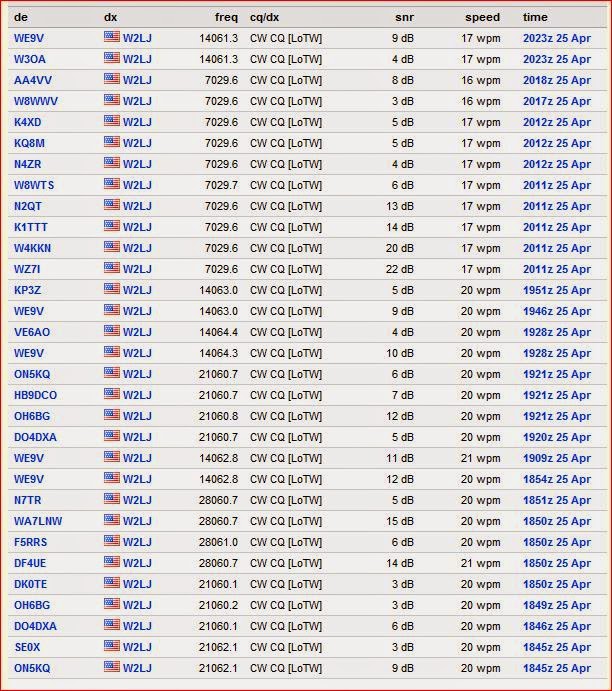
Now that QRPTTF is over, except for e-mailing in my log summary, I thought I'd post where my signal was being heard on Saturday, according to the Reverse Beacon Network.
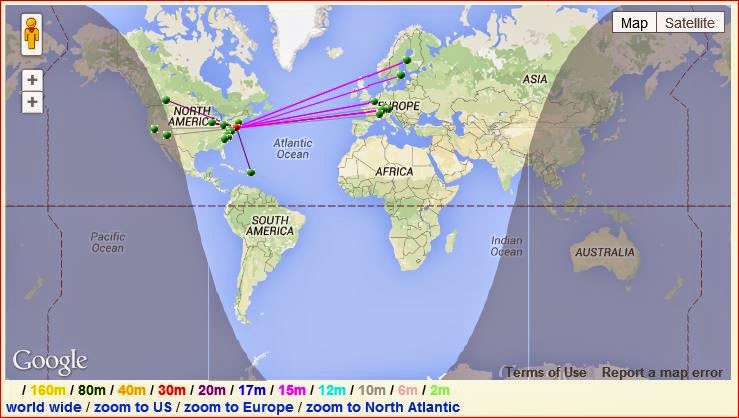
Bob W3BBO and I were discussing QRPTTF yesterday amongst ourselves, and it occurred to both of us that the western half of the nation seems to have reported larger QSO totals than the eastern half of the nation. This based on e-mails sent to QRP-L that we had read. Not sure what that means, but so far I haven't seen many e-mails from anyone east of the Mississippi with log summaries of around 40 QSOs or so. It will be interesting to see how it breaks down geographically once the results are in.
The EARCHI does get heard, and being on the top of a high hill (we call those mountains, here in NJ) sure makes a difference. And this makes for the other important lesson I've learned from events such as these. As nice as it would be to come in 1st place in a contest such as QRPTTF, the real prize won is enjoying a day outdoors, playing radio in the fresh air and sunshine, being able to forget about everyday worries, cares and concerns, even if it's just for a couple hours.
72 de Larry W2LJ
QRP - When you care to send the very least!
* - For those of you who are new to the Ham radio game, Hiram Percy Maxim who founded the ARRL, often wrote editorials under the pseudonym "The Old Man". Since HPM lived from 1869 - 1936. I guess that makes Mr. Morse the rightful holder of "The Old Man" title.
Does this make Samuel the original "Old Man"? Sorry Mr. Maxim*, I think Mr. Morse has seniority on you for that title, as Mr. Morse would be celebrating his 224th birthday today, were he of the kin of Methuselah.
Now that QRPTTF is over, except for e-mailing in my log summary, I thought I'd post where my signal was being heard on Saturday, according to the Reverse Beacon Network.
Even though I didn't make any contacts on 15 Meters, it appears my signal was leaping over The Pond. Not the loudest, but still making it. Here's as much of the table was I was able to snip.
Bob W3BBO and I were discussing QRPTTF yesterday amongst ourselves, and it occurred to both of us that the western half of the nation seems to have reported larger QSO totals than the eastern half of the nation. This based on e-mails sent to QRP-L that we had read. Not sure what that means, but so far I haven't seen many e-mails from anyone east of the Mississippi with log summaries of around 40 QSOs or so. It will be interesting to see how it breaks down geographically once the results are in.
The EARCHI does get heard, and being on the top of a high hill (we call those mountains, here in NJ) sure makes a difference. And this makes for the other important lesson I've learned from events such as these. As nice as it would be to come in 1st place in a contest such as QRPTTF, the real prize won is enjoying a day outdoors, playing radio in the fresh air and sunshine, being able to forget about everyday worries, cares and concerns, even if it's just for a couple hours.
72 de Larry W2LJ
QRP - When you care to send the very least!
* - For those of you who are new to the Ham radio game, Hiram Percy Maxim who founded the ARRL, often wrote editorials under the pseudonym "The Old Man". Since HPM lived from 1869 - 1936. I guess that makes Mr. Morse the rightful holder of "The Old Man" title.













