Author Archive
 K0NR June VHF Contest 2013
 May 24th, 2014 |
  Author:
 My award certificate for the 2013 ARRL June VHF Contest arrived in the mail this past week. The new VHF contest certificates look great, don’t you think? Nice job, ARRL! Similar to other years, I operated from the family cabin at 9600 feet elevation in DM78 near Trout Creek Pass with temporary antennas (see my previous blog posting.) I knew that I scored OK in the contest but I’ve had higher scores in the past. The June VHF results article is a good summary of the national activity.

This was the first year for the Single Operator Three Band category, defined as operating on 50 MHz (100W limit), 144 MHz (100W limit) and 432 MHz (50W limit). I found this category to be very attractive because my interests are focused on VHF and not the higher bands. Often, I’ll just run 6m and 2m during VHF contests but with the three-band category it was not a big stretch to add in 70cm. The scoring system for the normal single operator categories provides a large incentive to operate on 1.2 GHz and higher, which makes it more difficult for a “VHF only” station to win in those categories. Some guys like the challenge of operating more bands and pushing the limits of going higher in frequency. I totally get that, so more power to them…it is just not that interesting to me.
It was not a big surprise that I took first place in Colorado and the Rocky Mountain Division because there were only a handful of entries in my category. I was pleased to place third in the overall contest. I expect that competition in this category will get more intense as other single-op stations realize they can win in this category. But limited to three bands and 100W, this competition will be more about propagation and operator skill, and less about deploying lots of gear.
The 2014 June VHF Contest is just around the corner (June 14-15), so time to get the station ready!
73, Bob K0NR
SSB Makes the Difference on Prospect Mountain
Spring is finally making an appearance in the Rocky Mountain region which means it is time to get on top of some SOTA peaks and transmit some RF energy. On Saturday, Joyce K0JJW and I had planned to drive through the Big Thompson Canyon to Estes Park and also sneak in a quick SOTA activation. Matt K0MOS suggested a few peaks and we chose Prospect Mountain (W0C/FR-069) just south of Estes Park. See Matt’s trip report for a good overview of the hike.
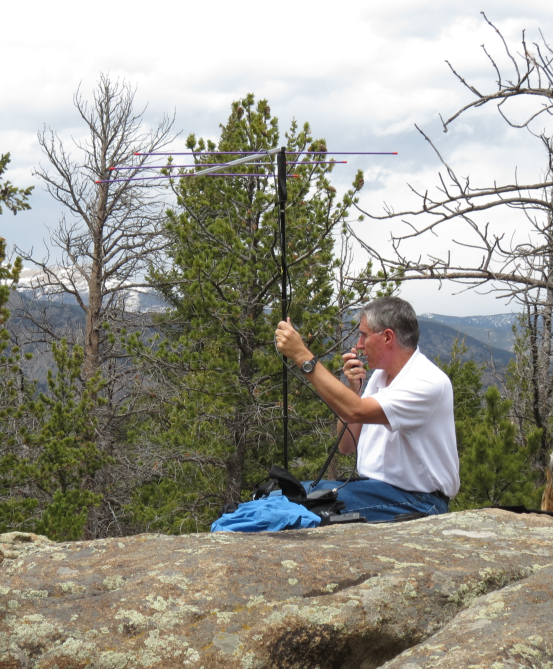
For a low hassle SOTA activation, I usually just take my Yaesu FT-60 handheld radio and operate 2m FM. Most of the VHF activity is on FM anyway and I usually rustle up some SOTA contacts that way. On this trip, I also brought along my Yaesu FT-817 so that I could operate 2m ssb, to provide better weak signal options. For SSB operation, my 3-element Arrow yagi antenna was mounted on my walking stick for easier pointing, with horizontal polarization.
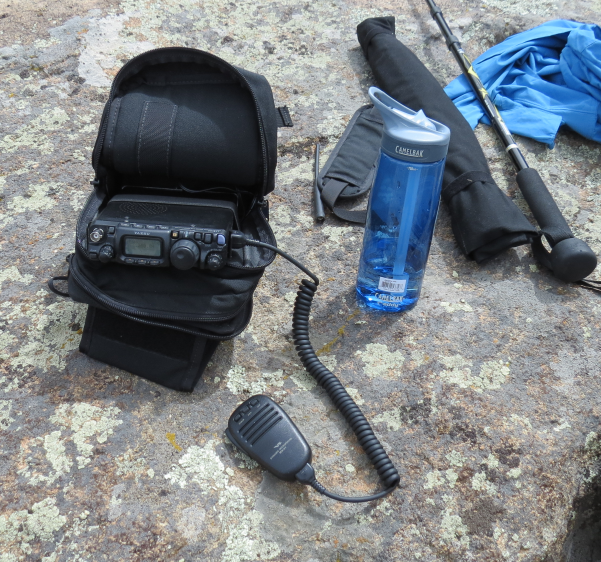 The above photo shows the FT-817 in its Sitting-On-A-Big-Rock operating position, using the AMP-3 carrying case with lead-acid battery inside.
I had arranged a sked with Stu W0STU who was located ~100 miles away with a group of Scouts at Peaceful Valley Scout Ranch. There wasn’t a solid radio path between our two locations, so I wasn’t sure if we’d make it or not. I did not think we could make the contact on FM but the efficiency of SSB should do better. He had a small yagi pointed in my direction driven by an FT-857 transceiver but we tried working on 144.200 MHz SSB without any success. Another station W6LEV near Loveland came up on the calling frequency so I worked him.
After working a few stations on 146.52 MHz using a half-wave whip on the FT-60, I decided to try to work W0STU one more time. I sent him a text message and confirmed that he was available. However, snow was moving into his location (welcome to spring) so he had dismantled his yagi antenna and only had a vertical antenna on his truck. I told him to give me a call on 144.200 SSB and I’d try to find him. I flipped my yagi to vertical polarization and pointed in his direction.
At first, I heard nothing but noise. I was about to give up when I rotated my antenna around to see if the signal peaked up in another direction. Sure enough, when pointed S/SW, I could hear Stu’s signal rise to just above my noise floor. His actual direction from me was SE, so we were probably getting a reflection off one of the mountains to the south. My signal was right at his noise floor, so we just barely completed a contact. Without the weak-signal performance of SSB and the gain of the yagi antenna, I am sure we would have never completed the contact. Another lesson is that it pays to point your antenna in different directions, since you don’t always know what the best propagation path will be.
Another fun day messing around with ham radio.
73, Bob K0NR
This Spewed Out of the Internet #27
 More important things spewing forth from the interwebz:
The Ham Hijinks guys have been at it again, with this article: New Drug Aims To Get More Hams On The Air
Warning: Do Not Take These Guys Seriously, It Only Encourages Them
Chiming in on April 1st, Dan KB6NU reported that the FCC is going to reinstate the Morse Code test.
I posted an article about using UTC over at HamRadioSchool.com: Does Anybody Really Know What Time It Is?
KB9VBR has a nice article that explains the common types of antenna connectors used with ham radio.
Elliot KB0RFC has been writing some interesting stuff about D-STAR, DMR and other things digital on his blog. See his latest article: Developing a DMR / D-STAR radio
James R. Winstead, KD5OZY, of Coleman, Texas found out that sometimes the FCC does show up and bust radio amateurs that are causing problems on the air. See the ARRL article here. It always cracks me up when the FCC Engineer reports that during their station inspection, the offender’s radio is still tuned to the frequency where the problems were occurring.
Serious DXers all over the world are in severe depression after finding out that Crimea is Not a New DXCC Entity. Conspiracy Theory: the whole thing was instigated by a group of hams that believed Crimea would be a new one.
73, Bob K0NR
The KP2 Slacker DXpedition Guide
I’ve had several opportunities to take amateur radio along on vacation and do a little radio operating from other countries. I try not to focus too much on ham radio during such a trip, as it has a tendency to create marital discord and can suck the fun out of the vacation. Some people call this a “holiday style” DXpedition, or maybe it’s just the slacker approach.
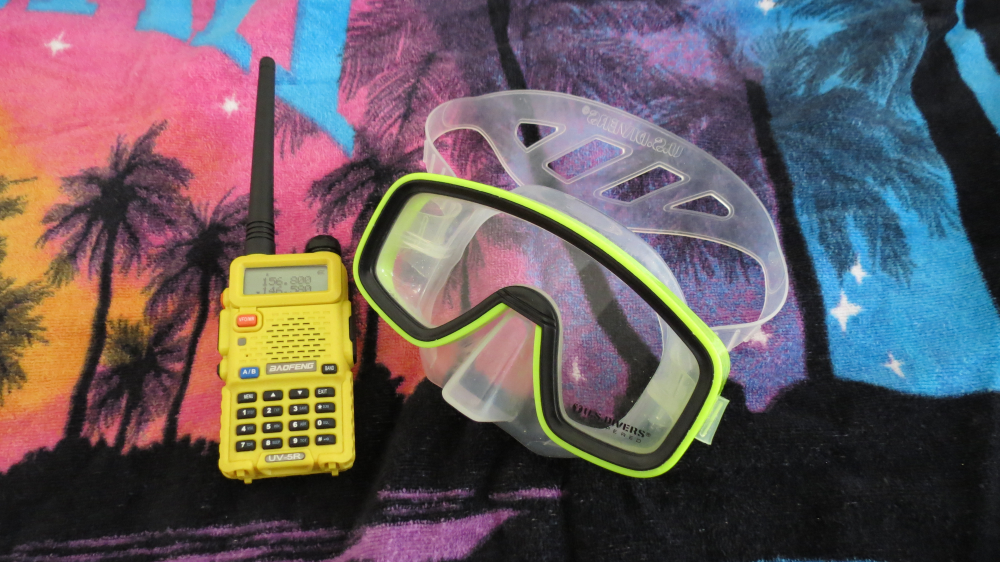
The marine yellow Baofeng UV-5R handheld transceiver got a lot of use.
St John USVI
Joyce (K0JJW) and I were planning a vacation with three other couples that we’ve known for years. It turns out that six of the eight have their ham licenses. (We’re still working on the last two.) Our primary goal was to find an island location with great beaches and snorkeling. Someone proposed the island of St John in the US Virgin Islands and the idea took hold.
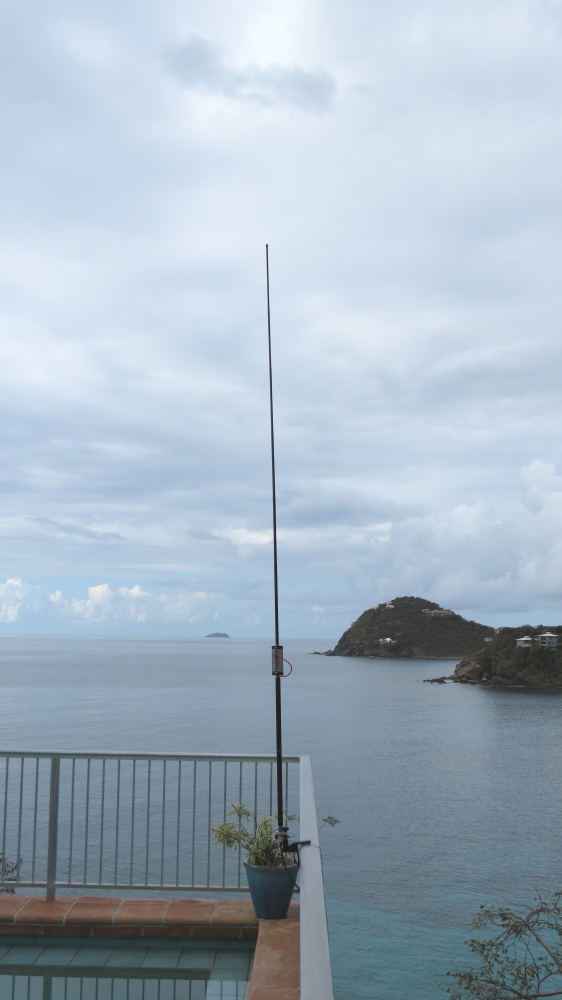
The Buddistick antenna is mounted on the railing of the patio, overlooking the sea.
From a ham radio perspective, USVI is an interesting choice since it does count as a DXCC entity (“country”), even though it is a US possession. See my article on HamRadioSchool.com for more information on how that works. Anyone with an FCC license can operate from there without any special licensing or approval. KP2 is the prefix for USVI, so identify as KP2/<callsign> to indicate that you are operating from USVI.
Radio Gear
We were trying to pack light, so the radio equipment had to fit into our normal luggage. I took my Yaesu FT-817 and a Buddistick™ antenna. Paul (KF9EY) took along a Yaesu FT-100D, while Denny (KB9DPF) transported his FT-817 and a G5RV Junior antenna. Our primary operating mode was using the FT-100D (more power, baby) to drive the Buddistick, which was attached to the railing on the patio.

The FT-100D was the primary operating rig, carefully placed on a random table out by the pool, with the St John Guidebook nearby.
I decided that the true slacker approach required some Official Beach QRP contacts in the style of Buddies in the Caribbean (see the video). One day on the beach, I took along my FT-817 and the Buddistick and set up for some QRP action.
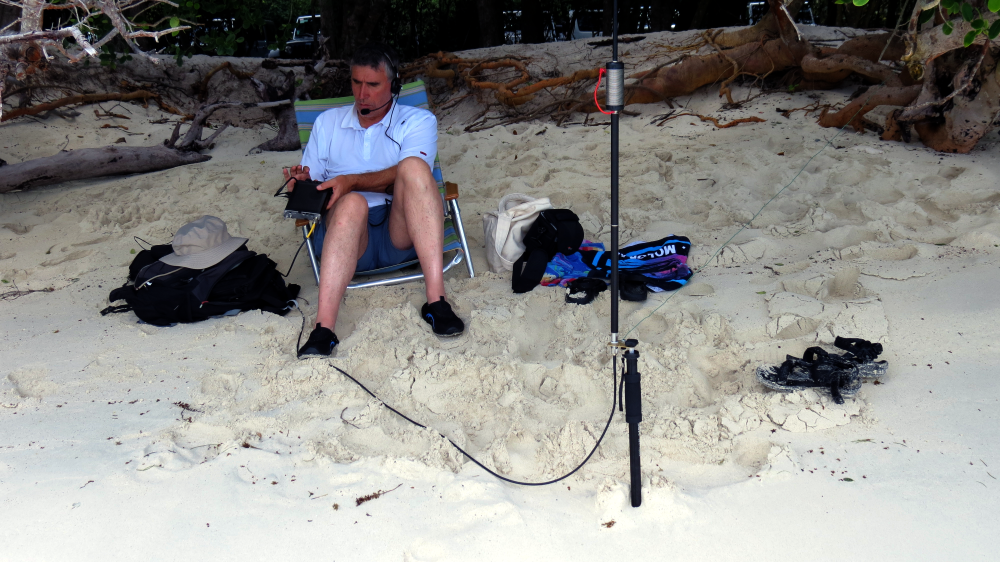
Some slacker beach operating (Bob K0NR).
The Buddistick was mounted on a Dolica WT-1003 camera monopod stuck into the sand, with the radial trailing off into the vegetation. My compact Heil headset was a convenient way to make some phone contacts without blasting my fellow beach bums with noisy audio.
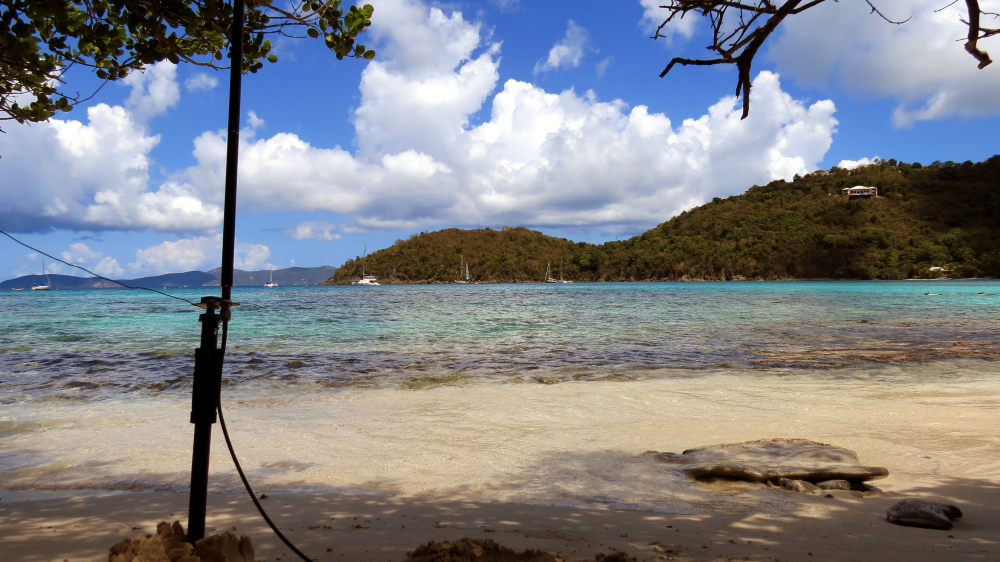
The view looking out from the beach operating location.
How did we do on the HF bands? We managed to make a number of contacts on 20m, 15m and 10m into the Americas and Europe. I was a bit disappointed that we never really got a pileup going. I think our signal was plenty strong but KP2 is maybe just not that rare.
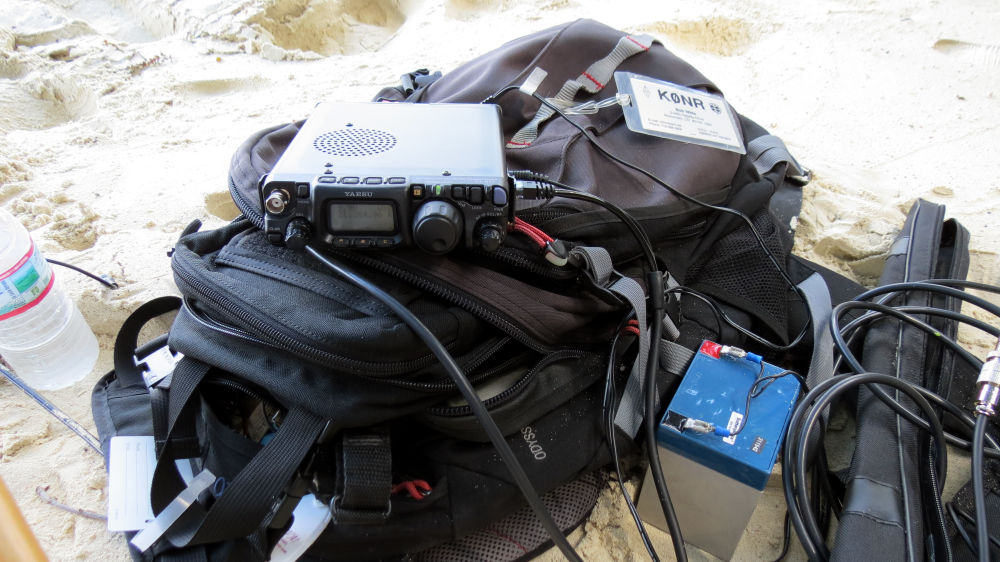
The innovative “plop the rig on top of a backpack” operating configuration.
We spent quite a bit of time exploring the island, driving around in two rental Jeeps. For mobile communications, we chatted back and forth on 146.58 MHz, the Golf-November-Tango frequency, using handheld transceivers. In the end, these radios probably got the most use during the trip. (Did I mention this was a slacker DXpedition?) There are a few 2m repeaters in the islands but we did not make use of them.
I brought a Yaesu FT-60 and a Baofeng UV-5R along on the trip, but mostly ended up using the Baofeng radio. If was the perfect radio to take to the beach — does the job and not that big of a loss if it landed in the ocean. Using the dual receive feature of the HT, I monitored the marine calling frequency, 156.80 MHz, listening to the boat traffic.
So if you are looking for a great place to go to enjoy the sand and water, I highly recommend St. John. Go ahead and take along some ham gear and do some slacker DXing. For more information on KP2 ham radio, see the ARRL Virgin Islands Section web site.
— 73, Bob KP2/K0NR
QSL to KP2/K0NR via Logbook of the World or to K0NR via Buro or Direct with SASE
Get Your Mobile Frequency Sticker On
One of the things I try to do is monitor the National Simplex Calling Frequency for 2 meter FM: 146.52 MHz, especially when mobile. It is fun to see who might show up on 2m simplex: SOTA operators, hikers, mobile stations, campers, etc. See these two posts on operating ideas: A Simple Wilderness Protocol: 146.52 MHz and The Use of 146.52 MHz.
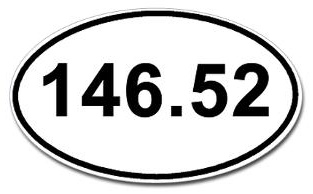 It is also fun to say hello to another ham when you pass them on the highway. While you may see their call letter license plates or notice their mobile antenna, you may not know what frequency they are monitoring. The Noise Blankers Radio Club has solved this problem — just put this sticker on your vehicle.
After poking around cafepress.com, I found some additional options for indicating your radio frequency:
The 2meter SSB calling frequency:
The APRS frequency:
And there’s this magnet for your refrigerator:
If you don’t like any of these, cafepress.com makes it easy to create your own. Go for it!
73, Bob K0NR
Bloody Proprietary Connectors
I came across this video rant by David L. Jones on the EEVblog concerning proprietary cables on consumer devices. I agree with him completely. Warning: some language not suitable for kids.
Unfortunately, if you look at ham radio gear, we are in even worse shape than the consumer market. Heck, even the freaking microphone connectors are unique to each manufacturer.
Colorado 14er Event – August 3, 2014
 During the Colorado 14er Event, Amateur Radio operators will be climbing many of Colorado’s 14,000-foot mountains and SOTA summits to set up amateur radio stations to communicate with other radio amateurs across the state and around the world. Join in on the fun on Sunday August 3 and see how many of the mountaintop stations you can contact.
The new Colorado 14er Event logo is now available on t-shirts and more.
Starting in 2012, Summits on The Air (SOTA) is part of this event. This means there are over 1700 summits that you can activate in Colorado, with a wide variety of hiking difficulty. This opens up the event to a lot more people and a lot more summits. See the new SOTA page.
Radio operators with 14er climbing experience who plan to activate a summit should log their name and intended peak at the Ham14er Yahoo group. This is also the email list for discussing the event and asking questions.













