Author Archive
 What’s Wrong With the ARRL?
 October 2nd, 2015 |
  Author:
 Every so often a blog posting takes on the topic of “the ARRL needs to change.” A recent one came from Dan KB6NU, referencing some worthwhile ideas he has encountered via Rotary International. (I like Dan’s blog and read it fairly consistently.) Whenever I see this kind of article, my brain immediately thinks:
The ARRL is the worst US national amateur radio organization, except when compared to all others.
Yeah, its easy to criticize the ARRL, but it is the only game in town in terms of a national organization. And they do a lot of good for amateur radio and probably don’t get sufficient credit for that. (I should point out that Dan is very clear that he just wants to see the ARRL improve, especially in attracting new hams. I believe him and I share that motivation.)
It is hard being the ARRL.
Amateur radio is not really one hobby, it is a collection of hobbies and activities. We’ve got CW-enthusiasts, QRP folks, Emcomm volunteers, HF contesters, VHF contesters, tinkerers, 75m AM operators, repeater operators and on and on and on. Because the ARRL is a member-driven organization, it tries to balance these competing interests. Just listen to the random-vector criticism that spews forth: the ARRL is too focused on QRP, doesn’t do enough for QRP, only cares about HF, doesn’t do enough for HF, is against new digital modes, is always promoting new digital modes, thinks CW is the only way to go, gave us the No Code license, hung on to the Morse Code requirement too long. This list goes on and on. It really is impossible to keep everyone happy.
Like every large organization that I belong to, the ARRL is not perfect. But the good it does clearly outweighs the stuff I don’t like, so I enthusiastically support it. Said another way, I get enough benefit out of the membership to justify the dues. The key benefits for me are: QST magazine, Logbook of the World, contests, awards and representation with the FCC. QST is clearly the biggest benefit of membership and many people just view the membership fee as a magazine subscription.
A huge threat to an organization with such a print franchise is the shift from print to new media (video, web, blogs, podcasts, social). The ARRL web site has a lot of good information and most of the bugs have been worked out of the major redesign of a few years ago. They have a basic presence on twitter and podcasts. The ARRL has a youtube channel but the content is weak. At the same time, other people are putting out some good video content. Look at what HamNation, HamRadioNow, HamRadioSchool.com are doing.
The ARRL is a long-lived institution and like most long-lived institutions they tend to be grounded in the past and are a bit old school in nature. Attracting newly licensed radio amateurs, especially Techs, is the big challenge for the ARRL. I don’t know what market research the ARRL does but I suggest they establish on on-going program that gets inside the heads of newer licensees and potential hams to understand how they view the ARRL. This requires an ongoing investment that is coupled to strategy. I’ve seen marketing pros do focus groups, interviews, surveys, etc. that bring customer needs to the surface so an organization can respond to changes that attract new customers members.
If you are an ARRL member, what can you do to change things? Your avenue to make your views known is via your Division Director, so I suggest you reach out to him or her. (Contact information is listed in the front of every QST.) Don’t be surprised if your voice is mixed in with a whole bunch of other people’s views…kind of like Congress 
If you are not a member and spend a substantial amount of time having fun messing around with radios, I encourage you to join the ARRL. You might like it.
That’s my view, what’s yours?
73, Bob K0NR
The post What’s Wrong With the ARRL? appeared first on The KØNR Radio Site.
You’ve Got Questions, We’ve Got Answers
 K3NG has performed an important public service by tabulating the answers to the top ten amateur radio questions swirling about the interwebz. This will save thousands of hours for hams searching for this critical information.
Unfortunately, he did not include the questions, so you will have to use your imagination on that. But its not difficult.
73, Bob K0NR
The post You’ve Got Questions, We’ve Got Answers appeared first on The KØNR Radio Site.
This Spewed Out of the Internet #31
 This is another update on important stuff spewing forth from the interwebz. It has been a while since I’ve done this, so we’ve got some catching up to do.
The KØNR Radio Site has expanded to Facebook. “Like” us there.
There is a statewide email list available to Colorado radio amateurs. Join us there to stay informed about regional events.
Grid locators are important for VHF/UHF operating. I came across this web site that does a good job of mapping the grids. I wrote a Shack Talk article over at HamRadioSchool.com that explains Simplex, Duplex, Offset and Split. Stu WØSTU posted a very helpful article explaing NVIS (Near Vertical Incidence Skywave) Antennas.
In June, Keysight Technologies donated some professional measurement software to the ARRL. Yeah, I had something to do with that.
From the Cheaters Gonna Cheat Department:
- CQ Magazine busts UT5UGR for padding his log in CQ WW contest
- The FCC fines David J. Tolassi, W4BHV, for failing to identify properly
- The FCC also went after Michael Guernsey, KZ8O, with a $22,000 fine. Ouch.
- The FCC also fined Daniel R. Hicks, KB8UYZ, for malicious interference to VHF repeaters.
The Ham Hijinks crew contributed some outstanding literary works to the ham radio community. Recently, they’ve latched onto the theme of hams using cheap radios to not make any contacts on VHF:
- Club Votes: Bob Should Buy New Radio
- No One, Anywhere, Having Good VHF QSOs
- Optimistic 6m DXer Ready for Opening of the Year
- New Ham Unsure If He Really Needs to Stand When Told To Stand By
Dodge uses Morse Code in one of their car commercials. Speaking of cars, check out Wired’s article: Hackers Remotely Kill a Jeep on the Highway.
Steve WGØAT created another SOTA video, this one with Clay NF1R on Mount Herman.
I heard this song by Phil Collins on a the radio recently and I’m convinced its about the heartbreak of trying to work a rare DXpedition. Give a listen.
And then there’s this…a very well done video about ham radio that has lots of people talking.
Well, that’s all for now.
73, Bob K0NR
The post This Spewed Out of the Internet #31 appeared first on The KØNR Radio Site.
Meet the Arc Fault Circuit Interrupter
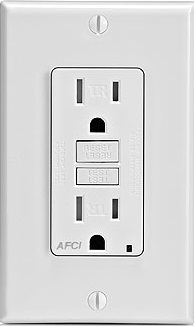 You are probably familiar with the Ground Fault Circuit Interrupter (GFCI), also called Ground Fault Interrupter (GFI), Residual-Current Device (RCD) and a few other names. While doing some electrical work for a family member, I discovered Arc Fault Circuit Interrupters (AFCIs) in the breaker box. Having a genuine Electrical Engineering degree (two, actually), I’d like to believe that I am reasonably up to date on basic house wiring. But somehow AFCIs had escaped my attention, even though they started appearing in the National Electric Code over 10 years ago.
A bit of searching on the internet revealed that these newfangled devices are intended to detect arc faults are below the trip level of a normal circuit breaker. Think in terms of a frayed extension cord that arcs over, creating a fire hazard, but not exceeding the 15 ampere rating of a typical house circuit. As usual, the Wikipedia entry is a good place to start. AFCIs detect arcs by monitoring the current behavior throughout the 60 Hz cycle. There are characteristics in the waveform that indicate an arc condition exists, causing the AFCI to disconnect the circuit. This article goes into more technical detail if you are interested:
New Technology for Preventing Residential Electrical Fires: Arc-Fault Circuit Interrupters (AFCIs)
Just like GFIs, AFCIs are available for installation in the main breaker panel and for installation at the electrical outlet. The diagram below shows the block diagram of a typical single-phase AFCI. This is not your old school circuit breaker but a complex system that performs both arc and ground fault detection. As already mentioned, the arc detection is performed by sensing the current behavior. The ground fault detection senses the difference between the current leaving and returning to the device. If there is a significant mismatch between the two currents, a ground fault has occurred.
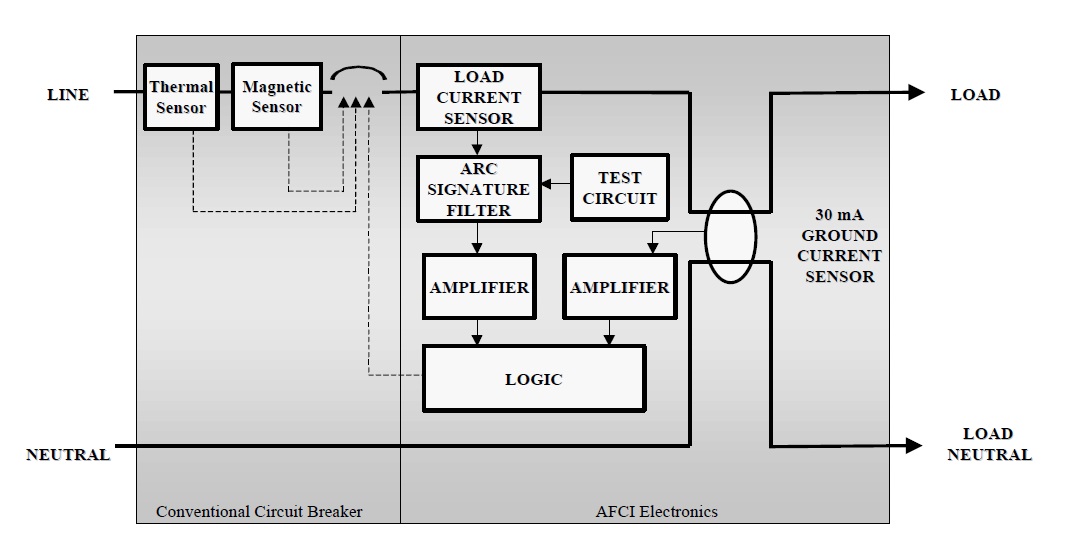
From “New Technology for Preventing Residential Electrical Fires: Arc-Fault Circuit Interrupters (AFCIs)”
This post is just a quick introduction to AFCIs, with a USA perspective. Your local building codes are now or will soon be requiring AFCIs on new construction, so you’ll probably encounter them sooner or later. The National Electrical Manufacturers Association has a website with additional information: www.afcisafety.org.
73, Bob K0NR
The post Meet the Arc Fault Circuit Interrupter appeared first on The KØNR Radio Site.
A Few New Ham Radio Podcasts
 Listening to podcasts has been part of my daily habit for almost a decade. I lean heavily towards audio podcasts (as opposed to video), so I can listen to them while driving. My smartphone is always loaded with hours of content on a variety of topics which is especially useful for international flights.
Podcasts come and go (or podfade) and recently I’ve noticed a few new ham radio podcasts. Well, they might not be all that new…perhaps I just woke up and noticed them. Anyway, I am passing them along in case you have not come across them.
The QSO Today Podcast by Eric 4Z1UG:
QSO Today is a weekly conversation between me, Eric Guth, 4Z1UG, and my amateur radio operator guest. Each guest tells his or her’s ham radio story to the present time. I select guests based on their contributions to the hobby through their publishing of articles and books on ham radio, their involvement in the creation of new technologies that enhance the hobby, and the role that they played to bring the amateur radio to others.
The Fo Time – The Other Ham Radio Podcast by Cale K4CDN:
It’s a new Podcast for the Up and Coming Amateur Radio Operator aka Ham Radio Operator. Whether you’re looking for the latest news, a different take on an idea, or just some good humor, Fo Time is the Podcast for you.
If you aren’t sure about the name, this might help.
The 100 Watts and a Wire by Christian KØSTH:
Created by Christian Cudnik, KØSTH in 2015, 100 Watts and a Wire is a program celebrating amateur radio through the eyes of a new ham. The show features topical conversation and interviews, news and an entertaining look at the adventures of a ham trying to figure it all out.
I’ve found all three of these podcasts to be well done and interesting. They all typically run about an hour long. Frankly, that’s a bit much for me, mostly because it does not fit my commute time. Not bad for an airplane ride, but too long for driving to work. More importantly, my smartphone is overflowing with interesting audio content, so I have to be selective.
Other Podcasts
I’ll mention a few other podcasts that deserve attention: The Ham Nation podcast has set a new standard for ham radio video podcasts. Hats off to Bob Heil and crew for their efforts. The Amateur Radio Newsline got its start by delivering audio programs via telephone for hams to play on their local repeater. Many repeaters still play their program but I get their feed via my smartphone. They continue to do an excellent job of stuffing interesting content into a 20-minute format. While not a ham radio podcast, This Week in Tech from TWiT remains a quality source of tech news and opinion (lots of opinion).
Give these podcasts a listen and let me know what you think.
73, Bob K0NR
The post A Few New Ham Radio Podcasts appeared first on The KØNR Radio Site.
Colorado 14er Event: Mount Antero (W0C/SR-003)
For the 2015 Colorado 14er Event, Joyce K0JJW and I activated Mount Antero (W0C/SR-003) on the 2m and 70 cm bands. Alan NM5S joined us on the summit, operating mostly HF plus some 2m fm.
We took our Jeep Wrangler up the moderate 4WD road and parked at 13,800 feet. This makes for a very manageable hike to the 14,269 foot summit. Of course, you can always choose to start the hike from lower on the mountain, but you’ll end up walking along the road. This web site provides a good overview of the 4WD road. The 14ers.com web site and summitpost.org are additional sources of summit info.
Here’s a short video of our operation on the summit.
Here’s the K0NR log on the 2m band, fm and ssb:
August 2, 2015 K0NR Log, time in UTC
15:09     144MHz     FM     K0JJW
15:13     144MHz     FM     W0CP
15:16     144MHz     FM     KC5JKU     Mt Elbert
15:17     144MHz     FM     KD0WHB     Grays Peak
15:21     144MHz     FM     N0XDW      Pikes Peak
15:37     144MHz     FM     KD5HGD     Mt Elbert
15:42     144MHz     FM     KD0MRC
15:42     144MHz     FM     KE0DMT
15:44     144MHz     FM     NQ0L       Franktown
15:45     144MHz     FM     KE0EUO     Mt Democrat
15:46     144MHz     FM     K7SO       Mt Democrat
15:50     144MHz     SSB    KD0YOB     W0C/PR-005
15:53     144MHz     SSB    W0BV       Buena Vista
15:53     144MHz     SSB    K0YV       Buena Vista
15:57     144MHz     SSB    W0STU      Monument
16:06     144MHz     FM     KD0WHB     Torreys
16:13     144MHz     FM     KI6YMZ     Mt Elbert
16:19     144MHz     FM     KE0EKT     Mt Elbert
16:29     144MHz     FM     WZ0N
16:29     144MHz     FM     KE0DAL
16:31     144MHz     FM     WO9S
16:33     144MHz     FM     K0UO
17:10     144MHz     FM     KD2FHB     Pikes Peak
It was a great day on the mountain with quite a few Summit-to-Summit (S2S) SOTA contacts. See you next year on a Colorado mountaintop!
73, Bob K0NR
The post Colorado 14er Event: Mount Antero (W0C/SR-003) appeared first on The KØNR Radio Site.
2014 September VHF Contest Certificate
The certificate for my entry in the 2014 ARRL September VHF Contest arrived in the mail last week. Given that it has been 11 months after the contest, I had pretty much forgotten about the effort. The ARRL VHF contest certificates look great, even if they do take a while to get issued. It turns out this contest entry was the combination VHF contest plus Summits On The Air (SOTA) activation from Mt Herman that I blogged about.
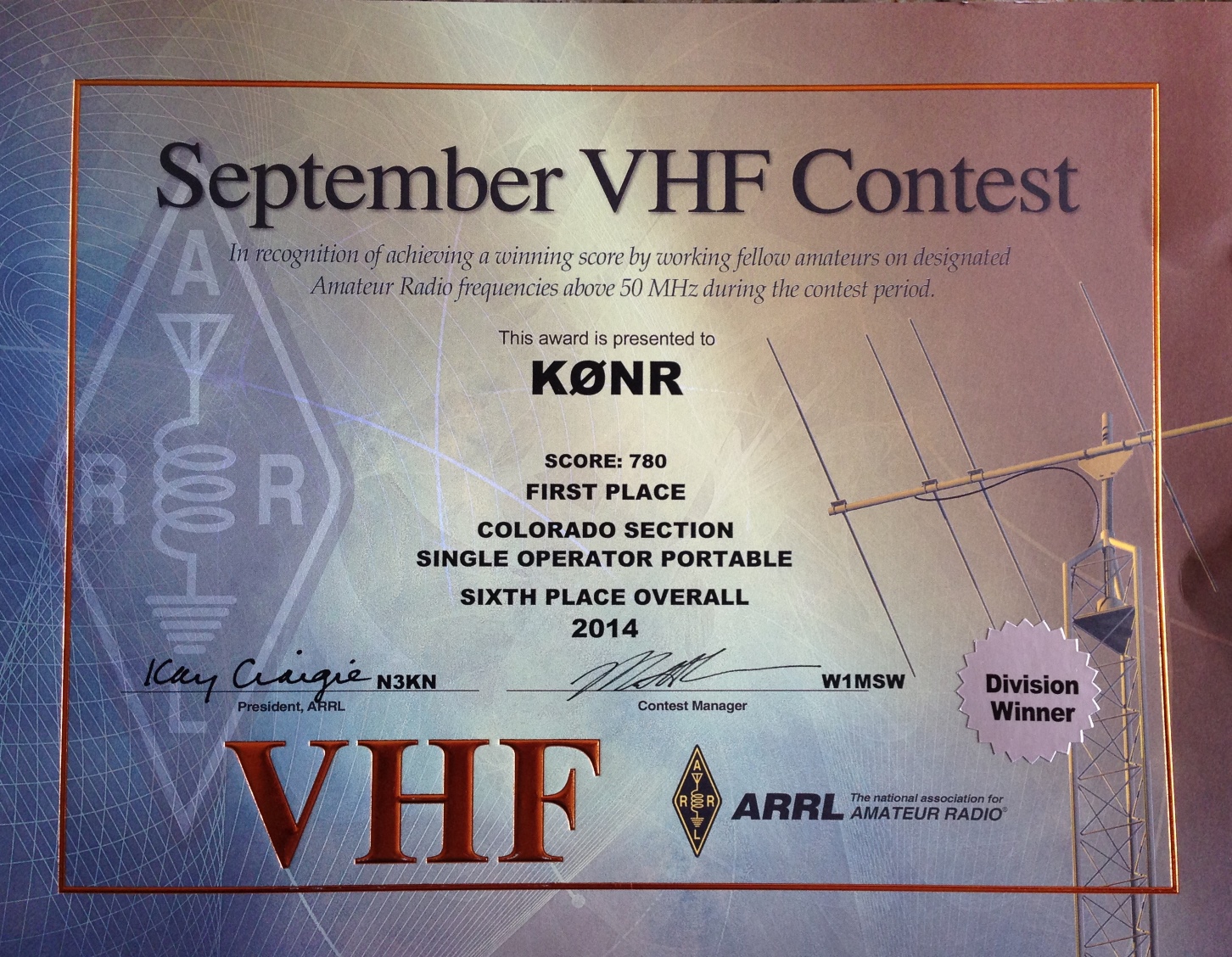 My blog posting said my score was 767 but the actual score was 780. Not a big score by any standard but not bad for ~4 hours of operating on a Saturday afternoon. As I suspected, this sets a new record for the Single Operator Portable category in the Colorado Section. What I did not expect is placing sixth in the overall contest (for my category). For the most part, this was just a really fun SOTA activation that included some VHF contest action.
Summary: The score doesn’t matter; any day having fun with ham radio is a good day.
73, Bob K0NR
The post 2014 September VHF Contest Certificate appeared first on The KØNR Radio Site.













