Author Archive
 20 over 9 into Michigan
 October 7th, 2011 |
  Author:
 Propagation has again been excellent on 10m. I heard many US stations and other DX at good strength. I didn’t make many contacts, though. Most of the stations I was hearing were enjoying 5 or 10 minute QSOs. You can use up a lot of time listening to such contacts, especially when you make your call and the station you are hoping to work replies to someone else and not you, so you get to wait another 5 or 10 minutes for the next chance.
Not that I’m complaining. But it doesn’t help that I refuse to use bad operating tactics to get a contact. One station I waited for got angry and went QRT because other European stations were calling over the final of the station he was working. If I can only hear the DX side of the conversation I won’t call until I hear the DX call CQ or say QRZ or listening for any calls. Others do, and too often they get rewarded with a contact. It makes me angry, too.
My first contact of the day was with UT1AN Alex on 10m FM. His QTH is not far from Kharkiv, Olga’s home town. Alex gave me an S9+20dB report.

The last – so far, anyway, was on 10m SSB with W8ERN Angelo in Brighton, Michigan, pictured right. I waited a long time before my call was heard. But it was worth the wait because Angelo replied with are you the G4ILO that wrote the VOAProp software? I ‘fessed up and Angelo told me how much he liked the program.
We also talked about web pages and logging programs. Angelo’s web page is produced using a software program called CommCat Live. You can hear live streaming audio from his station and see a graphical S meter plot of the station he is receiving. He told me my signal – 100w to the attic dipole – was almost peaking 20 over 9 and sure enough when I looked at the screen it was. Perhaps my QTH is not so bad after all.
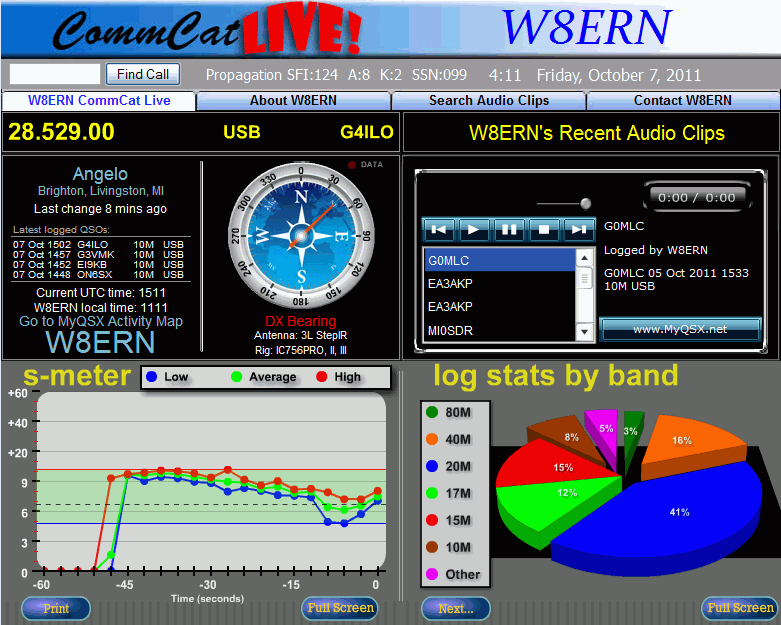
Here is the proof: W8ERN’s web page snapped while I was in QSO with him.
CommCat certainly adds interest to a ham radio web page. Unfortunately – but not surprisingly – it doesn’t support my home-written logging program KComm.

CB interlopers
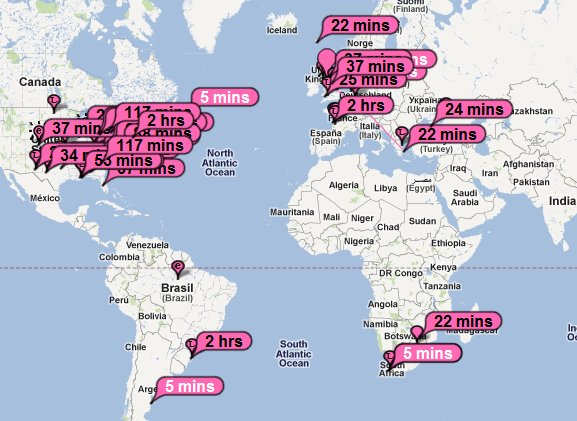
Propagation remains good on 10 metres. I left the K3 on 28.076 running JT65-HF for most of the day. I made several contacts including N3CAL, WA2CRB, PY8ELO, KE1AF, WB9OTX, WK8G and SV4FFK. The map shows where my signal was heard. I was even spotted by Joe, W6CQZ/4, the author of the excellent JT65-HF software.
JT65 is addictive. It’s also a very relaxing way to make QSOs. It’s ideal for me at the moment because my eyes tire very easily. I end up with blurred or double vision if I read or stare at the computer screen for too long so modes like PSK31 aren’t really a good idea. Thanks to the JT65-HF add-on JT-Alert an alarm sounds if a station I haven’t worked before calls CQ and another sound wakes me up if a station replies to me. This means that I can look out the window or something and only need look at the screen when I have something to do. The print in the JT65-HF program window is nice and big too.
Listening on 28.076 I heard some strange noises which I eventually realized were FM transmissions being received in SSB mode. CBers transmitting out of band I presume.
I don’t suppose many CBers read this blog but come on, guys. It’s none of my business if you choose to operate illegally but if you do, please stay below 28MHz. You may not hear our weak JT65 signals with your FM radios but we sure as hell can hear you.
Update: Just worked Joe “The Man” W6CQZ/4 in Florida. He was running 5W to what I seem to remember him posting once in the JT65-HF Google group is a Hamstick on a mag mount stuck to the roof of his shed. Thank you Joe for the contact and for the fantastic JT65-HF software!

Nothing but whispers
In the last few days several people have posted in their blogs or in forums that conditions on 10m have been great. Either I have been listening at the wrong times or this QTH is as bad on the higher HF bands as it is on VHF. When I have tuned across the 10m band I have found only one or two signals strong enough to be heard above the S4 noise level I now have on this band and none loud enough to work.
It’s probably my QTH. Last year when Olga was away in Ukraine I operated from the car with my QRP K2 and an MP-1 antenna on a mag mount and from just a few miles away but overlooking the coast I worked DX on 15 and 17m that I had never heard from home. Unfortunately going mobile is no longer an option as I am not allowed to drive due to my illness.
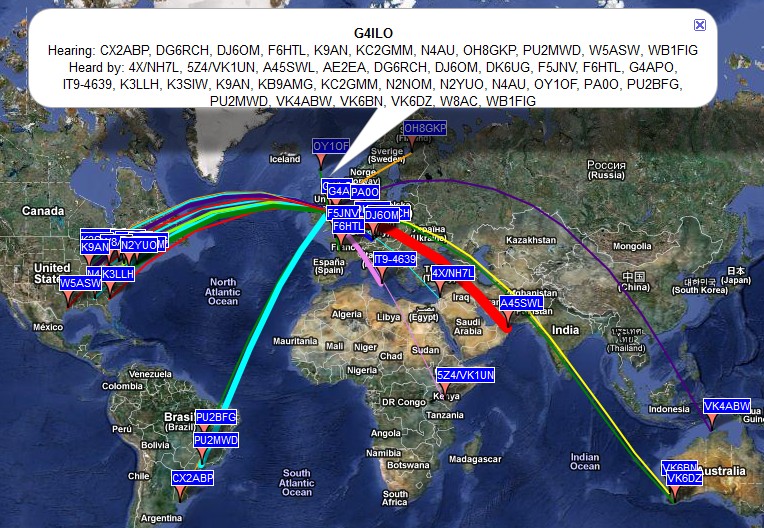
Something must be working right though. Most of the day I have been running WSPR on 10m with 5 watts to the dipole and my signal was spotted on 5 continents. It’s good, but it isn’t the same as having an actual conversation. You can see why my interest these days is turning more towards things like EchoLink.

EchoLink or D-Star?
Over the last few days I have been running my EchoLink node #3098 connected into the IRELAND conference server. As I’ve been feeling a bit tired and lethargic recently it has been a way to pass the time listening to QSOs and making the occasional contact.
Apart from IRELAND there seems to be nowhere else on the EchoLink network where there is enough activity that you can guarantee something to listen to or that someone will reply if you call CQ. I know this is like talking of selling your soul to the Devil but would D-Star, which I have never experienced but which I gather has something called “reflectors”, be any better from the point of view of making contacts with hams around the globe using a handheld?

Yet another fake Diamond antenna
I ordered a Nagoya NA-771 antenna on eBay. I was impressed with the shorter NA-701 and wanted something with a bit more gain that was not poke-you-in-the-eye long. The NA-771 had mostly good reviews on eHam.
I ordered from an eBay seller that shipped from the UK. The price was £4.99. When it arrived, I found the packaging and the antenna itself claimed to be a Diamond RH-771 not a Nagoya NA-771.

But this is clearly another fake Diamond. The lettering is white whereas the real Diamond product is lettered in blue. The lettering also contains nonsense. It claims “144/430 MHz & VDE BAND HECEMNG COVERAGE JAPAN.” Eh??? Perhaps it was supposed to say wide band general coverage? And the antenna is only 36cm long whereas the real RH-771 (and the NA-771) are supposed to be 39-40cm long.
None of this would matter if the antenna was any use, but in fact its resonant frequency is just below 120MHz. At 145MHz the SWR is more than 4 to 1 and it radiates a poorer signal than the shorter Nagoya NA-701 antenna.
Anyone want an air band antenna? Yours for a fiver. And can anyone recommend a seller that has the genuine Nagoya NA-771?

Waste of money
Yesterday I received a personally addressed letter from our cash-strapped radio society, the RSGB. What had motivated them to write to me? Apparently it was to tell me the annual subscription is to rise to £47 a year – the first increase since 2006 – and to ask if I would donate to the Spectrum Defence Fund – which I already have, once, and a lot of good that did – or the Radio Communications Foundation.
Why could this letter not have been put in the same mailer as RadCom, the monthly magazine that all members receive, or even published in the magazine itself? Why did this even merit a letter, rather than a page of the magazine, in the first place?
A few months ago I read that the RSGB was to use a bequest from a silent key member to employ a professional fund raiser. This, presumably, is the result. What a waste of money.

UV-3R programming software
A new programming software has been released for the Baofeng UV-3R. At the moment you can download it here. I used BitZipper to open the rar file.
This software is claimed to be for the UV-3R MkII with the dual frequency display but it works with my MkI as well. I took the precaution of reading from the radio before modifying and writing anything: some people who didn’t do that with the old program experienced problems.
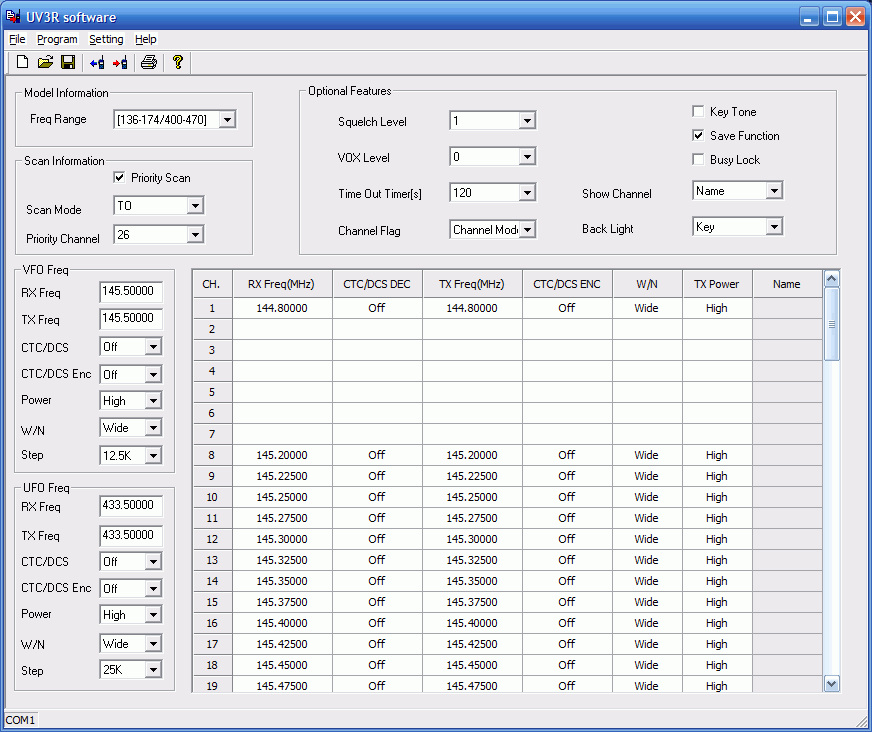
The new program is easy to use. Interestingly, it has two options for frequency range, one of which limits the range to the ham bands 144-146MHz and 430-440MHz. I assume that is to get approval in some countries that don’t allow radios that can transmit out of band. There is also a column called Name for each channel, though I couldn’t type anything in there. Perhaps a newer model will allow you to have channel names as well.
I discovered a bug with setting the priority channel, though it’s kind of hard to explain. You choose the priority channel from a drop-down list of channels that have been used. If you haven’t used all the channels between channel 1 and the priority channel then the radio will check the channel corresponding to the position in the list of the one you selected instead of that actual channel number. I wanted to make channel 20 the priority channel butthe radio started checking channel 14 because 20 was the 14th filled channel in
the list! To use channel 20 as the priority channel I had to select channel 26, which was the 20th one in the list.
I don’t know what would have happened if the channel I’d picked was one that didn’t have a frequency programmed into it – and I’m not going to risk finding out!
I ought to mention that the cross-platform multi-radio supporting memory management software CHIRP supports the UV-3R as well. Not sure about the UV-3R MkII though.














