Posts Tagged ‘WSPR’
 Isn’t QRP amazing?
 October 19th, 2010 |
  Author:
 The Royal Society for the Protection of Birds, a British wildlife conservation charity, has a slogan “aren’t birds brilliant!” I think QRPers should start promoting low power operation using the slogan “Isn’t QRP amazing!” Because whenever I try using low power the results simply amaze me.
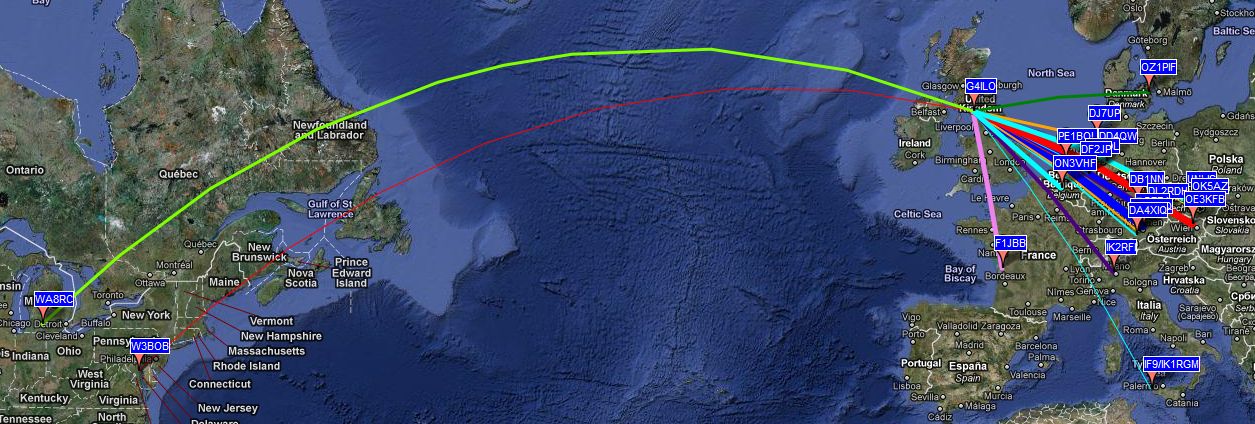
Until starting on my QRSS adventure I had never tried very low power, sometimes called QRPP. I was inspired by Paul PC4T who yesterday wrote about using WSPR on 20m using 50 milliwatts. At the moment I am QRSSing with 50mW on 30m using my magnetic loop, but that still leaves my multiband dipole antenna for some QRPP WSPR experiments.
I connected my QRP power meter to my K3, turned the power control to the lowest setting (0.1W) and sent a Tune signal from the WSPR software. The meter read about 65mW. I thought that I would be lucky to get any reception reports at all at that power level so I was amazed to be spotted by around 20 different stations in the space of a couple of hours, including two from the USA. One, WA8RC, was at a distance of more than 5,800km! To be heard, consistently, over that kind of distance across the Atlantic Ocean using less than 100mW to a dipole zig-zagged into a tiny attic is simply incredible.
I think we all use too much power, myself included. We do it because it makes copy easier or because it increases the chance of someone hearing us calling CQ. Even WSPR users mostly use 5W or more, despite the fact that the “WS” in the name of the mode means “weak signal.” Because of our macho desire to have a bigger signal than the other guy we never discover just how far a little power will really go. And that’s a discovery that’s far more enthralling than receiving yet another 599 report, surely.
Isn’t QRP amazing?

10m open to the north
Once again, WSPR is revealing the existence of consistent propagation paths every day on 10m between Iceland (TF), the Faroes (OY) and northern Norway (LA/LB) and the UK and north-west Europe when there is no Sporadic-E and no other propagation except over very short distances between closely located stations. This has occurred even during periods of zero sunspots.
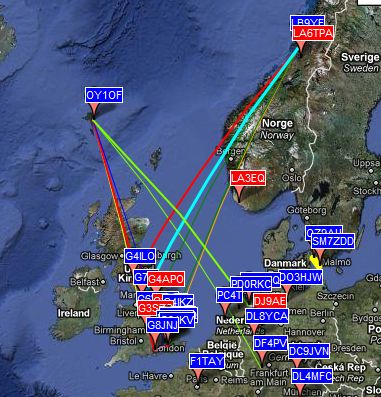 I’m guessing that because we have only in the last few weeks had a large number of WSPR monitors on 10m because of the Sporadic-E season, no-one has previously observed it. But I’m surprised at the lack of comment about it. Perhaps this is a phenomena known to everyone but me, in which case I’d welcome some enlightenment.

Sporadic-E action
The screengrab below, from WSPR at 0815 this morning, shows just how selective Sporadic-E propagation can be. For a change, G4ILO is hearing and being heard by all the European stations while those in the south of England aren’t getting anything.
 Look, too, at all those lines going off the top of the map to OY1OF. I wish I could understand the propagation. It appears that if you like the 10m band, the best place to live is the Faroe Islands!

Whispered contacts?
A recent discussion on the WSPRnet website concerns whether one should log WSPR contacts. It was pointed out that normal WSPR “spots” are not contacts. However it appears that some operators consider that if two stations spot each others’ signals within a short interval of time then they treat it as a contact and QSL it.
In my opinion WSPR spots, even if they occur both ways within a short time, are not contacts because you have no way of knowing if someone else received your transmission (or what signal report you got) without using the internet. It would be nice if the WSPR protocol provided a way to discover who is hearing your signals without using the internet but it doesn’t. I have no issue with QSLing WSPR “spots” as SWL reports. But they are not contacts, and if anyone uses eQSL to send a QSL to me for a WSPR spot it will be rejected as “not in log.”

Quiet day
 Not much happening today. I have been WSPRing on 10m with 5W but heard nothing and have been spotted just once – by OY1OF on the Faroe Islands.
Yesterday evening I was receiving EA4SG in Spain but he was running 20W. I upped my power to a similar level, and was spotted by G0HNW and M1AVV in the early evening. I left the system running all evening but after it was dark I noticed my neighbour’s security lights were coming on at the start of my WSPR transmissions. Not good when you are trying to maintain a “stealth” station!
Before I started with WSPR today I got out the old DOS laptop and the Motorola programming software to make a few changes to my GP300 configuration. I reduced the squelch threshold slightly, reduced the power from 6W to 5W which should help the battery endurance more than it will affect reception of my signals, and I programmed the radio for 16 channels.
Now there are 16 channels it’s difficult to remember what they all are so I made a paper scale to go under the tuning knob which shows the 2m channel numbers or repeater calls. I had to use the magnifying headset to do the very small lettering and I can only read the scale with my reading glasses on – which I don’t when I’m out and about. But I couldn’t read the channel numbers on the original dial scale either so I’m not actually any worse off. I used to have great eyesight – this is what happens after spending most of your life in front of a computer!

Scrubbed out
One of the greatest uses of WSPR is to get accurate, real-world comparative reports on antennas. When comparing antennas in the past I have used two computers and two radios on two different frequencies using the same power and manually set the WSPR programs to both transmit on the next cycle so that they send their beacon signals simultaneously. During the transmission I set both programs back to “no transmit”. This way I get directly comparable reports from both antennas at the same time and I don’t have to worry about one transmission being received and reported by the other system.
Now, this is no longer possible. The WSPRnet website has implemented a “data scrubber” which will filter out invalid spots including bad calls (bogus decodes), bad timestamps, wrong band reports and duplicate reports. The latter are apparently the most common type of error, accounting for 1.7% of spots. I wasn’t aware this was that common, though it can happen due to reciprocal mixing in the receiver or the computer sound card. But one result of this is that you can no longer intentionally transmit two beacons at the same time using the same call, locator and power level, because if you do all but the strongest report will be filtered out.
I think this is an ill thought out move that will result in deleting valid spots just because they can’t be distinguished from invalid ones. The WSPR software does report the transmit frequency being used by each instance of the software so it should be possible in some cases to determine whether duplicate spots in the same timeslot are genuine or not. This won’t help those using hardware based WSPR transmitters that don’t connect to the website though.

What is a contact?
As someone who has quite often used WSPR, I have often said that it would be nice to be able to exchange reports with other stations and confirm the “contact”. I felt this simply because the WSPR network is a friendly community and it feels right somehow to be able to do that, just as you would confirm an enjoyable contact on another mode.
Modes like the little used WSPR QSO mode and JT65A on HF offer the chance to make two way QSOs using similar power levels to WSPR. But my recent experience using JT65A on HF, and more recently watching a station in Iceland take half an hour to try to exchange a signal report and confirmation with a station in Brazil using a certain other weak signal mode led me to wonder if in trying to make it possible to make “contacts” using the least possible power we have thrown the baby out with the bath water.
Communicating via moonbounce (EME) on VHF has always been about exchanging the barest minimum of information, because even doing that is a major achievement. But on HF it is always possible to have a proper contact, even if it means using a bit more power or waiting until propagation is a bit better. So why are we endeavouring to use modes designed for EME on the HF bands? What is actually being achieved? Someone’s computer is able to pick a few characters of information out of my barely audible signal, with the help of heavy error correction and the fact that the message format is known. My computer is able to do the same with his. Is this actually a contact?
Yesterday I tried for the first time in several years to use the Olivia digital mode. Before I did, I Googled up some information about it, and came across a Yahoo group containing a post by Waldis, VK1WJ. He wrote: “Yesterday I had a sked with DJ2UK on 20m in JT65A. Bert came in with around -17dB but he couldn’t decode my signal. After a while I saw in SPECJT that he had switched to Olivia 8/125. So I did the same, and we had quite a long error-free QSO. Olivia 8/125 is not exactly fast, but it still beats JT65A hands down. May be we could entice our JT65A friends to try Olivia instead?”
According to Waldis, instead of exchanging a couple of numbers using JT65A, you could have an actual (if slow) conversation using the 8/125 variant of Olivia. But the JT modes are currently in vogue, whereas Olivia – being developed in 2003 – is yesterday’s news. People are raving about the capabilities of a certain other mode that is making a lot of news recently. Have all these people actually tried some of the forgotten modes? Because I think if they did they might wonder what all the fuss was about and whether the newcomer really justifies its use of bandwidth.
What was I saying about reinventing the wheel?














