Posts Tagged ‘WSPR’
 Who broke it this time?
 January 30th, 2012 |
  Author:
 I have just finished the heavy dose of chemo for my fourth cycle so for the last week and for several more days it will be more than usually difficult to concentrate or even get motivated to do anything. Mostly over the last week I have just been tinkering with the Parallax Propeller WSPR and Opera beacon code and running the beacon barefoot on the air.
Stupidity seems to dog my programming efforts as much as my attempts at electronics construction. I wasted a couple of hours trying to understand why the Propeller was not doing what I wanted before eventually realizing that it was doing exactly what I had told it. I was nearly at the point of splashing out on ViewPort, an interactive debugger for Spin code that would allow me to step through my programs a line at a time. That would quickly have revealed the error, but it would have been a high price to pay to show me what was staring me in the face.
I had been pleasantly surprised at the reach of my barefoot 20mW Propeller beacon, receiving a number of reports of both Opera and WSPR signals. Today I modified my beacon program to transmit both a WSPR and then an Opera beacon, but frustratingly I have not received a single report of either of them on 30 metres. Have I broken the program again or did someone break the ionosphere? I really need to get motivated enough to build a small PA and boost the signal to at least the hundred milliwatt level.

Propeller takes to the air
Today I have been playing around with MEPT beacon code on my Gadget Gangster Parallax Propeller board. First I wandered over to Jeff, KO7M’s blog and borrowed his WSPR beacon code.
 |
| Gadget Gangster in use as a 25mW WSPR/Opera beacon |
WSPR was the thing I originally wanted to try when I decided to get the Gadget Gangster: I hadn’t even heard of OPERA at that time. But I was unsure whether I would be able to generate the FSK frequencies WSPR uses: four tones separated by about 1.48Hz. Jeff decided to shoot as near as he could and programmed for a 2Hz separation of tones, and found that the signal was decoded by K1JT’s WSPR program. So no problem!
I measured the RF output from the Propeller board and it was somewhere in the region of 25 to 40mW, depending on which measurement method you believe. I also looked at the output using my oscilloscope.
 |
| Output waveform from Parallax Propeller on 80m |
It wasn’t a pure sine wave, there’s obviously some harmonic content there, but it was not as bad as I feared it might be. As I would be using my MFJ magnetic loop on 30m, which has a very narrow bandwidth, I decided not to bother with a low pass filter for the sake of these initial trials. I watched the seconds tick over on my shack radio-controlled clock, started the beacon and was soon rewarded by several WSPR spots!
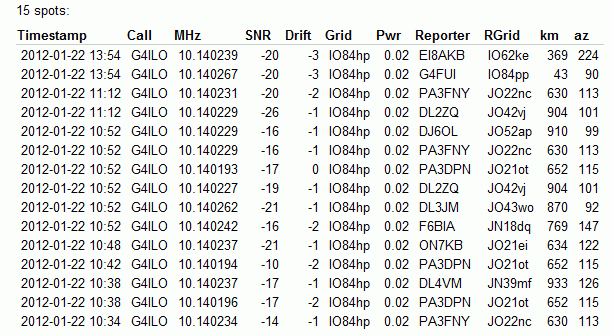 |
| WSPR spots for 25mW Propeller beacon |
Because WSPR is a time-synchronous mode I had to start the beacon when the seconds ticked over to 00. This brought to light a problem Jeff had already observed: the Propeller drifts. The drift seems to be worst during the first few minutes of operation, so leaving the beacon running so it can reach a stable temperature would appear to be the solution. However that is not so easy when you have to power it on at an exact time. I will need to look in to implementing a real-time clock for WSPR, unless I want to interface a GPS receiver to the Propeller – which is certainly possible and something else I hope to try as I’d like to have a go at making an APRS tracker.
An advantage of the OPERA mode is that it is not time synchronous so I can leave the beacon running in that mode with an arbitrary delay between transmissions. My first OPERA transmission also produced several spots, including reports from fellow bloggers PC4T and G4NKX.
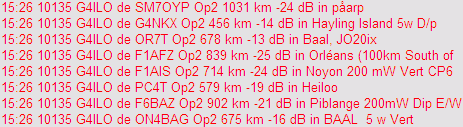 |
| OPERA spots for 25mW Propeller beacon |
I can also generate Morse and QRSS beacons using the Propeller chip. There is still a lot to do to reach my goal of a multimode, frequency-agile beacon, including adding a PA and some switchable bandpass filters. But so far this project has turned out to be easier than I thought it would.

Propeller does WSPR
Through Eldon, WA0UWH I have discovered another blog to add to the blogroll: that of Jeff, KO7M. Jeff is interested in a lot of the same things I have been (including light aviation: an ambition of mine when I was in my 20s but which I could never afford to take up.) But what really piqued my interest was that he has just got a Parallax Propeller to generate a WSPR signal.
This is one of the things I was interested in trying. But I never got further than wondering how to implement the fractional frequency shifts of the WSPR signal, which uses 4 tones shifted by just under 1.5Hz from each other. Jeff has apparently found that a 2Hz shift is good enough to be decoded, allowing WSPR to be sent using the integer frequencies the Propeller chip can easily generate.
Once I have finished the Tiny Keyer project and can get back to the Propeller I will be trying this myself. My ambition at the moment is to make a multi-band multi-mode (OPERA, WSPR and perhaps QRSS as well) standalone beacon with an LCD panel to enable me to choose the band and mode. We’ll see how far I get, but having two other people working on the same ideas should certainly make the task easier!

Resting and radio……..
 |
| CT1IUA on the beach |
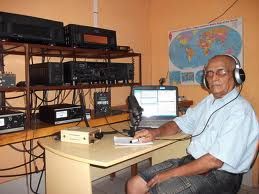 |
| PV8ADI at the desk |

Operatic triumph
A new version of the Opera software has just been released which can output the bit code of a beacon signal so it can be programmed into a microcontroller such as a PIC or a Parallax Propeller chip. (You can find the download via the Links page of the Opera Yahoo group.)
I modified Eldon Brown WA0UWH’s QRSS program code to send the bit code generated by the Opera software and it was received by my K3 on 30m and successfully decoded. Not bad for 5 minutes’ work! You can download the code here.
Just as Eldon did I will have to build an amplifier to raise the output of the Propeller from a couple of milliwatts to something with a better chance of being received. Before it is worth doing that people will have to start using the Opera mode on the HF bands because with my antenna restrictions I have no hope of receiving or radiating a signal on LF or VLF. But I am quite excited at the possibility of building simple standalone beacon transmitters for this new weak signal mode which is much easier to generate than WSPR or QRSS.
Stop press: Just decoded G0NBD on 10.135MHz +1500Hz for my first real over-the-air Opera spot. And it appears my first transmission (using the PC software and my K3 at 5W) has been received by OM5NA at -21dB. This is fun!

Fun on 10m and a call from the past
I checked WSPRnet.org this morning and found quite a lot of activity on 10m so I fired up the K2 and joined the fun with a 1 watt signal. By late afternoon I’d had well over 40 unique call / spotter combinations including good reports from FR1, VK6, VE and the USA.
At lunch time I switched to the K3 (which has a mic attached) to make some SSB QSOs. This was not especially productive. Several US stations running high power to multi-element beams were huge signals over here, but they had huge numbers of European stations calling them and my 100W to an attic dipole had trouble being heard over them. Actually I was only using 80W as I found going up to 100W on 10m caused my homebrew digimodes interface to disconnect itself from the computer. When I was heard, I received good reports from N2JF and NU1O. Perhaps I’d have made more contacts if I’d called CQ.
During my WSPR session I saw that my signal had been spotted by a callsign that rang a bell: G4HBA. A quick look at qrz.com confirmed that my memory was correct: G4HBA was Roger who had also been G8KRT some 35 years ago. During the long hot summer of 1976 when I was G8ILO and only allowed to use 2m and up I was home from university and using an Icom IC-202. Roger was portable from near his place of work in south east Essex and working strings of Continental stations during the endless tropo openings. As I had no antenna at the parental QTH I drove out to find him and on several days I joined Roger and made some contacts under my own call.
One evening I drove out to the site and Roger was not there, so I went to the top of the hill and started operating using my IC-202 and a small beam I made that was supported by the car door. After about half an hour it was getting dark and I noticed torches moving about and closing in on the car. Suddenly I was surrounded by police in uniform! Apparently my car interior light had been spotted from several miles away (as I was on top of a hill) and as I was right next to a radar station someone had wondered what I was up to. That was the end of my operating from that particular site, but I will always remember the amazing VHF propagation of that summer and regret that I never experience such conditions on 2m here.

Nothing but whispers
In the last few days several people have posted in their blogs or in forums that conditions on 10m have been great. Either I have been listening at the wrong times or this QTH is as bad on the higher HF bands as it is on VHF. When I have tuned across the 10m band I have found only one or two signals strong enough to be heard above the S4 noise level I now have on this band and none loud enough to work.
It’s probably my QTH. Last year when Olga was away in Ukraine I operated from the car with my QRP K2 and an MP-1 antenna on a mag mount and from just a few miles away but overlooking the coast I worked DX on 15 and 17m that I had never heard from home. Unfortunately going mobile is no longer an option as I am not allowed to drive due to my illness.
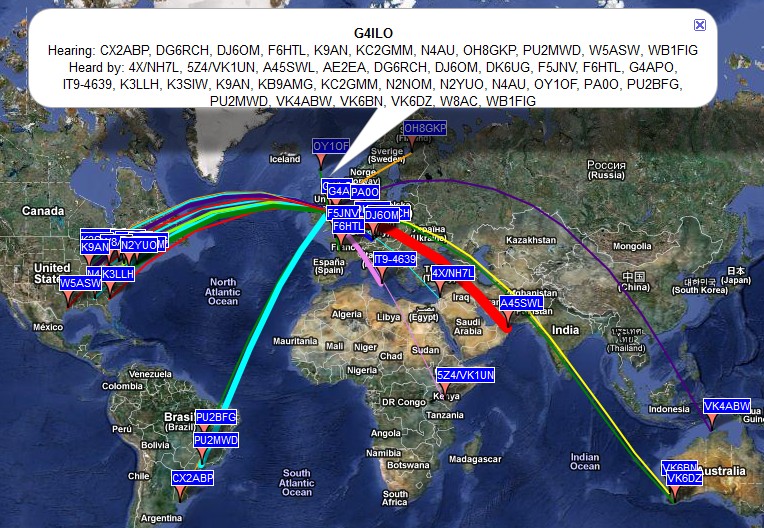
Something must be working right though. Most of the day I have been running WSPR on 10m with 5 watts to the dipole and my signal was spotted on 5 continents. It’s good, but it isn’t the same as having an actual conversation. You can see why my interest these days is turning more towards things like EchoLink.














