Posts Tagged ‘WSPR’
 September 18th, 2012 |
  Author:

 Ping!
Ping!
WSPRing on 6m this afternoon and I captured this trace:
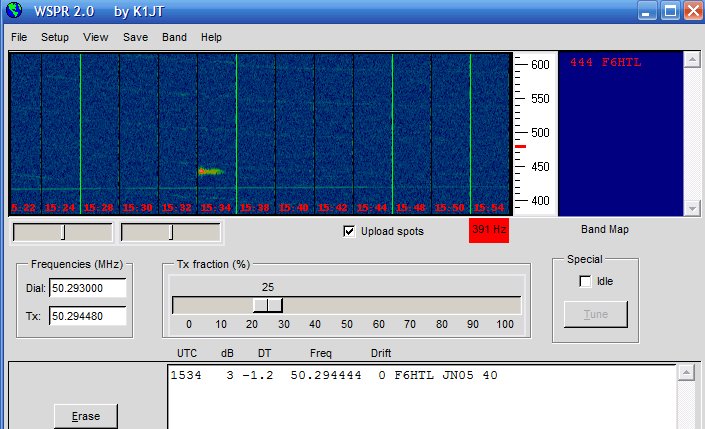
I’m not seeing anything else, though F6HTL spotted my transmission 2 minutes later. I wonder what type of propagation that was?
(Interesting that WSPR decoded the transmission even though the signal was only present for half a cycle.)

New WSPR / QRSS beacon kit
Hans Summers (G0UPL) and Steve Farthing (G0XAR) have recently begun selling a new kit for a QRPp (150mW) beacon that can generate Hellschreiber, various QRSS modes and best of all WSPR. Unlike the ones now sitting unused in a drawer in G4ILO’s shack which have my details programmed in, the Ultimate QRSS Transmitter Kit has a user interface with an LCD panel that allows you to input your own callsign, locator and power output. This means it has resale value – when you get bored you can sell it on and the new owner can program it with his own details.

At the moment, kits are only available for the 30m, 40m and 80m bands, though they can also generate an audio signal that can be used to drive an SSB transmitter.
I asked Hans if they were going to offer a version for 20m, which has become one of the most popular WSPR bands. His reply was that the kits will actually work fine on any frequency between 1MHz and 20MHz, they just require a different crystal and different components in the low pass filter.
A 20m beacon for WSPR would need a 14.097MHz crystal. I searched my junkbox and couldn’t find one. Nor could I find a source for one and having one specially made would be expensive. Perhaps if there is enough demand for a 20m version it will be worth Hans and Steve’s while to have a batch made which will be cheaper.

6m WSPR
On 10th June DX Sherlock showed that a big Sporadic E opening was in progress. The red lines showing contact paths stopped tantalizingly short of north-west Cumbria, unfortunately.
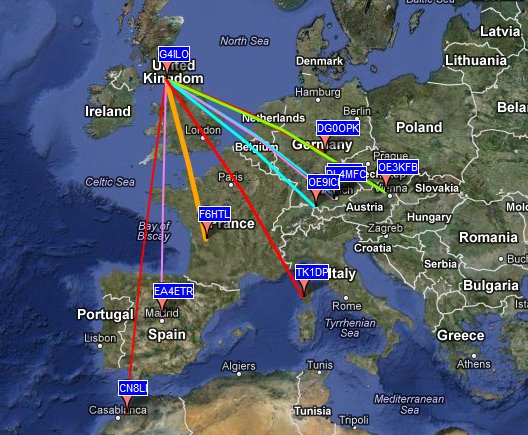
I listened on 10m but I didn’t hear the S9+ signals such an opening would suggest so I thought I would do some WSPR on 10m, moving to 6m if the 10m signals suggested the skip would be short enough. They eventually did, as DX Sherlock indicated the lift was getting stronger. I moved to 6m, running 5W to the attic multi-band dipole, and eventually spotted or was spotted by stations as far afield as Austria, Spain and Morocco.

During the peak of the opening I broke off from WSPR to tune the bands and make a few contacts. On 10m I worked TM210VH – a special call commemorating 210 years since the birth of Victor Hugo. I made contacts into Italy, Switzerland and France on 6m as well.
Seeing some massively strong signals now on 10m WSPR so time to check out 6m I think!

Thanks postie
I’d almost forgot that I had an order in for one of these. But my royal weekend was topped off nicely a royal (mail) delivery of 1 Raspberry Pi.
I had a few plans for one of these when I first heard about it but first off I’ll spend a bit of time getting to know the linux distro and I’ll assume there is a way of running something like WSPR without too much trouble as it has a native Debian (.deb) version. First off though will be trying to get a video signal out to my rather old monitor that doesn’t have a HDMI input.
In the mean time I think I’ll have a google about to see what anyone else has done. Always a good start to learn from others.

Big Gun
It’s not often I hit some DX but WSPR helps me out quite a lot. Here’s a screenshot from my latest 1w big gun escapade

1w into Hustler 6-BTV
Whilst some might say that lifes too short for QRP. Newly licenced hams take note. 1w into a lossy vertical in a bad location doesn’t mean you’re stuck with QSO’s as far as the end of the street.
All this was achieved with a modest transceiver (IC-7000) and a modest antenna (Hustler 6-BTV with a few radials). The lesson here is that DX isn’t just for those with limitless pockets of cash, elevated QTH’s and antenna systems that can rival your nearest broadcaster. You just might not be talking to the other station!
The bands are dead but can a WSPR defibrillator get results
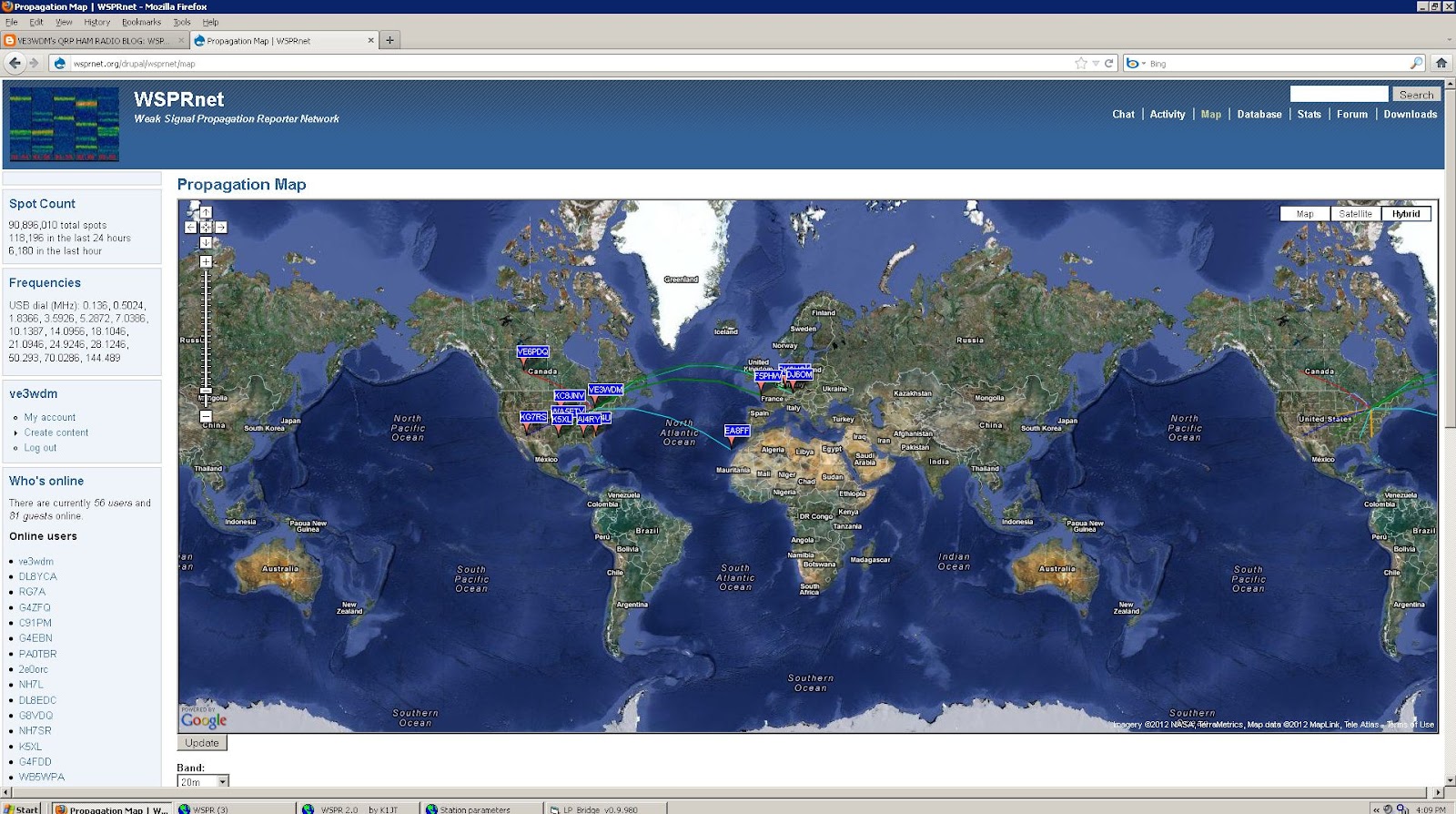 |
| 20m WSPR results |
 |
| 30m's was local only |
 |
| 40m's was dead |














