Posts Tagged ‘technology’
 Powerhouse History: WLW, W8XAL, WSAI
 May 24th, 2026 |
  Author:
 The photograph, below, captures a compelling moment of technical mastery during the formative years of American broadcasting, set deep within the inner workings of the Crosley Radio operation in Cincinnati, Ohio, during the 1930s. This was not just a studio but a nerve center for one of the most ambitious radio experiments in history. In the frame, an unidentified announcer sits with a quiet, practiced focus before a sensitive microphone, his presence framed by a formidable wall of equipment that served as the control interface for Powel Crosley Jr.’s broadcasting empire.

WLW, W8XAL, and WSAI
The machinery in front of him represents the sophisticated control panels for three distinct stations, labeled for WLW, W8XAL, and WSAI. These panels were the operational gateway to a signal that redefined the reach of radio. WLW, in particular, earned the nickname The Nation’s Station, and for a brief but legendary period in the mid-1930s, it was granted special authorization by the Federal Communications Commission to experiment with a massive power output of 500,000 watts. This made it the most powerful radio station in the United States, a true technological titan of the era. The signal was so incredibly potent that listeners across North America and beyond often reported hearing the broadcast under unusual circumstances, such as through the metal teeth of fillings, in the coils of mattress springs, or even through the humming of household plumbing.
Beyond the standard AM broadcast of WLW, the inclusion of W8XAL in this control room highlights the critical role shortwave technology played in the Crosley vision. While the standard AM signal was meant for domestic reach, W8XAL served as an experimental shortwave companion, designed to project the Cincinnati broadcasts far beyond the limitations of local and regional airwaves. Shortwave radio waves possess the unique ability to bounce off the ionosphere, allowing signals to travel thousands of miles and transcend national borders. Through W8XAL, the Crosley organization was testing the feasibility of true international broadcasting, turning the modest studios in Cincinnati into a point of origin for listeners located as far away as South America or Europe.
This shortwave capability was a significant leap in the evolution of mass media. It represented a deliberate attempt to overcome the geographical isolation that had defined the earlier, more fragmented era of radio. By operating on shortwave frequencies, the announcers and engineers were participating in a grand experiment to see if a single localized voice could truly become a global one. It was an ambitious pursuit that demanded even greater precision than standard broadcasting, as atmospheric conditions and solar activity could frequently disrupt the long-distance transmission path.
Working in this control room was a task that required both the poise of a performer and the precision of an engineer. Each dial, needle gauge, and switch was a critical element in maintaining the integrity of the broadcast, as the announcer had to carefully monitor the modulation levels to ensure the signal remained clear and stable for millions of listeners. A lapse in focus could mean a technical failure or a broadcast error that reached a massive, dispersed audience in real time. It was a high-stakes, high-pressure environment, yet it functioned as the primary, and often only, window to the wider world for families weathering the depths of the Great Depression.
Powel Crosley Jr. was a man of intense vision, and he understood better than most that radio was the ultimate tool for domestic and international unification. These transmitters were the engine that bridged the vast geographical distance between his studio in Cincinnati and the living rooms of families scattered across the continent and beyond. When people turned their dials to find the station, they were connecting to a piece of engineering that stood at the very cutting edge of the twentieth century. Looking at this image today, it is easy to feel a sense of awe for that era, when the simple act of turning a knob could bring the world into a home, effectively shrinking the vastness of the country and changing the way society experienced culture, news, and shared humanity forever.
1939 Film: Morse Code on HF in New Zealand (Historical)
Before modern radio broadcasting, the trails were being blazed both in public broadcast, but also critical links out of the local area. Here’s a side-look back in time…. in this 1939 Film: New Zealand Shortwave Communications; Morse code (CW)
The romance of the radiotelegraph service (in this video, the service in New Zealand) is a fascinating aspect of communication history. The use of shortwave, longwave, and medium frequency spectrum for communication, particularly through Morse code, played a significant role in connecting people across vast distances. This service utilized the high-frequency spectrum known as “shortwave” (from 3 MHz up to 30 MHz) as well as the longwave (30 kHz to 300 kHz) and medium frequency spectrum (300 kHz to 3 MHz).
This short film is from 1939, and captures the essence of communication at that time in history, to and from New Zealand using shortwaves and Morse code. It showcases the importance of the radiotelegraph service in enabling long-distance communication during that era. The transition from Morse code via spark-gap communications to continuous wave (CW) modulation marked a significant advancement in the technology and efficiency of radio communication.
It’s incredible to see how technology has evolved over the years, transforming the way we communicate and connect with each other globally. Films like these provide a glimpse into the past and remind us of the ingenuity and dedication of those who worked in the radiotelegraph service to ensure effective communication across the seas.
[embedyt] https://www.youtube.com/watch?v=H-KUat5WEkU[/embedyt]
This film is a 1939 Government film scanned to 2K from a 16mm combined B/W reduction print.
New to Amateur Radio? What is a Repeater?
If you have not yet explored ham radio repeaters, this might be interesting to you.
What is an amateur radio repeater and how do they work?
In this video, with a non-amateur-radio viewer in mind, I chat about the very basic concepts of a repeater.
It is filmed in a relaxed, “ride along with me,” format.
Want to learn more about ham radio (amateur radio)?
Visit: http://nw7us.us/arrl
[embedyt] https://www.youtube.com/watch?v=R_a5Pxh931U[/embedyt]
Complete Version: On How NCIS Maligned the Amateur Radio Service
Some of you wanted to see the complete version, uncut, of this video in which I discuss the differences between CB and the Amateur Radio Service. This is in response to the recent episode in which the NCIS writers missed a great opportunity to discover the vibrant reality of the current amateur radio service in the United States of America.
The previous version of the video was prematurely cut short by just over three minutes. This version includes that ending. I also remove some of the low-end rumblings from the vehicle. This version should sound a little bit less annoying. Hopefully, the quality of the video is sharper, as well. This version was edited by Adobe Premiere CC 2017.
I appreciate the many comments, views, and shares. Please subscribe, too!
73 from Omaha!
OK, OK! I Will Write that Ham Radio Book!
Ever since I began writing articles about my hobby of choice–amateur or “ham” radio–for my ham radio web site and several others, people have been asking me when I was going to do an amateur radio book. The truth is, I have just been too darn busy to even think of such a thing. And I also knew, in my heart of hearts, that it be would difficult indeed to get any kind of decent book contract for such a niche book. I presented my idea of a half-fiction/half-nonfiction book to the ARRL and they passed, so that confirmed my feelings. If they had no interest, I doubted anyone else who published books would either.
Fast-forward to July 2012. Things have changed, both in my personal life and in the wild and woolly world of big-time book publishing.
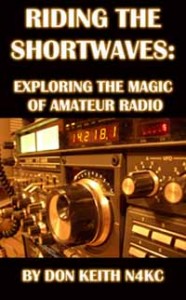
Don Keith N4KC has just published his new book of short stories, articles, advice, and more about ham radio.
First, I retired from my 60-hour-a-week day job back in May. And as I shuffled through the articles I had in the can, several more I was working on, and a few still in my head, I realized I was closer to a book than I had thought. And I truly believed I had something that would be different and could find a readership.
Secondly, as I investigated Kindle Direct Publishing at Amazon.com for the re-issue of a couple of my previous now-out-of-print books, I realized that I should absolutely pull the ham radio book together for that outlet–Kindle and some other e-book readers–at least. Amazon has become a real threat to traditional publishing companies–especially when it comes to e-books–as the old-line publishing houses struggle to figure this newfangled thing out. At the very least, it gives me the opportunity to make my book available at a very reasonable price to those interested in amateur radio. No, I don’t make much money at the price I set, even if I actually sell some downloads of the book, but that is not really the object anyway. As I have said many times, and not totally facetiously, if I wanted to make a fortune writing books, I would write pornography (See FIFTY SHADES OF GREY).
Then, as I considered other options, I realized that Amazon offers a truly unique opportunity for works like this one that allows me to offer the book in a traditional paperback format with minimal investment up front. Remember, I’m retired, on a fixed income these days! Amazon’s is a print-on-demand deal, but they seem to have it down to a science. I ordered some copies as soon as I got the book and cover uploaded and accepted for publication. The very next day I got the email that they were being shipped that day. Wow!
Again, this was with very little upfront cost and minimal hassle. Now, the paperback will be available not only via Amazon.com, but through major distributors, for order by libraries, and even in many European markets. We will see how good the print job is, but believe me on this: the major houses don’t necessarily produce the highest quality book any more either. They have to cut where they can to make a profit and printing, binding, and warehousing is a big drain on them.
Talk about rapid technological change and its effect on society and the media! Broadcast radio, TV, the Internet and telephone communications are not the only things evolving at a dizzying pace. Include the anachronistic business of book publishing in that mix, too!
Realistically, will tons of booksellers and all the Barnes & Noble stores order a box full of the books each? Or will hundreds of thousands of libraries order up a couple dozen copies each? Of course not. The big publishers do have sales staff to encourage that sort of thing. But a) no big publishing house was going to do a contract for RIDING THE SHORTWAVES: EXPLORING THE MAGIC OF AMATEUR RADIO and b) even if they did, it would be somewhere near the bottom of the sales staff’s sample case, so c) Amazon’s various self-publishing options are perfect for this kind of book.
By the way, if you have any interest in the dynamic and rapidly growing hobby of ham radio–believe me, it ain’t your weird uncle’s past-time any more!–then you may want to stop by Amazon.com and take a look “Inside the Book,” read the description, and maybe buy a copy or two…for yourself or someone you know and want to spark the interest in our amazing hobby.
See, right there in that last sentence, I did more publicity for RIDING THE SHORTWAVES than the big publishers do for most of the books they print up and ship out!
73,
Don Keith N4KC
www.donkeith.com www.n4kc.com













