Posts Tagged ‘POTA’
 Yellowstone and Grand Teton: SOTA and POTA
 September 26th, 2021 |
  Author:
 Visiting Yellowstone and Grand Teton National Parks is a favorite trip for us. It is a 9-hour drive to get there from Colorado, so we can make it in a day. In September, we visited these two parks with a blend of activities in mind: RV camping, hiking, viewing wildlife and ham radio. The ham radio part means Summits On The Air (SOTA) and Parks On The Air (POTA).

Our trip started from Monument, CO, followed by a stop at our cabin near Trout Creek Pass. Heading north, we spent one night at Steamboat Lake State Park (Colorado), which broke up the road trip into smaller sections.

Grand Teton NP
Grand Teton NP listed 27 activations for POTA (POTA K-0031) which is really not that many activations for such a well-known national park. The park and the surrounding national forests have many SOTA summits available, some quite difficult to climb (such as 13,770 foot Grand Teton). We camped two nights at Colter Bay RV Park, inside the park. This is a decent RV-style campground with full hookups and campsites packed in a bit tight.

Our usual POTA station is the Yaesu FT-991 driving a single-band end-fed halfwave (usually 40m, 20m or 17m) supported by a fishing pole and powered by a 20 Ah Bioenno battery. Joyce/K0JJW likes to use a paper log but I usually log my contacts with HAMRS, either on my notebook PC or an iPad. HAMRS is a relatively new logging program that runs on most operating systems (Windows, Mac, Linux, iOS, Android, etc.) It is tuned for portable operating, with templates for SOTA and POTA. Check it out, if you haven’t tried it.
One unfortunate surprise while operating from the campsite was a ton of RFI coming from the electronic devices in use by the herd of RVs. The noise floor on 20m was S5— not so good. It seems that today’s RV enthusiast brings along complete wireless network support with internet access points, WiFi routers, and their associated Part 15 emissions. Oh, well.
After setting up on 20m SSB, K0JJW and I both completed 10 QSOs with some difficulty. We were clearly being heard but we had trouble digging signals out of the noise.
Next up was a VHF SOTA activation on Signal Mountain (W7Y/TT-161). This is an easy-to-access drive-up summit with a great view, highly recommended with or without a SOTA activation. We debated on whether to use HF for SOTA on this trip. Normally, we’ve stuck to VHF/UHF on SOTA summits, as part of the Height-Above-Average-Terrain experience. However, knowing that Northwest Wyoming is a bit sparse for VHF activity, we could easily get skunked on a SOTA activation (less than 4 QSOs). Despite that, we opted to stick with VHF for SOTA and focus on a successful activation (1 QSO or more), with or without the SOTA points. On Signal Mountain, we worked two stations on 2m FM, including Steven/KB7ITU in Rexburg, ID, about 60 miles away. (Hey, we worked another state on VHF!)
Speaking of VHF, we used our dualband mobile (IC-2730A) to listen to the national park repeaters while we travelled through the park. Our dual-receive radio always has 146.52 MHz on one side and “something else” on the other side. When inside large national parks, we’ll set the second receiver to a national park frequency. These are generally conventional FM in the 162 to 173 MHz range. I won’t list the Teton and Yellowstone frequencies here but you can find them with a little searching on the interwebz. For example, see wiki.radioreference.com for Yellowstone NP frequencies.

Yellowstone National Park
Yellowstone ( POTA K-0070 ) had only 22 POTA activations, not that many considering it is the nation’s first national park. It also has quite a number of SOTA summits of varying difficulty.
We camped two nights at Grant Village campground, a basic national park campground. The campground had no hookups but the campsites are well spaced with many trees and flush toilets. (The only problem we had was when the park service booked another group of campers onto our campsite one night.)

During a previous visit to Yellowstone, we activated Lake Butte (W7Y/PA-219). On this trip, we had our eye on Mount Washburn (W7Y/PA-163), a well-known 10k summit and popular hike, but the road that provides access to it was closed for the summer due to construction. (OK, maybe next time.)

Instead, we decided to try an unnamed summit 8770 (W7Y/TT-139) that was relatively easy to access but had not been activated for SOTA. We found some trip reports that said there is a nice trail to the summit and the only complaint was that the summit does not have a view due to the many trees. We parked at the Divide Trailhead, about 12 miles west of Grant Village. The trail is 1.8 miles in length (one way) with 700 feet of elevation gain. So not too difficult but a real hike. The summit is broad and sure enough with lots of trees, so no view. Practice normal bear precautions on this trail.

Again, we opted for VHF SOTA, knowing that we might not get enough radio contacts for points…but we only needed one contact to qualify as the first activation. We worked two mobile stations passing through the park on 146.52 MHz. Yes, it is good to always be monitoring the calling frequency. You never know who is going to show up.
For POTA, we noted that the Continental Divide Trail National Scenic Trail (K-4558) passes through Yellowstone NP, which would allow for a double activation. The CDT has always been special to me as it passes through Colorado and provides some of the most scenic hiking in the state. It only had 15 activations listed at that time, two of those were ours from when we activated it a month earlier, in Colorado. We choose the Old Faithful area as a good place to activate Yellowstone NP ( K-0070) and the CDT. We set up near the edge of the parking lot, away from the crowds. Again it was the FT-991 driving the endfed halfwave on 20m SSB. It was midday, so we expected good 20m propagation (and a nice pileup for Yellowstone) but the band was not cooperating. We both made at least 10 QSOs for a successful activation, so we count that as a win, but the pileup never happened.
Besides the radio operating, we had a good time touring through the park and looking for wildlife. We saw tons of buffalo, not quite so many elk and deer, but no bears or wolves. We have had better wildlife viewing on previous trips but it was still fun.
Heading South
Then it was time to start home, heading south out of Yellowstone back through Grand Teton. Of course, we were monitoring 146.52 MHz, when we heard Lorene/KG6MWQ on unnamed summit 7586 (W7Y/TT-164). She was on the summit with AE6NH, operating both HF and VHF. It was great to catch a VHF activator in Yellowstone. This was the first activation for TT-164, so congratulations to both of them.

We decided to make a stop at the Colter Village area on the way through Grand Teton NP. Our first priority was to use the shower facilities there. Our second priority was doing another POTA activation.

This time we set up in a large parking lot, away from anything that might produce RFI. Again, it was 20m SSB using the halfwave antenna supported by a fishing pole. We sat near the RV on our camp chairs and table. Our typical configuration is to have two sets of headphones so both of us can copy well. We just use the standard handheld microphone which is easily passed between us when we change operators.

Later in the day, we exited the park and headed south through Jackson, WY. We stayed overnight at a farm near Afton, WY which is surrounded by Bridger-Teton National Forest (K-4535). Of course, we needed to do one more POTA activation. We searched around for a usable spot to park and then fired up on 20m SSB. Propagation was OK but not great but we got it done.
The next day, we were up and going early, driving the rest of the way home to Monument. It was a wonderful road trip that blended sightseeing, hiking, camping, and ham radio. Let’s go do it again!
73 Bob K0NR
The post Yellowstone and Grand Teton: SOTA and POTA appeared first on The KØNR Radio Site.
My POTA Activation Guidelines
Joyce/K0JJW and I have been doing Parks On The Air (POTA), in addition to our normal Summits On The Air (SOTA) activations. Sometimes we do both simultaneously. (See More on SOTA and POTA.) SOTA will probably continue to be our top priority because, well, you just can’t beat operating from the summit of a mountain.

SOTA and POTA
The programs have a lot in common but still have some significant differences. One of the key differences is that SOTA inherently puts you outdoors and away from your vehicle. This happens naturally if you hike some distance to get to a summit. But even on a drive-up mountain, the rules (W0C ARM) say:
Operations must not be in, or in the close vicinity of a motor vehicle, cannot use a permanent electrical power source, nor use a fossil fuel generator in any fashion. No part of the station may be connected in any way with the motor vehicle. All equipment must be operated from portable power source (batteries, solar cells, etc).
I have come to appreciate the wisdom of these restrictions as it helps keep the program “backpack portable,” without being overly restrictive. POTA does not have these restrictions, so it is common to see POTA activators operating from inside vehicles, inside RVs, even inside buildings using commercial power. Quite different from SOTA and I suppose that’s just fine. It does provide a higher degree of flexibility and radio hams can choose to participate in a manner that works for them. Certainly, this is a good thing for physically challenged individuals.

Here is a definition of “park” as it applies to national, state and local parks.
Park (noun):
an area of land, usually in a largely natural state, for the enjoyment of the public, having facilities for rest and recreation, often owned, set apart, and managed by a city, state, or nation.
The main idea of visiting a park is for people to enjoy being outdoors in a natural setting.
My POTA Rules Guidelines
Everyone gets to decide “how to POTA” as long as they stay inside the POTA rules. We’ve adopted these guidelines to keep POTA oriented towards outdoor, portable radio operating.
- Set up outdoors Get outside the vehicle and find a place to set up outdoors. At a picnic area or campsite, this might be using a picnic table or it might be setting up on a stump, on a rock, or on the ground. Whatever works. Even a tailgate-style operation is better than just sitting in the car.
- Take a hike Before or after the activation, take a hike. Get some exercise and explore the park. A mile or two of walking in the forest is usually a good thing.
- See the park Some parks are not very hikeable, but you can still explore what is special about the place. Look around to see what is interesting about the park and why it exists.
Note that these are guidelines and not strict rules. This is what we try to do for a POTA activation. There will be times when this is not practical and that’s OK, too. Sometimes we’ll do a Drive-Up/Drive-By activation when time is limited or the weather is bad. For example, I recall a recent winter activation in K-4407 where the temperate was -3 deg F. We stayed in the truck for that one!
So keep on POTAing and having fun with ham radio.
These are my thoughts, what do you think?
73 Bob K0NR
The post My POTA Activation Guidelines appeared first on The KØNR Radio Site.
Parks, Summits and Roadtripping
Getting out on the road and exploring is always fun, especially if you have ham radio on board. Joyce/K0JJW and I have been doing quite a bit of travel lately and we just completed our longest road trip so far with our RV.

Our main destinations for the trip were four national parks: Congaree NP, Biscayne NP, Everglades NP, and Dry Tortugas NP. This determined the main route but we also found plenty of other things to do along the way. We started in Colorado, cut the corner across New Mexico into Texas, then east through Oklahoma, Arkansas, Mississippi, Alabama, Georgia and South Carolina. Then we headed south to Florida and ended up in Key West. Our return trip followed the gulf coast back to Texas, then back home.
Travel Philosopy
Planning a trip is full of trade-offs, so it is useful to have a general approach that the participants agree on. Our approach to this trip was to not drive too far every day but drive enough to hit the various places we wanted to visit. We are still working to find the right balance. This trip lasted 39 days, covering 6000 miles, which is about 150 miles per day. Some days we drove very little and other days were longer, maybe 400 miles.
Although the trip was created around the national parks, we filled in with interesting stops along the way. In particular, we like to camp at state parks: the campgrounds are great and there’s usually something interesting about the park to enjoy. And did I mention they are natural Parks On The Air (POTA) opportunities? We also tried to work in some Summits On The Air (SOTA) activations that are relatively easy to access.
Rocky Victoria
Our recreational vehicle (RV) is a 2018 Winnebago Paseo, built on a Ford Transit chassis. We named her Rocky Victoria, using non-standard phonetics, but usually just refer to her as “Rocky”.

Compared to your typical car or SUV, this Class B RV is huge. Compared to other RVs, this vehicle is small, about 22 feet long, usually fits in a standard parking space. With all of the normal RV stuff installed (stove, microwave, sink, refrigerator, toilet/shower combo, bed, etc.) there is not a lot of room left for personal gear.
Rocky fits us really well because it is easy to drive, getting in and out of places without much hassle. Also, setup and tear-down time at a campsite is minimal. One limitation is poor ground clearance, which is fine for forest service roads in good condition but not appropriate for offroad use. This affects what SOTA and POTA activations we do.
Radio Gear
We have an ICOM IC-2730A in Rocky, for normal 2m/70cm FM comms while running down the road. The antenna (not visible in the photo) is just a short whip on the driver’s side of the hood.
Rocky is not a big RV so by the time we load up all of our stuff, it is full. So the radio gear (and everything else we take along) must follow the backpacker principle of “take only what you need, use what you take.” No room for extra stuff you don’t use.
For this trip, we took along two ham stations: A basic VHF SOTA station and a capable, picnic-table POTA station.
VHF SOTA Station
The VHF SOTA station is very compact and easy to carry. It covers the 2m and 70cm bands on FM, which is usually sufficient for us. The RF output power is only 5W, so it does not have the punch of one of our higher power radios. Not a bad tradeoff though.
Two Yaesu FT-1DR 2m/70cm handheld transceivers
Arrow 3-element Yagi 2m antenna
Two RH 770 dualband SMA antennas
HT chargers and other accessories
Picnic Table POTA Station
The POTA station is built around the FT-991, which is a 100 watt transceiver (HF/VHF/UHF) that is reasonably compact. We use a 20 Ah LFP battery to power the radio so it is portable and independent of the RV power sources.
Yaesu FT-991 Transceiver (HF, 6m, 2m, 70cm)
End-fed halfwave antennas for 40m, 20m, 17m, 15m, 10m
Roll-up j-pole antenna for 2m/70cm
20-foot fishing pole to support antennas
Two 25-foot lengths of RG-8X coaxial cable
12V, 20 Ah LFP Battery (Bioenno Power)
The POTA station does a great job at a campsite, usually on a picnic table. The POTA station fits inside my Kelty backpack so it can be taken for a hike. It is a bit heavy for a typical SOTA summit but works OK for drive-up and short-hike summits. It can also be set up inside the RV if required.

Typically, we are going to try operating on 20m or 17m so that the halfwave antenna easily hangs from the fishing pole support. Depending on conditions, we often have to use 40m which takes a little more work to hang. Not a huge problem, though.

For portable operating, I’ve tended to use a variety of end-fed wire antennas supported by a non-conductive pole of various sizes. For this trip, we used a 7 meter (21 feet) telescoping fishing pole that collapses to about 30 inches. This pole will fit into my SOTA backpack.

To support the fishing pole directly from the RV, I attached a short length of plastic pipe to the ladder. It is a simple matter to slide the pole into pipe, resulting in the top of the pole being about 26 feet off the ground.

The combination of the two stations gives us a lot of options for ham radio operating.
Summits On The Air
We activated three summits along the way: Mount Scott (W5O/WI-002) in Oklahoma, Choctaw County HP (W5M/MS-001) in Mississippi, and Monte Sano Mountain (W4A/HR-002) near Huntsville, AL.

Monte Sano Mountain turned out to be a unique location because it is located in the Monte Sano State Park. The park surrounds the summit, which is broad and flat. We determined that the park campground is within the activation zone, so we camped there and did both SOTA and POTA activations.
Parks On The Air
We did a number of POTA activations along the way. This was done opportunistically, typically in the afternoon after we had set up our campsite. Our radio operating used SSB on 20m or 40m, along with a few 2m FM contacts.
K-0688 Lake Meredith National Recreation Area US-TX
K-1090 Lake Chicot State Park US-AR
K-1048 Monte Sano State Park US-AL
K-0017 Congaree National Park US-SC
K-1832 Anastasia State Park US-FL
K-0024 Everglades National Park US-FL
K-0635 St. George State Park US-FL
K-2992 Brazos Bend State Park US-TX
Every one of these activations was a lot of fun. There’s nothing like sitting outdoors in the sunshine working a pileup of enthusiastic POTA hunter stations.
Summary
In this post, I emphasized the ham radio activity during this trip. Radio operating was not our main goal but it was a big part of the overall experience. Joyce and I had a fantastic time touring this section of the country, and we are looking forward to our next trip.
73 Bob K0NR
The post Parks, Summits and Roadtripping appeared first on The KØNR Radio Site.
Reactions to the North America Adventure Frequency
 While I did not originate the idea, I have been promoting the use of 146.58 MHz as the North America Adventure Frequency. (Rex/KE6MT and George/Kj6VU came up with the idea.) My previous blog post explained the thinking behind it, along with my own personal biases, I’m sure.
When presented with the idea of The Other Simplex Frequency, I generally get three types of reactions:
1. Great idea! These people generally live or operate in locations where the 2m FM calling frequency (146.52 MHz) can get kind of busy, so they see that having an alternate frequency that everyone knows about has value. They may or may not still call on .52 but having another designated frequency is a plus.
2. It will never get used in my area This reaction comes from locations where people tend to congregate on 146.52 MHz and will probably not monitor any other frequency. The SOTA activators say stuff like “I’ll never contact anyone on 146.58 MHz so I’ll have to just use keep using 146.52.” This is not a problem, do whatever makes sense. The North America Adventure Frequency will probably not get used everywhere and that is just fine.
3. What, people actually talk on 2m FM simplex? These folks are just plain missing out. I don’t know how to help them.
73 Bob K0NR
The post Reactions to the North America Adventure Frequency appeared first on The KØNR Radio Site.
Parks on the air or POTA
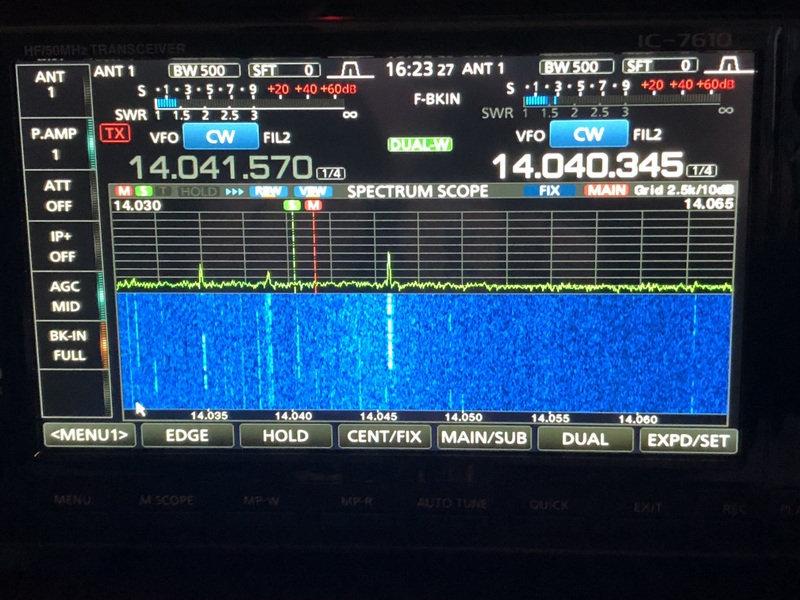
I toddled into the radio room this afternoon and flipped on the radio and most of the time I have my PC on and head over to DX Summit spotting network to see what's happening on the bands. I did notice right off the bat the RTTY contest was up and going fast and furious. I did notice some spots for POTA (Parks on the air) I headed over on my PC to the POTA website to see how many active POTA stations there were. I found some that were operating CW and I spun the dial to see if I could hear anything. I first tried KD3D he was in Allegany National Forest in the state of PA. He was around 559 coming into me and I gave him a call and was answered on the first call. We made our exchange and he was in the logbook with that I thought I would give a few other POTA stations a go.
I saw K4SWL was spotted and the call rang a bell so I looked him up and he has I blog that I follow and read regularly. I followed him around as he moved from band to band but I just could not hear him and if I did he was way down in the noise floor. I did hear other stations calling him and sending their reports. I did not want to try a call if I was not able to really hear him.
I then went after AI6ZD who was in California on Bolsa Chica State Beach.....it's -18 C here and just to think here is a ham on the beach in sunny California. Sometimes I feel the U.S/Canada border should have run north to south and not east to west! AI6ZD signal was down at the noise floor but now and then he jumped up to about S5. I hung on for a while and his signal slowly crept up and I was able to make contact and get him in the log.
I then noticed K4SWL was on 80m and I thought that could be my chance to make contact but it was not meant to be for today.
Radio Fun on Threemile Mountain (W0C/SP-107)
Lately, for the ARRL January VHF contest, I try to find a SOTA summit to activate. Operating time is usually just a few hours, so it does not make for a big score. The main advantage is for VHF SOTA (Summits On The Air) because there is a lot more activity on 2m CW and SSB. This year, I wanted to go for the mountaintop trifecta of SOTA, POTA (Parks On The Air) and VHF contest in one activation.


Threemile Mountain (W0C/SP-107) emerged as the activation summit because it is not too far from our cabin and accessible in the winter. (This time of year, the roads to many of our favorite summits are blocked.) For POTA, it is located in the Pike National Forest (K-4404). Because it is a short hike, I concluded that I could carry the Yaesu FT-911 and the 20 Ah Bionno battery. This would cover all the bands, give us more RF punch and still have plenty of battery capacity.

I carried quite a collection of antennas which gave us plenty of operating choices. We started out on 2m and 70 cm FM, working mostly local stations. This quickly got us enough contacts for SOTA and POTA points. We used a rollup J-pole for 2 meters and 70 cm, until it became intermittent and the SWR went wild. Then we switched to the Arrow 3-element Yagi for 2 meters.
About that time, I decided to see what was happening on 2m SSB. There were a number of contest stations on the air, mostly from the front range cities (Denver, Boulder, Colorado Springs, …). I worked a bunch of them using 50 watts from the FT-991 to the 2m Yagi antenna (horizontally polarized).

Suddenly, I was surprised to hear N0LL from Kansas calling me. I’ve worked Larry before from Colorado but it usually was from a really good location such as Mt Herman or Pikes Peak. Even then, we often had to switch to CW to complete the contact. Today he was louder than many of the Denver stations. We easily worked on SSB, which turned out to be a new personal best DX for me from a SOTA summit (372 miles).

After things slowed down on 2m SSB, I decided to make some HF contacts. The North American QSO Party (SSB) was active, so I decided to set up for 20m and see who I could work. Running 100 watts to an endfed halfwave kept me competitive with the contest stations. Then I moved up to 17m SSB and worked non-contest POTA and SOTA chasers.

We both accomplished the three-in-one mountaintop activation for SOTA, POTA, and the VHF contest. I also worked the NA QSO Party, so that makes it four-in-one, but who is counting? The January weather cooperated with us with almost no wind on the summit, about 28 degrees F. We sat there in the sunshine and just enjoyed the view before hiking back down.
73 Bob K0NR
The post Radio Fun on Threemile Mountain (W0C/SP-107) appeared first on The KØNR Radio Site.
North America Adventure Frequency: 146.58 MHz
Recently, on the nasota group, there was a discussion about designating an alternative 2m FM frequency for Summits On The Air (SOTA) use (instead of 146.52 MHz). The main driver for this is that 146.52 MHz can get busy with other radio traffic and/or a busy SOTA activation can tie up the calling frequency for a long time.
Rex KE6MT (SOTA W6 Association Manager) kicked it off with:
A friend of mine, George KJ6VU, has been talking with me and several others about the idea of an FM “Adventure Frequency.” It would be for more than just SOTA – other *OTA’s could also use it. There are other ideas to layer on top of it, such as tone signaling so that you don’t have to hear traffic you don’t want to hear, and repeater infrastructure for announcing someone’s on the frequency with a given tone, etc. But the core thing would be to decide on a frequency and really get it in use. The National Calling Frequency (146.52) can be great for a few contacts sometimes, but other times it’s problematic either because it’s being hogged or because nobody’s listening. Of course, this Adventure Frequency could have the same issues present themselves differently, but would alleviate some and pave the path for future additions mentioned above.
I have previously written about the challenges of using 146.52: The Use of 146.52 MHz
One important idea is to include the other “OTAs” in adopting this frequency, most notably Parks On The Air (POTA). Hence the name “Adventure Frequency,” and not “SOTA Frequency.” It is really about hams operating portable in an outdoor setting. Of course, like all amateur spectrum, this frequency must be shared with other users.
It may seem like a simple thing to choose a nationwide simplex frequency but VHF band plans are managed regionally. In particular, there is a mix of 15-kHz and 20-kHz channel spacings. (For more background on this see Simplex Channel Confusion on 2 Meters.)
After some discussion, the group settled on 146.58 MHz. There was some dialog around using CTCSS for signaling but nothing specific surfaced.
Some key points:
- The NAAF is 146.58 MHz.
- This frequency is in addition to, not a replacement for, the National Simplex Calling Frequency 146.52 MHz.
- Local usage will likely vary depending on needs.
- Program 146.58 MHz as The Other Simplex Frequency in your radio.
What does this mean to you?
Program 146.58 MHz into your radio and have it available. If you are doing SOTA (or POTA) activations, consider using this frequency, especially if you are in an area where 146.52 is used a lot. (I’ve already started using this frequency for SOTA activations near urban areas.)
73 Bob K0NR
The post North America Adventure Frequency: 146.58 MHz appeared first on The KØNR Radio Site.













