Posts Tagged ‘portable ops’
 Announcing the First Annual NJQRP Skeeter Hunt
 May 3rd, 2012 |
  Author:
 The NJQRP Club is announcing a new summertime operating event – “The Skeeter Hunt”. The objective is to get QRPers out of their shacks for the day; and into the fresh air and sunshine, to spread their wings and fill the airwaves with “Skeeters”. While commercial equipment can certainly utilized, bonus points will be awarded for those who personally home brewed their own or kit built their own equipment (equipment not built by the operator would not count as either home brewed or kit built – it would be considered commercial equipment). The inaugural event is to be held on Sunday August 12th. It will be a four hour sprint – from 17:00 UTC to 21:00 UTC (1:00 TO 5:00 PM EDT).

The theme for this year is “My favorite outdoor place”. You are encouraged to operate from your favorite outdoor place and tell us about it in your Soapbox comments.
Stations who wish to be designated as “Skeeters” can get a Skeeter number by requesting one by sending an e-mail to [email protected] Skeeter numbers would be issued from May through the day before the event.
Station Classes and Multipliers
X1 Home stations – commercial equipment
X2 Home stations – home brewed or kit built equipment
X3 Portable station – commercial equipment
X4 Portable station – home brewed or kit built equipment
Portable stations cannot use permanent antennas, i.e you can’t work from your backyard, hook up to your dipole or tower and yagi and be considered a portable station. Also, portable stations cannot be connected to the local power grid – alternative energy sources must be used – solar, battery, wind, etc.
Suggested Call – Either CQ QRP or CQ Buzz
Exchange –
Skeeter Stations – RST, S/P/C, Skeeter number
Non-Skeeter Stations – RST, S/P/C, Output power
Mode – CW
Power – 5W max
Scoring –
Working a Skeeter Station – 2 points
Working a non-Skeeter Station – 1 point
Total score equals the number of QSO points times the number of S/P/Cs worked on all bands (stations can be worked on multiple bands for QSO points and S/P/C credit) times the multiplier for station class.
Bonus points – design and home brew a key or paddle specifically for the event and earn an extra 1000 points.
Suggested frequencies:
The QRP “Watering Holes
80 Meters ~ 3.560 MHz
40 Meters ~ 7.040 and 7.030 MHz – also consider using from 7.114 to 7.122 MHz for a “slower” speed CW area. We want to have everyone involved!
20 Meters ~ 14.060 MHz
15 Meters ~ 21.060 MHz
10 Meters ~ 28.060 MHz
These are suggested starting points, of course. Feel free to spread out and give your “Skeeter” wings a chance to do their thing.
Logs, photos and soapbox comments can be sent to [email protected] no later than 30 days after the event. Certificates will be issued to the top scorers of each category as well as others to be determined.
A table of call signs and issued “Skeeter” numbers will appear on a separate page on this site.
Hope to hear and work all of you during this new event. Special thanks to the NJQRP club for their sponsorship!
72 de Larry W2LJ
QRP – When you care to send the very least!

New Summer Operating Event
I’ve been working with the leadership from the NJQRP club to start a new annual Summertime outdoor QRP operating event. My idea has earned their blessing.
Thanks to George N2APB and Joe N2CX, I will be announcing the details for the First Annual NJQRP Skeeter Hunt, in the next few coming days.
.jpg)
Stay tuned !
72 de Larry W2LJ
QRP – When you care to send the very least!

Battery Evolution
As mentioned in one of my last posts, the lithium ion battery that I had acquired from eBay arrived. There was a “return receipt, signature confirmation” slip in the mail box and I went and picked it up from the Post Office this morning.
Batteries sure are getting lighter and smaller!
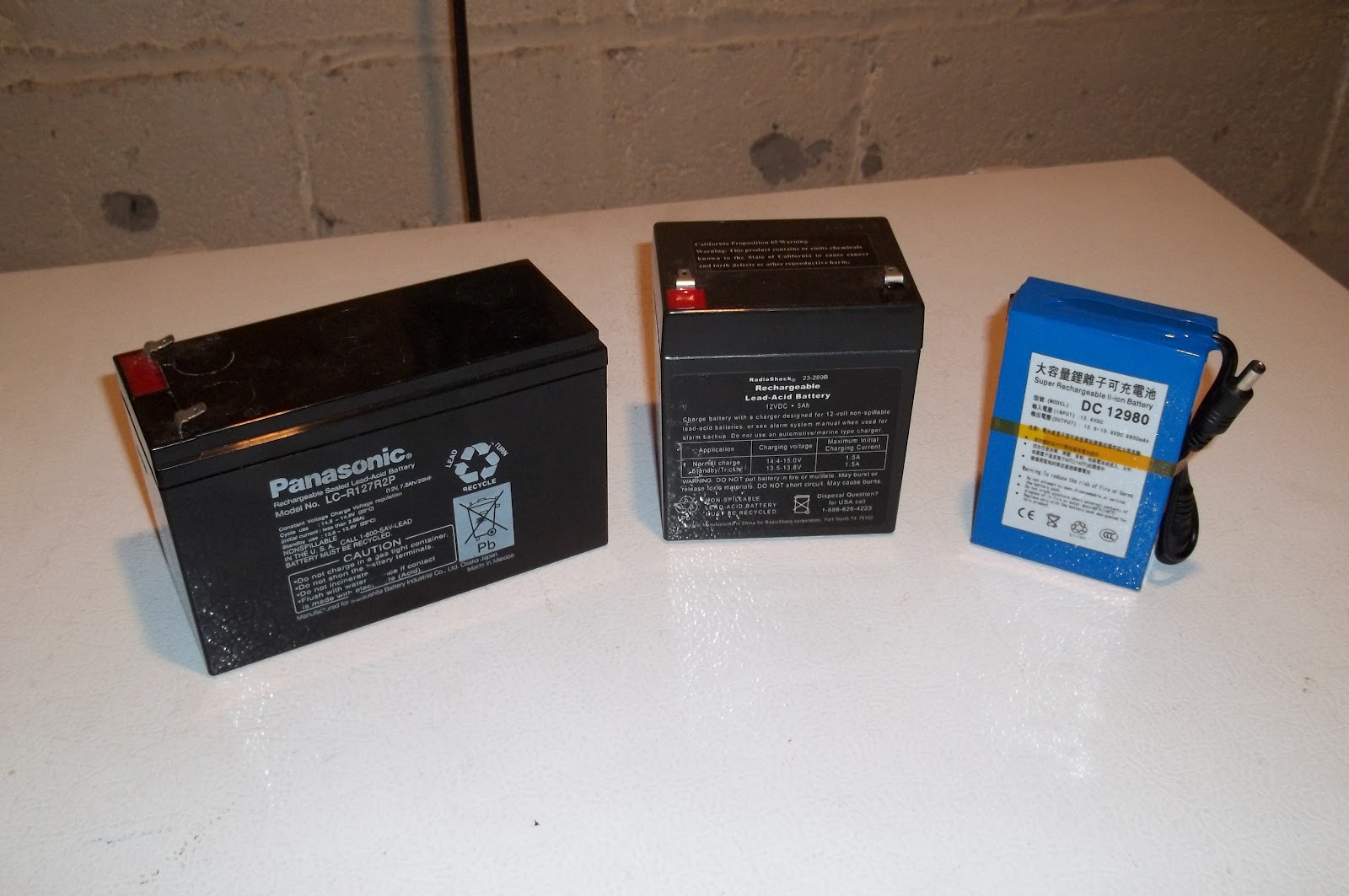
The battery to the left is the very first sealed lead acid battery that I’ve ever used for portable field operations. I’ve had this guy for about eight years now. It’s a 7.2Ah battery, probably about 5 pounds (a tad more than 2 kilos)- about the weight of a bag of sugar (roughly). It came out of an emergency EXIT light that was in the building that I used to work at. I saved it from the dumpster and there was (and still is) absolutely nothing wrong with it. Only drawback for field operations is the weight.
The middle battery is the one I’ve been using for about the last three years. It’s rated at 5Ah and is roughly half the weight of the big battery (approx. 2.5 pounds or about 1 kilo).
“Little Boy Blue” to the extreme right is the lithium ion battery. 9.8Ah and I would say, the same size as a pack of cigarettes. It weighs less than a pound (less than 1/2 a kilo). It came with a wall wart (not pictured) for charging, it has both male and female 3.5mm connectors for output; and it has a little switch on the left hand side with a tiny red LED indicator to let you know you have turned the battery “on”.
More capacity in a smaller, lighter package. How cool is that?
72 de Larry W2LJ
QRP – When you care to send the very least!

W1PID – at it again!
Jim W1PID proves that it doesn’t have to be a long outdoor session in order to have success.
http://www.w1pid.com/quickie/quickie.html
I need to remember this. There are times when I am guilty of being lazy, I guess. I hesitate sometimes, to set up the station even with the fast mobile setup, because I convince myself that “there’s not enough time”.
Jim proves that if you know what you are doing, that even 15 minutes can be enough. And that’s a good habit to get into. In his case though (and I say this with my tongue firmly planted in my cheek) I have to admit the local scenery sure can make up for things even when the bands are dead. Who wouldn’t want to spend time out in the New Hampshire countryside? The QSOs are the icing on the cake!
As always, thanks for sharing, Jim. Another FB job, OM!
72 de Larry W2LJ
QRP – When you care to send the very least!

From the Winter that never was
to the beautiful Spring that is upon us. Celebrated with Amateur Radio by Jim W1PID:
http://www.w1pid.com/april/april.html
72 de Larry W2LJ
QRP – When you care to send the very least!

Titanic error on my part
I don’t like to “steal” from my fellow bloggers; but I caught this on John N8ZYA’s blog. It is worth sharing with those of you who might not read his blog (You’re cheating yourself if you don’t! Just saying!) This “independent movie” is about 45 minutes long. It’s worth viewing to get an idea on how wireless was situated on seafaring vessels.
Now for the error as described in the post title. I didn’t work any of the Titanic Special Event stations due to some pandemonium that has been enveloping me over the past few days. With this Saturday being a full week past the anniversary day, I doubt any of them remain on the air. Oh well, centennial observances, like the tides, wait for no man.
Oh – before I close. This rule change to QRPTTF appeared on QRP-L today:
~~~~~~~~~~~~~~~~~~~~~~~~~~~~~~~~~~~~~~~~~~~~~~~~~~~~~~~
Gang,
While QRPTTF is open to all QRPers, I have always seen it as a “QRP-L” function. This is where it is administered and the QRPers on this list are those I attempt to satisfy and respond to.
Response to having additional SOTA stations on the air for QRPTTF has generally been positive. However, I underestimated the desire of QRPers to go climb their nearby mountain or feature, whether a SOTA summit or not. A few want to make a camping trip out of it. SOTA began and is headquartered in the UK. There are numerous US chapters. Not all states/call districts have a SOTA chapter, mostly due to no or few summits to survey or activate over 500 feet high. SOTA guidelines state that the minimum “prominence” for a summit is 100M or 300 feet. Sounds good enough for me. Therefore, we will also use this definition.
RULE CHANGE
QRPTTF has been expanded from three to four categories and multipliers
STATION CLASS AND MULTIPLIERS:
X1 HOME station
X2 FIELD HILL station – operating on a hill from 3-300 feet above
average terrain
X3 SUMMIT station – operating from a “hill” or geological feature
300 feet or higher from the average terrain
X4 SOTA Summit – operating from a designated SOTA summit
I have received several emails from those wanting to operate from the largest darn “mountain” in their corner of the state, though not a SOTA summit, which in most cases will require a substantial effort. This rule change will allow you to do this and receive a X3 multiplier for the additional effort. In turn, operating from a designated SOTA summit is now X4.
This rule change has been updated on the website, rules and summary sheet
http://www.zianet.com/qrp/ or direct: http://www.zianet.com/qrp/QRPTTF/ttf.html
So for those of you who want to be a QRP “Mountain man” for the weekend, go
for it!
72, Paul NA5N
PS – Driving out to the VLA site today (54 miles from Socorro), it made me appreciate how we have to drive through or around three different mountain ranges, with numerous peaks from 9,000-12,000 feet. I always took them for granted. Not anymore. Average terrain here is about 4,700 feet, the VLA is at 7,000 feet.
~~~~~~~~~~~~~~~~~~~~~~~~~~~~~~~~~~~~~~~~~~~~~~~~~~~~~~~~~
72 de Larry W2LJ
QRP – When you care to send the very least!

QRPTTF Rules for 2012
Hot off QRP-L:
~~~~~~~~~~~~~~~~~~~~~~~~~~~~~~~~~~~~~~~~~~~~~~~
Gang,
The rules for this year’s QRP TO THE FIELD (QRPTTF) and Summary Sheet are posted at: http://www.zianet.com/qrp/
This year, we are teaming up with the Summits on the Air stations – or SOTA. SOTA stations will be operating from designated summits to participate in QRPTTF. SOTA stations are QRP – some QRPp, and operate on the usual QRP watering holes. This joint effort was designed to give us all more stations to work (since the sun isn’t helping us out much … solar flux for QRPTTF predicted to be 100).
Since we’re talking mountains and summits, this year’s theme is “Get high with QRP” … basically, operate from any old nearby hill or as high as you want to go.
SOTA stations will send the exchange, plus a SOTA designator they use for identifying the summit (this gives them credit for their awards as well). Many hike to the summits with a minimalist station, often QRPp, so may be a bit weak. Whether you work TTF or SOTA stations, they all go in the log for credit. However, you also get an extra multiplier for each SOTA station worked to reward you for your effort to boost your score.
Complete details and scoring on the website http://www.zianet.com/qrp/
There are also several SOTA members on QRP-L that will be participating in QRPTTF. If you have any questions regarding SOTA, or if you feel so inclined to operate a SOTA location, ask here and they will answer your questions.
None of us want to haul our gear to the field then struggle to find stations to work. Past few years, we have plenty of experience with that! This will give us more stations to work for more QSOs, higher scores, and of course, more fun.
72, Paul NA5N
~~~~~~~~~~~~~~~~~~~~~~~~~~~~~~~~~~~~~~~~~~~~~~~
Thanks, Paul – remember folks, QRPTTF is Saturday, April 28th.
72 de Larry W2LJ
QRP – When you care to send the very least!














