Posts Tagged ‘Operating’
 Across the pond mobile
 March 16th, 2010 |
  Author:
 With rain being forecast for the rest of the week I thought I would take the opportunity to make a few more mobile contacts. Before I did I decided to make a modification to the antenna that I hoped might improve the SWR of the MP-1 on the magnetic mount.
The Moonraker 7in. Turbo mag mount is not, in fact, a 7in. diameter magnet. It is more like a 5in. diameter magnet inside a steel case shaped like an upside down dinner plate with a 7in overall diameter. The magnet is not a tight fit inside the recess of the plate, so by drilling close to the flange I was able to make a hole without drilling into the magnet, to which I attached a terminal for one of those push-on electrical connectors. This could be used to attach a wire to ground the antenna to the car body. But as I hadn’t found a suitable grounding point I decided instead to make up a set of quarter wave counterpoises for 10m, 15m and 20m which I attached to a mating connector.
This time I thought I would drive to the coast to see whether being close to the sea would help me work across to North America. I parked beside the road half way between Maryport and Allonby, looking across the Solway estuary to the Scottish mountains in the distance. It was a sunny afternoon, the sky was blue and the sun glittered off the sea. A nice mobile QTH for a spot of operating.
I set up the MP-1 on the magnetic mount and checked the SWR on 20m using the antenna analyzer: it was about 2:1 as it was before. I then connected the counterpoise, expecting the SWR to come down to a 1:1 and was amazed to find it made absolutely no difference. It was as if there was no connection to the counterpoise at all – though I checked, and there was. Possibly the SWR curve changed slightly but the null stayed exactly the same, which was very disappointing.
I switched to 15m, tuned the MP-1 for best SWR and had a listen around. The first contact was with Nick, UY3LA from Lozovaya 150km south of Kharkov in Ukraine. My report from him was 55 to 59. He spoke good English and we had a chat for five minutes. I told Nick that my wife was in Kharkov at this very moment, and he invited us to visit him the next time we are both in Ukraine.
I heard some nice DX including FM5WD, A71CV, XE1HH, VU2JQ and CU2AA. I also heard several Stateside stations but could not get through to any of them. I switched to 17m for a while and made a couple of European contacts with good reports, which surprised me as there was a small hill about 80ft high immediately behind me in the direction of Europe. I’ll never understand HF propagation.
I also had an eyeball QSO with a local from Allonby who drove by and saw my antenna. He was a fellow radio enthusiast and wanted to say hello. It turned out the radio he was enthusiastic about was the 11m kind, but he was interested in getting a ham license so I told him to contact the Workington club for more information. He has a better antenna than me – a Sirio vertical up at 20 feet above all the TV antennas. I can just imagine what my neighbours would do if I tried that. That’s the trouble with living in a “posh” area.
Eventually I returned to 15m where I could still hear several US stations. I called K1JDL who said “I can hear a mobile in there but I just can’t pull you out” and then immediately QSY’d. Then I called Tom W0WP in Iowa who came right back with a report of 57 to 58. We had a really good chat for 15 minutes and Tom said that he “didn’t miss a word.” He was running 1200W to a TH6DXX so I said he must have a good receiver as my power was 20dB less than his. I thought he would say he was using a K3 but in fact he was using a TS-2000! However he is out in the country in a plot of several acres and the nearest neighbour is a quarter of a mile away so he doesn’t suffer from man-made QRN. I can only dream!
Mission accomplished: my first Stateside contact from the mobile and a good solid ragchew to boot. I decided to call it a day and go home for tea.

Mobile DX
It occurred to me recently that the reason why I can rarely bring myself to work anything other than digital modes is because the noise level on the HF bands at home is so high that listening to the radio is too unpleasant. Tune across the band and you hear dozens of carriers against a background of hash and buzz, with odd patches of warbly noises. Although the noise falls off on the higher bands the carriers if anything get worse. Forget about listening for beacons on VHF! I don’t think the problem is solvable, as I believe I am hearing the combined output of all the houses in the neighbourhood, not the product of a single rogue device that could (theoretically) be tracked down and eliminated. So my instinct is just to work digital modes with the volume turned off.
People have often asked me why I don’t operate portable or mobile from the car to get away from all this QRN. My usual answer is that I often operate for an hour or so here and there and it isn’t practical for such a short time as that. Operating from the car on a cold dark winter night isn’t as attractive a prospect as doing it from a warm shack, and my wife would probably take a dim view my going off for three or four hours at a time just to talk on the radio in any case. But Olga is away at the moment and I’m getting fed up with digital modes, so I thought I would give it a go.
 I already had a Superantennas MP-1 which I bought for portable use, but haven’t made much use of it for that due to the British weather rarely being warm enough to tempt me out. (Yes, I know SOTA types operate from hilltops in sub-zero temperatures and howling gales, but I like my comforts and they’re masochists.) A quick trip to Maplin in Carlisle resulted in the purchase of a Moonraker 7 inch Turbo mag mount with the requisite 3/8 fitting. Then I drove out to a quiet spot to try it out. The spot I chose isn’t an ideal radio location as it is surrounded by hills, but I haven’t yet found somewhere with a good take-off that isn’t a “viewpoint” and packed with tourists, or anywhere that I can drive on to the beach.
I took the antenna analyzer along which made tuning the antenna a lot easier. I started off on 15m, where I got an SWR of 1.5:1. For the radio I took along my Elecraft K2, which has been little-used since the K3 came along. I set the power to 12W and searched for someone to work.
My first mobile contact was with John 9H5JW, a British expat living in Malta. He gave me a 58 report to my 59 (he was running 100W). We had a good chat for ten minutes and I felt the MP-1 was doing a really good job.
Next I heard KD4FNI from Ozark, Alabama. He didn’t hear me, unfortunately. My next contact was with Nick RV3EFR near Orel for 59 both ways. Then I tried to call Harry 7Q7HB in Malawi. He was working another mobile in Finland, but unfortunately when he finished there was a bit of a pile-up and he didn’t hear my call. He was strong enough that I’m sure we could have made a contact, as was KP4BD in Puerto Rico whom I also called without success.
My third contact was VU2DSI from near Mumbai in India. He gave me a 56 to his 59. I’m pretty sure I haven’t worked India before, even from home, so I was very happy with this. The /M suffix is really worth about 10dB of gain. “Will the mobile please call again.”
My final contact on 15m was with Mauro I5HOR near Florence. He gave me a 55.
I was pretty happy with those contacts, but I wanted to see how the MP-1 performed on a mag mount on the other bands. On 10m I got a 1.2:1 SWR, though there was nothing to be heard on that band. I went up to 40m and the SWR dip was pretty sharp and would only come down to 3:1. On 20m I got around 2:1, and managed a quick QSO with Franco IZ4NPE for a 58 report on that band, so it was not too bad.
Clearly the poor ground through the mag mount affects the SWR of the MP-1 on the lower bands. The K2 ATU can take care of this quite happily, but possibly performance is compromised as well. A permanent mount on the car isn’t an option, nor would it be worth the trouble for the amount of use it is likely to get. I will have to see if I can drill the mag mount and fit a terminal that would allow me to attach a temporary ground wire to the car body, or even a resonant counterpoise, if that would make a difference.
All in all it was a worthwhile exercise that I’ll probably try again. To make a contact with India from a parked car using 12W to a whip antenna is quite an achievement!

WebSDR

My bud Ulis K3LU just turned me onto the WebSDR project. Spent a little time this morning listening to W4MQ’s station, which is set up for 160m, 40m, and 20m. Very impressive — I’ve steered clear of online remote receivers in the past because they were typically a single radio controlled by a single user at a time (or, worse, by multiple users continuously changing frequency and mode, making it little more than an exercise in hi-tech uselessness). But this is different — a true server that lets multiple people listen at the same time on whatever band/frequency/mode they want, completely independent of one another. Way cool.
NCJ: What’s the Best Contest Rig?
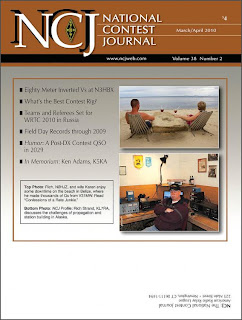 The March/April 2010 National Contest Journal arrived yesterday, torn and tattered as always (thanks again, US Postal Service!), and with it the results of K3MD’s informal poll of top contesters asking, “What’s the best contest rig?” It’s by no means a scientific survey, nor all-inclusive, but many of the Big Guns you’d expect participated.
February 2010 Wrap-Up
All | 80m | 40m | 30m | 20m | 17m | 15m | Ph | CW | Dig | |
DXCC | 80 | 2 | 43 | 10 | 66 | 13 | 22 | 52 | 5 | 62 |
WAS | 50 | 28 | 49 | 7 | 48 | 19 | 19 | 43 | 1 | 50 |
WAZ | 26 | 3 | 21 | 8 | 23 | 9 | 9 | 22 | 5 | 22 |
NAQP RTTY – Feb 2010

- QSOs: 160
- US States: 35
- VE Provinces: 5
- Total Mults: 71
- Score: 11,360 pts.
- 15m: 34 QSOs, 10 states, 2 provinces
- 20m: 42 QSOs, 22 states, 2 provinces
- 40m: 84 QSOs, 30 states, 5 provinces
January 2010 Wrap-Up
All | 80m | 40m | 30m | 20m | 17m | 15m | Ph | CW | Dig | |
DXCC | 80 | 2 | 42 | 10 | 66 | 12 | 20 | 52 | 5 | 62 |
WAS | 50 | 28 | 48 | 7 | 48 | 19 | 12 | 43 | 1 | 50 |
WAZ | 26 | 3 | 20 | 8 | 23 | 9 | 8 | 22 | 5 | 22 |













