Posts Tagged ‘Morse Code’
 Nifty I Phone Morse Code Decoder
 July 6th, 2015 |
  Author:
 HOT PAW
MORSE CODE DECODER FOR I PHONE

Screen Snap of Hot Paw Morse Code Decoder
I recently installed a ham radio station in my truck. Since then I’ve been having a lot of fun with it, using SSB mostly, since that is a novelty for me. Most of my operating has been using CW, but taking a side trip into PSK occasionally. Logging is somewhat cumbersome in a truck. I used big elastic bands to attach a small clip board to my leg so I could quickly write down a call sign and very basic information. This information would be then transferred to a computer log at home. I tried using the computer in the truck also, and that proved even more cumbersome, having the laptop jammed into the steering wheel.
I like to use a keyboard to send code but no matter what I used, it was a bit awkward in the truck. At the very least, the laptop stays put when its jammed into the steering wheel. Using the passenger seat would require my changing the radio head orientation, the antenna control and paddles which are all set up for easy use from the drivers seat.
Occasionally I’d switch to CW and fumbled for a pen to write down a call sign, time, and band. The guy I was chatting with on 40 meter CW was running just a tad too fast for me to copy ‘everything he sent’, so I missed some of it. It seems that the ‘buffer in my brain’ is smaller than I’d like it to be and with FIFO being the rule, the beginning of a word vanishes as I copy the ending.
(FIFO, First In, First Out’) Some folks may complain that using a ‘decoder’ is cheating somehow. Yes, for a contest, but for every day QSO’s its not cheating at all. If you don’t like it, don’t use it!
I discovered this app and tried it last night for the first time. Wowzah, can it copy code! Just lean it up against your radio, or just near it, and it copies CW. This is a really great help when someone is sending just a ‘tad faster’ than my ability to copy ‘everything’! Its also handy to ‘get the entire call sign’, while I was fumbling with other things in the truck! It works pretty well even in poor band conditions, and has Farnsworth Method as well as regular copy. It has ultra high speed copy, but I have not tried it. 1oo WPM code is hard to come by on the air.
This proves very useful in the truck, but my guess is that other hams will find it handy in other ways.
PIXIE 2 QRP Transceiver build
PIXIE 2 QRP Transceiver build
Listening to code practice
"Whoa! What's that now? How can listening to code practice help improve sending?" you might be asking yourself (and me).
By listening to the timing gents (and ladies) ...... it's all in the timing - and the spaces.
Too many times I get carried away and ignore my spacing. Spacing between individual characters and spacing between words and even spacing between sentences is critical. Ignore spacing and I'll bet you dollars to donuts that you leave others scratching their heads trying to figure out what you're sending. You probably run into a lot of "Gotta QRT now" scenarios, too.
By paying attention to your timing and spaces, and you'll be that guy that everyone wants to QSO with - you'll be that guy with the "good fist". Run on sentences and run on words are not only hard to read - they're also hard to hear.
So I listen to W1AW to remind myself from time to time what perfect code sounds like. The more often I hear perfect code, the better I am equipped to emulate it. Oh, and this doesn't apply only to the QRQ guys, although I suspects it's more important for them. Proper spacing applies to the QRS guys as well - no one is exempt.
Do yourself a favor and tune into W1AW every now and then - especially if you feel you don't need to.
72 de Larry W2LJ
QRP - When you care to send the very least!
Happy Morse Code Day!
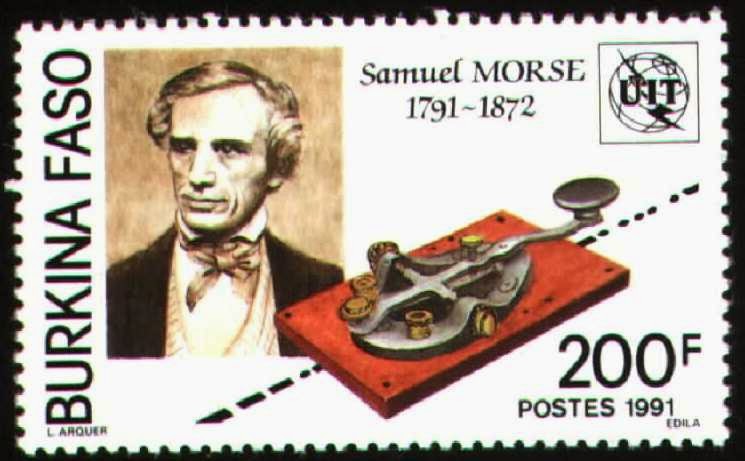
Does this make Samuel the original "Old Man"? Sorry Mr. Maxim*, I think Mr. Morse has seniority on you for that title, as Mr. Morse would be celebrating his 224th birthday today, were he of the kin of Methuselah.
Now that QRPTTF is over, except for e-mailing in my log summary, I thought I'd post where my signal was being heard on Saturday, according to the Reverse Beacon Network.
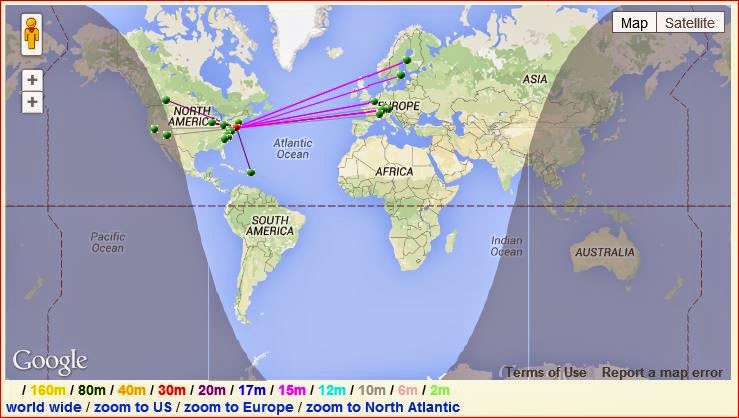
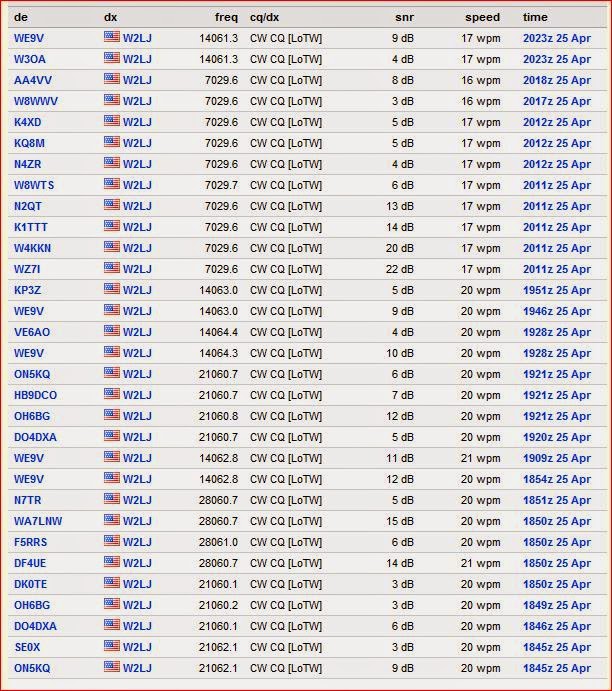
Bob W3BBO and I were discussing QRPTTF yesterday amongst ourselves, and it occurred to both of us that the western half of the nation seems to have reported larger QSO totals than the eastern half of the nation. This based on e-mails sent to QRP-L that we had read. Not sure what that means, but so far I haven't seen many e-mails from anyone east of the Mississippi with log summaries of around 40 QSOs or so. It will be interesting to see how it breaks down geographically once the results are in.
The EARCHI does get heard, and being on the top of a high hill (we call those mountains, here in NJ) sure makes a difference. And this makes for the other important lesson I've learned from events such as these. As nice as it would be to come in 1st place in a contest such as QRPTTF, the real prize won is enjoying a day outdoors, playing radio in the fresh air and sunshine, being able to forget about everyday worries, cares and concerns, even if it's just for a couple hours.
72 de Larry W2LJ
QRP - When you care to send the very least!
* - For those of you who are new to the Ham radio game, Hiram Percy Maxim who founded the ARRL, often wrote editorials under the pseudonym "The Old Man". Since HPM lived from 1869 - 1936. I guess that makes Mr. Morse the rightful holder of "The Old Man" title.
January Special Event – Straight Key Century Club and K3Y/0
All month long, during January 2015, a group of volunteers using the special event callsign, “K3Y” with a slant-region number (i.e., “K3Y/3” or “K3Y/0”), were on the amateur radio HF bands (and some, on six meters). I was one of these volunteers, operating nearly every day of the month for at least one hour, but some times a few hours per day.
“K3Y,” the Straight Key Century Club’s annual January celebration, commemorates the club’s founding in 2006 following the American Radio Relay League’s Straight Key Night. A small group of participants wanted to extend the fun of SKN throughout the year. The SKCC is the result.
For the first three years, the club’s founders used K1Y, K2A, and K3Y as the celebration’s special-event calls. But someone cleverly noticed that a 3 is nothing more than a backwards, curvaceous E. This “KEY” event has operated under the K3Y call ever since.
The on-air party is open to members and non-members alike. It runs from 0000 UTC Jan. 2 through 2359 UTC Jan. 31. It’s a great time to introduce others to the joys of hand-crafted Morse code using straight keys, bugs, and side swipers.
In this video, you can see this operation at my ham radio shack, as I am the control operator of the special event station, “K3Y/0”, during one of the many shifts. “K3Y” is the special event callsign of the Straight Key Century Club (SKCC). The special event operates each January.
In the following video, you can see some of the QSL cards associated with this year’s operation, and then some other QSL cards in my collection.
https://www.youtube.com/watch?v=gOsNjT7OCyc
+ The SKCC website is at http://skccgroup.com
+ The “K3Y” special event page is http://www.skccgroup.com/k3y/index.php
+ My page is at http://NW7US.us
+ My Morse code page is http://cw.hfradio.org
It’s been a while
I haven't run this piece in a long time. It's from my old webpage on how to adjust a bug:
Using a bug is a real fun part of using Morse Code. Adjusting one properly so that it works right for you and doesn't frustrate the heck out of you is easy; if you take your time and work methodically. Refer to the photo below for reference.
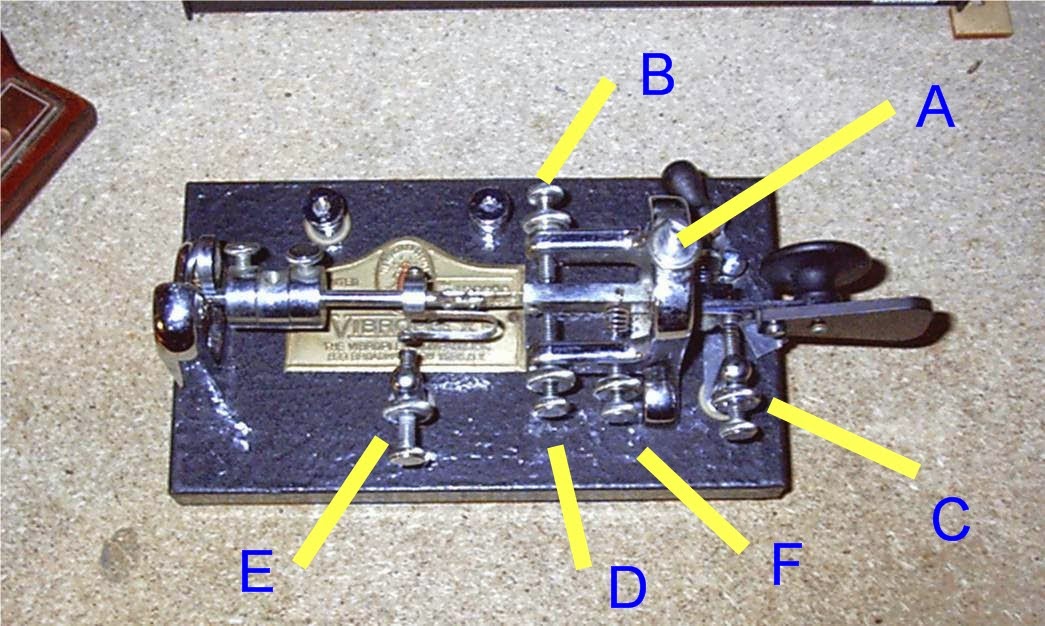
The first thing you do is to back off all the adjusting screws quite a bit. Not all the way; but far enough out so that everything is nowhere near being set. Once that's done you want to adjust the action of the pendulum. Unscrew "A" - this is the pivot point for the pendulum. Slowly tighten it. You'll know you have it adjusted correctly when the pendulum moves from side to side freely with no binding; but, at the same time, you can move the finger pieces up and down with your fingers and feel very little or no play.
The next thing you want to do is to adjust screw "B". Allow the pendulum to hit the damper. Screw in "B" to the point where you can either see or just perceive the pendulum has touched the damper. Stop there and secure the screw with the knurled lock nut. It is important not to move the pendulum too far away from the damper or else you will not be able to reliably stop your "dits".
The next thing you want to do is adjust the left trunnion screw - D. This will control the amount of side to side travel of the pendulum. For smooth code this gap should be very small. I take a piece of ordinary printer paper, fold it in half to double it and adjust the spacing so that the paper will just slip between the point of the screw and the pendulum. This results in a very small amount of side to side travel. The end result is a nice and clean transition between "dits" and "dahs". I do the same thing for the amount of spacing for the "dah" contact at C. I turn that trunnion screw in so that the paper slips in the gap easily with no binding, then I lock the set screw in place to keep the setting.
The next thing you want to do is adjust the "dits" making part of your bug. This is done by adjusting "E". When "E" is adjusted correctly, you should be able to swing the pendulum to make "dits"; and get 10 to 15 "dits" before the pendulum dampens out and comes to a rest.
"F" controls the tension of the "dit" action. I find it best to tension the spring about half way. Hopefully, if you follow this guide and play around a little bit and experiment, you will find the "sweet spot" that will allow you to send really glassy smooth Morse Code.
Sending with a Bug is just as much fun as sending with a keyer and paddles. However, sending with a Bug allows you to add a little personality. Listening to CW sent with a keyer sounds sterile compared to that sent with a Bug.
If you need to slow down the speed of your Bug to a point that's even slower than what you can get with the weight(s) positioned all the way to the end of the pendulum, then clip a clothes pin or a few alligator clips to the end of the pendulum. This will slow down a Bug to an effective speed as low as 13 words per minute or so.
In my opinion, you know that your bug is adjusted properly when you can send characters like X, Y, Q, C, F and L with little effort, and they sound good - or at least recognizable in my case!
Here's a great video that shows you how to do it, also:
72 de Larry W2LJ
QRP - When you care to send the very least!













