Posts Tagged ‘hobbies’
 What was your first major receiver?
 May 30th, 2026 |
  Author:
 I started in the ham radio and shortwave listening hobby in 1972. By 1975, this was my first real receiver. It heard very well, and ignited my lifelong passion for radio.

The R-366/TRR-5 military receiver.
This old radio, the R-366/TRR-5, which is clearly identified on the faceplate in this picture of the military rig, had great ears. It was what I used to hone my Morse code copying skills and to get the hang of how amateur radio operators conducted communications with each other, with CW, AM, or SSB. I hope someday to own one once again.
The R-366
The R-366/TRR-5 is a significant piece of military history manufactured for the Navy Department Bureau of Ships by the Espey Manufacturing Company. Built during an era when the United States Navy required absolute reliability for ship to shore and ship to ship communications, the unit is a testament to the rugged industrial design of the mid-twentieth century. Often referred to as part of the TRR-5 receiving set, this equipment frequently incorporated high quality components and precision engineering including the gold standard Collins Radio Company designs of that period. These internal components were vital in providing the remarkable stability and selectivity needed to pull weak signals out of the dense electronic noise environment found on a crowded naval vessel. It did have heterodyne squeals on a select few frequencies, which any old tube receiver was prone to have, but those did not detract from the excellent capability of the radio.
The Service
For the sailors and radio operators serving aboard ships in the 1950s and 1960s these receivers were far more than just tools for duty. In the often cramped and isolated conditions of life at sea these radios served as a critical psychological anchor. Access to the bands meant hearing the familiar sounds of home or tuning into MARS stations where amateur radio operators facilitated phone patches that reconnected sailors with their families. This bridge to the outside world was essential for maintaining morale and supporting the mental health of military personnel who were otherwise cut off from the rhythms of civilian life for months at a time. Sitting in the radio shack and slowly tuning that large central dial while listening to the crackle of the ionosphere was a meditative escape from the constant hum of shipboard operations. Many ships would pipe ball games and news shows, or music programs, over the ships intercomms, providing health and morale to the personnel.
Operating the Radio
The tactile experience of operating this specific receiver remains vivid in my memory. The layout with its distinct knobs for selectivity phasing and BFO control was designed for the hands of a professional radio operator who needed to manipulate the signal in real time. It required a disciplined ear and a steady hand to copy Morse code through heavy atmospheric conditions but that struggle made every successful reception feel deeply rewarding. It taught me the patience and technical appreciation that have defined my amateur radio hobby for decades. Owning and using a piece of history like this represented a connection to the generations of operators who stood the watch before me.
Traveling the World…
With this historic military receiver, I discovered an entire world as a child in the mid 1970s. I spent countless nights in the quiet darkness of my room with only the warm orange and yellow glow from the vacuum tubes leaking out of the back and top grills and slots of the radio enclosure, as those hot tubes cast soft light on the ceiling and walls. That radio allowed me to travel the globe from my listening position often sitting cross-legged on the floor in front of this big rig. Those late night listening sessions, when I should have been sleeping, ignited a lifelong passion for understanding the vast and interconnected world of shortwave radio as well as medium-wave DXing. I heard International Shortwave Broadcast stations as well as AM broadcast stations from Europe, Asia, the South Pacific, the Atlantic regions, South America, Central America, and North America–all over the world! I listened to amateur radio operators on Morse code, SSB, and AM modes. Ships at sea, aircraft doing transoceanic flights, fishing vessels comms where fishing captains would chat with other boat captains, and even military communications were all at my fingertips on the dial of the radio as I listened to these exotic places by headphones. I even picked up a station from Peru, South America late one night, on the mediumwave broadcast band. That is how great that receiver could hear. Of course, I had a very excellent outdoor dipole antenna that was cut for 160 meters.
What Receiver Was Your First?
What was your first major receiver? Was it just a receiver, or was it a transceiver? When was that? What did you hear that captured your imagination? Do you still have that radio?
I hope to someday have this R-366/TRR-5, once again.
~ Happy DX!
NW7US
January Phase Noise
Radio activity around here was asymptotically approaching zero until this past weekend when I managed to put about two hours into the ARRL January VHF contest. In brief, here’s what’s happening around K8GU:
- 47Q x 17G on 6 (8/2), 2 (29/11), and 432 (10/4) in ARRL January VHF. The 6-meter QSOs were all made with an HF antenna. I ran 100 watts on 432 so I’m ineligible for the 3-band category. Heard, but didn’t work, N1GC (EM59), K1TEO (FN31, whom I almost always work), and VE3??? (FN03, I had the whole call at the time but forgot, working K1RZ).
- I did not work EP6T on any bands and really don’t care. I didn’t hear much of the jamming when I did listen (on 40 and 80). To paraphrase KE9V quoting JA1NUT, “I’m kind of over DXing.” Who has time for this, anyway?
- Speaking of the seedy underbelly of DXing…do you know what a “QSL grubber” is? I’ve experienced a couple of different variations on this in the past year and it’s disturbing. One guy was asking about specific QSOs and provided detailed description of (my) signal characteristics. Nevermind the fact that I never operated on the band he mentioned during that operation. He sent similar e-mail to several friends. As if DX operators don’t talk to each other? The DXCC desk has been notified. I wonder if anybody actually falls for it or gives in, though?
- I made token efforts in NAQP CW and Phone to chalk up a participation multiplier for PVRC in the three-way PVRC-SMC-NCCC competition.
- No homebrewing or repair work has been undertaken since the summer.
- The baby can crawl and wants to walk so badly she can’t stand it. The end is near.
- I took Evan to the Odenton Hamfest on Sunday morning. The highlight for him was stopping for donuts…and stopping at a playground on the way home. Bought some Snap-N-Seal F-type compression connectors for a work project, part of my quest to find the perfect F-connector for the perfect RG-6 type cable (quad-shielded, flooded). More on this in a future post.
- It seems there are plenty of Elecraft K2’s on the market these days. As the price slips below 1000 USD for a loaded K2/100, this radio is becoming a good buy. As a secondary note, they all seem to be “professionally constructed by a well-known builder.” This leads me to wonder what fraction of K2s were built by someone other than the owner (I estimated this fraction once to be about 1/3 of them). I also wonder if people who built their own K2s hold onto them longer?
And so it goes, time to punch my card…
Custom Backshells for Cinch-Jones Connectors
What do you do to complete these hamfest bargains? 3D printing for the win!
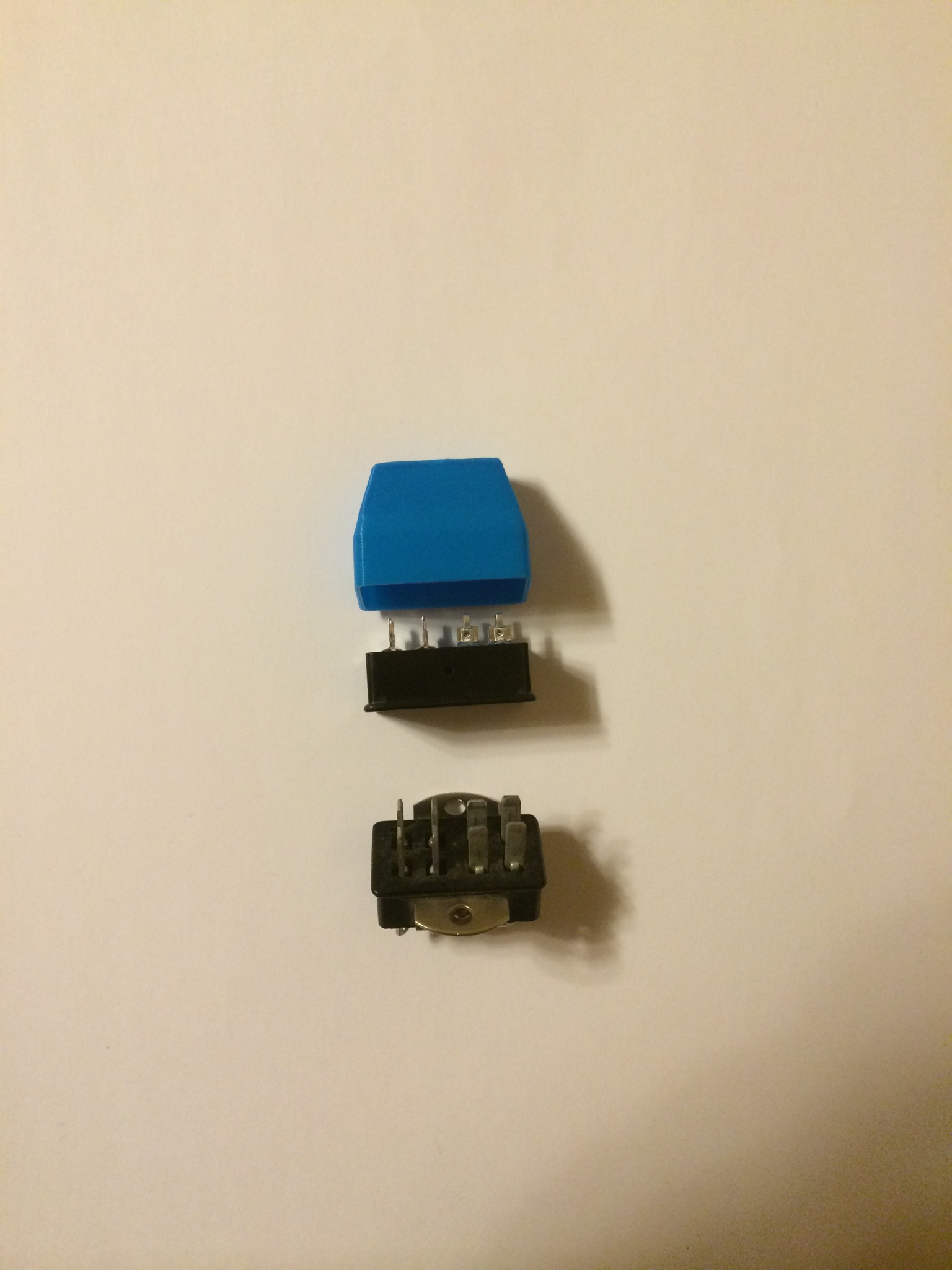
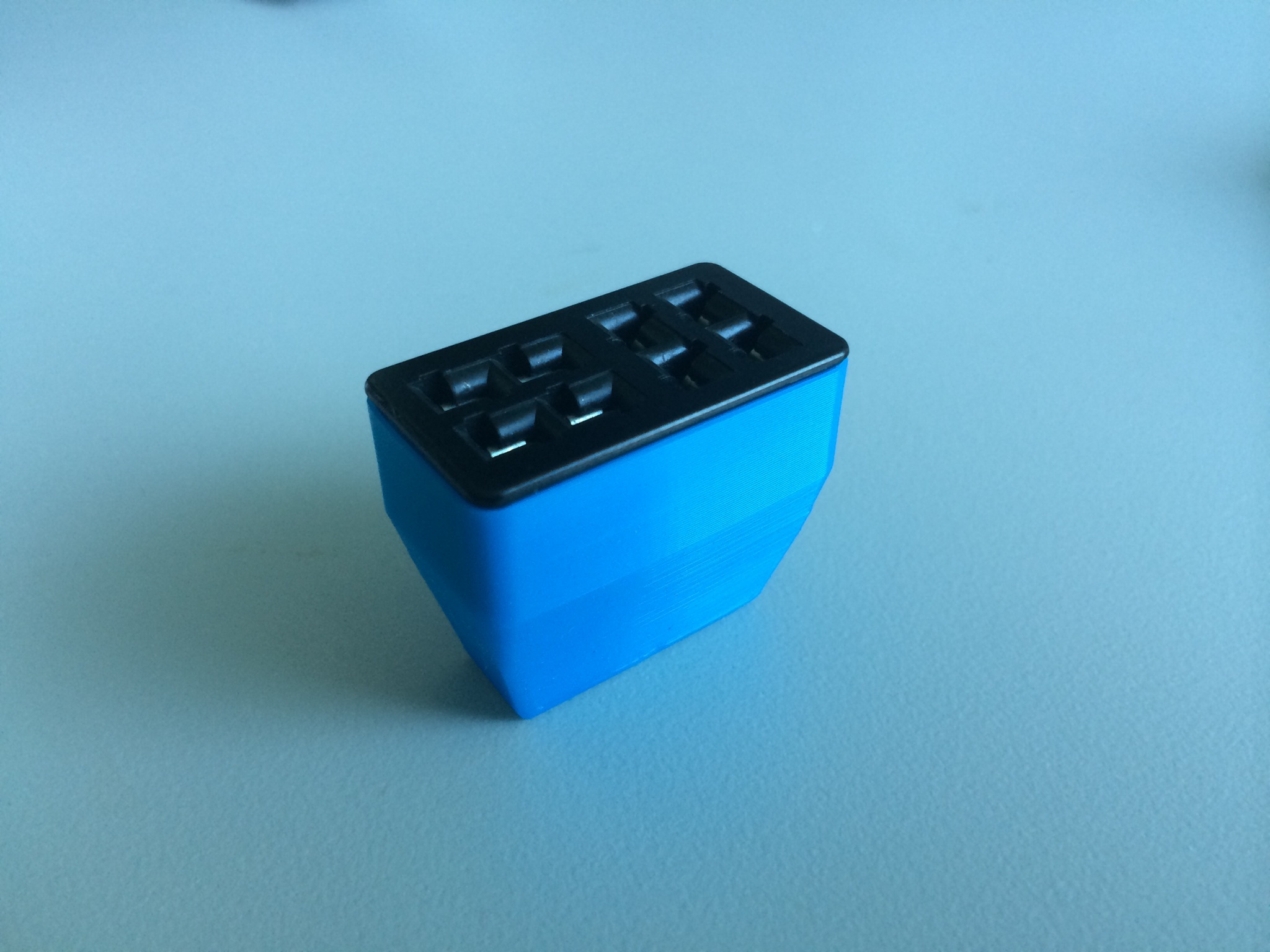
The best thing about it is that you can color-code the connectors, too! Finally, props to a CAD-ninja coworker for whipping up the beautiful SolidWorks model in a couple of minutes.
Latest Tinkering (or how Elecraft is taking all my money)
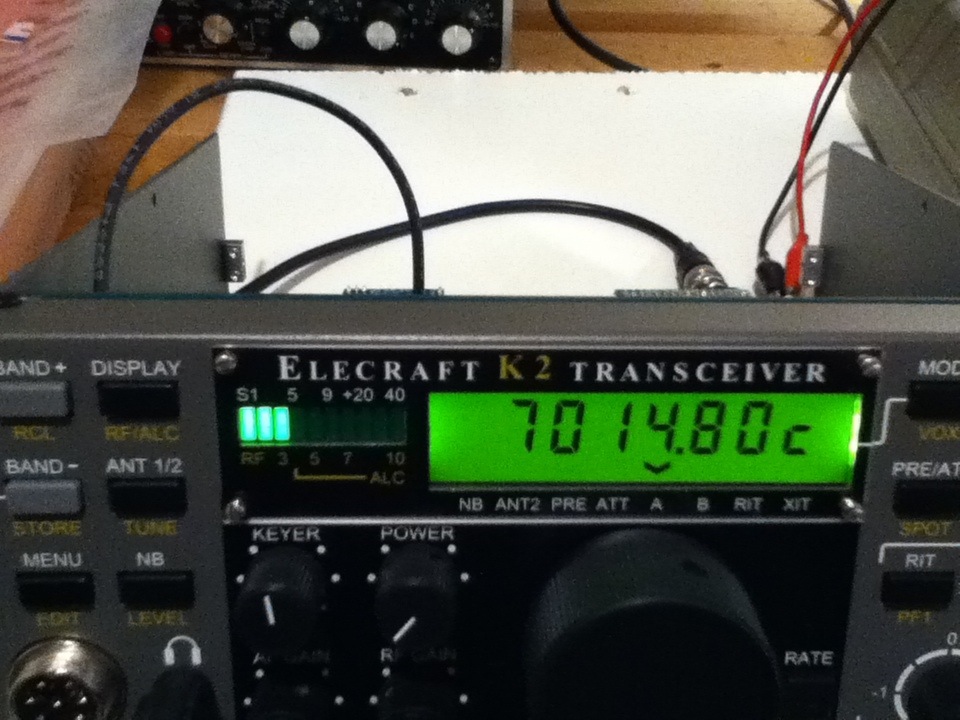
On Christmas Eve, I was sitting at my in-laws’ kitchen table with the Small Wonder Labs SW-40 I built as a high school kid in 1998 listening to beautiful music and I got the itch to come up with a radio smaller (and less expensive) than the K3 to drag around with me when I go places. My mind wandered to the NorCal Sierra, which was a featured project in ARRL Handbook’s of my youth. I was able to come up with a draft version of that Handbook article on the web—pause for a moment and think how revolutionary that is—my in-laws don’t have an ARRL Handbook, let alone the one that contained the Sierra article. I looked at the bill of materials and realized that I had some 70% of the parts in my junkbox. This seemed like a good idea until I went searching for a PCB.
Why PCB? Well, I’ve done the dead-bug thing and it works great but it’s a pain to troubleshoot and unless you have decades of experience doing it, it looks like a Mexico City suburb, sprawling unpredictably in every direction with only the most tenuous connections to the core. Since I was seeking a travel radio, I wanted it to be compact, easy-to-troubleshoot, and relatively rugged. Due in no small part to the wishes of the Sierra’s designers (not coincidentally founders of Elecraft), boards are no longer available. I looked into doing my own board, but if you don’t mix chemicals yourself, you’ve suddenly spent $150 on PCBs, plus the layout effort. I toyed with making the board smaller (a win in several ways) by using surface-mount parts but even that was a non-starter since my junkbox parts are through-hole, requiring me to buy everything.
Astute readers can extrapolate what occurred next. I went to the Elecraft web site to price the Sierra’s successor, the K1. I had all but made up my mind to sell off some junkbox items and raise the capital to buy a K1 kit when something occurred to me: fellow ham blogger Mike, VE3WDM, had recently moved to a smaller QTH and was offering a half-completed K2 kit for sale. His asking price was only a little more than the K1 kit with some of the options I wanted and it was all-band. The ad had been posted for some days by this point, so I fired off a sheepish e-mail to Mike asking if the radio was still available. It was. We sealed the deal and the radio made the somewhat tortuous ride (for us, not the radio—it sat in Chicago for two weeks) from his QTH to mine via the postal system.
I would not have bought a partially-finished kit from just anyone. However, since this was Mike’s second K2 build and he was documenting it carefully in a blog, I figured it was a pretty safe bet. So far, that is definitely true.
While I was eagerly awaiting the radio’s arrival, I redoubled my efforts to get a friend’s TS-930S off of my workbench, a task that involved replacing all 115 electrolytic capacitors on the cookie-sheet-sized “Signal Unit” board (similar to the K2 and K3 “RF unit”). That radio still has low drive (it has ALC again and sounds like a million bucks), something I traced to a hard-to-find semiconductor that’s now on-order. So, I gathered it up and started work on the K2 on Sunday afternoon.
Last night, I got it on 40 meters RX-only and peaked up the RX BPF. Former K2 owner KL9A mentioned to me that it has some blow-by on strong signals but that he thinks it’s a pretty good radio. I can confirm that based on my experience last night. It sounds really really good on CW.
More on the build to come…including a look back at some troubleshooting of the BFO circuit.
Dayton 2013 Recap
Some good planning on Sarah’s part yielded a bridal shower for her sister scheduled on the same weekend as the Hamvention. Huge win.
- Speaking of huge wins, there was no sewer back up this year.
- Like the last time I attended in 2011, I’m pleased to see more younger (than me) hams in attendance. A high-ranking ARRL official noted to me the “energy and enthusiasm” present in this generation of young hams that was not present 15 years ago (this year marks my 20th year as a ham, but I didn’t mention that). Attendance was still thin compared to my first visit in the mid 1990s.
- Deals. I stimulated the economy by purchasing a small CDE rotor for my VHF activities, an HP server power supply for a future solid state amplifier project (>55 amps at 50 volts), a couple of 900-MHz antennas, and some miscellaneous small parts. I sold some junk to partially cover that expense.
- People. Ran into a lot of old friends and made some new ones. This is really why I go to Dayton, well, that and the junk. K8MFO tells me there are Bureau cards coming. W8AV has 930s for me to work on. W2NAF had people for me to meet. AD8P was able to win himself a pizza from an unnamed W5 in the “SB-200 challenge” of correctly differentiating an SB-200 from an SB-220 at a distance of 20 feet—a tribute to the W5′s failure to distinguish the two until after the sale last year.
- W2NAF has written an article about our trip to Adak (NA-039) that was published in the June 2013 issue of CQ. It has a lot more background detail than what I wrote on the blog. Check it out. I picked up a copy of that and the May 2013 issue which has the 2012 CQ WW CW results in it.
- Products. I just don’t care that much about new products. The Ten-Tec Rebel that several people have already discussed is a cool idea. I know that Ten-Tec took some flak for not opening up the Orion SDR core when they produced it. But, let’s be realistic, people. Hams would have bricked those suckers in a heartbeat. A sandbox “open source” radio is a step in the right direction, but I question what a ham can really customize that matters without screwing it up. Maybe I’m just not visionary enough. Almost 10 years ago now, I interned in the R&D lab at a large consumer appliance manufacturer as an undergraduate my supervisor was always saying, “How can we make this attractive to the [hardware] hackers?”
- Guns. The Hamvention web site was very specific that the Trotwood Police Department would be actively enforcing Hara Arena as a non-gun zone. Seriously? It’s a ham radio convention. Bill Goodman is there at least once a month the rest of the year. Do hams bring their go-kits to gun shows? They must. Inquiring minds want to know…
- Suites. I did not do the contester suite thing. Was thinking of going on Friday night but fell asleep in my in-laws’ living room. This is a recurring problem when I visit so no one bothered to awaken me.
Was the trip worthwhile? I think so.
More Hexbeam
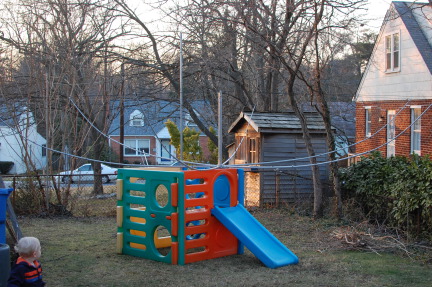
“What have you done to my play set?” This gym made a convenient place to string wires, etc. Two poles in the photo form part of the EWE RX antenna here at K8GU that was hastily erected before the NA Sprint CW. One of the poles is ty-wrapped to the play set. Doing my best to keep it klassy and impress the neighbors.
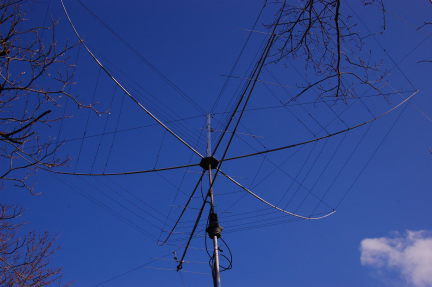
And, we’re up in the air! The M2 9M2SSB is a little bit out of alignment due to the hex getting tangled in one of the antennas that it was due to replace. I have already realigned that. So far, the antenna seems to have useful front-to-back. Gain is hard to tell since I took down all of the antennas it was to replace. But, it does seem to work. I’m suffering from high SWR (above 3) on both 21 and 50 MHz. G3TXQ warns of interaction between 18 MHz and 50 MHz. Do not yet know the cause, but I’m looking into it.
Although the antenna is relatively easy to handle, I don’t plan to make a habit of taking it down for work. Speaking of taking down, the 40m dipole whose center insulator is just visible behind the reflector of the 2-meter beam will be replaced by an as-of-yet-secret antenna.
Hexbeam Photos
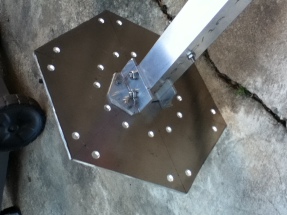
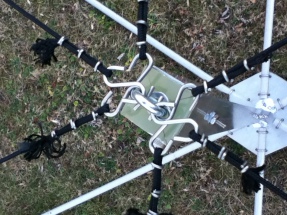
Construction project: G3TXQ hex beam built from scratch. K4KIO directions with K8GU modifications (and reverse-engineered square coaxial center post). Details to follow once I determine it works to my satisfaction.













