Posts Tagged ‘history’
 Chat From a Quarantined Software Engineer – Welfare Check!
 April 20th, 2020 |
  Author:
 This is a welfare check on you. Please leave a comment on how you are faring, what is happening in your situation with the lock-down.
Are you quarantined? Working from home? Did you lose your job? How are you doing during this crazy time?
What is going on with you during this challenging situation?
I talk about what I’m doing, too. I’m quarantined at home. I can work from home, as I am a senior software engineer. I can do my job by remote access to a virtual workstation, through a secure VPN connection. I’m blessed that I still can work during this lock-down.
But, I have a medical emergency – a dental problem – and trying to be seen by a dentist is difficult, because all of the local dentists were told to shut down their daily business and quarantine. Only emergency appointments are being made! I was finally, after two days of phone calls, able to schedule an emergency visit to my dentist!
I want to know: How do you use amateur radio, now that we are all stuck at home? Are you using ham radio more, now? Less?
Please leave a comment to let me know how you are doing, and answer the other questions, too. I hope to hear from you.
I hope to meet you on the shortwave amateur radio bands. I am usually using Olivia, or Morse code CW. More information about Olivia: http://OliviaDigitalMode.net.
Be healthy, be safe, stay sane!
“BEST REGARDSES” AND “BEST REGARDS’S”

Meme: Car and Woman Arguing, 73
“Best regardses” and “Best regards’s”
That’s silly, of course. We who speak and write in the English language know that you should not pluralize a word that is already in its plural form. “Best regards” means, “I wish you the best of regards.” It is implied that there is more than one regard. Perhaps there are a few, perhaps many more. It then is clear that we wouldn’t normally pluralize “regards,” into, “regardses.”
It is also silly to say that the best of regards owns something. How can a regard let alone a group of regards own anything? So, why “73’s” when written?

Old SWLer QSL Card With 73’s
The usage of “73” comes from early landline telegraph (typically railroad telegraphy landlines). Originally devised in the era of telegraphs, 73 and other numbers were used to speed up the transmission of common messages over landlines by mapping common messages to these specific numbers. And, numbers were quicker to send than the longer messages the numbers replaced.
QST, April 1935, on page 60, contains a short article on the origin of the amateur radio vernacular, 73. This article was a summation of another article that appeared in the “December Bulletin from the Navy Department Office of the Chief of Naval Operations,” published December of 1934.

A skilled landline Morse code operator, in action.
Here’s a quotation from that Navy article:
“It appears from a research of telegraph histories that in 1859 the [land-line] telegraph people held a convention, and one of its features was a discussion as to the saving of ‘line time.’
A committee was appointed to devise a code to reduce standard expressions to symbols or figures. This committee worked out a figure code, from figure 1 to 92.
Most of these figure symbols became obsolescent, but a few remain to this date, such as 4, which means “Where shall I go ahead?’. Figure 9 means ‘wire,’ the wire chief being on the wire and that everyone should close their keys. Symbol 13 means ‘I don’t understand’; 22 is ‘love and a kiss’; 30 means ‘good night’ or ‘the end.’
The symbol most often used now is 73, which means ‘my compliments’ and 92 is for the word ‘deliver.’ The other figures in between the forgoing have fallen into almost complete disuse.”
We can see, then, that “73” mapped to “best regards” or “my compliments” and was intended as a general valediction for transmitted messages. That’s why it is silly to say, “73s,” as that maps to, “best regardses” – 73s adds the plural to a plural. (And, don’t make it possessive, as in using, “73’s” – a regard cannot own something).

Cartoon: Jeeves, there is no plural for 73…
For reference and some more interesting background on this, see http://www.signalharbor.com/73.html
An example of on-the-air conversation (or, QSO—“QSO” is the shorthand Q-code for, “two-way exchange of communications”) illustrates proper usage of 73. When saying your goodbye, you would tap out the Morse code as follows:
TNX FER FB QSO. C U AGN. 73 ES HPY NEW YR.
That is interpreted as, “Thanks for the fine-business chat. I hope to see you again for another chat. Best regards and happy new year.”
This, if you choose to throw around shorthand Morse code number codes when you are speaking, you wouldn’t say, “73s.” You would say, “73.”

The Old Man Hiram Percy Maxim 1AW used 73’s on his QSL cards.
My friend, David Edenfield, opined, “This idea is beyond turning into glue from the dead horse it’s beating again. This is so petty to be concerned with this. Even the Old Man Hiram Percy Maxim 1AW used 73s on his QSL cards.”
Well, even Hiram Percy Maxim has been incorrect and incorrectly used grammar. (chuckle)
There is something to be said about teaching new amateur radio operators the best of our traditions, history, skills, procedures, protocols, ethics, and culture. There’s no rational argument that can make a case that allowing these aspects of our service and hobby to degrade over time (by the lack of Elmering) is a good way to see our service and hobby thrive and progress.
I don’t see any slippage from high standards as being a good strategy for nurturing growth, progress, and effectiveness of our service and hobby. Keeping some level of excellence in every aspect of our hobby can only be beneficial.
In this case, how many new hams that learn to repeat ham lingo know anything of the history behind the common “73?” My dead horse turned glue is educational and it is my belief that educating about origins elevates the current.
73 – NW7US

NW7US QSL Card (circa 2019)
..
Hey! I almost forgot !!!
As per the ARRL Announcement
Museum Ships Weekend will take place over the June 1 – 2 weekend, sponsored by the Battleship New Jersey Amateur Radio Station NJ2BB. Radio operation will be from a variety of vintage and noteworthy vessels. This is not a competition.
So far 75 ships are on the roster to take part. All stations working at least 15 different participating ships will receive a certificate, if they send a copy of their log showing these contacts.
While operation on any amateur frequency is allowed, most ships will be operate in the General portion of the bands. PSK31 operation will be on 14.070 MHz, 10.142 MHz, 18.100 MHz, 21.070 MHz, and 28.120 MHz.
Some ships also may be found on 75 meters (3.880 – 3.885 MHz) and on 40 meters (7.290 MHz) using AM, some using the vessel’s original restored equipment.
This is what I love about Summer - there's always something going on, just about every weekend. If you follow the link above, you'll get a list of who will be on the air. Log 15 ships and $4 will get you a piece of wallpaper for your shack.
72 de Larry W2LJ
QRP - When you care to send the very least!
Radio Virgin: the First QSO
My first QSO (and, yeah, it was with Morse code) was petrifying and…
What’s your story of your first QSO?
73 de NW7US
Let’s Call CQ – QSO Today Episode 184 with NW7US
I got a Skype call a few weeks ago from Eric, 4Z1UG–the creator and host of the QSO Today Podcast–during which he asked me about how and why I got into amateur radio. Here’s the result.
Eric writes,
We talk a lot about the band conditions due to the Sunspot cycle. Most of it on Facebook and other places is about how “dead” the bands are at this point. We all can’t wait until the cycle starts to rise and we will be making contacts with little effort. I remember in my conversation with Chuck Adams, K7QO in Episode 58, that he really enjoys operating is “Pigrig”, one watt, CW transceiver on 20 meters. When I asked him, (I liberally paraphrase) “but Chuck, the bands are dead. How does that work for you?”. His reply was that while most hams are listening to the bands, he calls CQ until he gets a reply. Works every time.
My QSO this week is with Tomas Hood, NW7US, who has years of expertise in propagation and Solar activity. He is the propagation editor of more than a few radio magazines and websites. In our post-recording conversation we discussed this phenomenon of listening and not calling CQ. I even had this idea that maybe one of the reasons that the digital modes are so successful is because they “beacon”, as part of the whole digital experience, the same as calling CQ. This is why they make contacts. From what I see, looking at PSK Reporter, hams are making lots of contacts worldwide using the digital modes. While SSB may not be working so well, CW and the digital modes seem to work fine.
I like to work on my bench or make the podcast while listening to the bands. Jeff Damm, WA7MLH, in Episode 177, says that he will put his keyer in CQ mode while he is working on a new radio. Invariably, sometimes after many minutes, he gets a reply. Great idea Jeff!
73,
Eric, 4Z1UG
Episode 184 can be found here: https://www.qsotoday.com/podcasts/nw7us
Highlights of Episode 184:
Tomas Hood, NW7US is the propagation editor of a number of shortwave and amateur radio magazines, and has a wide variety of websites, that grew out of his love for all things radio, and for listening on the bands to far off DX and commercial broadcast stations. Tomas shares his understanding of propagation and the lessons we can learn from listening, really listening to the QSOs and exchanges during contest operation.
All of the QSO Today episodes are great. I enjoy hearing about many different hams. Do check out all of the episodes that Eric has published.
73 de NW7US dit dit
Some more oldies, but goodies
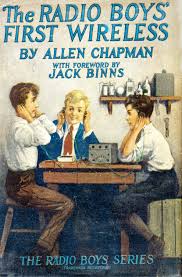
For those of you with a kindle, these can be download for FREE from Amazon.
1. The Radio Boys’ First Wireless
https://www.amazon.com/gp/product/B008476T3S/
2. The Radio Boys at Ocean Point
https://www.amazon.com/gp/product/B004TSAZWM/
3. The Radio Boys at the Sending Station
https://www.amazon.com/gp/product/B004TQF6BE/
4. The Radio Boys at Mountain Pass
https://www.amazon.com/gp/product/B006T5TLSM/
5. The Radio Boys Trailing a Voice
https://www.amazon.com/gp/product/B004TRF6S6/
6. The Radio Boys on the Mexican Border
https://www.amazon.com/gp/product/B004TIJRP8/
7. The Radio Boys on Secret Service Duty
https://www.amazon.com/gp/product/B00AQMGFB0/
8. The Radio Boys in the Thousand Islands
https://www.amazon.com/gp/product/B00AQMZS86/
9. The Radio Boys’ Search for the Inca’s Treasure
https://www.amazon.com/gp/product/B004Z0MNBU/
10. The Radio Boys Rescue the Lost Alaska Expedition
https://www.amazon.com/gp/product/B0058KSAW2/
11. Radio Boys Cronies
https://www.amazon.com/gp/product/B00848O6YQ/
12. Radio Boys Loyalty: Bill Brown Listens In
https://www.amazon.com/gp/product/B004TRO448/
13. The Radio Boys with the Revenue Guards
https://www.amazon.com/gp/product/B004UKEU2A/
So yeah, the stories are a bit campy, perhaps and the language and slang is old - but what the heck? They're free and they're almost 100 years old!
I downloaded them all to my kindle and am enjoying them. I hope you will, too!
72 de Larry W2LJ
QRP - When you care to send the very least!
ETH081 – Flying Around the World with Brian Lloyd

I’m sure that all of you have heard about Amelia Earhart and how she wanted to become the first woman to fly solo around the world. On June 1, 1937, she and her navigator took off from an airport in Florida and attempted to do just that. She however didn’t make it, but she came close. Her plane disappeared somewhere in the Pacific ocean.
Eighty years later, Brian Lloyd, WB6RQN, decided that he would attempt to fly around the world solo following(for the most part) her historic flight. Thankfully, Brian made it home back here to Texas, however it wasn’t without it’s problems.
In this episode of the Everything Ham Radio Podcast, we talk with Brian about his trip We talk about all the highs and lows, about all the awesome people that helped him along the way and generally about his adventure.
Give this episode a listen, I had a great time talking with Brian and I hope that you enjoy listening in on our conversation. You can find the show notes for the episode as well as listen to it at:













