Posts Tagged ‘history’
 My grandfather’s Blaupunkt radio
 February 13th, 2013 |
  Author:
As I was clearing out my childhood home I came across an old radio that my father had tucked away in the basement. It was a German Blaupunkt radio, and what a historic dial it had!
It turned out that my father had himself found it as he was clearing out his childhood home many years before and that it had belonged to my grandfather who died in 1959.
It covers longwave, medium wave and three shortwave bands from 5.5 to 21 MHz. I had never before seen a radio with a dial given in meters rather than kHz or MHz, but I have later understood that that was not uncommon for pre world war II radios.
Since the back was missing, I had no information about age or type. The tubes which were all in the 11-series suggested the end of the thirties, but here it turned out that the dial had valuable information.
The medium wave part of the dial had a separate side on the left hand for German stations and here one can find cities that are no longer in Germany such as Königsberg on 223 m and 291 m (1348 and 1031 kHz). Today this is Kaliningrad in Russia. The dial also showed Danzig on 230 m (1303 kHz), ”Schles. G. W.” (Schlesische Gleichwelle – a single frequency net with stations in Gleiwitz and Reichenbach/Oberlausitz) on 244 m (1231 kHz), and Breslau (315 m – 950 kHz). Today these are the cities of Gdansk, Gliwice and Wroclaw in Western Poland, an area which was in Germany until the end of the war. At least the radio must have been from before the end of WW2.
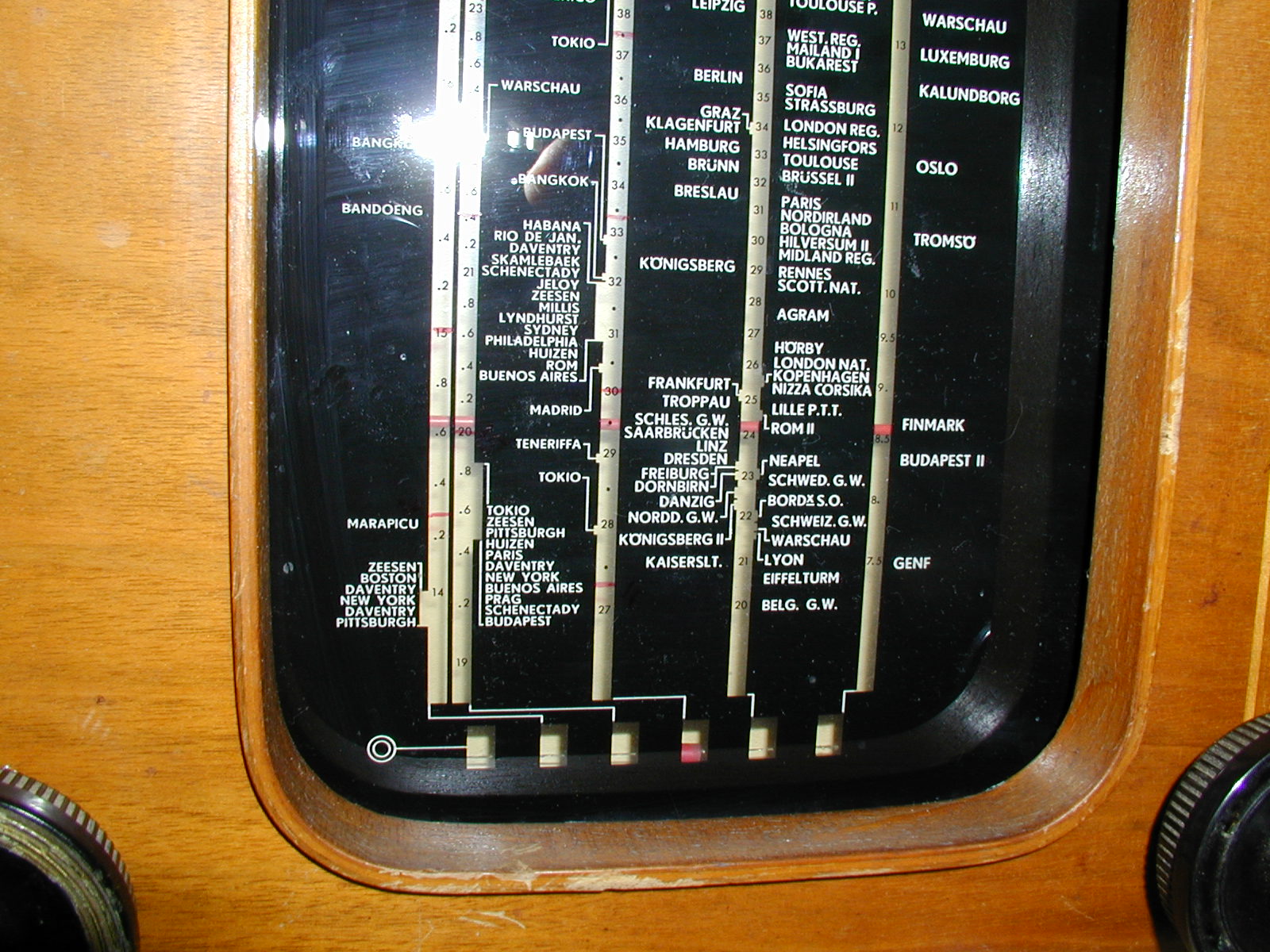
But there were a couple of more names with a lot of history in them. Troppau can be found on a wavelength of 249 m (1204 kHz), a frequency which it had until September 1939. Today Troppau is called Opava and lies in the Czech Republic. Troppau lies in the Sudetenland which Germany annexed on 30. September 1938. Finally one can find Memel on 531 m (565 kHz). This city is today called Klaipeda and lies in Lithuania. It was occupied on 22. March 1939 as the last German annexation before the outbreak of the war on 1. September 1939.
Thus the conclusion of this historic search across the dial is that the radio dates from some time between March and September 1939.
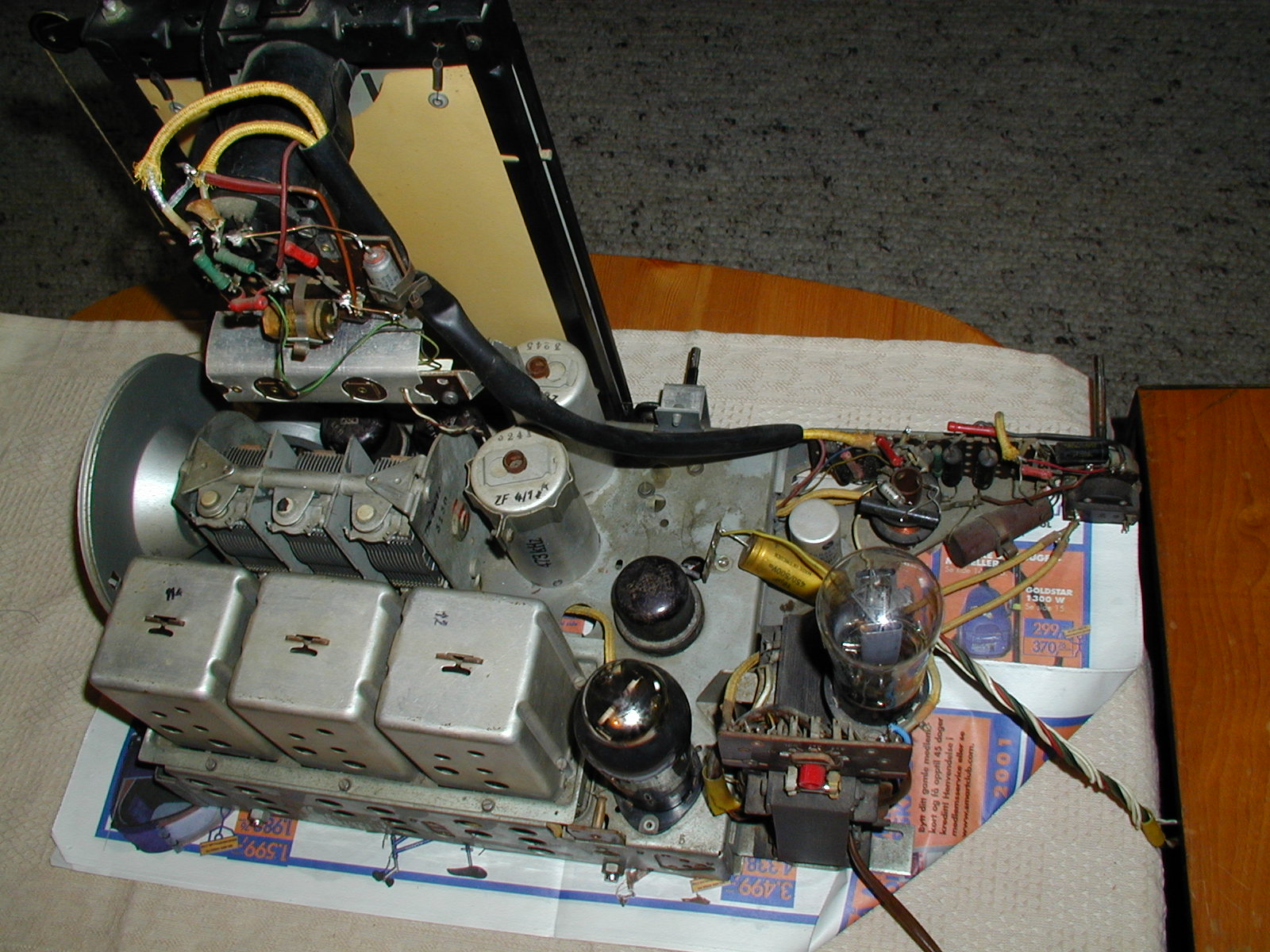
With some cleaning the exterior turned out to be quite nice. I thought to myself that I cannot give up now, so on inspection I could see that a couple of electrolytic capacitor had been replaced, probably by my father. It had the following tubes: ECH11 as mixer/oscillator, EBF11 and EF11 for the intermediate frequency stages, and EFM11 for the magic eye and the first low frequency amplifier.
The output tube and the rectifier were missing, and it was natural to look for tubes in the same 11-series. I was not able to find this particular radio in the large archives of the Norwegian Radio History Society, but there was documentation for a few other Blaupunkts there. From their descriptions I could guess EL11 for the output tube. Measuring the filament voltage for the rectifier gave 4 Volts, so then AZ11 was a good choice.
With some excitement I turned on the voltage for the first time, and to be on the safe side I connected it in series with a 60 W light bulb to reduce the voltage. No explosion! As incredible as it sounds, with full voltage it actually produced sound. But unfortunately after a few seconds everything disappeared. One evening with diagnosis of the radio and I could isolate the problem to the beginning of the audio section and two rotten shielded cables connecting audio in and out of the pentode in the magic eye. Not everything is as new after 60 years! After having replaced the cables the radio was perfect, and even the magic eye and the dial lamps functioned. In my experience the magic eye is often weak and in the Oslo region the dial lamps for the longwave band may have burnt out as the local station used to be on 218 kHz.
Some weeks later as I was about to clean the dial for dust I disassembled the glass in the front and found an inscription saying Blaupunkt 7W79 and the date 28.3.39. So the result of my detective search wasn’t too bad! In fact the dial was produced with an updated name just 6 days after the occupation of Memel/Klaipeda.
This radio cannot have been more than a couple years old when all radios were confiscated in Norway in 1941. Imagine how sad it must have been to give up such a nice and costly radio at that time! This must also have been one of the few radios that actually were returned to their rightful owners in 1945.
Now the radio has a prominent place in my house and every time it is turned on it is a reminder of both the history of my family and of a turbulent era in the history of Central Europe.
First published as “Min farfars Blaupunkt radio” in Hallo Hallo of the Norwegian Radio History Society, September 2001, updated in 2013. © Sverre Holm
Happy Anniversary !!!
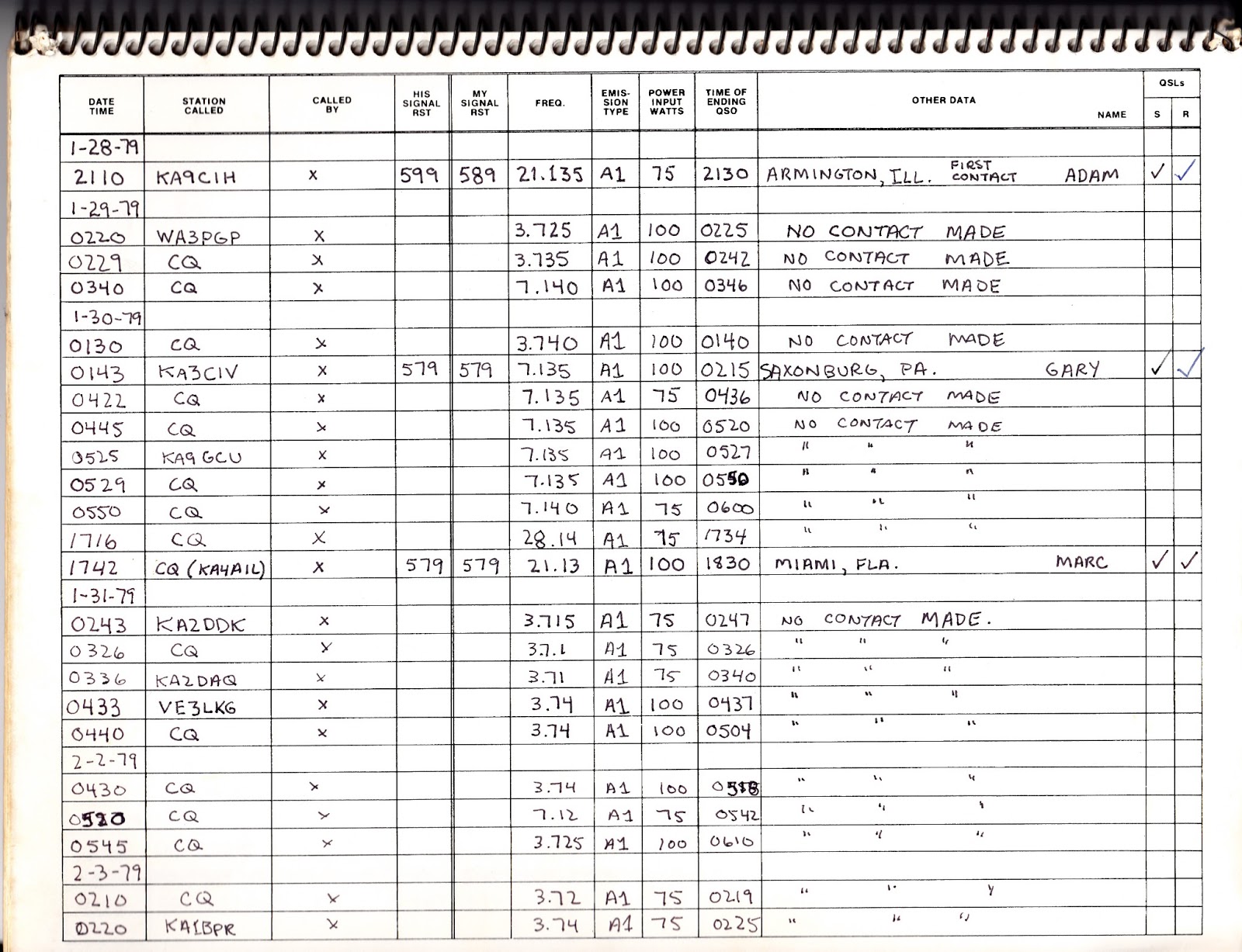
I took the test for my Novice license in November of 1978. I received my ticket in the mail at the very end of December 1978. I remember that I was sitting, taking a break from my job at the camera store where I was working. We were having a post-Christmas sale and it had been a frantic day. My Mom had called to tell me that I had received the vaunted envelope from the FCC and that my call was KA2DOH. Between that time and my very first QSO, I was occupied with putting my station together.
For some reason, in my mind, I always remember my first QSO as having taken place on January 29th, 1979. But a look in Logbook Number One reveals the date as January 28th, 1979 – so the 34th anniversary of my very first QSO was yesterday!


Waxing nostalgaic
I posted the other day about the Novice sub bands and how a lot of us got our feet wet there and paid our dues there. There is a really great Website about the history of the Novice license. You can find it at the Novice Historical Society.
The Novice Class license was issued for a period of almost 50 years, from 1951 until 2000. There are a lot of good stories and photographs in there, and I’m sure if you entered the ranks as a Novice, you will enjoy what you see there. It will bring back a lot of memories, perhaps summed up the best by the following line (not sure right now which Ham said it):
“We didn’t know any better and we were having the time of our lives!”
A lot of names and calls of some prominent QRPers show up in the list there.
If you didn’t become a Ham as a Novice, you should go take a look see and read some really good stories to get a feel of what it was like.
On the other hand, if you WERE a Novice and you haven’t posted your Novice story – please consider doing so! The stories make for great reading and this truly was an era of Amateur Radio which will never be duplicated. It deserves to be preserved for posterity.
Oh, and while I’m talking about nostalgia, I got a link through K6MM’s Website – television commercials from the 1950s and 1960s. Take a look and see how many you can remember – I was able to recall quite a few!
72 de Larry W2LJ
QRP – When you care to send the very least!
Taking stock
“It was the best of times, it was the worst of times ……”
Mr. Dickens could not have written more appropriate words to describe my 2012. I have never been a big reveler of the New Year holiday; but this year, I am quite eager and pleased to see the ushering in of a new year and with it, new beginnings and new possibilities.
2012 was not all depression, sadness and tears, however. It did have highlights, particularly with regard to Amateur Radio. The KX3, which I had so diligently saved up for, and ordered on the first night of availability in December of 2011, arrived at the end of May. For me, it has lived up to and has exceeded my expectations. I am quite happy with it and am so glad that it is an available part of the W2LJ “radio stable”. Quite unexpectedly, a K3/10 joined the ranks as well. I hadn’t dreamed of or intended purchasing one – but consider this to be my dear Mom’s last gift to me. It is an amazing radio; and I am so lucky and fortunate to have use of both of these fine pieces of gear.
The inaugural 2012 NJQRP Skeeter Hunt was an integral part of my year. Once again, so many thanks to George N2APB and Joe N2CX and the entire NJQRP Club for agreeing to sponsor this new operating event. Also thanks to Bob W3BBO who helped me ruminate and come up with some of the details for this new outdoor QRP sprint. I had such an enjoyable time assigning Skeeter numbers, actually operating in the event and then collecting and tabulating and posting the results. I am so happy that my fellow QRPers seemed to have as good a time as I did, and I eagerly look forward to the 2013 edition of the Skeeter Hunt.
I got two new antennas up in the air this year. My venerable G5RV finally made way, after a dozen or so years, for the 88’ EDZ antenna. Later in the year, post-Sandy, the W3EDP went up to join it in the W2LJ antenna garden. Too small to be a “farm”, the antenna garden consists of the Butternut HF9V and the two aforementioned wires. I pray these wires will last as long as the G5RV did. There were plenty of hurricanes and nasty winters and wind storms that the G5RV made it through – may these two new wires be as resilient.
I have to include as one of this year’s highlights, my decision to purchase the PAR END-FEDZ 10/20/40 antenna. This simple wire is a delight for portable QRP ops. It’s super easy to deploy as a sloper or inverted “L”. It tunes up with nary a problem and is neatly and easily storable in my “Go Bag”. I can’t think of any downsides to this antenna. It’s well worth the price and comes along with instructions on wire lengths to cut so that you can use it for other bands, if you so desire. This antenna, as well as my Buddistick have become my aerials of choice for portable QRP ops.
Due to all the unfortunate events which took place this year, and their aftermath, I was not able to actually get on the air nearly as much as I had intended. I actually had “a QSO a Day” going until the middle of February, when events started taking unexpected turns. From that point forward, “unexpected” became the norm for 2012, and as a result, severely curtailed my on-the-air time My major 2012 New Year’s Resolution, to complete the ARRL’s Diamond DXCC Challenge, didn’t even come close to happening. So as 2013 arrives, I am going to tempt fate once more, and will try for a QSO a Day in 2013. I am not so foolhardy as to think I will be able to pull it off, but I will do my best – hence my ever present New Year’s Resolution “To get on the air more”!
In addition to day-to-day operating, managing the Skeeter Hunt and sending out notices for The Run For The Bacon each month, this blog (which will be entering its 9th year in 2013) has become a huge part of my Amateur Radio experience. It is a most enjoyable part of Ham Radio for me, and I want to extend my deepest and most sincere thanks to all of you out there who take time out of your busy day to read this and share the Amateur Radio world with me. You are the best friends a Ham could ask for. You all have helped me to deal with what would have otherwise been a most sorrowful year. A very Happy, Blessed, Joyous and Prosperous New Year to all of you!
Lastly, I hope you all enjoy Straight Key Night tonight and tomorrow. W2LJ will be hanging out near and at the various QRP “Watering Holes” (I will spot myself on QRPSPOTS, so be sure to look out for me). I will be using my Vibroplex Original as my aging wrists just can’t stand up to a classic straight key any longer. If we have the good fortune to work each other, please excuse my less than stellar “Bug fist”. I haven’t had much practice lately!
72 de Larry W2LJ
QRP – When you care to send the very least!
Pearl Harbor

“Getting the Message Through: A Branch History of the U.S. Army Signal Corps” by Rebecca Robbins Raines
CENTER OF MILITARY HISTORY, UNITED STATES ARMY, WASHINGTON, D.C., 1996 (pgs 242-244)
During 1940 President Roosevelt had transferred the Pacific Fleet from bases on the West Coast of the United States to Pearl Harbor on the Hawaiian island of Oahu, hoping that its presence might act as a deterrent upon Japanese ambitions. Yet the move also made the fleet more vulnerable. Despite Oahu’s strategic importance, the air warning system on the island had not become fully operational by December 1941. The Signal Corps had provided SCR-270 and 271 radar sets earlier in the year, but the construction of fixed sites had been delayed, and radar protection was limited to six mobile stations operating on a part-time basis to test the equipment and train the crews. Though aware of the dangers of war, the Army and Navy commanders on Oahu, Lt. Gen. Walter C. Short and Admiral Husband E. Kimmel, did not anticipate that Pearl Harbor would be the target; a Japanese strike against American bases in the Philippines appeared more probable. In Hawaii, sabotage and subversive acts by Japanese inhabitants seemed to pose more immediate threats, and precautions were taken. The Japanese-American population of Hawaii proved, however, to be overwhelmingly loyal to the United States.
Because the Signal Corps’ plans to modernize its strategic communications during the previous decade had been stymied, the Army had only a limited ability to communicate with the garrison in Hawaii. In 1930 the Corps had moved WAR’s transmitter to Fort Myer, Virginia, and had constructed a building to house its new, high-frequency equipment. Four years later it added a new diamond antenna, which enabled faster transmission. But in 1939, when the Corps wished to further expand its facilities at Fort Myer to include a rhombic antenna for point-to-point communication with Seattle, it ran into difficulty. The post commander, Col. George S. Patton, Jr., objected to the Signal Corps’ plans. The new antenna would encroach upon the turf he used as a polo field and the radio towers would obstruct the view. Patton held his ground and prevented the Signal Corps from installing the new equipment. At the same time, the Navy was about to abandon its Arlington radio station located adjacent to Fort Myer and offered it to the Army. Patton, wishing instead to use the Navy’s buildings to house his enlisted personnel, opposed the station’s transfer. As a result of the controversy, the Navy withdrew its offer and the Signal Corps lost the opportunity to improve its facilities.
Though a seemingly minor bureaucratic battle, the situation had serious consequences two years later. Early in the afternoon of 6 December 1941, the Signal Intelligence Service began receiving a long dispatch in fourteen parts from Tokyo addressed to the Japanese embassy in Washington. The Japanese deliberately delayed sending the final portion of the message until the next day, in which they announced that the Japanese government would sever diplomatic relations with the United States effective at one o’clock that afternoon. At that hour, it would be early morning in Pearl Harbor.
Upon receiving the decoded message on the morning of 7 December, Chief of Staff Marshall recognized its importance. Although he could have called Short directly, Marshall did not do so because the scrambler telephone was not considered secure. Instead, he decided to send a written message through the War Department Message Center. Unfortunately, the center’s radio encountered heavy static and could not get through to Honolulu. Expanded facilities at Fort Myer could perhaps have eliminated this problem. The signal officer on duty, Lt. Col. Edward F French, therefore sent the message via commercial telegraph to San Francisco, where it was relayed by radio to the RCA office in Honolulu. That office had installed a teletype connection with Fort Shafter, but the teletypewriter was not yet functional. An RCA messenger was carrying the news to Fort Shafter by motorcycle when Japanese bombs began falling; a huge traffic jam developed because of the attack, and General Short did not receive the message until that afternoon.
Pearl Harbor Day
December 7th, 1941, “A date which will live in infamy”. These words were uttered by Franklin Delano Roosevelt, the 32nd President of the United States, after the Imperial Japanese Navy attacked Pearl Harbor. Eight US Naval battleships were damaged, four of them were sunk. In addition, three cruisers, three destroyers, a mine layer and one anti-aircraft training ship were all destroyed or sunk. 2,402 Americans lost their lives, and 1,282 were wounded.

The very next day, The Congress of the United States declared a state of war with Japan, and three days later declared a state of war with the Axis powers of Europe.
World War II, which was to last until 1945, was a period of time where electronics and electronic innovations blossomed. Because of the war effort, radios became smaller, lighter, tougher and were built to withstand all kinds of battle conditions.
The Amateur Radio Service in the United States was shut down for the duration of the war, with the exception of drills and excersizes conducted by the Radio Amateur Civil Emergency Service, or RACES as we still know it today. Many Hams, young and old alike, volunteered for duty in the Armed Forces, serving in the Signal Corp in the Army and as radiomen in the Navy.
But there were other operators, too.
These were clandestine radio operators, who put their lives in peril. Some lived behind enemy lines. Others parachuted into or otherwise secretly gained access to territory that was behind the enemy lines in the European Theater of Operations. They volunteered their radio skills to get critical information from behind those lines to the Commanders of the Allied Forces. The average lifetime of one of these brave radio ops was about six months. They were either extricated, or lost their lives as they were ruthlessly hunted by the German and other Axis armies.
These were the original QRPers, operating tiny little radios, often putting out less power than we QRPers are accustomed to today. Because of their mission, their antennas were also stealthy, and not because they were worried of upsetting their neighbors. No, these antennas were stealthy because if they were discovered, it cost the operators their lives. The “go kits” of these valiant operators often included cyanide or other poison pills, as while discovery meant death, it also meant a period of gruesome torture before that end.
Some of the stories of these clandestine radio operators, as well as the equipment they used were chronicled in a book called, fittingly enough, “The Clandestine Radio Operators” by Jean-Louis Perquin. It is still available at Amazon.
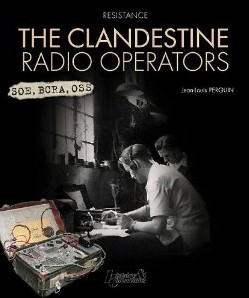
So the next time you’re operating your “flea power” radio, whether it be from the comfort of your shack, or in the grandeur of the great outdoors, say a silent prayer for those who went before us – on a mission that had life and death consequences. Their valiant efforts helped to preserve the freedoms that allow us to continue operating our “clandestine radios” today.
72 de Larry W2LJ
QRP – When you care to send the very least!
Thanksgiving – Part 1
I really like Thanksgiving – it is my favorite holiday.
I know that I have many readers that are not from the US, who might have heard of Thanksgiving; but might not be familiar with the history behind the holiday. Here’s a short and by no means authoritative version, of the US version of Thanksgiving. Our Canadian friends also celebrate Thanksgiving (on the second Monday of October); but the historical basis behind their celebration is different than ours.
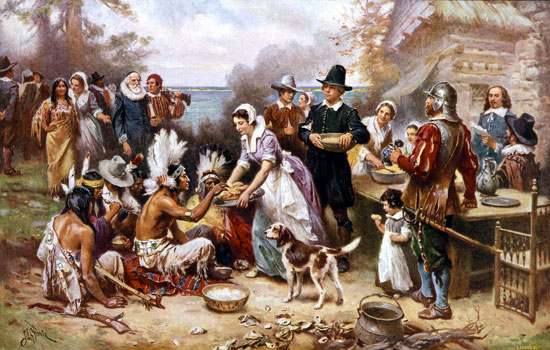
In the year 1620 a small ship named the Mayflower, left Plymouth, England and headed for “The New World”. The passengers were mainly a group of people known as Pilgrims, who had left England to come to a new land where they could practice their religion publicly without oppression or harassment. The rest of the passengers were people who wanted to come and settle a new land and make a life for themselves.
The Mayflower landed at what is now known as Plymouth, Massachusetts in November of 1620. Shortly after landing, the settlers came in contact with an Indian (read – Native American for the PC crowd) who was a member of the Abenaki tribe. A few days later this Native American returned with a friend named Squanto, who was a member of the Pawtuxet tribe. Earlier in his life, Squanto had been kidnapped by an English sea captain who had sold him into slavery. Squanto escaped and managed to get to London for a time, where he was able to successfully find a way to get back to America (and learn the English language in the process). Squanto introduced the Pilgrims to the nearby Wampanoag tribe. With Squanto’s help, an alliance was formed between the Wampanoag and the settlers which lasted for a period of over 50 years. If this alliance hadn’t been formed, the settlers probably would have totally perished that first harsh Winter. Even though the Wampanoag chief, Massasoit had donated food and provisions to the settlers to see them through that first brutal and snowy cold Winter, almost half of the passengers of the Mayflower perished from scurvy, malnutrition and other disease.
The following Spring, Squanto and the Indians taught the surviving Pilgrims where to fish, how to catch eels, how to plant corn, barley and other crops, which indigenous plants were poisonous and which were not, among other things. The planting and growing season of 1621 proved to be exceptionally good, ending with a bountiful harvest that would, without a doubt, be more than enough to sustain the Pilgrims through the next Winter. The leader of the settlement, Plymouth Plantation, declared that a feast be held that November. It lasted three days and the Native Americans were invited to celebrate the bountiful harvest; and 90 came. The Pilgrims had just completed a “Fowling mission” and the Wampanoag brought five freshly killed deer – so the menu from the First Thanksgiving feast (according to written records) consisted of venison, turkey, goose, duck, various fish (cod and bass among them), eels, clams (quahogs), and fruits and vegetables. As the Pilgrims stores of sugar were used up, there was probably not much in the way of pies or cakes!
Days of Thanksgiving have been proclaimed on and off throughout our history, beginning during the Revolutionary War. But Thanksgiving, as we come to know it, came into its own when a national Thanksgiving Day on the last Thursday of November was proclaimed by Abraham Lincoln in 1863. And since that time, it has been celebrated annually.
On a radio note – last weekend, I tried hauling up the W3EDP without much success. Trying to bring down the short end of the frayed and snapped Zepp was futile as it is unmercifully snagged in my neighbors trees and bushes. So a new plan evolved, which I will try to implement this coming weekend. Instead of using the mast on that side of the yard, I will run the W3EDP from the house to the maple, horizontally (actually sloping slightly upwards). Then from the maple, I will allow it to slope down towards the privacy fence post in that far corner of the yard and will tie it off with however much antenna rope I will need – probably no more that 5 -6 feet worth.
I am hoping that the old saying will hold true – “Where there is a will, there’s a way!”
72 de Larry W2LJ
QRP – When you care to send the very least!














